Within France's Strange Fears
What Really Happened in Strasbourg's Dancing Plague?
The 1518 dancing outbreak remains a vivid but uncertain case shaped by hardship, religious expectation and later mythmaking.
On this page
- What surviving accounts actually describe
- Stress, belief and contagious behaviour
- Why ergot poisoning remains disputed
Page outline Jump by section
Introduction
The Strasbourg Dancing Plague of 1518 is one of the most famous episodes of unusual collective behaviour in European history. It began when a woman reportedly started dancing uncontrollably in the streets of Strasbourg, then an imperial city of the Holy Roman Empire rather than part of France. Within weeks, dozens and perhaps hundreds of people had joined her. Contemporary reports describe participants dancing for days despite exhaustion, with some allegedly dying from collapse or related complications. Although the event has often been presented as an unsolved medical mystery, most historians today see it less as an inexplicable epidemic than as a product of extreme social stress, deeply rooted religious beliefs and culturally shaped expectations. The surviving evidence is real but incomplete, making the outbreak both historically documented and open to interpretation.[ScienceDirect]sciencedirect.comIn a spin: the mysterious dancing epidemic of 1518 - ScienceDirect…
For a history of collective fears in modern France, the episode occupies an unusual place. Strasbourg only became French much later, yet the city now lies within France, and the dancing plague has become part of the wider social history of the region rather than simply a curiosity of medieval Europe.
What surviving accounts actually describe
The outbreak is usually dated to July 1518. According to several contemporary and near-contemporary chronicles, a woman commonly identified as Frau Troffea began dancing in a Strasbourg street without obvious cause. She continued for hours and then days. Within a week, others had reportedly joined her, and by late summer the number of dancers was said to have reached several hundred.[National Geographic]nationalgeographic.comdancing plague of 1518 strasbourg choreomaniaNational GeographicWhat caused Strasbourg’s dancing plague of 1518? | National Geographic…
Modern retellings often present these numbers as certain, but the historical record is less straightforward. The figures come from chronicles, municipal records and later medical writers rather than systematic observation. Historians generally accept that an unusual dancing outbreak occurred, but they are more cautious about precise participant numbers and reported death tolls. Claims that dozens died every day appear in later accounts and are harder to verify directly from surviving civic documents.[ScienceDirect]sciencedirect.comIn a spin: the mysterious dancing epidemic of 1518 - ScienceDirect…
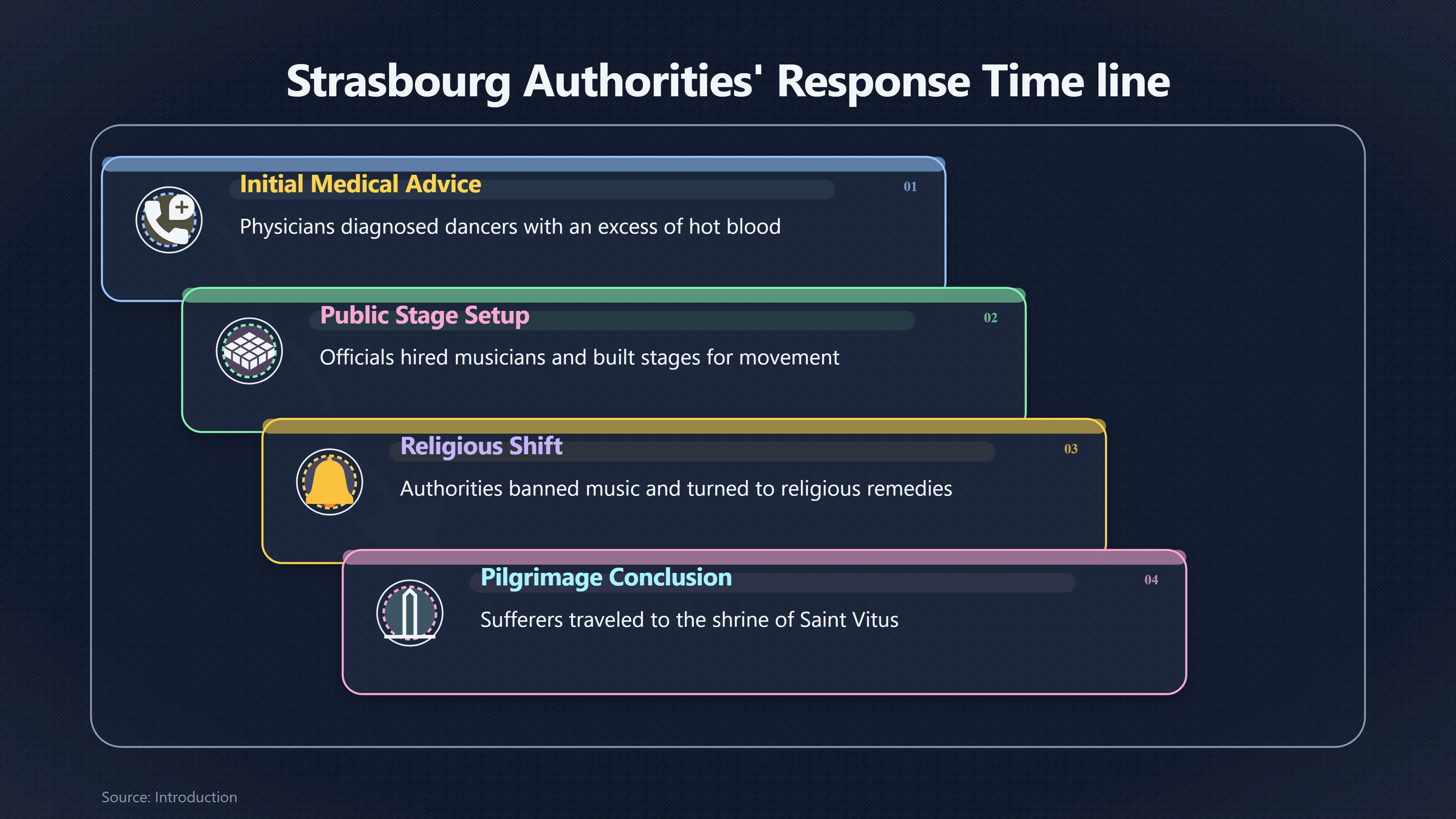
The city’s authorities initially accepted the advice of local physicians, who rejected supernatural possession and instead argued that the dancers suffered from an excess of “hot blood”, a concept drawn from contemporary humoral medicine. Believing that dancing itself would exhaust the illness, officials organised spaces where the afflicted could continue moving. Musicians were hired, stages were erected and dancers were encouraged rather than restrained. When this failed, the authorities abandoned the medical approach and turned to religious remedies. Music was prohibited, and many sufferers were taken on pilgrimage to the shrine of Saint Vitus, where religious rituals were performed. Contemporary reports suggest the outbreak then subsided.[The Guardian]theguardian.combizarre dance epidemic of summer 1518 strasbourgThe GuardianKeep on moving: the bizarre dance epidemic of summer 1518 | Dance | The GuardianJuly 5, 2018…
Stress, belief and contagious behaviour
The leading modern explanation is not that people were pretending, nor that they shared an infectious disease, but that they experienced a form of mass psychogenic illness shaped by the culture in which they lived.
This interpretation argues that several ingredients came together.
- Strasbourg had experienced repeated harvest failures, famine and disease during the preceding decades.
- Political tensions and economic insecurity created widespread anxiety.
- Religious expectations remained intense in the years before the Protestant Reformation.
- Local people believed that saints, particularly Saint Vitus, could inflict or relieve involuntary dancing as punishment for sin or broken vows.[ScienceDirect]sciencedirect.comIn a spin: the mysterious dancing epidemic of 1518 - ScienceDirect…
Modern psychology recognises that severe stress can sometimes produce physical symptoms without conscious deception. Such symptoms may spread socially when people share expectations about how distress should appear. In sixteenth-century Strasbourg, involuntary dancing already existed within popular religious belief as a recognised form of affliction. Historians such as John Waller argue that this cultural script made the behaviour both believable and, under exceptional circumstances, socially contagious.[ScienceDirect]sciencedirect.comIn a spin: the mysterious dancing epidemic of 1518 - ScienceDirect…
This does not mean that everyone consciously copied one another. Rather, the theory proposes that overwhelming stress interacted with sincerely held beliefs about divine punishment and healing, producing genuine altered states of behaviour among susceptible individuals.
Recent scholarship has also cautioned against treating the outbreak simply as “mass hysteria”, a term that has accumulated misleading and sometimes dismissive meanings. Researchers increasingly prefer “mass psychogenic illness” or speak more broadly of culturally shaped collective behaviour because these descriptions better acknowledge that participants experienced real distress rather than deliberate performance.[National Geographic]nationalgeographic.comdancing plague of 1518 strasbourg choreomaniaNational GeographicWhat caused Strasbourg’s dancing plague of 1518? | National Geographic…
Why ergot poisoning remains disputed
One of the most familiar explanations is ergot poisoning.
Ergot is a fungus that can infect rye and other cereals, producing chemicals capable of causing convulsions, hallucinations and severe illness. Because these compounds are chemically related to substances later used in the development of LSD, the theory has obvious popular appeal. Flooding and damp weather before 1518 may also have encouraged fungal growth.[National Geographic]nationalgeographic.comdancing plague of 1518 strasbourg choreomaniaNational GeographicWhat caused Strasbourg’s dancing plague of 1518? | National Geographic…
However, most historians and medical historians regard ergot poisoning as an unlikely explanation for the Strasbourg outbreak.
Several problems weaken the hypothesis.
- Ergot poisoning usually causes severe pain, vomiting, seizures, impaired circulation and, in many cases, gangrene rather than prolonged coordinated dancing.
- Victims are generally too ill to dance continuously for days.
- A toxic food source would not normally produce such a uniform behavioural response across many people.
- Similar dancing outbreaks occurred across several centuries and locations linked more closely by shared religious culture than by identical food supplies.[wikipedia.org]WikipediaDancing plague of 1518Dancing plague of 1518
For these reasons, ergot poisoning has largely shifted from being a leading explanation to a possibility that cannot fully account for the evidence.
Other explanations that have been proposed
Over the centuries, numerous other theories have appeared.
Some writers suggested epilepsy, encephalitis or another neurological illness. These explanations struggle because none convincingly match the prolonged, apparently socially contagious nature of the outbreak.[National Geographic]nationalgeographic.comdancing plague of 1518 strasbourg choreomaniaNational GeographicWhat caused Strasbourg’s dancing plague of 1518? | National Geographic…
Others have argued that the dancers were participating in a secret religious ritual or organised protest. The surviving records do not strongly support this view. Contemporary observers consistently described the dancers as distressed rather than celebratory, and civic authorities treated the event as an unwanted crisis rather than an organised festival.[The Guardian]theguardian.combizarre dance epidemic of summer 1518 strasbourgThe GuardianKeep on moving: the bizarre dance epidemic of summer 1518 | Dance | The GuardianJuly 5, 2018…
A more recent line of scholarship focuses less on diagnosis and more on meaning. Researchers argue that asking only “What disease caused this?” risks overlooking how sixteenth-century people understood suffering. In a society where divine punishment, saintly intervention and supernatural forces formed part of everyday reality, physical distress and religious belief were not separate categories. The outbreak therefore reflected both psychological mechanisms and a shared cultural world that made such behaviour intelligible to participants and observers alike.[National Geographic]nationalgeographic.comdancing plague of 1518 strasbourg choreomaniaNational GeographicWhat caused Strasbourg’s dancing plague of 1518? | National Geographic…

Why the dancing plague still matters
The Strasbourg dancing plague has endured because it sits at the intersection of medicine, psychology, religion and social history. It reminds us that collective behaviour cannot always be explained by a single biological cause. Human expectations, fears and cultural beliefs can shape how distress is experienced and expressed.
It also serves as a caution against simplistic labels. Earlier generations often described the outbreak simply as “mass hysteria”, implying irrationality or fantasy. Modern historians instead emphasise that the participants were responding to extraordinary hardship within a belief system that made involuntary dancing a recognised possibility. Their suffering appears to have been genuine, even if its underlying mechanism remains uncertain.[ScienceDirect]sciencedirect.comIn a spin: the mysterious dancing epidemic of 1518 - ScienceDirect…
Within the broader history of France and its border regions, the Strasbourg episode illustrates how periods of famine, epidemic disease and religious anxiety could produce remarkable forms of collective behaviour without requiring fraud, conspiracy or supernatural intervention. It remains one of the clearest examples of how social pressures and shared belief can combine to create events that later generations find both fascinating and difficult to explain.
Amazon book picks
Further Reading
Books and field guides related to What Really Happened in Strasbourg's Dancing Plague?. Use these as the next step if you want deeper reading beyond the article.
Extraordinary Popular Delusions and the Madness of Crowds
Rating: 4.0/5 from 5 Google Books ratings
Broad context for contagious collective behavior.
The witch-hunt in early modern Europe
Places the event within early modern European belief systems.
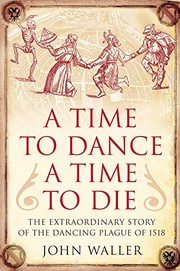
A time to dance, a time to die
Directly examines Strasbourg 1518 and competing explanations.
The pursuit of the millennium
Explores social and religious conditions behind mass behavior.
Endnotes
1.
Source: sciencedirect.com
Link:https://www.sciencedirect.com/science/article/pii/S0160932708000379
Source snippet
In a spin: the mysterious dancing epidemic of 1518 - ScienceDirect...
2.
Source: Wikipedia
Title: Dancing plague of 1518
Link:https://en.wikipedia.org/wiki/Dancing_plague_of_1518
3.
Source: sciencedirect.com
Link:https://www.sciencedirect.com/science/article/abs/pii/S2352007823000811
4.
Source: everything.explained.today
Title: Dancing plague of 1518
Link:https://everything.explained.today/Dancing_plague_of_1518/
5.
Source: youtube.com
Link:https://www.youtube.com/watch?v=yU_FhT7a6P0
Source snippet
The Dancing Plague | The History Show...
6.
Source: youtube.com
Title: The Dancing Plague | The History Show
Link:https://www.youtube.com/watch?v=S-w6d8gxROg
Source snippet
The Plague that made People Dance until they Dropped Dead...
7.
Source: nationalgeographic.com
Title: dancing plague of 1518 strasbourg choreomania
Link:https://www.nationalgeographic.com/history/article/dancing-plague-of-1518-strasbourg-choreomania
Source snippet
National GeographicWhat caused Strasbourg’s dancing plague of 1518? | National Geographic...
8.
Source: theguardian.com
Title: bizarre dance epidemic of summer 1518 strasbourg
Link:https://www.theguardian.com/stage/2018/jul/05/bizarre-dance-epidemic-of-summer-1518-strasbourg
Source snippet
The GuardianKeep on moving: the bizarre dance epidemic of summer 1518 | Dance | The GuardianJuly 5, 2018...
Published: July 5, 2018
9.
Source: newhistorian.com
Title: strasbourg dancing plague of 1518
Link:https://www.newhistorian.com/2018/05/22/strasbourg-dancing-plague-of-1518/
Source snippet
New HistorianMay 22, 2018 — Image: Mass-anxiety in Strasbourg: what was the dancing plague of 1518? MASS-ANXIETY IN STRASBOURG: WHAT WAS...
Published: May 22, 2018
Additional References
10.
Source: publicdomainreview.org
Title: Citizens by the hundred became compelled to dance, seemingly for no reas
Link:https://publicdomainreview.org/essay/the-dancing-plague-of-1518?fs=e&s=cl
Source snippet
The Dancing Plague of 1518 — The Public Domain ReviewJuly 10, 2018 — THE DANCING PLAGUE OF 1518 By Ned Pennant-Rea Five hundred years ago...
Published: July 10, 2018
11.
Source: anomalydesk.com
Title: dancing plague 1518
Link:https://anomalydesk.com/dancing-plague-1518
Source snippet
The Dancing Plague of 1518 (Strasbourg) | AnomalyDesk Case File 103May 21, 2026 — File 103 · Open Case The Dancing Plague of Strasbourg P...
Published: May 21, 2026
12.
Source: theconspiratory.com
Title: dancing plague 1518
Link:https://theconspiratory.com/theory/dancing-plague-1518
Source snippet
Hundreds of people danced themselves to death in Strasbourg in 1518 — The ConspiratoryJuly 8, 2026 — HUNDREDS OF PEOPLE DANCED THEMSELVES...
Published: July 8, 2026
13.
Source: youtube.com
Title: The Plague that made People Dance until they Dropped Dead
Link:https://www.youtube.com/watch?v=HQNcbhhulAI
Source snippet
How Psychology Can Explain the Deadly Medieval Dancing Plagues...
14.
Source: cambridge.org
Title: Unlike m
Link:https://www.cambridge.org/core/journals/the-drama-review/article/it-caught-me/514420DE98AA68DA7F08C307D94D5B14
Source snippet
“It caught me” | TDR | Cambridge CoreSeptember 5, 2025 — In various episodes of choreomania, bodily intensities could not be fully contai...
Published: September 5, 2025
15.
Source: researchgate.net
Link:https://www.researchgate.net/publication/321311385_Divine_Punishment_or_Disease_Medieval_and_Early_Modern_Approaches_to_the_1518_Strasbourg_Dancing_Plague
16.
Source: danceandhistory.org
Link:https://danceandhistory.org/informationen/bibliographie/miller-lynneth-j-divine-punishment-or-disease-medieval-and-early-modern-approaches-to-the-1518-strasbourg-dancing-plague
17.
Source: youtube.com
Link:https://www.youtube.com/watch?v=1UBaXusLjCk
Source snippet
The Dancing Plague of 1518: History's Weirdest Epidemic...
18.
Source: researchgate.net
Title: 5249909 In a spin the mysterious dancing epidemic of 1518
Link:https://www.researchgate.net/publication/5249909_In_a_spin_the_mysterious_dancing_epidemic_of_1518
19.
Source: youtube.com
Title: How Psychology Can Explain the Deadly Medieval Dancing Plagues
Link:https://www.youtube.com/watch?v=yHVTgZw7geY
Topic Tree