When Fear and Belief Spread Across Tanzania
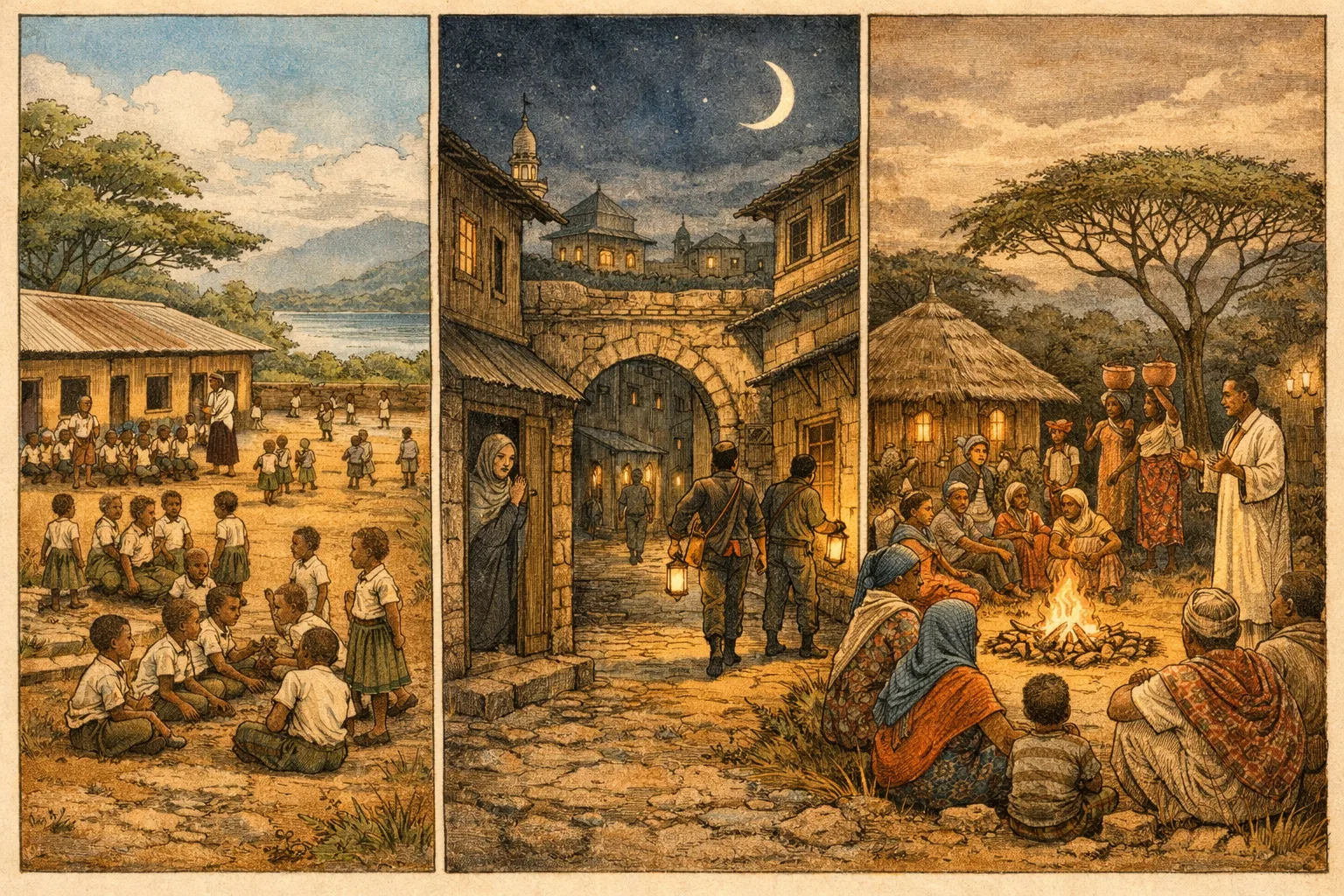
Tanzania’s history of contagious belief is not one story but several different kinds of event. The best-known is the 1962 Tanganyika “laughter epidemic”, in which waves of laughing, crying, agitation and physical distress moved through schools and villages near Lake Victoria.
Page outline Jump by section
Introduction
These episodes should not all be called “mass hysteria”. The laughter outbreak is commonly interpreted as mass psychogenic illness, meaning real symptoms spreading through social and psychological processes after physical causes have been investigated. Popobawa was a rumour-driven spirit panic with episodes of mob violence. Witchcraft killings are persecution, not a mysterious group illness. The Maji Maji uprising, meanwhile, shows how a shared sacred belief could unite resistance to colonial rule without being reducible to collective delusion.[journals.co.za]journals.co.zaAJA00089176 6171The epidemic was characterised by episodes of laughing and crying. The disease commenced on 30th January, 1962, During April and May, 217…
The 1962 laughter epidemic: what actually happened?
The outbreak began on 30 January 1962 at a girls’ boarding school in Kashasha, in the Bukoba area of what was then independent Tanganyika. The original medical account described episodes of laughing and crying rather than simple infectious merriment. Pupils also experienced restlessness, pain and other distressing symptoms. The school closed in March after a substantial proportion of its pupils had been affected; when it reopened, another cluster followed. Related episodes then appeared among families, villages and other schools in the wider district.[journals.co.za]journals.co.zaAJA00089176 6171The epidemic was characterised by episodes of laughing and crying. The disease commenced on 30th January, 1962, During April and May, 217…
Popular retellings often say that laughter “infected” about 1,000 people and forced 14 schools to close. Those figures come from later summaries of the regional sequence, but they should not be imagined as one thousand people laughing continuously or simultaneously. Attacks varied in length and included crying, faintness, breathing difficulties, rashes and inability to concentrate. Christian Hempelmann’s re-examination concluded that the event was genuine but that later accounts had exaggerated the role of laughter and wrongly presented it as joyful, viral or triggered by something funny.[ResearchGate]researchgate.net249929567 The laughter of the 1962 Tanganyika 'laughter epidemicThe laughter of the 1962 Tanganyika 'laughter epidemic'The present article discusses the role of laughter in the much cited '…
Why doctors called it psychogenic
Investigators did not identify an infectious agent or environmental poison that could explain the pattern. Teachers were largely unaffected, while adolescent pupils and young villagers formed the main groups involved. Symptoms travelled along social connections: girls returned home when schools closed, and fresh episodes appeared among people in their communities. That pattern, together with the changing mixture of emotional and bodily symptoms, supported a diagnosis now usually described as mass psychogenic illness.[journals.co.za]journals.co.zaAJA00089176 6171The epidemic was characterised by episodes of laughing and crying. The disease commenced on 30th January, 1962, During April and May, 217…
“Psychogenic” does not mean imaginary or deliberately performed. Fear, stress and expectation can produce involuntary fainting, pain, shaking, breathing changes and altered behaviour. In a close group, seeing another person become unwell can increase attention to one’s own bodily sensations; rumours and anxious observation may then reinforce the process. The neutral term is preferable to “hysteria”, a label historically used to dismiss women and girls without adequately considering their circumstances. Research on comparable school outbreaks stresses that symptoms are real even when no toxin or infection is found.[PMC]pmc.ncbi.nlm.nih.govOpen source on nih.gov.
Independence, schooling and stress
The timing has encouraged broader interpretations. Tanganyika had gained independence from Britain only weeks before the outbreak. Later historians have placed the event within a period of intense hope, uncertainty and pressure to modernise. Mission and boarding schools could impose strict discipline while pupils navigated conflicting expectations from teachers, families, religious institutions and local social life. Some scholars therefore interpret the outbreak as a bodily expression of strain among young people with little authority over their environment.[harvard.edu]dash.harvard.eduOpen source on harvard.edu.
That explanation is plausible rather than conclusively proved. Contemporary medical reports documented the pattern more securely than they documented each pupil’s inner life. It would therefore be too confident to claim that independence itself “caused” the epidemic. The safest conclusion is that a socially transmitted illness occurred in a population facing institutional and cultural pressures, while its precise triggering combination remains uncertain.
Popobawa: how a night terror became a public panic
In early 1995, people on Pemba in the Zanzibar archipelago began reporting nocturnal attacks by a frightening being commonly called Popobawa. Accounts varied, but victims often described waking unable to move or speak, feeling pressure on the chest, sensing an intruder and experiencing sexual assault. Reports moved between households and settlements before reaching Zanzibar’s main island and, in some versions, parts of mainland Tanzania. Residents gathered together at night, stayed awake, discussed new attacks and searched for suspected manifestations of the assailant.[academia.edu]academia.eduOpen source on academia.edu.
The panic had deadly consequences. On 3 April 1995, a visitor from mainland Tanzania was killed by a mob in Zanzibar Town after being identified as Popobawa or as one of the spirit’s possible forms. This is the point at which the episode ceases to be merely an unusual belief or sleep-related mystery. Once frightened communities began treating strangers and vulnerable individuals as supernatural threats, rumour became a licence for violence.[ResearchGate]researchgate.netKilling Popobawa: collective panic and violence in ZanzibarOn the night of Monday 3rd April 1995 a visitor from the Tanzanian…
Sleep paralysis offers a persuasive explanation for at least some initial experiences. During transitions between sleep and wakefulness, a person may be conscious yet temporarily unable to move, while sensing a presence, pressure or vivid visual, auditory and tactile phenomena. Different cultures interpret these experiences through different supernatural figures. Popobawa accounts fit parts of this pattern, although the reported sexual assaults, public rumours and subsequent group actions cannot be explained by sleep physiology alone.[arxiv.org]arxiv.orgarXiv Sleep Paralysis: phenomenology, neurophysiology and treatmentarXiv Sleep Paralysis: phenomenology, neurophysiology and treatment
The social environment mattered. Talking through the night may have reduced opportunities for isolated attacks but also kept fear constantly active. Each new account supplied details that shaped expectations for the next one. People who awoke in distress already possessed a public explanation for what had happened, while neighbours had a recognised enemy to watch for. The panic therefore operated as a loop: disturbing experiences generated stories; stories heightened vigilance; vigilance made ambiguous sensations and strangers seem more threatening.
Was Popobawa political?
The major 1995 panic coincided with the approach of Tanzania’s first multiparty general election. Later recurrences also appeared near politically tense periods in Zanzibar, leading some commentators to connect Popobawa with party conflict, state power or unresolved memories of political violence. During the panic itself, however, explanations changed over time, and not every victim considered the attacks political. Ethnographic work suggests that politics became one influential interpretation among several rather than the single hidden cause.[Academia]academia.eduOpen source on academia.edu.
Popobawa is therefore best understood as a collective panic assembled from several layers: culturally available spirit beliefs, experiences resembling sleep paralysis, sexual fear, dense circulation of testimony, local conflict and political uncertainty. A purely medical explanation misses the public drama; a purely supernatural or political explanation overlooks how sleep, suggestion and frightened attention can create sincere experiences.
Witchcraft accusation as persecution
Belief in harmful occult power has a long and varied history in Tanzania, but belief alone is not the central human-rights problem. The danger begins when illness, crop failure, death, poverty or family conflict is blamed on a particular person and punishment follows. Older women have been especially vulnerable, sometimes because age, widowhood, red eyes associated with smoky cooking fires, disputed property or dependence on relatives makes them easy targets. Tanzanian institutions and international organisations have repeatedly identified killings and abuse linked to witchcraft accusations, particularly in parts of the Lake Zone and other rural regions.[helpage.org]helpage.orgHelp Age International Tackling witchcraft accusations in TanzaniaHelp Age International Tackling witchcraft accusations in Tanzania
Economic stress appears to affect the risk. Economist Edward Miguel examined Tanzanian village data and found that extreme rainfall—both drought and excessive rain—was associated with increased killings of alleged witches. His interpretation was not that weather created supernatural belief from nothing, but that severe income shocks intensified pressure within poor households and communities. Elderly women could then be scapegoated during periods of scarcity. The study remains influential because it connects accusation to material hardship rather than treating violence as a timeless feature of “tradition”.[emiguel.econ.berkeley.edu]emiguel.econ.berkeley.eduPoverty and Witch KillingPoverty and Witch Killing
Gender and power are equally important. An accusation may express genuine fear on the accuser’s part, yet it can also function as a means of removing an unwanted relative, settling a dispute or gaining access to property. This is why describing every case as mass hysteria is misleading. These are targeted acts with perpetrators, victims and social incentives, even when those involved sincerely believe occult harm has occurred.
The appropriate response is also different from the response to a psychogenic school outbreak. Health officials confronting unexplained symptoms must investigate toxins, infection and environmental hazards before reassuring the public. Witchcraft-related violence requires protection of threatened people, reliable policing, prosecution of assault and murder, social support and public education. United Nations guidance recommends concentrating law on harmful conduct rather than attempting to criminalise private belief itself.[OHCHR]ohchr.orgaccusations of witchcraft and ritual attacksHarmful practices related to accusations of witchcraft and ritual attacks have contribut…
Attacks on people with albinism
From the 2000s, Tanzania became internationally associated with murders and mutilations of people with albinism. Criminal networks supplied body parts for practices promoted by some fraudulent or abusive healers, who claimed that these remains could bring wealth, success or luck. Children were at particular risk, but adults were also attacked, and graves were sometimes desecrated. These crimes combined superstition with an organised market: belief created demand, while intermediaries and killers converted that demand into profit.[nationalgeographic.com]nationalgeographic.com131011 albino killings witch doctors tanzania superstition131011 albino killings witch doctors tanzania superstition
The victims were not “albinos” in the sense of a strange separate class, but people with the inherited condition albinism, which reduces pigmentation and may cause serious visual impairment and vulnerability to sun damage. Sensational reporting sometimes repeated lurid claims about magical body parts without sufficiently centring survivors, discrimination and failures of protection. A humane account must distinguish the offenders’ mythology from the reality of the people targeted.
Tanzanian authorities responded with arrests, prosecutions, public campaigns and, in 2015, a crackdown on unregistered or suspected practitioners. International bodies nevertheless continued to raise concerns about impunity, discrimination and the security of people with albinism. The broader lesson is that attacking “superstition” in the abstract is not enough. Effective prevention also depends on accessible policing, safe accommodation where necessary, education, health support, economic inclusion and consistent prosecution of those organising the trade.[un.org]media.un.orgited Nations Media UN / TANZANIA ALBINISM | UNifeedited Nations Media UN / TANZANIA ALBINISM | UNifeed
It is also important not to stigmatise all traditional healers. Healing practices are diverse, and many practitioners have no connection to ritual violence. Loose use of words such as “witch doctor” can collapse legitimate herbal, spiritual and community healing into the crimes of a small number of exploitative actors. The relevant distinction is between lawful practice and incitement, trafficking, assault or murder.
Maji Maji: sacred belief, war and colonial violence
The Maji Maji uprising of 1905–07 is sometimes presented as another example of irrational mass belief because fighters received sacred water associated with protection against German bullets. That interpretation is too narrow. The movement grew from coercive colonial rule, forced cotton production, taxation and violence. Kinjikitile Ngwale, a healer and religious leader, drew on existing ritual traditions and offered a symbol capable of joining communities that did not share one political organisation.[MDPI]mdpi.comReligion and Healing from Colonial Violence in Tanzaniaby N Rushohora · 2019 · Cited by 15 — The Majimaji War was organized around pr…
The sacred water did carry protective meaning, and some fighters appear to have believed that it would neutralise bullets. When colonial firepower killed large numbers, the belief did not survive unchanged. Yet the importance of the medicine lay partly in what it made socially possible: it created confidence, obligation and unity across more than twenty groups facing a heavily armed state. Religion was not a decorative addition to an otherwise political revolt; it was one of the languages through which resistance was organised.[MDPI]mdpi.comReligion and Healing from Colonial Violence in Tanzaniaby N Rushohora · 2019 · Cited by 15 — The Majimaji War was organized around pr…
Calling Maji Maji a “cult uprising” would therefore repeat a colonial habit of dismissing African political action as fanaticism. The protective claim had devastating military limits, but the movement addressed real exploitation. Historians treat its ritual system as part of mobilisation, healing and collective identity, not as proof that the revolt itself was a mass delusion.
What links these cases—and what does not
Tanzania’s episodes of contagious fear and belief share a few mechanisms. Uncertainty encourages people to seek explanations; trusted stories make ambiguous events legible; tight social networks spread testimony quickly; and institutions can either reduce fear or intensify it. Schools, villages, religious communities, political gatherings and news reports all provide channels through which attention and expectation travel.
The differences are more important than the resemblance:
- The Tanganyika laughter epidemic involved clusters of real, involuntary symptoms without an established toxic or infectious cause. Mass psychogenic illness is the strongest broad interpretation, although the precise trigger remains uncertain.
- The Popobawa panic combined nocturnal experiences, spirit narratives, rumour, political anxiety and crowd action. Sleep paralysis may explain some experiences but not the whole social episode.
- Witchcraft accusations are systems of scapegoating and persecution when directed at named people. Poverty, gender inequality, inheritance disputes and weak protection can turn belief into lethal violence.
- Attacks on people with albinism involved discriminatory myths joined to organised criminal demand. They require a human-rights and criminal-justice analysis, not the language of contagious illness.
- Maji Maji was an anti-colonial war in which sacred medicine helped create solidarity. Its religious claims cannot be separated from the real coercion and violence of German rule.
The most persistent myth is that these histories reveal a uniquely credulous society. They do not. Mass psychogenic illness, supernatural assault traditions, scapegoating panics and millenarian political movements occur in many parts of the world. What is specifically Tanzanian is the form they took: mission schools in the first months of independence, Zanzibar’s island politics and spirit traditions, the economic insecurity surrounding witchcraft accusations, the persecution of people with albinism, and a colonial rebellion unified through sacred water.
Why the history still matters
These cases shape how Tanzania is represented abroad. The laughter epidemic is often reduced to an amusing oddity, Popobawa to an exotic monster story and attacks on people with albinism to evidence of a supposedly backward culture. Such retellings remove the pressures that made the episodes intelligible: authoritarian schooling, political transition, poverty, gendered vulnerability, criminal markets and colonial domination.
A better account begins by asking who had power and who bore the harm. The girls in the 1962 outbreak were patients, not performers in a comedy. People reporting nocturnal attacks may have experienced genuine terror even when a supernatural assailant cannot be verified. Older women and people with albinism were victims of accusation and violence, not embodiments of the beliefs projected onto them. Maji Maji fighters were resisting colonial exploitation, even when faith in ritual protection exposed them to catastrophic danger.
Tanzania’s history therefore warns against treating every unusual collective event as either foolish superstition or medical “hysteria”. Belief can relieve distress, organise resistance, explain misfortune, spread fear or legitimise violence. Understanding which of those processes is operating is essential, because each demands a different response: medical investigation and calm reassurance, protection from mobs, prosecution of criminal harm, reform of unequal institutions, or recognition of the political world that gave the belief its force.
Amazon book picks
Further Reading
Books and field guides related to When Fear and Belief Spread Across Tanzania. Use these as the next step if you want deeper reading beyond the article.
Extraordinary Popular Delusions and the Madness of Crowds
Rating: 4.0/5 from 5 Google Books ratings
Foundational work on collective belief and social panics.
The Wisdom of Crowds:Why the Many Are Smarter Than the Few an...
Explores how collective behaviour and shared beliefs emerge.
African religions and philosophy
Provides cultural context for belief and ritual in East Africa.

Mistakes Were Made (But Not by Me)
Explains belief persistence and self-justification.
Endnotes
1.
Source: journals.co.za
Title: AJA00089176 6171
Link:https://journals.co.za/doi/pdf/10.10520/AJA00089176_6171
Source snippet
The epidemic was characterised by episodes of laughing and crying. The disease commenced on 30th January, 1962, During April and May, 217...
2.
Source: researchgate.net
Title: 249929567 The laughter of the 1962 Tanganyika ‘laughter epidemic’
Link:https://www.researchgate.net/publication/249929567The_laughter_of_the_1962_Tanganyika%27laughter_epidemic%27
Source snippet
The laughter of the 1962 Tanganyika 'laughter epidemic'The present article discusses the role of laughter in the much cited '...
3.
Source: researchgate.net
Link:https://www.researchgate.net/publication/270393629_Killing_Popobawa_collective_panic_and_violence_in_Zanzibar
Source snippet
Killing Popobawa: collective panic and violence in ZanzibarOn the night of Monday 3rd April 1995 a visitor from the Tanzanian...
Published: April 1995
4.
Source: ohchr.org
Link:https://www.ohchr.org/sites/default/files/2022-12/PAP-Guidelines-EN.pdf
Source snippet
accusations of witchcraft and ritual attacksHarmful practices related to accusations of witchcraft and ritual attacks have contribut...
5.
Source: mdpi.com
Link:https://www.mdpi.com/2077-1444/10/9/519
Source snippet
Religion and Healing from Colonial Violence in Tanzaniaby N Rushohora · 2019 · Cited by 15 — The Majimaji War was organized around pr...
6.
Source: data.isiscb.org
Link:https://data.isiscb.org/isis/citation/CBB001567593/
7.
Source: pmc.ncbi.nlm.nih.gov
Link:https://pmc.ncbi.nlm.nih.gov/articles/PMC9210177/
8.
Source: arxiv.org
Title: arXiv Sleep Paralysis: phenomenology, neurophysiology and treatment
Link:https://arxiv.org/abs/1704.02342
9.
Source: dash.harvard.edu
Link:https://dash.harvard.edu/entities/publication/73120378-c9c1-6bd4-e053-0100007fdf3b
10.
Source: academia.edu
Link:https://www.academia.edu/694054/The_politicisation_of_Popobawa_changing_explanations_of_a_collective_panic_in_Zanzibar
Published: January 1, 2009
11.
Source: researchgate.net
Link:https://www.researchgate.net/publication/272202097_The_politicisation_of_Popobawa_changing_explanations_of_a_collective_panic_in_Zanzibar
12.
Source: scribd.com
Link:https://www.scribd.com/document/17111963/The-Politicisation-of-Popobawa-Changing-Explanations-of-a-Collective-Panic-in-Zanzibar
13.
Source: helpage.org
Title: Help Age International Tackling witchcraft accusations in Tanzania
Link:https://www.helpage.org/blog/tackling-witchcraft-accusations-in-tanzania/
Published: July 4, 2014
14.
Source: tbinternet.ohchr.org
Link:https://tbinternet.ohchr.org/_layouts/15/TreatyBodyExternal/DownloadDraft.aspx?key=e2ymseNax61wasyPcEzFDB+I9zS71vRIgYivTFtp0zo3rTwfxbY%2FkFIWHwP6mEQ+
15.
Source: emiguel.econ.berkeley.edu
Title: Poverty and Witch Killing
Link:https://emiguel.econ.berkeley.edu/assets/assets/miguel_research/44/_Paper__Poverty_and_Witch_Killing.pdf
16.
Source: ohchr.org
Title: hunted their body parts
Link:https://www.ohchr.org/en/stories/2017/04/hunted-their-body-parts
17.
Source: time.com
Link:https://time.com/3666772/tanzania-witchdoctor-ban-albino-attacks/
18.
Source: ohchr.org
Title: Albinism Worldwide Report 2021 EN
Link:https://www.ohchr.org/sites/default/files/2022-12/Albinism-Worldwide-Report-2021-EN.pdf
19.
Source: docstore.ohchr.org
Link:https://docstore.ohchr.org/SelfServices/FilesHandler.ashx?enc=mRusA74or4qTQBqim43Zy3YRMwEtzzCFsLidOUX8s%2Fl4GZ8%2B8c5fkyDhRj6Brdapy2WIfj7onB3F%2FzRlv5RRNcYrHd3BMaE5458j8XXw%2BV0%3D
20.
Source: ohchr.org
Title: witchcraft killings people albinism rose during pandemic un expert
Link:https://www.ohchr.org/en/press-releases/2021/07/witchcraft-killings-people-albinism-rose-during-pandemic-un-expert
Published: July 2021
21.
Source: spcommreports.ohchr.org
Link:https://spcommreports.ohchr.org/TMResultsBase/DownLoadPublicCommunicationFile?gId=27872
Published: February 2023
22.
Source: docstore.ohchr.org
Link:https://docstore.ohchr.org/SelfServices/FilesHandler.ashx?enc=g8%2FfCQ427uD7M7M%2FRAv4L6aZJNpGTzPZXdTnR1aawdn5B%2BOTm%2B8jRke7OLB71i3Hdu14ZfMizq6uMzgqkZK%2FGQ%3D%3D
23.
Source: tbinternet.ohchr.org
Link:https://tbinternet.ohchr.org/_layouts/15/TreatyBodyExternal/DownloadDraft.aspx?key=cDFnclCUQx3uiXv1DhcT7r9e+M3gXv+LtBbVjmkZumFupltJ2nDqpIqjg5Ki%2FMLh
24.
Source: uprdoc.ohchr.org
Link:https://uprdoc.ohchr.org/uprweb/downloadfile.aspx?file=EnglishTranslation&filename=8835
25.
Source: ohchr.org
Title: attacks against people albinism are hate crimes un albinism expert
Link:https://www.ohchr.org/en/stories/2022/03/attacks-against-people-albinism-are-hate-crimes-un-albinism-expert
26.
Source: scribd.com
Link:https://www.scribd.com/document/13997211/Diabolical-Delusions-and-Hysterical-Narratives-in-a-Postmodern-State
27.
Source: researchgate.net
Link:https://www.researchgate.net/publication/380092151_Cults_of_conspiracy_and_the_ongoing_Satanic_Panic
28.
Source: researchgate.net
Title: Rumor and History in Colonial Africa
Link:https://www.researchgate.net/publication/272725141_Speaking_With_Vampires_Rumor_and_History_in_Colonial_Africa
29.
Source: researchgate.net
Link:https://www.researchgate.net/publication/228668099_Witchcraft_and_the_law_in_Tanzania
30.
Source: researchgate.net
Link:https://www.researchgate.net/publication/235754862_View_Point_Episodes_of_mass_hysteria_in_African_schools_A_study_of_literature
31.
Source: researchgate.net
Link:https://www.researchgate.net/publication/286833226_When_the_vampires_come_for_you_A_true_story_of_ordinary_horror
32.
Source: researchgate.net
Title: 43195952 Making History Historical Narratives of the Maji Maji
Link:https://www.researchgate.net/publication/43195952_Making_History_Historical_Narratives_of_the_Maji_Maji
Published: May 2026
33.
Source: academia.edu
Link:https://www.academia.edu/9441900/Explaining_Popobawa_conflicting_interpretations_of_a_collective_panic_in_Zanzibar
34.
Source: journals.sagepub.com
Link:https://journals.sagepub.com/doi/10.1177/136346156500200218
Source snippet
Sage JournalsAN EPIDEMIC OF LAUGHING IN THE BUKOBA DISTRICT...AN EPIDEMIC OF LAUGHING IN THE BUKOBA DISTRICT OF TANGANYIKA by A. M. RANK...
35.
Source: nationalgeographic.com
Title: 131011 albino killings witch doctors tanzania superstition
Link:https://www.nationalgeographic.com/history/article/131011-albino-killings-witch-doctors-tanzania-superstition
36.
Source: europarl.europa.eu
Title: European Parliament Albino killings in Tanzania
Link:https://www.europarl.europa.eu/doceo/document/TA-6-2008-0413_EN.html
37.
Source: media.un.org
Title: ited Nations Media UN / TANZANIA ALBINISM | UNifeed
Link:https://media.un.org/unifeed/en/asset/d146/d1468860
38.
Source: pmc.ncbi.nlm.nih.gov
Link:https://pmc.ncbi.nlm.nih.gov/articles/PMC4125237/
Additional References
39.
Source: medicalindependent.ie
Title: mass psychogenic illness was no laughing matter for the kids of tanganyika
Link:https://www.medicalindependent.ie/life/the-dorsal-view/mass-psychogenic-illness-was-no-laughing-matter-for-the-kids-of-tanganyika/
40.
Source: obiter.mandela.ac.za
Link:https://obiter.mandela.ac.za/article/download/11193/16442/
41.
Source: amnesty.org
Link:https://www.amnesty.org/en/wp-content/uploads/2021/06/English.pdf
42.
Source: amnesty.org
Title: ghana witchcraft accusations 2
Link:https://www.amnesty.org/en/latest/news/2025/07/ghana-witchcraft-accusations-2/
43.
Source: amnesty.org
Link:https://www.amnesty.org/ru/wp-content/uploads/2021/06/afr030042002en.pdf
Published: June 2000
44.
Source: amnesty.org
Title: ghana witchcraft accusations
Link:https://www.amnesty.org/en/latest/news/2025/04/ghana-witchcraft-accusations/
45.
Source: atlasobscura.com
Title: 1962 laughter epidemic tanganyika
Link:https://www.atlasobscura.com/articles/1962-laughter-epidemic-tanganyika
46.
Source: law.bepress.com
Link:https://law.bepress.com/cgi/viewcontent.cgi?article=4468&context=expresso&httpsredir=1&referer=
47.
Source: businessinsider.com
Title: was mass hysteria behind a mysterious middle school fainting epidemic 2023 6
Link:https://www.businessinsider.com/was-mass-hysteria-behind-a-mysterious-middle-school-fainting-epidemic
48.
Source: centerforinquiry.org
Title: zanzibars popobawa demon still attacking skeptics
Link:https://centerforinquiry.org/blog/zanzibars_popobawa_demon_still_attacking_skeptics/
Topic Tree
Follow this branch
Related pages 192
- Antigua and Barbuda
- Argentina Belief Scares
- Azerbaijan Belief
- Bahrain Beliefs
- North Korea
- +187 more in sidebar