Within Argentina Belief Scares
How Argentina's Sect Panic Took Hold
Media reports turned diverse spiritual groups into a single public threat, often blurring eccentric belief, coercion and proven crime.
On this page
- How the media defined a dangerous sect
- The Guaratuba murder and satanic accusations
- Where fear ended and documented abuse began
Page outline Jump by section
Introduction
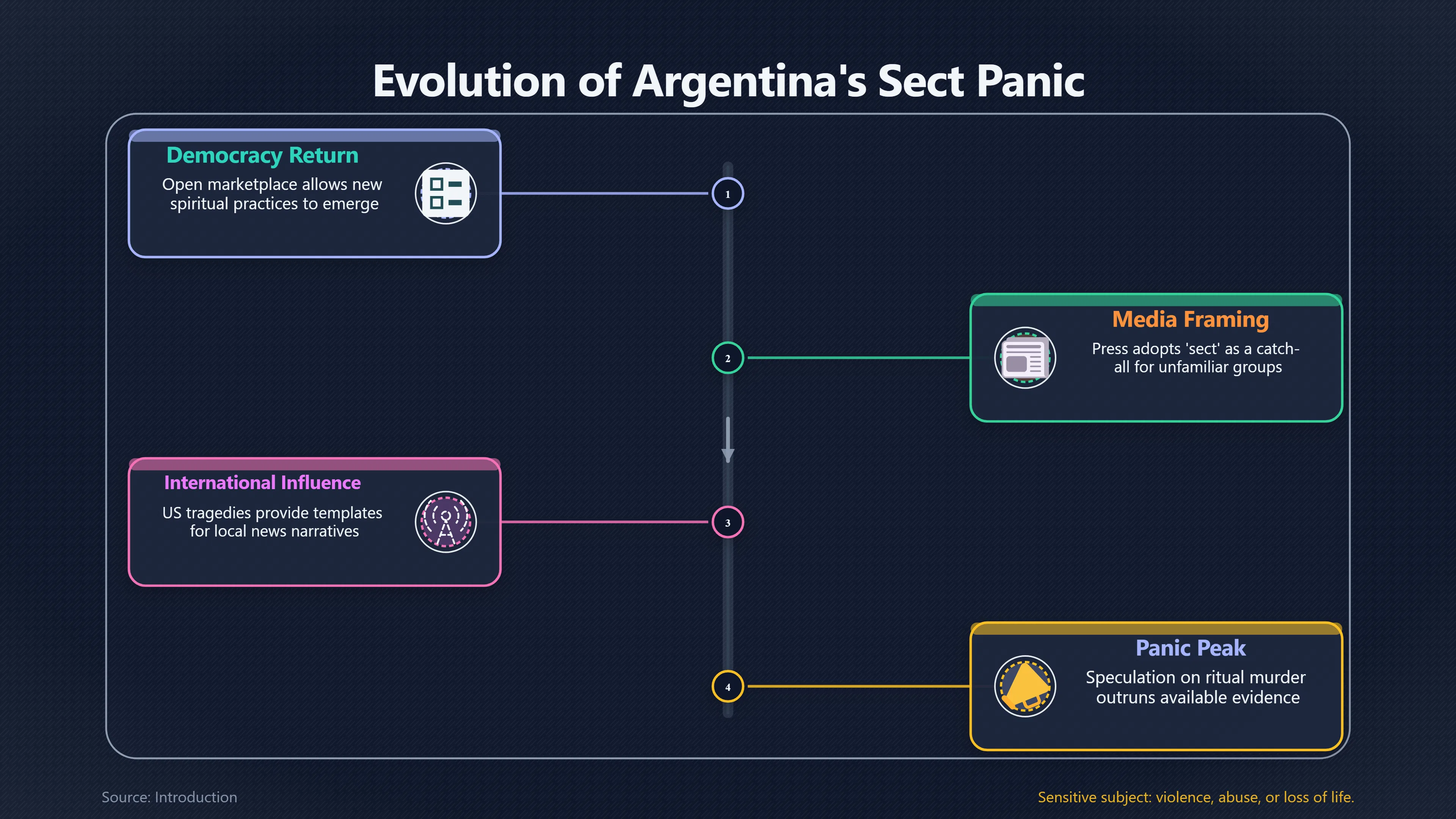
Argentina’s 1990s “sect scare” was less a single event than a period in which journalists, anti-sect campaigners and public officials increasingly portrayed a wide range of unfamiliar religious and spiritual groups as part of a common social threat. Small new religions, Afro-Brazilian traditions, UFO movements, therapeutic organisations and groups later accused of genuine crimes were frequently discussed under the same label: “sects”. As the decade progressed, fears about manipulation, ritual murder and Satanism became intertwined, creating a moral panic in which speculation often outran the available evidence. While some organisations were later investigated for real abuse or fraud, many allegations of satanic conspiracies and ritual killing were never substantiated. Scholars now regard the period as an important example of how media narratives, international influences and genuine public anxieties combined to blur the line between documented criminality and suspicion directed at religious minorities.[conicet.gov.ar]ri.conicet.gov.arCONICET Digital This article was downloaded by: [Alejandro FrigerioCONICET DigitalThis article was downloaded by: [Alejandro Frigerio]November 4, 2025…
How the media defined a dangerous sect
During the early 1990s, the Argentine press increasingly treated the word “sect” as a catch-all category rather than a precise description. Reports commonly implied that any small or unfamiliar religious movement might conceal psychological manipulation, financial exploitation, sexual abuse or violent rituals. This broad framing made little distinction between organisations with unconventional beliefs and those actually under criminal investigation.[CONICET Digital]ri.conicet.gov.arCONICET Digital This article was downloaded by: [Alejandro FrigerioCONICET DigitalThis article was downloaded by: [Alejandro Frigerio]November 4, 2025…
Several factors reinforced this shift.
- Newly established anti-sect organisations became regular media commentators and presented themselves as experts on hidden religious dangers.
- Television programmes favoured dramatic accounts of “brainwashing”, secret ceremonies and charismatic leaders, themes that attracted large audiences.
- International tragedies—including the Branch Davidian siege in the United States and later the Order of the Solar Temple deaths—provided powerful templates through which local journalists interpreted Argentine groups, even when circumstances were very different.[CONICET Digital]ri.conicet.gov.arCONICET Digital This article was downloaded by: [Alejandro FrigerioCONICET DigitalThis article was downloaded by: [Alejandro Frigerio]November 4, 2025…
Researchers studying this period argue that anti-sect activists helped reshape public debate by promoting theories of coercive psychological control. These ideas offered worried families an explanation for why relatives joined unfamiliar movements, but critics note that they also encouraged the assumption that members of minority religions lacked agency and that unconventional belief itself was evidence of danger.[CONICET Digital]ri.conicet.gov.arCONICET Digital This article was downloaded by: [Alejandro FrigerioCONICET DigitalThis article was downloaded by: [Alejandro Frigerio]November 4, 2025…
The Guaratuba murder and satanic accusations
One of the most influential episodes behind Argentina’s sect panic originated not in Argentina but in neighbouring Brazil.
In 1992, the murder of a young boy in Guaratuba, Paraná, generated sensational allegations that the killing formed part of a satanic ritual. As investigators pursued different suspects, media coverage expanded beyond the homicide itself. Reports increasingly linked Afro-Brazilian religions, supposed occult organisations and a UFO movement whose leadership included both Brazilian and Argentine figures. This transformed a criminal investigation into a broader story about alleged “satanic sects” operating across national borders.[ResearchGate]researchgate.netResearchGate(PDF) “Sectas satánicas” en el Mercosur: un estudio de la construcción de la desviación religiosa en los medios de comunicaci…
Argentine newspapers and television gave the case extensive coverage. Anthropologists Alejandro Frigerio and Ari Pedro Oro later demonstrated that the reporting frequently blurred together several unrelated subjects:
- Afro-Brazilian religious traditions.
- Small esoteric or UFO organisations.
- Alleged ritual crime.
- Claims of organised satanic conspiracies.
Rather than carefully separating proven evidence from speculation, much reporting encouraged readers to see these as interconnected parts of a hidden network. The authors argue that national stereotypes also influenced coverage. Brazilian religions were often portrayed as inherently more prone to ritual violence, while Argentine involvement received somewhat different treatment because of national identity and media assumptions.[ResearchGate]researchgate.netResearchGate(PDF) “Sectas satánicas” en el Mercosur: un estudio de la construcción de la desviación religiosa en los medios de comunicaci…
The Guaratuba case therefore became much more than a criminal investigation. It served as a symbolic example repeatedly invoked whenever the press discussed dangerous sects, reinforcing fears that ritual murder and Satanism represented a growing regional threat.[ResearchGate]researchgate.netResearchGate(PDF) “Sectas satánicas” en el Mercosur: un estudio de la construcción de la desviación religiosa en los medios de comunicaci…
Why the panic spread so quickly
The sect scare flourished because several wider developments converged during the same period.
Argentina had recently returned to democracy, allowing a much more open religious marketplace than under military rule. New religious movements, imported spiritual practices and alternative therapies became more visible. At the same time, economic instability and rapid social change left many people anxious about family breakdown, youth culture and declining authority.
Television also changed the dynamics of public debate. Talk shows and current-affairs programmes increasingly relied on dramatic personal testimony and expert commentary rather than detailed investigation. Allegations of secret cults proved especially attractive because they combined crime reporting, religion and psychological mystery into compelling television.[CONICET Digital]ri.conicet.gov.arCONICET Digital This article was downloaded by: [Alejandro FrigerioCONICET DigitalThis article was downloaded by: [Alejandro Frigerio]November 4, 2025…
The panic also reflected international trends. Throughout the English-speaking world during the 1980s and early 1990s, claims of vast satanic ritual abuse conspiracies circulated widely despite repeated failures to produce corroborating evidence. These narratives travelled through books, television and anti-cult networks and influenced discussions far beyond North America. Argentine commentators adopted many of the same themes—brainwashing, ritual murder, child sacrifice and hidden conspiracies—even though the local evidence was much weaker.[ResearchGate]researchgate.netOpen source on researchgate.net.
Where fear ended and documented abuse began
The central difficulty in interpreting the 1990s is that two different realities existed simultaneously.
On one hand, some organisations operating in Argentina genuinely engaged in abusive or criminal behaviour. Authorities investigated allegations involving fraud, coercive control, sexual exploitation and financial crimes in particular groups. These cases deserved serious scrutiny and should not be dismissed simply because the broader panic became exaggerated.
On the other hand, the moral panic encouraged a tendency to assume that unfamiliar religions were inherently dangerous. Accusations of satanic ritual murder, widespread occult conspiracies and organised ritual abuse often rested on rumour, sensational reporting or unsupported claims rather than verified evidence. Some highly publicised allegations against specific groups were eventually shown to be false or lacked sufficient proof to sustain the dramatic claims made in the press.[CONICET Digital]ri.conicet.gov.arCONICET Digital This article was downloaded by: [Alejandro FrigerioCONICET DigitalThis article was downloaded by: [Alejandro Frigerio]November 4, 2025…
For historians and sociologists, this distinction is essential. Genuine criminal investigations and moral panic are not mutually exclusive. A society may correctly identify some abusive organisations while simultaneously exaggerating the prevalence or nature of the threat.

How scholars interpret the episode today
Modern scholarship generally treats Argentina’s sect scare as a classic moral panic rather than evidence of a widespread satanic underground.
Researchers point to several recurring features:
- Diverse religious minorities were merged into a single threatening category.
- Journalists relied heavily on anti-sect campaigners as authoritative sources.
- International cases provided ready-made narratives for interpreting local events.
- Media attention greatly exceeded the number of verified criminal cases involving religious groups.
- Allegations of Satanism often functioned as symbolic explanations for broader fears about social change, family authority and religious diversity.[conicet.gov.ar]ri.conicet.gov.arCONICET Digital This article was downloaded by: [Alejandro FrigerioCONICET DigitalThis article was downloaded by: [Alejandro Frigerio]November 4, 2025…
The period also illustrates how labels matter. Calling an organisation a “sect” frequently implied criminality before any evidence had been established. Scholars therefore favour more specific descriptions—such as new religious movement, minority religion or criminal organisation—depending on the documented facts rather than relying on a single emotionally charged label.[CONICET Digital]ri.conicet.gov.arCONICET Digital This article was downloaded by: [Alejandro FrigerioCONICET DigitalThis article was downloaded by: [Alejandro Frigerio]November 4, 2025…
Why the sect scare still matters
Although the intense panic faded by the end of the 1990s, its legacy remains visible in Argentine discussions about religious freedom, coercive groups and media responsibility.
The episode demonstrated how rapidly public concern can spread when genuine social problems become intertwined with sensational claims. It also highlighted the need to distinguish carefully between unconventional belief, abusive leadership and proven criminal conduct. Modern investigations into coercive organisations increasingly focus on demonstrable acts—such as fraud, exploitation or violence—rather than assuming danger simply because a movement is small, secretive or religiously unusual.
For Argentina’s social history, the 1990s sect scare stands as an instructive example of how moral panic can emerge from a mixture of real abuses, international influences, sensational journalism and public uncertainty, leaving a lasting impact on both religious minorities and the wider culture.[conicet.gov.ar]ri.conicet.gov.arCONICET Digital This article was downloaded by: [Alejandro FrigerioCONICET DigitalThis article was downloaded by: [Alejandro Frigerio]November 4, 2025…
Amazon book picks
Further Reading
Books and field guides related to How Argentina's Sect Panic Took Hold. Use these as the next step if you want deeper reading beyond the article.
Extraordinary Popular Delusions and the Madness of Crowds
Rating: 4.0/5 from 5 Google Books ratings
Historical perspective on collective scares and public fears.

Combating cult mind control
Provides context for distinguishing coercive groups from moral panics.
Cults in Our Midst
Explores controversial new religious movements and public responses.
Endnotes
1.
Source: researchgate.net
Link:https://www.researchgate.net/publication/305226453_Sectas_satanicas_en_el_Mercosur_un_estudio_de_la_construccion_de_la_desviacion_religiosa_en_los_medios_de_comunicacion_de_Argentina_y_Brasil
Source snippet
ResearchGate(PDF) “Sectas satánicas” en el Mercosur: un estudio de la construcción de la desviación religiosa en los medios de comunicaci...
2.
Source: researchgate.net
Link:https://www.researchgate.net/publication/292145151_Deconstructing_a_Modern_Witch_Hunt_Satanic_Cults_Ritual_Abuse_and_Moral_Panic
3.
Source: ri.conicet.gov.ar
Title: CONICET Digital This article was downloaded by: [Alejandro Frigerio]
Link:https://ri.conicet.gov.ar/bitstream/handle/11336/199019/CONICET_Digital_Nro.b5b39812-bcc6-47fd-9410-af5372040704_B.pdf?isAllowed=y&sequence=2
Source snippet
CONICET DigitalThis article was downloaded by: [Alejandro Frigerio]November 4, 2025...
Published: November 4, 2025
4.
Source: bicyt.conicet.gov.ar
Link:https://bicyt.conicet.gov.ar/fichas/produccion/en/1708548
Source snippet
Brasil - CONICET...
5.
Source: ri.conicet.gov.ar
Link:https://ri.conicet.gov.ar/handle/11336/106656
6.
Source: ri.conicet.gov.ar
Link:https://ri.conicet.gov.ar/handle/11336/106656?show=full
Additional References
7.
Source: ifp.nyu.edu
Title: ‘Gender ideology’ discours
Link:https://ifp.nyu.edu/2019/journal-article-abstracts/0268580919856488/
Source snippet
geopolitics of moral panic: The influence of Argentinian neo-conservatism in the genesis of the discourse of ‘gender ideology’ - informat...
8.
Source: academic.oup.com
Link:https://academic.oup.com/edited-volume/61796/chapter-abstract/546064061
Source snippet
Introduction 2. Expand Original Models * Cohen’s Processual Model * Expand Goode and Ben-Yehuda’s Attributional Model * Concern * Hostili...
9.
Source: journals.sagepub.com
Link:https://journals.sagepub.com/doi/abs/10.1177/0268580919856488?mi=ehikzz
Source snippet
geopolitics of moral panic: The influence of Argentinian neo-conservatism in the genesis of the discourse of ‘gender ideology’ - José Man...
10.
Source: lmneuquen.com
Link:https://www.lmneuquen.com/pais/corrupcion-mayores-y-una-desprogramacion-fallida-el-caso-la-secta-del-horror-n943819/amp
11.
Source: sciencedirect.com
Link:https://www.sciencedirect.com/science/article/pii/S0048721X83710213
12.
Source: doaj.org
Link:https://doaj.org/article/32c6981f8eae4068abd7b6058351a4c6
13.
Source: scienceopen.com
Link:https://www.scienceopen.com/document?vid=2369b8e7-9d86-4c3d-b3d0-be69448ed1f1
14.
Source: latimes.com
Title: Americans Among Hundreds of Cultists Held in Argentina
Link:https://www.latimes.com/archives/la-xpm-1993-09-04-mn-31506-story.html
15.
Source: upi.com
Title: British branch of cult claims persecution in Argentina
Link:https://www.upi.com/Archives/1993/09/03/British-branch-of-cult-claims-persecution-in-Argentina/6016747028800/
16.
Source: es.scribd.com
Title: Frigerio La invasion de las sectas en Argentina
Link:https://es.scribd.com/document/152081582/Frigerio-La-invasion-de-las-sectas-en-Argentina
Topic Tree