When Fear Became a Force in Guinea
Guinea’s best-documented history of contagious fear is not a classic story of a secretive “cult” or an unexplained outbreak of mass psychogenic illness.
Page outline Jump by section
Introduction
Neither case can be reduced to “mass hysteria”. Ebola was a genuine and exceptionally dangerous epidemic, while Touré’s alleged plots were instruments of an authoritarian state. The collective-belief history lies in how fear spread, whom people trusted, and how rumours became powerful enough to shape behaviour and cause further harm.[World Health Organization]who.intRead moreWorld Health OrganizationKey events in the WHO response to the Ebola outbreakThe reason was clear: community resistance had joined inadeq…
Why Guinea has few clear-cut “cult panic” cases
Reliable sources do not identify Guinea as the centre of a major millenarian sect, UFO religion, satanic panic or medically verified outbreak of mass psychogenic illness comparable with better-known cases elsewhere. That absence matters. It prevents ordinary religious life, healing traditions or local explanations of misfortune from being forced into a sensational category simply because they are unfamiliar to outsiders.
The word cult is particularly unhelpful unless it refers to a specific group with documented beliefs, organisation and conduct. In Guinea, the strongest evidence concerns political conspiracy narratives and epidemic rumours rather than an isolated religious movement controlling followers. Likewise, descriptions such as “superstition” or “primitive fear”, common in some early Ebola reporting, can obscure the practical reasons people distrusted officials: poor access to healthcare, experiences of corruption, unresolved political violence and memories of interventions imposed without meaningful consultation. Anthropological studies of Guinea’s Ebola response argue that resistance should be understood through political relationships and historical experience, not attributed vaguely to a fixed local “culture”.[ids.ac.uk]archive.ids.ac.ukIDS ArchiveUnderstanding social resistance to Ebola response in GuineaThis paper seeks to understand the fear many Guineans feel towards…
This does not mean that every rumour was reasonable or harmless. False beliefs about treatment centres, disinfectant and burial teams obstructed diagnosis and contact tracing. The point is that rumours became persuasive because they attached themselves to existing social fractures. That distinction—between explaining a belief and endorsing it—is essential to understanding Guinea’s panic history.
Ebola: when a real disease generated a second epidemic of fear
The West African Ebola epidemic began in Guinea’s forest region in late 2013 and was officially recognised in March 2014. The virus initially went unidentified for nearly three months, by which time transmission chains had become established. Symptoms could resemble malaria, typhoid or other familiar illnesses, while many communities had never encountered Ebola before. Sudden deaths, unfamiliar protective clothing, emergency isolation and restrictions on funerals therefore arrived before many people had received a convincing explanation of what was happening.[World Health Organization]who.intWorld Health OrganizationFactors that contributed to undetected spreadCHAPTER 3 - In Guinea, it took nearly three months for health offic…
Ebola was not an imagined danger. The 2014–16 epidemic produced 28,616 reported infections and 11,310 deaths across Guinea, Liberia and Sierra Leone. Guinea itself suffered more than 2,500 deaths. Yet the biological epidemic was accompanied by a social crisis in which treatment teams were sometimes suspected of inventing the disease, introducing it into communities or profiting from the emergency.[UKCDR]ukcdr.org.ukOpen source on ukcdr.org.uk.
Several features made these rumours unusually potent.
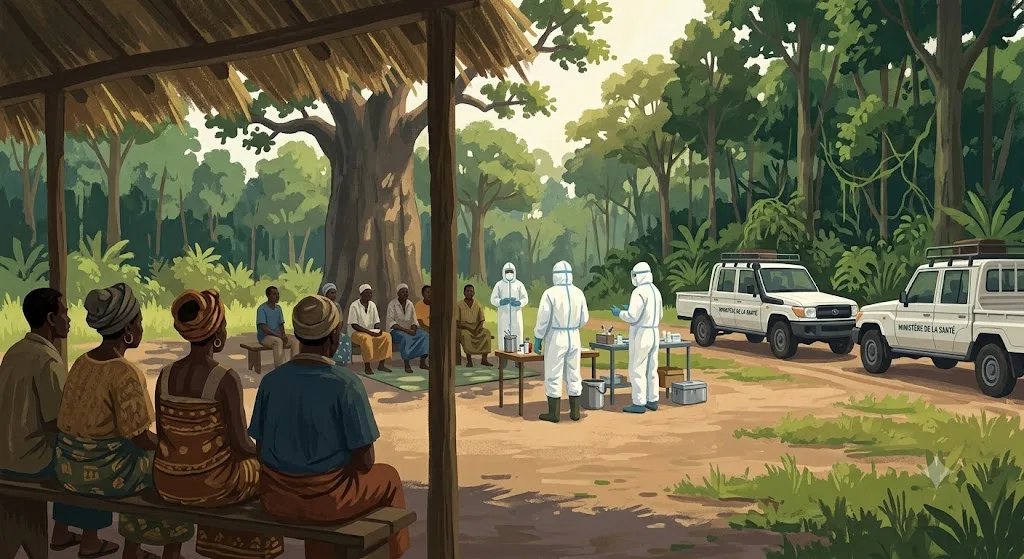
The response looked frightening. Health workers arrived in masks, gloves and protective suits, removed sick people, sprayed disinfectant and sometimes returned bodies in sealed bags. From a medical standpoint these procedures reduced transmission. From the perspective of families who could not see what happened inside treatment units, they could resemble the disappearance of relatives into an opaque system.
Funeral controls struck at a moment of grief. Ebola remains infectious after death, so washing, touching and preparing a body could spread the virus. Emergency burial protocols therefore restricted practices through which families expressed care and social belonging. When these controls were applied abruptly, some people saw them not as protection but as an assault on dignity and community authority.[World Health Organization]who.intebola response what needs to happen in 2015ebola response what needs to happen in 2015
The state was not automatically trusted. Guinea’s forest region had a history of tense relations with central government, security forces and development projects. Researchers found that resistance could not be explained by funeral tradition alone. It also reflected long-standing political and economic inequalities and uncertainty about whose interests officials and foreign organisations served.[IDS Archive]archive.ids.ac.ukIDS ArchiveUnderstanding social resistance to Ebola response in GuineaThis paper seeks to understand the fear many Guineans feel towards…
Early communication was often one-way. Instructions were delivered before local questions had been answered. Messages that simply told people to abandon familiar practices could sound accusatory, especially when the official response itself appeared inconsistent. WHO later broadened its teams to include medical anthropologists, social-mobilisation specialists and risk-communication experts because community resistance had become a major barrier to controlling the epidemic.[World Health Organization]who.intRead moreWorld Health OrganizationKey events in the WHO response to the Ebola outbreakThe reason was clear: community resistance had joined inadeq…
Rumour therefore travelled alongside the virus. Some families concealed sick relatives or resisted surveillance. Treatment centres and medical teams were attacked. In late 2014 and early 2015, Red Cross personnel in Guinea reported repeated verbal and physical assaults; one contemporary account placed the rate at roughly ten attacks a month. Such incidents endangered both responders and residents by delaying treatment, safe burial and the tracing of people who had been exposed.[PMC]pmc.ncbi.nlm.nih.govPMCHistorical Parallels, Ebola Virus Disease and CholeraPMCHistorical Parallels, Ebola Virus Disease and Cholera
Calling this merely “panic” would miss half the story. People were responding to an actual lethal threat, but incomplete information and inherited distrust altered how they identified the source of danger. For some, the greatest threat appeared to be the virus. For others, it seemed to be the people arriving in vehicles with disinfectant, body bags and government authority.
Womé: the moment rumour became lethal
The most notorious incident occurred on 16 September 2014 at Womé, a village near Nzérékoré in south-eastern Guinea. A delegation of health officials, local administrators, medical workers, journalists and a pastor entered the village to provide Ebola information and carry out disinfection. Members of the group were attacked; eight were killed, and their bodies were later recovered.[who.int]who.intOpen source on who.int.
Reports from the period indicate that some residents believed Ebola teams were bringing or spreading the disease. The attack followed earlier confrontations in the region, including unrest after disinfectant was sprayed in a marketplace and rumours circulated that the operation was intended to infect people. The victims at Womé were not distant foreign scientists: several were Guinean officials, health workers and local radio journalists attempting to communicate with the population.[Los Angeles Times]latimes.comLos Angeles Times Eight reported dead in attack on Ebola workers in GuineaLos Angeles Times Eight reported dead in attack on Ebola workers in Guinea
The killings are sometimes presented as an eruption of irrational mob violence. That description captures the horror but not the mechanism. Womé occurred where several fears had converged:
- fear of a disease that killed rapidly;
- fear of treatment centres from which many patients did not return;
- suspicion of government interventions in a politically neglected region;
- uncertainty about disinfectant, protective equipment and burial procedures;
- rumours strengthened through repetition and apparent confirmation when more people died after response teams arrived.
None of these factors excuses the murders. They explain why a false causal story—health workers are bringing the disease—could become more credible to some residents than the biomedical account. The episode demonstrates a common pattern in collective scares: when official action is poorly understood, every new intervention may be absorbed into the rumour as further “evidence” of conspiracy.
The state response introduced another layer of fear. Security forces were deployed, suspects were arrested and residents later alleged abuses and property damage during operations connected with the investigation. Human-rights organisations had already warned West African governments that coercive epidemic measures could deepen distrust and drive people away from treatment.[Human Rights Watch]hrw.orgHuman Rights Watch West Africa: Respect Rights in Ebola ResponseHuman Rights Watch West Africa: Respect Rights in Ebola Response
How trust changed the outcome
The response became more effective when communication shifted from issuing commands to negotiating practical changes with communities. Red Cross teams consulted religious leaders, families and local representatives about safer ways to mourn and bury the dead. Radio broadcasters, community figures and locally trusted messengers explained symptoms, treatment and transmission in forms that people could question and discuss.[CIDRAP]cidrap.umn.edured cross highlights attacks guinea ebola workersred cross highlights attacks guinea ebola workers
This was more than a public-relations exercise. Local radio could establish what neighbours understood to be normal and acceptable behaviour. Later research on Guinea found that access to genuinely local radio was associated with fewer Ebola infections; the study estimated that around 13 per cent of cases might have been prevented had communities receiving neighbouring stations instead had access to their own local broadcasters. The suggested mechanism was social coordination: people were more likely to change behaviour when information became shared local knowledge rather than a remote instruction.[arXiv]arxiv.orgOpen source on arxiv.org.
Vaccine trials revealed the same trust problem in another form. Some potential participants feared experimental products or distrusted the teams offering them. Successful programmes used community liaison staff, public meetings, radio discussions and social-science research to identify concerns and adjust procedures rather than dismissing every question as ignorance.[nih.gov]pmc.ncbi.nlm.nih.govPMCWillingness to get vaccinated against Ebola: A mappingPMCWillingness to get vaccinated against Ebola: A mapping
When Ebola returned to Guinea in February 2021, officials had vaccines, laboratories and experience that had not existed at the beginning of 2014. Vaccination began within days. Even so, Médecins Sans Frontières warned that limited vaccine supply and targeted eligibility had to be explained clearly; otherwise, unequal access could generate fresh misunderstanding and distrust. The lesson from 2014 was not that rumour could be permanently defeated, but that trust had to be maintained through transparency and locally credible action.[who.int]afro.who.intebola vaccination starts guinea curb new outbreakebola vaccination starts guinea curb new outbreak
The state’s conspiracy scares under Sékou Touré
Decades before Ebola, Guinea experienced a different form of contagious suspicion. President Ahmed Sékou Touré, who led the country from independence in 1958 until his death in 1984, repeatedly announced that internal enemies and foreign powers were plotting against the revolution. Some threats to his government were real: Guinea faced hostility from former colonial interests, exile organisations and, in November 1970, an armed invasion launched from Portuguese Guinea. But genuine threats were folded into a much larger political system in which alleged conspiracies could be used to remove rivals and frighten the wider population.[Human Rights Watch]hrw.orgOpen source on hrw.org.
A succession of supposed plots was associated with purges of teachers, soldiers, officials, traders, intellectuals and members of particular communities. Accused people were imprisoned, and confessions extracted under coercion were used to implicate further suspects. Amnesty International reported that thousands were detained for political reasons during the late 1960s and 1970s, with many prisoners’ fates unknown. Camp Boiro in Conakry became the best-known centre of detention, torture, starvation and execution.[Amnesty International]amnesty.orgOpen source on amnesty.org.
This was not “mass hysteria” in the clinical sense. Fear did not rise spontaneously from a crowd experiencing unexplained symptoms. It was cultivated from above through speeches, accusations, interrogations, public denunciations and a justice system subordinated to political authority. The conspiracy narrative offered a simple explanation for economic failures, dissent and internal conflict: saboteurs, traitors and foreign agents were undermining Guinea.
The process was self-reinforcing. Forced confessions produced new names; new arrests appeared to confirm the scale of the conspiracy; silence could be interpreted as concealment; and personal or ethnic connections to an accused person could themselves become suspicious. In such a system, the evidence for a plot was often generated by the machinery supposedly investigating it.
The 1976 case involving Diallo Telli, a former secretary-general of the Organisation of African Unity and then a Guinean minister, became one of the most prominent examples. He was accused in connection with an alleged conspiracy commonly described as a Fulani plot and died in detention after being denied food. The ethnic framing magnified the danger by allowing political suspicion to attach to a broader community rather than only to named individuals.[Wikipedia]WikipediaAhmed Sékou TouréAhmed Sékou Touré
The lasting result was not simply the destruction of organised opposition. It was a social climate in which association, conversation and family ties could carry risk. Human Rights Watch’s later research on Guinea described the need to confront a wider “banality of violence”: abuse had become embedded in institutions and political memory rather than confined to one exceptional moment.[Human Rights Watch]hrw.orgHuman Rights Watch“We Have Lived in Darkness”Human Rights Watch“We Have Lived in Darkness”
What the two histories have in common
The Ebola rumours and Touré-era conspiracy allegations arose from very different sources, but they share an important structure. In each case, people faced a danger that was difficult to see directly. Ebola infection passed through invisible chains of contact. Political “subversion” was portrayed as a hidden network operating beneath ordinary society. Both crises therefore depended heavily on whom people believed.
There were also crucial differences. During Ebola, many rumours moved horizontally through communities and challenged official authority. Under Touré, conspiracy narratives were largely projected downward by the state and backed by prisons, security forces and compelled confessions. One panic obstructed a medical response; the other helped sustain political repression.
Yet each demonstrates how secrecy and force can make suspicion stronger. Ebola treatment centres that appeared closed to families encouraged stories about what happened inside. Secret political trials and unexplained disappearances made it impossible to test state allegations openly. Where transparent evidence was weakest, rumour filled the gap.
The comparison also warns against treating mistrust as an individual defect. Trust is a judgement about institutions. Guineans who remembered arbitrary detention, official secrecy or neglect did not approach later emergencies with a blank slate. Researchers examining Ebola resistance have consequently argued that health interventions must account for political history rather than assuming that better biomedical information alone will settle public doubt.[ids.ac.uk]archive.ids.ac.ukIDS ArchiveUnderstanding social resistance to Ebola response in GuineaThis paper seeks to understand the fear many Guineans feel towards…
What remains uncertain or overstated
Public discussion of Guinea sometimes blurs several separate categories: established religious belief, traditional healing, witchcraft accusations, epidemic misinformation and organised cult activity. The available evidence does not support presenting these as one continuous phenomenon.
Belief in spiritual causation may influence how individuals interpret illness or misfortune, but that does not by itself constitute a witch panic. A witch panic requires evidence of spreading accusations, persecution or institutional action against alleged witches. Similarly, visiting a healer or religious leader does not establish membership of a coercive sect. Broad claims about “African superstition” often collapse highly varied societies into a stereotype and can distract from the political and medical failures that make rumours plausible.
There is also no strong basis for claiming that Guinea’s Ebola crisis was chiefly caused by burial customs. Funerals did contribute to transmission, but comparative and anthropological research shows that resistance also reflected poor communication, political inequality, distrust of government and the conduct of response organisations. Culture was part of the setting, not a complete explanation.[OUP Academic]academic.oup.comOUP AcademicSocial and cultural factors behind community resistance…by AI Carrión Martín · 2016 · Cited by 66 — During the Ebola outbr…
Finally, Womé should not be treated as representative of all Guineans or even of all communities in the forest region. Thousands of Guinean health workers, volunteers, survivors, religious figures and journalists helped contain Ebola, frequently at personal risk. Focusing only on violence creates another kind of myth: that the epidemic was a simple struggle between enlightened medicine and an irrational population. In reality, control improved through collaboration between biomedical expertise and local knowledge.
Why this history still matters
Guinea’s panic history shows that collective fear is rarely separate from institutional history. Rumours become dangerous when they supply an explanation for experiences that authorities have failed to explain convincingly. A frightening story can spread because it is dramatic, but it survives because it fits what people already believe about power.
The Touré years demonstrate how a government can turn conspiracy into a governing method, repeatedly discovering hidden enemies while preventing independent scrutiny of the evidence. The Ebola years show the reverse problem: a life-saving response can be perceived as conspiracy when it arrives through institutions that communities do not trust.
The practical lesson is not merely to “fight misinformation”. It is to reduce the conditions in which misinformation feels more credible than official truth. That means communicating uncertainty honestly, allowing questions, involving trusted local figures, making treatment and burial procedures as visible as safety permits, investigating abuses, and recognising that coercion may win immediate compliance while destroying the trust needed for the next crisis.
In Guinea, the most consequential contagious beliefs were not bizarre curiosities at society’s margins. They formed where disease, state power, memory and fear met—and where the question “Who is causing this?” became almost as important as the danger itself.
Amazon book picks
Further Reading
Books and field guides related to When Fear Became a Force in Guinea. Use these as the next step if you want deeper reading beyond the article.

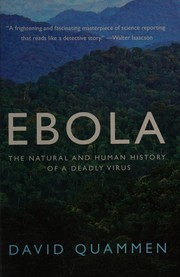
Ebola: The Natural and Human History of a Deadly Virus
Explains Ebola, outbreaks and public response.
Endnotes
1.
Source: who.int
Title: Read more
Link:https://www.who.int/news-room/spotlight/one-year-into-the-ebola-epidemic/key-events-in-the-who-response-to-the-ebola-outbreak
Source snippet
World Health OrganizationKey events in the WHO response to the Ebola outbreakThe reason was clear: community resistance had joined inadeq...
2.
Source: who.int
Link:https://www.who.int/news-room/spotlight/one-year-into-the-ebola-epidemic/factors-that-contributed-to-undetected-spread-of-the-ebola-virus-and-impeded-rapid-containment
Source snippet
World Health OrganizationFactors that contributed to undetected spreadCHAPTER 3 - In Guinea, it took nearly three months for health offic...
3.
Source: academic.oup.com
Link:https://academic.oup.com/inthealth/article/8/3/227/2458892
Source snippet
OUP AcademicSocial and cultural factors behind community resistance...by AI Carrión Martín · 2016 · Cited by 66 — During the Ebola outbr...
4.
Source: who.int
Title: guinea the ebola virus shows its tenacity
Link:https://www.who.int/news-room/spotlight/one-year-into-the-ebola-epidemic/guinea-the-ebola-virus-shows-its-tenacity
Source snippet
World Health OrganizationGuinea- The Ebola virus shows its tenacity1 Jan 2015 — Guinea has experienced three cyclical patterns of intense...
5.
Source: ukcdr.org.uk
Link:https://ukcdr.org.uk/case-study/containing-the-west-african-ebola-outbreak/
6.
Source: who.int
Title: ebola response what needs to happen in 2015
Link:https://www.who.int/news-room/spotlight/one-year-into-the-ebola-epidemic/ebola-response-what-needs-to-happen-in-2015
7.
Source: cidrap.umn.edu
Title: red cross highlights attacks guinea ebola workers
Link:https://www.cidrap.umn.edu/ebola/red-cross-highlights-attacks-guinea-ebola-workers
8.
Source: pmc.ncbi.nlm.nih.gov
Title: PMCHistorical Parallels, Ebola Virus Disease and Cholera
Link:https://pmc.ncbi.nlm.nih.gov/articles/PMC4739438/
9.
Source: who.int
Link:https://www.who.int/emergencies/disease-outbreak-news/item/2014_06_10_ebola-en
10.
Source: time.com
Link:https://time.com/3403202/guinea-ebola-mob/
11.
Source: arxiv.org
Link:https://arxiv.org/abs/2210.15946
12.
Source: pmc.ncbi.nlm.nih.gov
Title: PMCWillingness to get vaccinated against Ebola: A mapping
Link:https://pmc.ncbi.nlm.nih.gov/articles/PMC6284512/
13.
Source: link.springer.com
Link:https://link.springer.com/article/10.1186/s12889
14.
Source: afro.who.int
Title: ebola vaccination starts guinea curb new outbreak
Link:https://www.afro.who.int/news/ebola-vaccination-starts-guinea-curb-new-outbreak
15.
Source: pmc.ncbi.nlm.nih.gov
Link:https://pmc.ncbi.nlm.nih.gov/articles/PMC8224920/
16.
Source: amnesty.org
Link:https://www.amnesty.org/fr/wp-content/uploads/2021/06/afr290011977en.pdf
17.
Source: amnesty.org
Link:https://www.amnesty.org/ar/wp-content/uploads/2021/06/afr290091978en.pdf
18.
Source: Wikipedia
Title: Ahmed Sékou Touré
Link:https://en.wikipedia.org/wiki/Ahmed_S%C3%A9kou_Tour%C3%A9
19.
Source: link.springer.com
Link:https://link.springer.com/article/10.1186/s12889-024-20181-w
20.
Source: Wikipedia
Title: Witch cult hypothesis
Link:https://en.wikipedia.org/wiki/Witch-cult_hypothesis
21.
Source: Wikipedia
Title: Tanganyika laughter epidemic
Link:https://en.wikipedia.org/wiki/Tanganyika_laughter_epidemic
22.
Source: Wikipedia
Title: Peoples Temple
Link:https://en.wikipedia.org/wiki/Peoples_Temple
23.
Source: Wikipedia
Title: Camp Boiro
Link:https://en.wikipedia.org/wiki/Camp_Boiro
24.
Source: Wikipedia
Title: Witchcraft accusations against children in Africa
Link:https://en.wikipedia.org/wiki/Witchcraft_accusations_against_children_in_Africa
25.
Source: Wikipedia
Title: Western African Ebola epidemic
Link:https://en.wikipedia.org/wiki/Western_African_Ebola_epidemic
26.
Source: who.int
Link:https://www.who.int/emergencies/disease-outbreak-news/item/2014_06_18_ebola-en
27.
Source: afro.who.int
Title: afr rc65 10en0911
Link:https://www.afro.who.int/sites/default/files/sessions/documents/afr-rc65-10en0911.pdf
28.
Source: who.int
Link:https://www.who.int/emergencies/disease-outbreak-news/item/2014_07_17_ebola-en
29.
Source: who.int
Link:https://www.who.int/emergencies/disease-outbreak-news/item/2014_06_06_ebola-en
30.
Source: who.int
Link:https://www.who.int/emergencies/disease-outbreak-news/item/2014_07_03_ebola-en
31.
Source: amnesty.org
Link:https://www.amnesty.org/en/wp-content/uploads/2021/09/POL100011978ENGLISH.pdf
32.
Source: amnesty.org
Link:https://www.amnesty.org/es/wp-content/uploads/2021/06/nws210061978en.pdf
33.
Source: amnesty.org
Link:https://www.amnesty.org/en/wp-content/uploads/2021/06/nws210071978en.pdf
34.
Source: amnesty.org
Link:https://www.amnesty.org/es/wp-content/uploads/2021/09/POL100061977ENGLISH.pdf
35.
Source: archive.ids.ac.uk
Link:https://archive.ids.ac.uk/erap/evidence/1269/
Source snippet
IDS ArchiveUnderstanding social resistance to Ebola response in GuineaThis paper seeks to understand the fear many Guineans feel towards...
36.
Source: semanticscholar.org
Title: Semantic Scholar Understanding Social Resistance to the Ebola Response
Link:https://www.semanticscholar.org/paper/Understanding-Social-Resistance-to-the-Ebola-in-the-Fairhead/c20a2d271f4a80d4e640c190771940daa0cb24f1
Source snippet
Semantic ScholarUnderstanding Social Resistance to the Ebola Response...Abstract: Why did Ebola response initiatives in the Upper Guinea...
37.
Source: abc.net.au
Title: ebola workers, journalists found dead after attack in guinea
Link:https://www.abc.net.au/news/2014-09-19/ebola-workers%2C-journalists-found-dead-after-attack-in-guinea/5754654
38.
Source: latimes.com
Title: Los Angeles Times Eight reported dead in attack on Ebola workers in Guinea
Link:https://www.latimes.com/world/africa/la-fg-attack-ebola-guinea-outreach-20140918-story.html
39.
Source: hrw.org
Title: Human Rights Watch West Africa: Respect Rights in Ebola Response
Link:https://www.hrw.org/news/2014/09/15/west-africa-respect-rights-ebola-response
40.
Source: msf.org
Title: five questions 2021 ebola outbreak guinea
Link:https://www.msf.org/five-questions-2021-ebola-outbreak-guinea
41.
Source: hrw.org
Link:https://www.hrw.org/reports/2007/guinea0407/4.htm
42.
Source: hrw.org
Title: Human Rights Watch“We Have Lived in Darkness”
Link:https://www.hrw.org/reports/guinea0511webwcover_1.pdf
43.
Source: pmc.ncbi.nlm.nih.gov
Link:https://pmc.ncbi.nlm.nih.gov/articles/PMC3588562/
44.
Source: pmc.ncbi.nlm.nih.gov
Link:https://pmc.ncbi.nlm.nih.gov/articles/PMC10210265/
45.
Source: pmc.ncbi.nlm.nih.gov
Link:https://pmc.ncbi.nlm.nih.gov/articles/PMC10240637/
46.
Source: pmc.ncbi.nlm.nih.gov
Link:https://pmc.ncbi.nlm.nih.gov/articles/PMC7121864/
47.
Source: pubmed.ncbi.nlm.nih.gov
Link:https://pubmed.ncbi.nlm.nih.gov/39367378
48.
Source: pmc.ncbi.nlm.nih.gov
Link:https://pmc.ncbi.nlm.nih.gov/articles/PMC10158957/
49.
Source: pmc.ncbi.nlm.nih.gov
Link:https://pmc.ncbi.nlm.nih.gov/articles/PMC9805824/
50.
Source: pmc.ncbi.nlm.nih.gov
Link:https://pmc.ncbi.nlm.nih.gov/articles/PMC9618875/
51.
Source: ebsco.com
Link:https://www.ebsco.com/research-starters/history/ahmed-sekou-toure
52.
Source: hrw.org
Link:https://www.hrw.org/world-report/2016/country-chapters/guinea
53.
Source: ids.ac.uk
Title: a real time and anthropological response to the ebola crisis
Link:https://www.ids.ac.uk/opinions/a-real-time-and-anthropological-response-to-the-ebola-crisis/
54.
Source: youtube.com
Link:https://www.youtube.com/watch?v=pahi4AP6vC0
55.
Source: GOV.UK
Link:https://www.gov.uk/research-for-development-outputs/understanding-social-resistance-to-ebola-response-in-guinea
56.
Source: nationsencyclopedia.com
Link:https://www.nationsencyclopedia.com/Africa/Guinea-HISTORY.html
57.
Source: etdh.resolvetosavelives.org
Link:https://etdh.resolvetosavelives.org/2022/ebola/
Additional References
58.
Source: youtube.com
Link:https://www.youtube.com/watch?v=haWCqhx16ho
Source snippet
This archival report on West Africa's Ebola outbreak details how community rumors and deep-seated conspiracy theories hindered medical ou...
59.
Source: cambridge.org
Link:https://www.cambridge.org/core/journals/comparative-studies-in-society-and-history/article/guineas-political-prisoners-colonial-models-postcolonial-innovation/5CAEA02986DEF4DD6693608454E00BA1
Source snippet
Cambridge University Press & AssessmentGuinea's Political Prisoners: Colonial Models, Postcolonial...by MS MacDonald · 2012 · Cited by 1...
60.
Source: youtube.com
Link:https://www.youtube.com/watch?v=Dgturf3TPyg
Source snippet
Guinea Ebola outbreak: Government steps up efforts to combat virus...
61.
Source: youtube.com
Link:https://www.youtube.com/watch?v=S5zSAaW_uVY
Source snippet
Ebola: 8 humanitarian workers murdered by villagers – Guinea...
62.
Source: youtube.com
Title: Ebola: 8 humanitarian workers murdered by villagers – Guinea
Link:https://www.youtube.com/watch?v=sJJEFtrh6MU
Source snippet
Fake doctor treat people fearful of hospital; opposition claim no confidence in health system...
63.
Source: youtube.com
Title: Guinea Ebola outbreak: Government steps up efforts to combat virus
Link:https://www.youtube.com/watch?v=6WlI9JdrYmQ
Source snippet
When Sékou Touré Held All Americans in Guinea Hostage in 1966...
64.
Source: researchgate.net
Link:https://www.researchgate.net/publication/236695018_Witch_Craze_Beyond_the_Legends_of_Panic
65.
Source: researchgate.net
Link:https://www.researchgate.net/publication/259430222_History_is_stubborn_Talk_about_Truth_Justice_and_National_Reconciliation_in_the_Republic_of_Guinea
66.
Source: researchgate.net
Link:https://www.researchgate.net/publication/384637392_Responding_to_fluctuations_in_public_and_community_trust_and_health_seeking_behaviour_during_the_COVID-19_pandemic_a_qualitative_study_of_national_decision-makers%27_perspectives_in_Guinea_and_Sierra_Le
67.
Source: facebook.com
Link:https://www.facebook.com/IFRC/posts/a-deadly-ebola-outbreak-is-putting-lives-at-risk-in-guinea-last-month-cases-were/10159056895354280/
Topic Tree
Follow this branch
Related pages 192
- Antigua and Barbuda
- Argentina Belief Scares
- Azerbaijan Belief
- Bahrain Beliefs
- North Korea
- +187 more in sidebar