Within Saint Kitts and Nevis
When Rumours of Freedom Sparked Colonial Panic
The Nevis plot and the emancipation rumour show how hardship, resistance and planter panic could merge into powerful collective beliefs.
On this page
- The disputed Nevis plot of 1725
- The freedom rumour of 1834
- Resistance, uncertainty and planter fear
Page outline Jump by section
Introduction
Between 1725 and 1834, the most important episodes of collective fear in Saint Kitts and Nevis were not witch panics or miracle scares but rumours of slave rebellion and freedom. These episodes reveal how information travelled through plantation societies where trust was scarce, literacy was limited, and both enslaved people and planters expected deception from the other side. Rumours could spread rapidly because they filled genuine gaps in knowledge. For the enslaved, they offered hope that liberty had arrived or was close at hand. For plantation owners, they confirmed long-standing fears that hidden conspiracies threatened the colonial order.
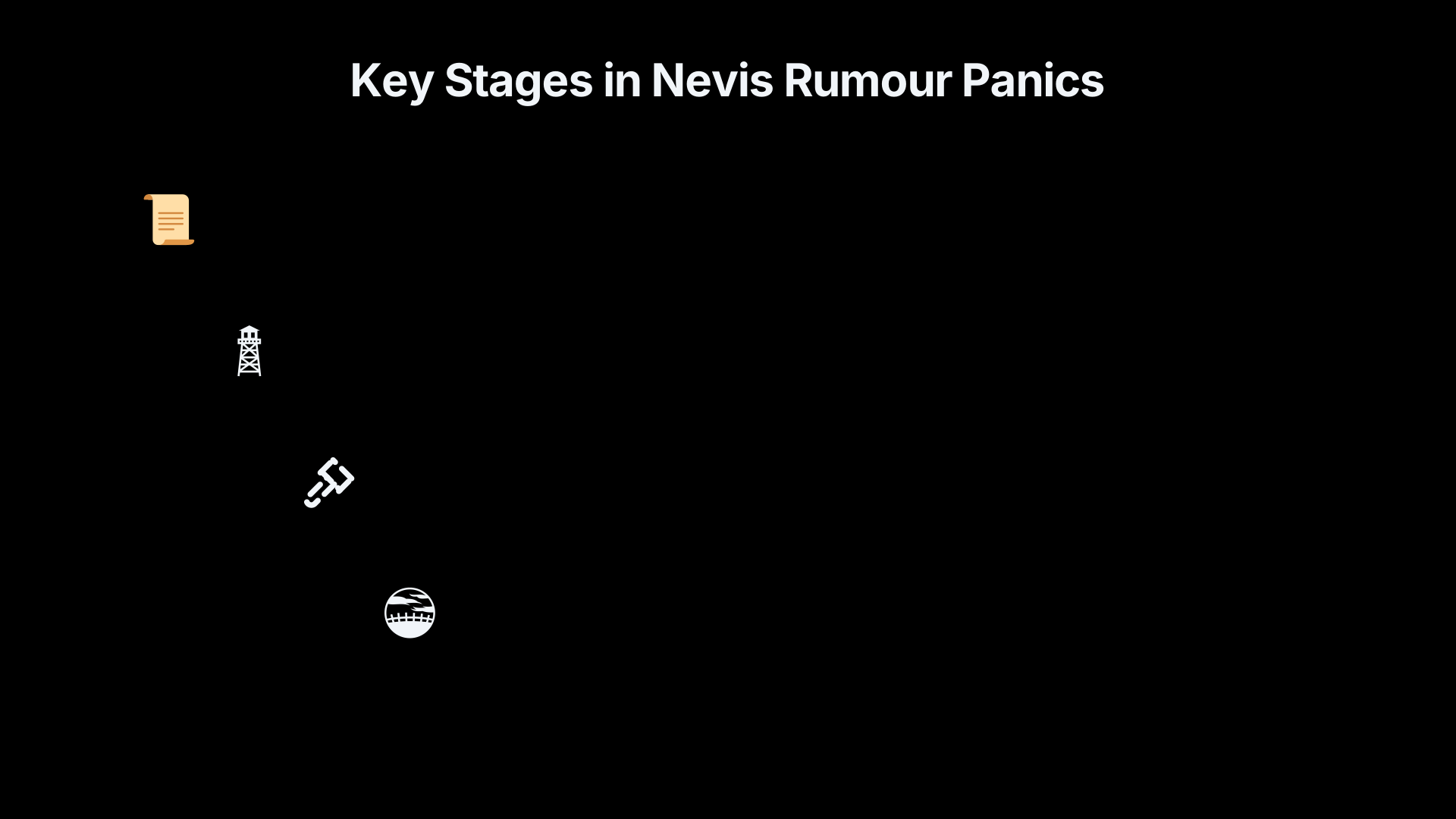
Two episodes stand out. The first is the disputed Nevis conspiracy of 1725, in which colonial authorities believed they had uncovered a planned slave uprising. The second followed the British abolition of slavery in 1834, when confusion over the new apprenticeship system produced widespread expectations of immediate freedom and corresponding fears among planters that resistance would turn into open rebellion. Together they illustrate how uncertainty itself became a powerful historical force.
The disputed Nevis plot of 1725
The reported conspiracy on Nevis in 1725 belongs to a broader pattern found throughout the eighteenth-century British Caribbean. Colonial governments repeatedly announced that they had uncovered slave plots before they could be carried out. Some conspiracies were genuine plans for resistance, while others rested on testimony obtained under pressure, hearsay or the fears of plantation owners. Historians therefore treat many such cases cautiously, recognising that colonial records often reveal elite anxieties as much as they document actual organised movements.
The surviving evidence for the alleged 1725 Nevis plot is fragmentary. Colonial officials believed that enslaved people were preparing an uprising, leading to arrests, investigations and heightened security. However, modern historians disagree about how extensive any conspiracy actually was. Unlike better-documented revolts elsewhere in the Caribbean, the Nevis case survives mainly through official reports rather than detailed accounts from participants themselves.
This uncertainty is historically significant. Plantation societies depended upon a small white population governing a much larger enslaved population. That imbalance meant even limited rumours could trigger disproportionate reactions:
- additional patrols and surveillance;
- rapid arrests based on suspicion;
- closer monitoring of meetings and religious gatherings;
- harsher discipline intended to deter any future resistance.
Whether the planned rebellion was extensive, embryonic or largely imagined, the colonial response demonstrates how readily fear translated into coercive action.
The freedom rumour of 1834
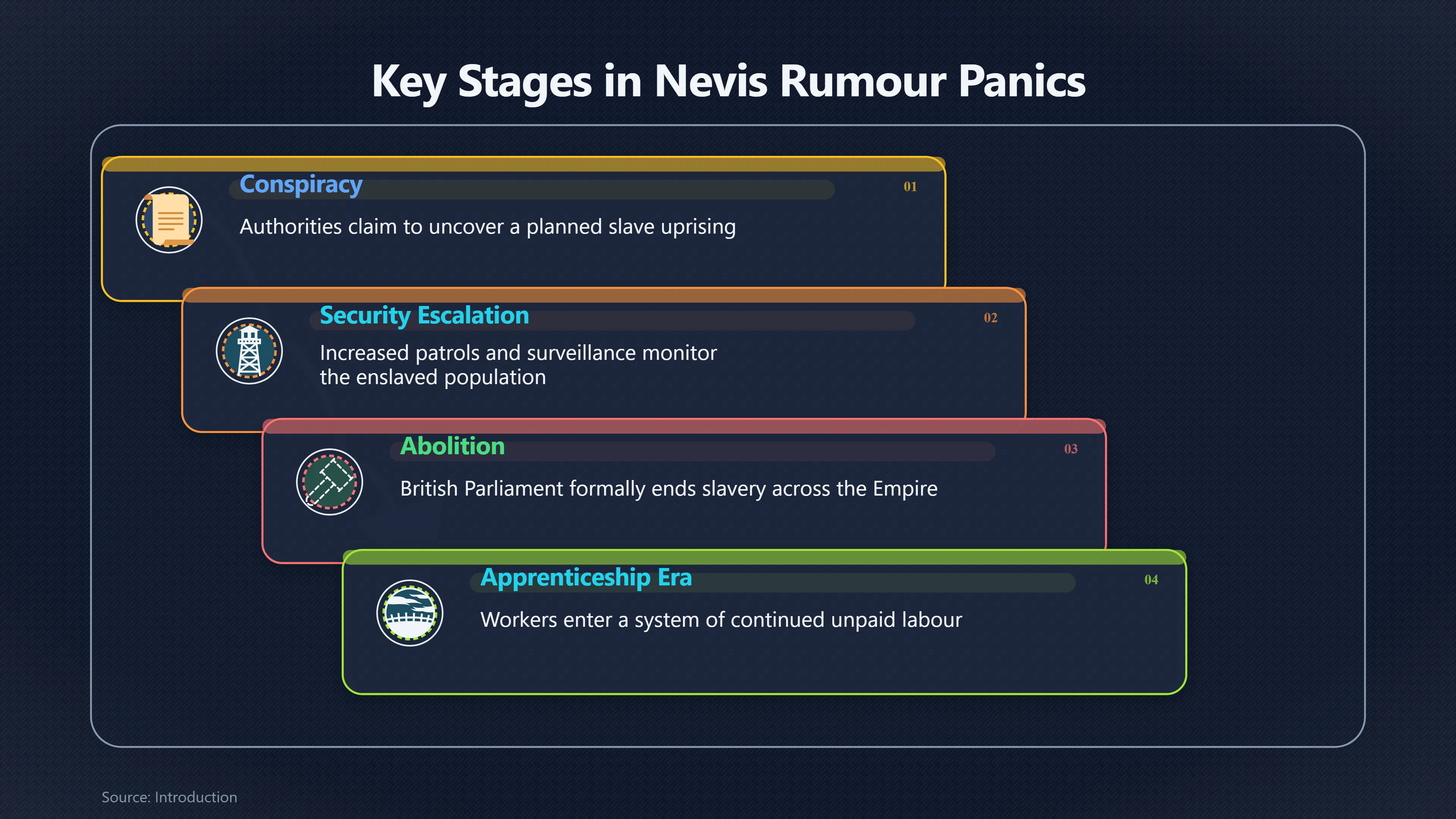
The end of slavery across the British Empire on 1 August 1834 created a different kind of rumour panic. Parliament formally abolished slavery, but most formerly enslaved people in Saint Kitts and Nevis did not receive immediate full freedom. Instead they entered the apprenticeship system, under which agricultural workers were required to continue unpaid labour for several more years while remaining under many of the old disciplinary controls.[stkittsnevisflag.com]stkittsnevisflag.comemancipation of slaves 1834 and the apprenticeship systemSt. Kitts Nevis FlagEmancipation 1834 & the Apprenticeship System — St KittsJune 7, 2026…
This legal compromise proved extremely difficult to explain and almost impossible to reconcile with popular expectations. Many enslaved people had heard that freedom had been proclaimed by Britain and believed that plantation owners were deliberately concealing or withholding it. Those suspicions were not irrational. Throughout slavery, colonial authorities had controlled access to official information, giving people ample reason to distrust planter explanations.
Rumours therefore spread that complete liberty had already been granted or was being illegally delayed. The resulting refusal by many apprentices to return to estate labour was interpreted very differently by each side. Apprentices believed they were defending rights already won; planters interpreted the same actions as the beginning of organised rebellion.[St. Kitts Nevis Flag]stkittsnevisflag.comemancipation of slaves 1834 and the apprenticeship systemSt. Kitts Nevis FlagEmancipation 1834 & the Apprenticeship System — St KittsJune 7, 2026…
Why rumours became so powerful
These episodes were not simply misunderstandings. They arose from structural conditions that made reliable information extremely difficult to obtain.
Several factors reinforced one another:
- Restricted communication. Official announcements passed through colonial administrators and plantation owners before reaching the enslaved population.
- Deep mistrust. Decades of coercion meant official reassurances carried little credibility.
- Different understandings of law. Imperial legislation drafted in London could be interpreted very differently on Caribbean plantations.
- Constant expectations of resistance. Planters expected rebellion because they understood how unpopular slavery had become, while enslaved people expected deception because they had repeatedly experienced it.
In this environment, rumours often appeared more believable than official explanations. Word-of-mouth communication through families, workplaces and neighbouring estates could spread alternative accounts far more quickly than printed proclamations.
Resistance, uncertainty and planter fear
The disturbances surrounding emancipation illustrate the close relationship between rumour and resistance. Contemporary reports describe apprentices refusing work, leaving estates and alarming colonial authorities, who feared that protests might develop into wider revolt. On St Kitts, officials even worried that dissatisfied apprentices might join communities of runaways associated with figures such as Marcus of the Woods. Punishments, imprisonment and deportation followed in response to early resistance.[historicstkitts.kn]historicstkitts.knHistoric St. KittsEmancipation - 1 August 1834…
Modern historians generally interpret these events less as irrational panic than as predictable consequences of contradictory policies. Britain announced emancipation while simultaneously preserving many features of plantation labour through apprenticeship. The gap between the promise of freedom and its practical reality generated confusion that rumours naturally filled.
For planters, every strike or work stoppage could resemble the opening stage of insurrection. For apprentices, continued compulsory labour looked like slavery under another name. Each side interpreted the other’s actions through assumptions formed by decades of conflict.

Why these episodes matter
The rumour panics of 1725 and 1834 occupy an important place in the history of Saint Kitts and Nevis because they demonstrate that collective fear did not require fabricated supernatural beliefs or mass psychological contagion. Instead, fear emerged from real political tensions, unequal access to information and profound distrust between rulers and the ruled.
They also remind historians to distinguish carefully between different kinds of evidence. Colonial archives preserve extensive documentation of official alarm but much less direct testimony from enslaved people themselves. As a result, the 1725 Nevis conspiracy remains disputed, while the rumours surrounding emancipation in 1834 are better understood because they can be linked to documented resistance against the apprenticeship system and to broader debates over Britain’s incomplete abolition of slavery.[stkittsnevisflag.com]stkittsnevisflag.comemancipation of slaves 1834 and the apprenticeship systemSt. Kitts Nevis FlagEmancipation 1834 & the Apprenticeship System — St KittsJune 7, 2026…
Endnotes
1.
Source: historicstkitts.kn
Title: Historic St. Kitts
Link:https://www.historicstkitts.kn/events/emancipation-1-august-1834
Source snippet
Emancipation - 1 August 1834...
Published: August 1834
2.
Source: historicstkitts.kn
Title: Historic St. Kitts
Link:https://www.historicstkitts.kn/st-kitts
Source snippet
St. Kitts...
3.
Source: historicstkitts.kn
Title: Historic St. Kitts
Link:https://www.historicstkitts.kn/people/ralph-b-cleghorn
4.
Source: parliament.uk
Title: The West Indian colonies and emancipation
Link:https://www.parliament.uk/about/living-heritage/evolutionofparliament/legislativescrutiny/parliament-and-empire/parliament-and-the-american-colonies-before-1765/the-west-indian-colonies-and-emancipation/
5.
Source: stkittsnevisflag.com
Title: emancipation of slaves 1834 and the apprenticeship system
Link:https://stkittsnevisflag.com/discover-stkitts-nevis/historical-overview/significant-historical-events-in-st-kitts-and-nevis/emancipation-of-slaves-1834-and-the-apprenticeship-system/
Source snippet
St. Kitts Nevis FlagEmancipation 1834 & the Apprenticeship System — St KittsJune 7, 2026...
Published: June 7, 2026
6.
Source: stkittsnevisflag.com
Title: emancipation of slaves 1834 and the apprenticeship system
Link:https://stkittsnevisflag.com/discover-stkitts-nevis/historical-overview/significant-historical-events-in-st-kitts-and-nevis/emancipation-of-slaves-1834-and-the-apprenticeship-system/?wmc-currency=GBP
Source snippet
St. Kitts Nevis FlagEmancipation of Slaves (1834) and the Apprenticeship System...
7.
Source: stkittsnevisflag.com
Title: Timeline of Key Events in St
Link:https://stkittsnevisflag.com/educational-resources/timeline-of-key-events-in-st-kitts-and-nevis/
Source snippet
Kitts and NevisJune 7, 2026 — TIMELINE OF KEY EVENTS IN ST. KITTS AND NEVIS St Kitts and Nevis, a twin-island nation in the Eastern Carib...
Published: June 7, 2026
8.
Source: stkittsnevisflag.com
Title: Each event be
Link:https://stkittsnevisflag.com/discover-stkitts-nevis/historical-overview/significant-historical-events-in-st-kitts-and-nevis/
Source snippet
Significant Historical Events in St Kitts and NevisJune 7, 2026 — SIGNIFICANT HISTORICAL EVENTS IN ST KITTS AND NEVIS From the first Indi...
Published: June 7, 2026
9.
Source: stkittsnevis.net
Title: Legacy of Slavery in Nevis: History, Culture & Change
Link:https://stkittsnevis.net/the-legacy-of-slavery-in-nevis-understanding-the-past/
Source snippet
It was harsh, tightly supervised, and shaped by constant negotiation. Field laborers wor...
10.
Source: stkittsnevisflag.com
Title: full emancipation and the end of apprenticeship 1838
Link:https://stkittsnevisflag.com/discover-stkitts-nevis/historical-overview/significant-historical-events-in-st-kitts-and-nevis/full-emancipation-and-the-end-of-apprenticeship-1838/?wmc-currency=GBP
Additional References
11.
Source: sciencedirect.com
Title: The Apprenticeship System in the Caribbean
Link:https://www.sciencedirect.com/org/science/article/pii/S1382237323001393
Source snippet
September 21, 2023 — NEW WEST INDIAN GUIDE / NIEUWE WESTINDISCHE GIDS Volume 97, Issues 3–4, 21 September 2023, Pages 229-25...
Published: September 21, 2023
12.
Source: seis.bristol.ac.uk
Title: bristol.ac.uk Other work on Nevis
Link:https://seis.bristol.ac.uk/~emceee/otherwork.html
Source snippet
work on NevisMarch 27, 2026 — > The view from Tower Hill onto St Kitts (C Eickelmann, 2016) * The Uprising of 1725: Frank's Story In Sept...
Published: March 27, 2026
13.
Source: youtube.com
Title: The Untold History of St. Kitts & Nevis: Colonial Resistance & Bermuda Ties
Link:https://www.youtube.com/watch?v=NtuXRlxT-fI
Source snippet
Uncovering the Lost Slave Village of Nevis - Caribbean Archaeology Revealed...
14.
Source: youtube.com
Title: The Apprenticeship System in the Caribbean: The World of the Apprentices
Link:https://www.youtube.com/watch?v=LIIRtN_JK2Y
Source snippet
The Untold History of St. Kitts & Nevis: Colonial Resistance & Bermuda Ties...
15.
Source: archives.history.ac.uk
Link:https://archives.history.ac.uk/history-in-focus/Slavery/articles/zacek.html
16.
Source: bvi.gov.vg
Link:https://www.bvi.gov.vg/content/our-history
17.
Source: nationalarchives.gov.uk
Title: 1833 abolition of slavery act and compensation claims
Link:https://www.nationalarchives.gov.uk/explore-the-collection/explore-by-time-period/georgians/1833-abolition-of-slavery-act-and-compensation-claims/
18.
Source: thestkittsnevisobserver.com
Title: Prime Minister Releases Emancipation Day Statement
Link:https://www.thestkittsnevisobserver.com/prime-minister-releases-emancipation-day-statement/
19.
Source: nationalarchives.gov.uk
Title: Caribbean social and cultural history
Link:https://www.nationalarchives.gov.uk/help-with-your-research/research-guides/caribbean-social-and-cultural-history/
20.
Source: youtube.com
Title: Tacky’s Revolt: The Story of an Atlantic Slave War
Link:https://www.youtube.com/watch?v=jkqeZuwGebc
Topic Tree