Within Barbados Panics
Why Did Quaker Worship Frighten Barbados?
An alleged slave conspiracy turned Quaker meetings and Christian conversion into suspected routes to rebellion.
On this page
- What colonial officials claimed happened in 1675
- Why Christian conversion appeared politically dangerous
- How the scare reshaped religious restrictions
Page outline Jump by section
Introduction
The alleged slave conspiracy uncovered in Barbados in 1675 quickly became more than a security investigation. Colonial leaders linked the supposed plot to Quaker religious meetings, arguing that allowing enslaved people to worship alongside Quakers threatened the island’s stability. This transformed an already fearful response to a possible rebellion into a broader panic about religious equality itself. Rather than seeing Christian conversion as a means of moral discipline, many slaveholders came to regard it as a source of political danger.
The episode is significant because it shows how fear could reshape colonial policy. Although historians generally accept that some form of conspiracy was investigated in 1675, they also emphasise that the surviving evidence comes almost entirely from colonial officials and slaveholders. Those sources reveal not only anxiety about revolt but also a growing belief that religious gatherings could foster resistance. That belief led directly to new legal restrictions on Quaker worship and on the religious participation of enslaved people.[tandfonline.com]tandfonline.comTaylor & Francis OnlineThe Ultimate Sin: Christianising Slaves in Barbados in the Seventeenth Century: Slavery & Abolition: Vol 31, No 1F…
What colonial officials claimed happened in 1675
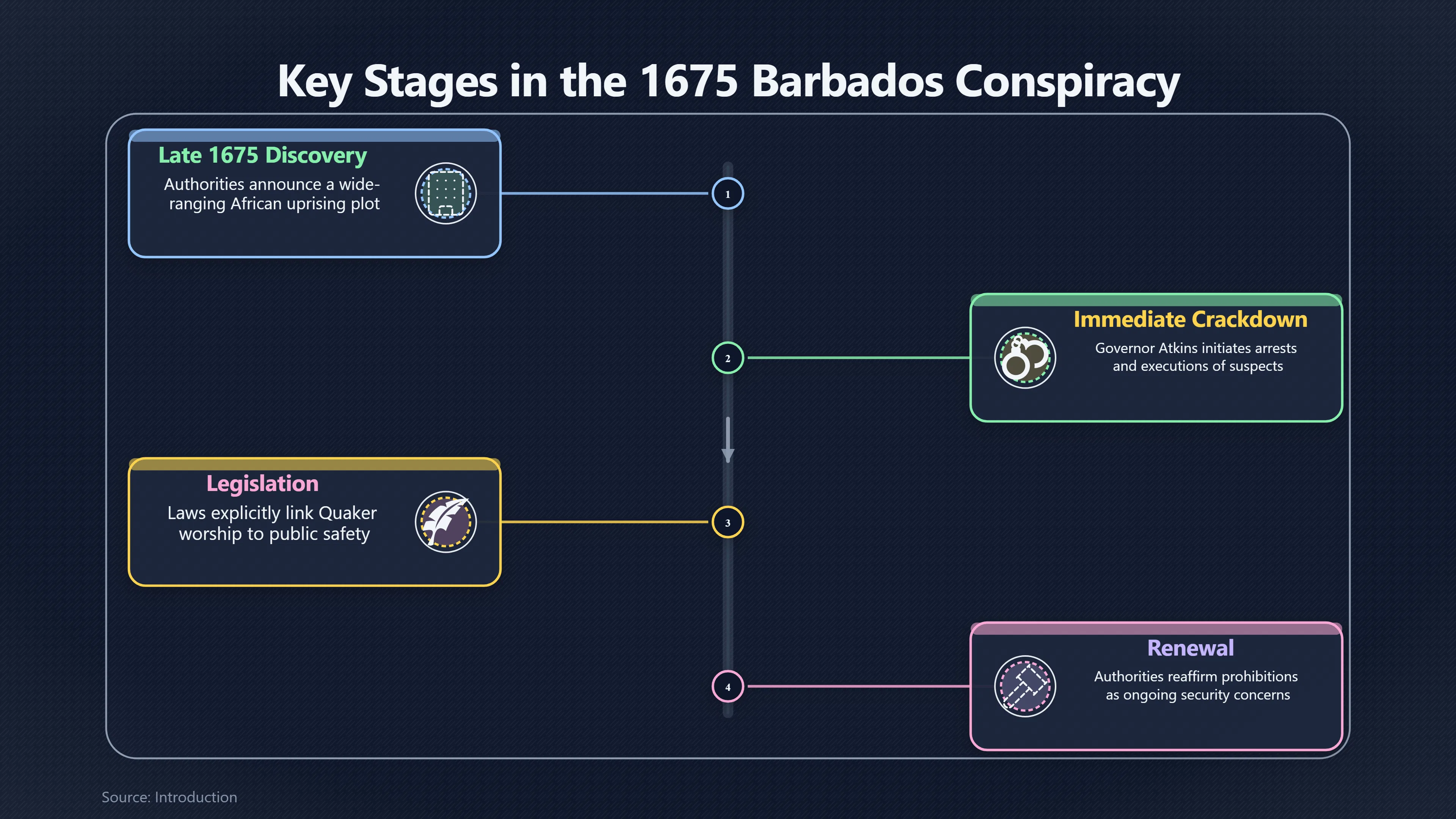
In late 1675 Barbados authorities announced that they had uncovered a wide-ranging conspiracy among enslaved Africans to overthrow the colonial government. Contemporary reports described plans to kill slaveholders and replace English rule with an African-led government. Governor Sir Jonathan Atkins responded with arrests, interrogations and executions. At least several dozen people were executed, although the precise scale of the alleged conspiracy remains difficult to establish because almost all surviving accounts were written by those suppressing it.[slaverylawpower.org]slaverylawpower.orgBarbados Slave RebellionBarbados Slave Rebellion
Modern historians distinguish between two separate questions:
- Whether resistance existed. Enslaved people undoubtedly resisted plantation slavery in many forms, and organised conspiracies did occur elsewhere in the Caribbean.
- How extensive the alleged plot actually was. The surviving evidence does not allow historians to verify every claim made by colonial officials, who had strong incentives to portray the threat as exceptionally serious.[slaverylawpower.org]slaverylawpower.orgBarbados Slave RebellionBarbados Slave Rebellion
This uncertainty is important because the rebellion scare soon expanded beyond those accused of conspiracy. Officials began to identify entirely different activities—especially Quaker religious meetings—as possible causes of political unrest.
Why Christian conversion appeared politically dangerous
The fear directed at Quakers did not arise because they openly advocated violent revolt. Instead, many plantation owners believed that Quaker religious practice undermined the social hierarchy on which slavery depended.
Unlike the established Church of England, Quakers stressed the spiritual equality of all people before God. They allowed enslaved Africans to attend meetings, encouraged religious instruction and sometimes worshipped with them in the same congregation. While most Barbadian Quakers still lived within a slaveholding society—and many owned enslaved people themselves—their willingness to recognise enslaved people as fellow Christians challenged assumptions that slavery rested upon natural or spiritual inferiority.[tandfonline.com]tandfonline.comTaylor & Francis OnlineThe Ultimate Sin: Christianising Slaves in Barbados in the Seventeenth Century: Slavery & Abolition: Vol 31, No 1F…
Historian Katharine Gerbner argues that the 1675 scare became the turning point at which slave conversion itself came to be viewed as dangerous. Before then, attitudes towards Christianising enslaved people had been mixed. Afterwards, missionary work increasingly appeared, in the minds of many colonial leaders, to threaten political order.[Taylor & Francis Online]tandfonline.comTaylor & Francis OnlineThe Ultimate Sin: Christianising Slaves in Barbados in the Seventeenth Century: Slavery & Abolition: Vol 31, No 1F…
The governor reportedly accused Quakers of teaching enslaved people Christianity so that they would eventually murder their owners. Whether or not officials genuinely believed this accusation, it demonstrates how easily religious fellowship became associated with rebellion during a period of acute insecurity.[Taylor & Francis Online]tandfonline.comTaylor & Francis OnlineThe Ultimate Sin: Christianising Slaves in Barbados in the Seventeenth Century: Slavery & Abolition: Vol 31, No 1F…
How the rebellion scare became a Quaker scare
The transition from rebellion investigation to religious panic happened remarkably quickly. Rather than limiting their response to those suspected of plotting revolt, legislators treated Quaker meetings themselves as potential centres of conspiracy.
The wording of the 1676 legislation is especially revealing. Its preamble stated that many enslaved people had been allowed to attend Quaker meetings and receive Quaker teaching, “whereby the safety of this Island may be much hazarded.” In other words, the law explicitly connected attendance at Quaker worship with threats to public safety rather than merely regulating religious practice.[slaveryandfreedomlaws.lib.unb.ca]slaveryandfreedomlaws.lib.unb.caOpen source on unb.ca.
This illustrates an important feature of colonial panic. Authorities did not claim that every Quaker was a rebel. Instead, they argued that religious mixing between enslaved and free people created conditions in which rebellion might develop. The perceived danger lay in the gathering itself.
How the scare reshaped religious restrictions
The immediate consequence was legislation aimed specifically at Quakers.
The 1676 Act:
- prohibited enslaved people from attending Quaker meetings;
- imposed severe penalties if Quakers brought enslaved people to worship;
- restricted who could preach publicly at Quaker meetings; and
- formed part of a wider tightening of colonial controls after the conspiracy scare.[slaveryandfreedomlaws.lib.unb.ca]slaveryandfreedomlaws.lib.unb.caOpen source on unb.ca.
The restrictions did not end there. A further Act in 1678 renewed the prohibition, demonstrating that lawmakers regarded the issue as an ongoing security concern rather than a temporary emergency.[slaveryandfreedomlaws.lib.unb.ca]slaveryandfreedomlaws.lib.unb.caLaws related to: Barbados | Laws of Enslavement and FreedomLaws related to: Barbados | Laws of Enslavement and Freedom
These laws reveal that colonial officials considered religious assemblies an extension of political surveillance. Worship was regulated not because of theological disagreement alone but because officials feared that gatherings could create networks of trust among enslaved people.
Was the fear justified?
Most historians reject the idea that Quaker worship itself encouraged violent rebellion.
There is no convincing evidence that Quaker meetings organised or directed the alleged 1675 conspiracy. Instead, historians argue that colonial authorities interpreted ordinary religious activity through the lens of plantation insecurity. The rebellion scare created a climate in which any institution encouraging communication across racial boundaries appeared suspicious.[Taylor & Francis Online]tandfonline.comTaylor & Francis OnlineThe Ultimate Sin: Christianising Slaves in Barbados in the Seventeenth Century: Slavery & Abolition: Vol 31, No 1F…
At the same time, the authorities’ fears were not entirely invented. Barbados was a slave society in which the enslaved population vastly outnumbered the white population. Slaveholders genuinely feared revolt because successful uprisings elsewhere—and later in Caribbean history—demonstrated that organised resistance was possible. What transformed legitimate security concerns into a broader panic was the extension of suspicion from alleged conspirators to a religious community whose principal offence was treating enslaved people as fellow worshippers.[slaverylawpower.org]slaverylawpower.orgBarbados Slave RebellionBarbados Slave Rebellion
Why the episode remains important
The 1675 rebellion scare shows how religious practice could become entangled with political fear in a plantation colony. Quaker meetings were not condemned primarily for their theology but because they blurred social boundaries that slaveholders believed essential to maintaining control.
The episode also highlights a wider pattern in Barbadian history. During moments of perceived crisis, authorities often expanded suspicion beyond identifiable acts of resistance to encompass religious belief, communal gathering and cultural practices associated with marginalised groups. Later campaigns against Obeah would follow a similar logic, treating belief systems as threats to public order rather than simply matters of religion.
For historians, the 1675 Quaker scare therefore represents more than an isolated legal dispute. It marks a moment when colonial fears about rebellion transformed Christian conversion itself into a suspected form of political subversion, leaving a lasting influence on the relationship between religion, race and law in seventeenth-century Barbados.[tandfonline.com]tandfonline.comTaylor & Francis OnlineThe Ultimate Sin: Christianising Slaves in Barbados in the Seventeenth Century: Slavery & Abolition: Vol 31, No 1F…

Amazon book picks
Further Reading
Books and field guides related to Why Did Quaker Worship Frighten Barbados?. Use these as the next step if you want deeper reading beyond the article.

Christian Slavery
Directly examines conversion, Quakers and slavery in the early Atlantic world.
Endnotes
1.
Source: slaverylawpower.org
Title: Barbados Slave Rebellion
Link:https://slaverylawpower.org/chapters/restoration-settlements/barbados-slave-rebellion/
2.
Source: slaveryandfreedomlaws.lib.unb.ca
Link:https://slaveryandfreedomlaws.lib.unb.ca/laws/barbados-1676
3.
Source: zenodo.org
Link:https://zenodo.org/records/13158972
Source snippet
Quakers in Barbados, 1655-1780 | Zenodo...
4.
Source: slaveryandfreedomlaws.lib.unb.ca
Title: Laws related to: Barbados | Laws of Enslavement and Freedom
Link:https://slaveryandfreedomlaws.lib.unb.ca/locations/caribbean/barbados?page=0
5.
Source: barbados.org
Title: Tourism Encyclopedia
Link:https://barbados.org/quaker.htm
6.
Source: slaveryandfreedomlaws.lib.unb.ca
Link:https://slaveryandfreedomlaws.lib.unb.ca/locations/caribbean
7.
Source: slaveryandfreedomlaws.lib.unb.ca
Link:https://slaveryandfreedomlaws.lib.unb.ca/laws?f%5B0%5D=facet_full_location%3A49
8.
Source: slaveryandfreedomlaws.lib.unb.ca
Title: ca An Act for the Governing of Negroes. | Laws of Enslavement and Freedom
Link:https://slaveryandfreedomlaws.lib.unb.ca/laws/barbados-1688
9.
Source: slaveryandfreedomlaws.lib.unb.ca
Link:https://slaveryandfreedomlaws.lib.unb.ca/laws/barbados-1661
10.
Source: tandfonline.com
Link:https://www.tandfonline.com/doi/abs/10.1080/01440390903481654
Source snippet
Taylor & Francis OnlineThe Ultimate Sin: Christianising Slaves in Barbados in the Seventeenth Century: Slavery & Abolition: Vol 31, No 1F...
11.
Source: doi.org
Title: 15700658 bja10080
Link:https://doi.org/10.1163/15700658-bja10080
Source snippet
Christian tradition, according to many authorities, laid down that a baptized individual could not be a slave. In the ea...
12.
Source: researchgate.net
Title: Quakers | Research Gate
Link:https://www.researchgate.net/publication/406963911_Quakers
13.
Source: tandfonline.com
Link:https://www.tandfonline.com/doi/abs/10.1080/01440390903481654?scroll=top&tab=permissions
Additional References
14.
Source: quod.lib.umich.edu
Link:https://quod.lib.umich.edu/e/eebo2/A30866.0001.001/1%3A8.150?rgn=div2&view=fulltext
Source snippet
Quod LibraryThe laws of Barbados collected in one volume by William Rawlin, of the Middle-Temple, London, Esquire, and now clerk of the A...
15.
Source: youtube.com
Title: Christian Slavery: Conversion and Race in the Protestant Atlantic World
Link:https://www.youtube.com/watch?v=cC0hE22e18c
Source snippet
206 Katharine Gerbner, Christian Slavery: Conversion and Race in the Protestant Atlantic World...
16.
Source: friendsjournal.org
Title: Did Quakers Own Slaves?
Link:https://www.friendsjournal.org/slavery-in-the-quaker-world/
Source snippet
Christian Slavery And White SupremacySeptember 1, 2019 — SLAVERY IN THE QUAKER WORLD September 1, 2019 By Katharine Gerbner CHRISTIAN SLA...
Published: September 1, 2019
17.
Source: youtube.com
Title: How Barbados became the first slave society | History
Link:https://www.youtube.com/watch?v=IpgD2ehtMmM
Source snippet
David Harewood Learns Horrifying Details of “Barbados Slave Code”...
18.
Source: youtube.com
Link:https://www.youtube.com/watch?v=Q-lQGLxuKTM
Source snippet
How Barbados became the first slave society | History - Britain's Forgotten Slave Owners...
19.
Source: youtube.com
Link:https://www.youtube.com/watch?v=siBXIPsuBAU
Source snippet
Quakers in Barbados, 1655 to 1688...
20.
Source: quakersintheworld.org
Link:https://www.quakersintheworld.org/quakers-in-action/11/Anti-Slavery
21.
Source: quakersintheworld.org.uk
Link:https://quakersintheworld.org.uk/quakers-in-action/57/Anti-Slavery-Raising-the-Moral-Issue
22.
Source: quaker.org.uk
Link:https://www.quaker.org.uk/blog/george-fox-400-expanding-the-narrative
23.
Source: jstor.org
Link:https://www.jstor.org/stable/10.5406/j.ctt7zw60d
Topic Tree