Within Uzbekistan
When Did 'Extremist' Become a Catch All Label?
Terms such as Wahhabi and extremist spread far beyond violent groups, making ordinary religious practice appear conspiratorial.
On this page
- How Wahhabi lost its precise meaning
- From real attacks to wider suspicion
- Evidence, propaganda and disputed hidden networks
Page outline Jump by section
Introduction
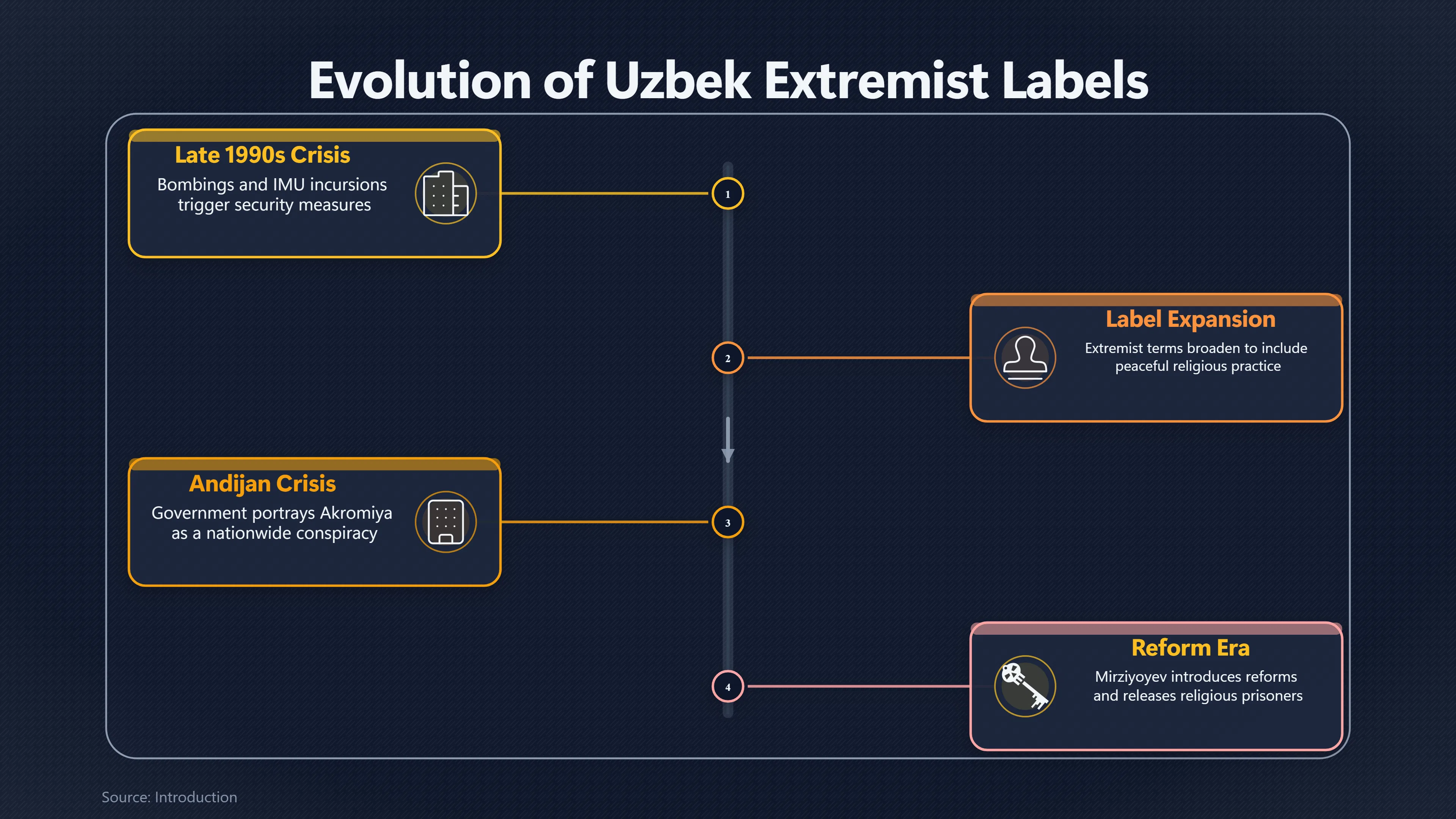
In post-independence Uzbekistan, the word extremist gradually expanded from describing people involved in or supporting violent militancy to becoming a much broader political and legal label. Genuine security threats did exist. Armed groups carried out bombings, assassinations and cross-border attacks during the late 1990s and early 2000s, giving the government legitimate reasons to strengthen counter-terrorism measures. However, human rights organisations, religious freedom monitors and later researchers argue that the state increasingly blurred the distinction between violent organisations, peaceful independent religious practice and political dissent. As a result, accusations of “extremism” or being a “Wahhabi” often became tools for controlling religious life rather than narrowly identifying people involved in violence.[Human Rights Watch]hrw.orgreligious persecution uzbekistanHuman Rights WatchCreating Enemies of the State: Religious Persecution in Uzbekistan | HRWMarch 29, 2004…
This mattered because once these labels lost their precise meaning, they could justify arrests, censorship, surveillance and long prison sentences even where evidence of violent activity was weak or absent. The controversy is therefore not whether Uzbekistan faced real militant threats—it clearly did—but whether the state’s use of extremist language became so broad that it undermined the distinction between security policy and political repression.
When did “extremist” become a catch-all label?
How “Wahhabi” lost its precise meaning
Outside Central Asia, Wahhabi normally refers to a particular reformist current within Sunni Islam associated historically with Arabia. In Uzbekistan during the Karimov era, however, the term acquired a much looser political meaning.
Human Rights Watch and the United States Commission on International Religious Freedom (USCIRF) have documented that officials applied the label to a remarkably diverse range of people, including:
- Muslims attending unofficial study circles.
- Followers of independent imams.
- People educated in Islamic institutions abroad.
- Members of banned organisations.
- Individuals accused of political opposition.
- Sometimes simply observant Muslims who prayed regularly, wore beards or headscarves, or possessed unauthorised religious literature.[Human Rights Watch]hrw.orgreligious persecution uzbekistanHuman Rights WatchCreating Enemies of the State: Religious Persecution in Uzbekistan | HRWMarch 29, 2004…
This expansion created a significant ambiguity. A word that originally described one religious tradition became an official shorthand for almost any form of unsanctioned Islamic activity. Researchers therefore caution against assuming that every person labelled a “Wahhabi” in Uzbek official documents actually belonged to that theological movement.
From real attacks to wider suspicion
The broadening of extremist terminology cannot be understood without recognising the genuine violence that preceded it.
During the late 1990s Uzbekistan experienced serious security crises, including bombings in Tashkent in 1999, incursions by the Islamic Movement of Uzbekistan (IMU), and later attacks linked to militant Islamist networks. These events convinced many officials that underground religious organisations posed an existential threat to the state.
After these attacks, however, many observers argue that suspicion spread well beyond those responsible for violence. Rather than distinguishing between armed militants and peaceful independent believers, security agencies increasingly treated unofficial religious activity itself as evidence of possible extremism. Human Rights Watch describes a pattern in which ordinary worshippers, relatives, students of independent clerics and occasional mosque attendees could all fall under investigation because of their perceived associations rather than demonstrated criminal acts.[Human Rights Watch]hrw.orgOpen source on hrw.org.
Government policy also tightened control over:[hrw.org]hrw.org“Bullets Were Falling Like Rain”: The Andijan Massacre,“Bullets Were Falling Like Rain”: The Andijan Massacre,
- private religious education;
- possession and distribution of religious books;
- informal prayer groups;
- unregistered religious meetings;
- contact with religious figures outside state-approved institutions.[USCIRF]uscirf.govreleases report religious freedom uzbekistanUSCIRF Releases Report on Religious Freedom in Uzbekistan | USCIRFSeptember 2, 2022…
In official rhetoric these measures were presented as preventing terrorism. Critics argued that they instead criminalised forms of peaceful religious expression that fell outside government supervision.
Evidence, propaganda and disputed hidden networks
One reason the period remains controversial is that evidence varied greatly between different cases.
There is little dispute that organisations such as the Islamic Movement of Uzbekistan engaged in armed violence. By contrast, the evidence surrounding many other alleged extremist networks proved much more contentious.
For example, organisations such as Hizb ut-Tahrir promoted the establishment of an Islamic political order but publicly rejected the use of violence in Uzbekistan. The government nevertheless treated membership as extremist and prosecuted thousands of alleged supporters. Human Rights Watch concluded that the authorities frequently failed to produce credible evidence connecting many defendants to violent acts, relying instead on possession of literature, religious association or alleged organisational membership.[Human Rights Watch]hrw.orgOpen source on hrw.org.
The same pattern appeared in accusations involving loosely defined underground groups whose structure, membership and operational capacity often remained difficult for outside researchers to verify independently.
Because independent journalism was heavily restricted and court proceedings lacked transparency, separating genuine clandestine organisations from exaggerated official narratives became extremely difficult. Historians therefore stress that each alleged network requires separate examination rather than assuming every government accusation reflected either complete truth or complete fabrication.
The Akromiya controversy
Few examples illustrate this problem more clearly than Akromiya.
Following the 2005 events in Andijan, the government portrayed Akromiya as a dangerous extremist organisation responsible for organising an armed uprising. Independent investigations, however, reached more cautious conclusions.
Many scholars and human rights organisations found evidence that a circle of local businessmen had been prosecuted for alleged membership in a religious movement whose structure and ideology remained poorly defined. While armed violence certainly occurred during the Andijan crisis, considerable disagreement remains over whether Akromiya existed as the coherent nationwide extremist conspiracy described by official accounts or whether the label was substantially expanded after the fact to explain wider unrest.[Human Rights Watch]hrw.orgOpen source on hrw.org.
The dispute demonstrates how difficult it became to separate:
- real armed resistance;
- local religious networks;
- economic grievances;
- political protest;
- official narratives constructed after violent events.
Why broad labels proved so powerful
Broad extremist terminology gave security agencies considerable flexibility.
Instead of proving participation in a violent conspiracy, investigators could often rely on combinations of indirect indicators, including:
- possession of banned religious literature;
- attendance at unofficial religious lessons;
- acquaintance with suspected individuals;
- travel abroad for religious education;
- participation in unregistered religious activities.[uscirf.gov]uscirf.govReport on Uzbekistan's Religious and Political Prisoners | USCIRFReport on Uzbekistan's Religious and Political Prisoners | USCIRF…
Human rights organisations argued that this encouraged guilt by association. Once a person entered an investigation as a suspected extremist, relatives, friends and fellow worshippers sometimes became subjects of scrutiny as well. The resulting atmosphere discouraged independent religious discussion and strengthened state control over Islamic institutions.
Changing policies after Karimov
Following Islam Karimov’s death in 2016, President Shavkat Mirziyoyev introduced reforms that eased some of the harshest practices.
International monitors have acknowledged improvements including:
- the release of a number of religious prisoners;
- fewer police raids on some religious communities;
- modest legal reforms;
- greater openness to international engagement on religious freedom.[USCIRF]uscirf.govreleases report religious freedom uzbekistanUSCIRF Releases Report on Religious Freedom in Uzbekistan | USCIRFSeptember 2, 2022…
At the same time, organisations such as USCIRF argue that important elements of the earlier legal framework remain in place. Authorities continue to regulate religious education, restrict certain religious literature and prosecute some forms of religious activity under laws concerning extremism. Recent assessments therefore describe continuity as well as reform, suggesting that while the language of repression has softened, broad official authority over religious life has not disappeared.[USCIRF]uscirf.govReligious Freedom Conditions in Uzbekistan | USCIRFMay 4, 2026…
Why the language still matters
The history of extremist labels in Uzbekistan illustrates a wider problem found in many countries confronting terrorism. Security agencies require legal tools to respond to genuine violent threats, but those tools become controversial when definitions expand beyond people who advocate or commit violence.
In Uzbekistan, the words “Wahhabi” and “extremist” gradually evolved from relatively specific descriptions into flexible administrative categories that could encompass peaceful religious practice, unofficial education and political suspicion alongside genuine militancy. Historians and human rights researchers therefore argue that understanding this period requires holding two realities together: Uzbekistan did face authentic extremist violence, yet the state’s response frequently extended suspicion far beyond those directly involved, making the language of counter-terrorism an important instrument of political and religious control.[hrw.org]hrw.orgOpen source on hrw.org.
Amazon book picks
Further Reading
Books and field guides related to When Did 'Extremist' Become a Catch-All Label?. Use these as the next step if you want deeper reading beyond the article.
Political order and political decay
Examines institutions, state power and governance.

JIHAD: THE TRAIL OF POLITICAL ISLAM
Helps readers distinguish Islamist movements from political labeling.
Endnotes
1.
Source: uscirf.gov
Title: Report on Uzbekistan’s Religious and Political Prisoners | USCIRF
Link:https://www.uscirf.gov/publication/report-uzbekistans-religious-and-political-prisoners
Source snippet
Report on Uzbekistan's Religious and Political Prisoners | USCIRF...
2.
Source: uscirf.gov
Title: releases report religious freedom uzbekistan
Link:https://www.uscirf.gov/release-statements/uscirf-releases-report-religious-freedom-uzbekistan
Source snippet
USCIRF Releases Report on Religious Freedom in Uzbekistan | USCIRFSeptember 2, 2022...
Published: September 2, 2022
3.
Source: uscirf.gov
Title: Uzbekistan Country Update | USCIRF
Link:https://www.uscirf.gov/resources/uzbekistan-country-update
Source snippet
Uzbekistan Country Update | USCIRF...
4.
Source: uscirf.gov
Link:https://www.uscirf.gov/countries/uzbekistan
Source snippet
Religious Freedom Conditions in Uzbekistan | USCIRFMay 4, 2026...
Published: May 4, 2026
5.
Source: uscirf.gov
Link:https://www.uscirf.gov/news-room/releases-statements/uscirf-releases-report-highlighting-uzbekistans-religious-and
6.
Source: 2009-2017.state.gov
Link:https://2009-2017.state.gov/j/drl/rls/irf/2003/24443.htm
7.
Source: hrw.org
Title: religious persecution uzbekistan
Link:https://www.hrw.org/report/2004/03/29/creating-enemies-state/religious-persecution-uzbekistan
Source snippet
Human Rights WatchCreating Enemies of the State: Religious Persecution in Uzbekistan | HRWMarch 29, 2004...
Published: March 29, 2004
8.
Source: hrw.org
Link:https://www.hrw.org/report/2014/09/25/until-very-end/politically-motivated-imprisonment-uzbekistan
9.
Source: refworld.org
Link:https://www.refworld.org/reference/annualreport/uscirf/2012/85521
Source snippet
USCIRF Annual Report 2012 - Countries of Particular Concern: Uzbekistan | Refworld...
10.
Source: hrw.org
Title: Uzbekistan: Authoritarian President Karimov Reported Dead | Human Rights Watch
Link:https://www.hrw.org/news/2016/09/02/uzbekistan-authoritarian-president-karimov-reported-dead
11.
Source: refworld.org
Link:https://www.refworld.org/reference/annualreport/uscirf/2013/93764
12.
Source: hrw.org
Title: uzbekistan rewrites story andijan massacre
Link:https://www.hrw.org/report/2005/09/18/burying-truth/uzbekistan-rewrites-story-andijan-massacre
13.
Source: hrw.org
Title: “Bullets Were Falling Like Rain”: The Andijan Massacre,
Link:https://www.hrw.org/report/2005/06/06/bullets-were-falling-rain/andijan-massacre-may
14.
Source: hrw.org
Title: Background on the Campaign of Religious Persecution
Link:https://www.hrw.org/legacy/backgrounder/eca/uzbek-aug/persecution.htm
15.
Source: hrw.org
Link:https://www.hrw.org/world-report/2025/country-chapters/uzbekistan
16.
Source: hrw.org
Link:https://www.hrw.org/reports/2004/uzbekistan0304/4.htm
17.
Source: hrw.org
Link:https://www.hrw.org/reports/2004/uzbekistan0304/2.htm
Additional References
18.
Source: youtube.com
Title: Uzbek leader Karimov says Andijan uprising was planned abroad
Link:https://www.youtube.com/watch?v=QUYy1QTFzW0
Source snippet
President Karimov visits, protests, HRW comment...
19.
Source: ecoi.net
Link:https://www.ecoi.net/en/document/2136279.html
Source snippet
HRW – Human Rights Watch (Author): “World Report 2026; Uzbekistan”, Document #2136279 - ecoi.netFebruary 4, 2026 — Document #2136279 HRW...
Published: February 4, 2026
20.
Source: youtube.com
Title: The Terrible Aftermath of the Andijan Massacre
Link:https://www.youtube.com/watch?v=thdWPvxMyyk
Source snippet
Uzbek leader Karimov says Andijan uprising was planned abroad...
21.
Source: youtube.com
Link:https://www.youtube.com/watch?v=Z0NRpPLqKOA
Source snippet
The Terrible Aftermath of the Andijan Massacre...
22.
Source: intl-crisis-group.org
Link:https://www.intl-crisis-group.org/projects/showreport_reportid_245.html
23.
Source: youtube.com
Title: President Karimov visits, protests, HRW comment
Link:https://www.youtube.com/watch?v=lEjMDYeELq4
Source snippet
Uzbekistan: Decade of Impunity for Massacre...
24.
Source: youtube.com
Title: Uzbekistan: Decade of Impunity for Massacre
Link:https://www.youtube.com/watch?v=h1RNLAYEkQI
Source snippet
Uzbekistan: Victim Of Terrorism Or Oppression?...
25.
Source: refworld.org
Link:https://www.refworld.org/reference/annualreport/uscirf/2010/en/14599
Source snippet
USCIRF Annual Report 2010 - Countries of Particular Concern: Uzbekistan | Refworld...
26.
Source: refworld.org
Link:https://www.refworld.org/reference/annualreport/uscirf/2014/en/99073
Source snippet
USCIRF Annual Report 2014 - Countries of Particular Concern: Uzbekistan | Refworld...
27.
Source: intl-crisis-group.org
Title: Crisisweb: the International Crisis Group’s on-line system
Link:https://www.intl-crisis-group.org/projects/showreport_reportid_538.html
Topic Tree