When Fear and Prophecy Gripped Finland
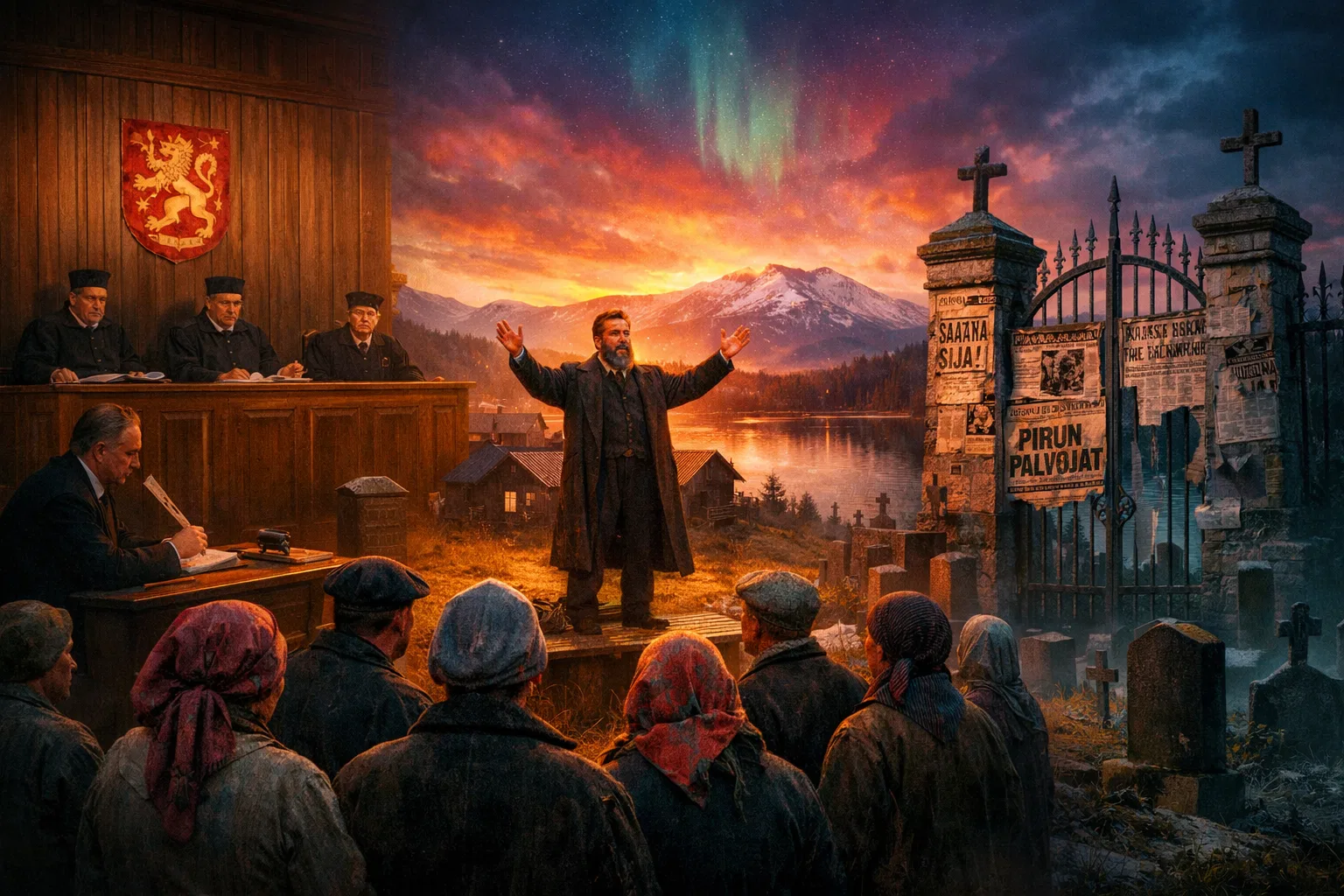
Finland’s history of collective fear is not a single procession of irrational crowds. It includes genuine persecution, small apocalyptic communities, criminal acts interpreted through frightening cultural stories, and later retellings that have blurred the line between evidence and legend.
Page outline Jump by section
Introduction
These episodes spread for different reasons. Witchcraft accusations grew from everyday disputes before imported demonology and child testimony helped create a concentrated hunt. Interwar prophets gained authority amid war trauma, poverty and religious upheaval. The Satanism scare attached an organised occult threat to real vandalism without establishing that a coherent Satanist campaign existed. Finland therefore offers a useful lesson: strange beliefs matter, but so do courts, newspapers, churches and police forces that decide which claims become public crises.[tuni.fi]webpages.tuni.fiWitchcraft - Finnish Witch Trials in SynopsisThe colourful stories regarding Finnish witches were well based: The amount of people accuse…
When witchcraft accusations became persecution
Witchcraft prosecutions in Finland took place while the country belonged to the Swedish kingdom and was governed under Swedish law. Surviving records are incomplete, so apparently precise national totals should be treated cautiously. A long-running research resource at Tampere University has identified at least 2,000 people accused of witchcraft or magic between 1520 and 1750, while narrower counts based on particular surviving judicial records produce lower figures. The important point is that accusations were common, but executions were much less typical than the word “witch hunt” may suggest. Many defendants were fined or otherwise punished rather than put to death.[tuni.fi]webpages.tuni.fiWitchcraft - Finnish Witch Trials in SynopsisThe colourful stories regarding Finnish witches were well based: The amount of people accuse…
The ordinary Finnish case often began with a practical grievance. A neighbour believed that livestock had sickened, food had spoiled or illness had been caused through harmful magic. Accused people could be known healers or specialists in charms whom the same community might consult in one circumstance and blame in another. This helps explain an unusual feature of the Finnish record: men formed a far larger proportion of defendants than in many better-known western European witch persecutions. Magic was not imagined solely as a female activity, and male healers and diviners could possess reputations that made them both useful and vulnerable.[tuni.fi]webpages.tuni.fiWitchcraft - Finnish Witch Trials in SynopsisThe colourful stories regarding Finnish witches were well based: The amount of people accuse…
For much of the period, such cases were quarrels processed by local courts rather than evidence of a nationwide panic. Recent research at Tampere University is examining not only how accusations escalated but how judges, clergy, neighbours and other participants prevented rumours from becoming large persecutions. That emphasis matters: Finland experienced witch trials, yet most communities did not continuously descend into hunts. Scepticism, evidential requirements, appeals and reluctance to impose death sentences could interrupt the cycle.[Tampereen yliopisto ja TAMK]tuni.fiTampereen yliopisto ja TAMKHow did Finland manage to avoid witch hunts?Action and…How did Finland manage to avoid witch hunts? Action and experience in de… witchcraft into trials and trials into hunts a…
The dangerous exception came during the 1660s and 1670s, especially in Åland and Ostrobothnia. Here the accusations began to resemble the great Swedish panic of the same period. Stories of pacts with the Devil, witches’ gatherings and supernatural journeys became more prominent, while children appeared as witnesses claiming that adults had carried them to forbidden assemblies. These narratives differed from Finland’s more usual accusations about harmful magic. They allowed one child’s story to name several adults, whose interrogations could generate still more names.[Wikipedia]WikipediaWitch trials in FinlandWitch trials in Finland
This was a contagious legal and narrative process rather than a disease spreading through the population. Judges and clergy supplied demonological ideas; witnesses adapted stories already circulating across the Swedish realm; and courts converted allegations into formal danger. Women became more prominent among those condemned during this exceptional wave, even though the wider Finnish pattern included many male defendants. Once higher courts became more doubtful of confession, spectral claims and child testimony, death sentences rapidly declined. The change shows that witch panics were not sustained by popular belief alone: they depended on institutions willing to validate the stories.[researchgate.net]researchgate.netResearch Gate(PDF) Discerning Voices and Values in the Finnish WitchResearch Gate(PDF) Discerning Voices and Values in the Finnish Witch
Prophets after war and revolution
Finland’s most striking modern religious movements appeared during a period of exceptional disruption. Independence in 1917 was followed by civil war in 1918, political violence, displacement and economic insecurity. Historian Leena Malkki identifies the 1920s and 1930s as a high point for Finnish millenarianism: belief that the existing world would soon be transformed through divine intervention. The groups were usually small and local, but the recently established security police watched religious activity that appeared capable of disturbing public order.[Helsinki Blogs]blogs.helsinki.fiHelsinki Blogs141tpv09.qxd…
This did not mean that revivalist Christianity itself was treated as inherently dangerous. Finland had a strong Lutheran “folk church”, and several revival traditions that had once challenged clerical authority eventually remained within it. The state’s attention fell mainly on movements that combined prophecy with separatism, hostility to officials, coercive discipline or alleged crime. The category “cult” can therefore obscure important differences between unconventional belief, communal control and prosecutable conduct.[Helsinki Blogs]blogs.helsinki.fiHelsinki Blogs141tpv09.qxd…
Maria Åkerblom and the authority of trance
Maria Åkerblom began preaching in 1917 and became known for delivering sermons while apparently asleep or in a trance. Followers believed that she received direct revelations from God and had been chosen to gather people before Christ’s approaching return. Her youth, dramatic performances and the instability of the period helped draw large audiences, particularly in Swedish-speaking Ostrobothnia. Academic research places the movement within a wider northern European tradition of prophetic and trance preaching rather than treating it as an inexplicable eruption of madness.[journal.fi]journal.fiOpen source on journal.fi.
The movement’s history cannot be reduced to hostile rumour. Suspicion among clergy and local residents did contribute to confrontation, but there were also riots, criminal proceedings and escalating efforts by the leadership to protect itself. About 200 adherents sold their property and left western Finland, reportedly with Palestine presented as an eventual destination, although the journey stopped in Helsinki. The crisis culminated in an unsuccessful attempt against a local governor and long prison sentences for leaders in 1927.[Helsinki Blogs]blogs.helsinki.fiHelsinki Blogs141tpv09.qxd…
Åkerblom’s reputation has subsequently been shaped by court records, family memories, journalism and fiction. Some descendants and local historians have challenged the most lurid inherited stories, arguing that opponents’ rumours became fused with documented wrongdoing. That does not erase violence or manipulation; it warns against treating every allegation attached to a notorious minority as equally proven. The movement remains culturally important because it concentrates several anxieties of the new republic: charismatic female authority, religious ecstasy, loyalty to family and church, and fear that private faith might become an alternative system of law.[yle.fi]yle.fiOpen source on yle.fi.
The Korpela movement across the northern border
The Korpela movement belongs partly to Finnish history and partly to Swedish history. Its founder, Toivo Korpela, was a Finnish preacher who attracted followers in the Finnish-speaking Tornio Valley, but the movement’s most notorious phase unfolded mainly in northern Sweden after he withdrew. Later leaders taught that the end of the world was near and that an ark would carry 666 believers to Palestine. When the predicted events failed, the teaching changed: the ark was reinterpreted as spiritual rather than physical.[Helsinki Blogs]blogs.helsinki.fiHelsinki Blogs141tpv09.qxd…
The group later became associated with heavy drinking, sexual licence and criminal trials. Sixty adherents received sentences in Sweden, while leading figures were imprisoned or confined in psychiatric institutions. Yet the scandalous version of the story also travelled through hostile religious communities, newspapers and later folklore. Scholars and modern dramatists have therefore had to distinguish documented court cases from claims about ritual behaviour that may have been embellished.[wikipedia.org]WikipediaKorpela movementKorpela movement
Geography is central to understanding the episode. The Tornio Valley was divided by a national border but joined by language, kinship and Laestadian religious culture. The movement was not simply a foreign “cult” entering Finland or Sweden. It emerged from a shared northern environment in which a rejected preacher, disputed biblical interpretation and local grievances could circulate between communities more easily than official national categories suggest.
How cemetery vandalism became a Satanism scare
Finland’s Satanism scare peaked much later than the best-known American panic over alleged ritual abuse. Religious Satanism became publicly visible in Finland in the early 1990s, but the national scare focused mainly on cemetery vandalism. Between 1997 and 2001, hundreds of gravestones were toppled around the country. The damage was real, distressing and criminal. What remained uncertain was the claim that it represented an organised Satanist movement threatening Finnish society.[brill.com]brill.comOpen source on brill.com.
News coverage connected overturned stones, heavy music, occult imagery and troubled youth. “Satanism” supplied a ready-made explanation that made otherwise disconnected acts appear coordinated. Researcher Titus Hjelm has described the interaction between the vandalism itself and the public ethos constructed around it: once the acts were interpreted as Satanic, similar incidents gained greater news value and could reinforce the original interpretation. When reporters stopped treating cemetery damage as evidence of Satanism, much of the wider media interest faded.[Helsinki Blogs]blogs.helsinki.fipublications 2publications 2
This does not mean that every accused young person was innocent of vandalism or that nobody in Finland identified with Satanism. It means the evidence supported individual offences and loose subcultural borrowing more clearly than it supported a disciplined occult organisation directing a national campaign. The broad label merged several populations: philosophical or religious Satanists, adolescent provocateurs, metal fans, vandals and young people described by anxious adults as being “drawn into” evil.[brill.com]brill.comOpen source on brill.com.
The Finnish episode differed from neighbouring scares. Norwegian reporting was shaped by church burnings and murder; Swedish fears drew on several themes, including ritual abuse and cemetery attacks; American panic centred heavily on claims that secret networks were abusing children. Finland’s gravestone narrative was comparatively narrow, but it drew strength from the same mechanism: genuine crimes were placed inside a far larger story about a concealed, coordinated enemy.[researchgate.net]researchgate.netResearchGate(PDF) Nordic Satanism and Satanism Scares: The Dark…18 Feb 2026 — Finnish Satanism scare centred on cemetery vandalism (Hj…
The harm was not only material damage to graves and distress to families. Loose use of the Satanist label could stigmatise harmless religious minorities, music fans and vulnerable adolescents while distracting attention from the ordinary causes of vandalism. At the same time, concern for children and young people was not invented from nothing. Professionals encountered substance misuse, violence and family crises. The analytical mistake was to assume that occult symbols automatically explained those problems.
Why Finland did not produce a millennium panic
The approach of the year 2000 generated dramatic predictions in many countries, ranging from computer collapse to religious violence. Finland saw concern about the millennium computer bug and general uncertainty, but research found little sign of a major apocalyptic mobilisation. Millenarian belief remained marginal, and Finnish security officials found no religious group resembling the violent movements highlighted in international threat assessments.[Helsinki Blogs]blogs.helsinki.fiHelsinki Blogs141tpv09.qxd…
Malkki proposed several reasons for this restraint. Mainstream Finnish Lutheranism did not strongly encourage end-times speculation, while religious revival movements had often been absorbed into the established church rather than pushed into permanent opposition. Public confidence in the state and welfare institutions also made anti-government apocalypse narratives less attractive than in societies where such institutions were widely regarded as illegitimate. These are explanations rather than timeless national traits: trust can change, and online conspiracy networks now cross borders more rapidly than the local prophetic movements of the 1920s.[Helsinki Blogs]blogs.helsinki.fiHelsinki Blogs141tpv09.qxd…
The quiet millennium is an important counterexample. Studies of panic can become biased towards dramatic outbreaks and overlook the occasions when alarming predictions fail to spread. Finland’s history includes actors who de-escalated witch accusations, churches that incorporated dissenting revival movements, courts that demanded firmer evidence and a public that did not turn the year 2000 into an apocalyptic crisis.

What these cases reveal
Finland’s episodes do not support a simple national story about unusual credulity. They show recurring interactions between uncertainty, compelling narratives and institutional power.
A rumour becomes dangerous when an authority adopts it. Neighbourly accusations of magic became lethal when courts accepted demonological stories and unreliable testimony. Cemetery vandalism became evidence of a national occult menace when media narratives repeatedly supplied that interpretation.
Real harm and exaggerated explanation can coexist. Gravestones were genuinely destroyed. Members of prophetic movements were involved in documented offences. Children and families could face real distress. None of this proves every claim about secret rituals, coordinated networks or supernatural powers.
Failed prophecy does not always end belief immediately. The Korpela ark was reinterpreted when it did not arrive, while the Åkerblom movement persisted despite prosecutions and its leader’s imprisonment. Groups can preserve commitment by revising predictions, blaming opponents or treating disappointment as a test of faith.[Helsinki Blogs]blogs.helsinki.fiHelsinki Blogs141tpv09.qxd…
“Cult” is a judgement, not a neutral diagnosis. It may identify genuine coercion in ordinary speech, but it can also collapse theology, eccentricity, crime and social unpopularity into one hostile word. “Prophetic movement”, “apocalyptic group”, “new religious movement” or the group’s own name usually gives readers a clearer starting point. Specific evidence of control, exploitation or violence should then be described directly.
Finland’s most valuable historical lesson is therefore methodological. Ask first what can be documented: who made the allegation, how it travelled, which institution endorsed it, what independent evidence existed and who suffered from the response. That approach neither dismisses unusual beliefs nor accepts frightening claims at face value. It reveals how collective fears are constructed—and how they can sometimes be stopped before suspicion becomes persecution.
Amazon book picks
Further Reading
Books and field guides related to When Fear and Prophecy Gripped Finland. Use these as the next step if you want deeper reading beyond the article.
Extraordinary Popular Delusions and the Madness of Crowds
Rating: 4.0/5 from 5 Google Books ratings
Broad historical perspective on collective belief and social panics.
The witch-hunt in early modern Europe
Provides essential context for Finland's witch trials within wider Europe.
Europe's inner demons
Explains intellectual roots behind later witch persecutions and panic.

Witchcraft in Europe,
Primary documents illuminate the legal and cultural background discussed.
Endnotes
1.
Source: webpages.tuni.fi
Link:https://webpages.tuni.fi/sochistoria/noitanetti/witchtrials.html
Source snippet
Witchcraft - Finnish Witch Trials in SynopsisThe colourful stories regarding Finnish witches were well based: The amount of people accuse...
2.
Source: tuni.fi
Title: Tampereen yliopisto ja TAMKHow did Finland manage to avoid witch hunts?
Link:https://www.tuni.fi/en/tau/research/how-did-finland-manage-avoid-witch-hunts-action-and-experience-de-escalating
Source snippet
Action and...How did Finland manage to avoid witch hunts? Action and experience in de... witchcraft into trials and trials into hunts a...
3.
Source: blogs.helsinki.fi
Link:https://blogs.helsinki.fi/leenamalkki/files/2012/07/Malkki-2002.pdf
Source snippet
Helsinki Blogs141tpv09.qxd...
4.
Source: researchgate.net
Link:https://www.researchgate.net/publication/240708991_Nordic_Satanism_and_Satanism_Scares_The_Dark_Side_of_the_Secular_Welfare_State
Source snippet
ResearchGate(PDF) Nordic Satanism and Satanism Scares: The Dark...18 Feb 2026 — Finnish Satanism scare centred on cemetery vandalism (Hj...
5.
Source: cambridge.org
Title: University Press & Assessment Raisa Maria Toivo
Link:https://www.cambridge.org/core/services/aop-cambridge-core/content/view/C65CE82C560D7845AE0A77FADF5A870A/S0034433800035491a.pdf/raisa_maria_toivo_witchcraft_and_gender_in_early_modern_society_finland_and_the_wider_european_experience_women_and_gender_in_the_early_modern_world_aldershot_ashgate_publishing_company_2008_x231_pp_index_append_illus_tbls_map_bibl_9999_isbn_9780754664543.pdf
Source snippet
Witchcraft and Gender in Early Modern...by GK Waite · 2009 — In Finland, witch trials were no cynical maneuver of elites seeking to shap...
6.
Source: tuni.fi
Title: Tampereen yliopisto ja TAMKHow did Finland manage to avoid witch hunts?
Link:https://www.tuni.fi/en/research/how-did-finland-manage-avoid-witch-hunts-action-and-experience-de-escalating-persecution
Source snippet
Action and...How did Finland manage to avoid witch hunts? Action and experience in de... witchcraft trials, historical experience and e...
7.
Source: Wikipedia
Title: Witch trials in Finland
Link:https://en.wikipedia.org/wiki/Witch_trials_in_Finland
8.
Source: researchgate.net
Title: Research Gate(PDF) Discerning Voices and Values in the Finnish Witch
Link:https://www.researchgate.net/publication/263677265_Discerning_Voices_and_Values_in_the_Finnish_Witch_Trials_Records
9.
Source: journal.fi
Link:https://journal.fi/scripta/article/view/67087
10.
Source: blf.fi
Link:https://www.blf.fi/artikel.php?id=5684
11.
Source: yle.fi
Link:https://yle.fi/a/7-1381558
12.
Source: sls.fi
Title: Sektledaren Maria Åkerblom fortsätter att fascinera
Link:https://www.sls.fi/sv/blogg/sektledaren-maria-akerblom-fortsatter-att-fascinera/
13.
Source: Wikipedia
Title: Maria Åkerblom
Link:https://en.wikipedia.org/wiki/Maria_%C3%85kerblom
14.
Source: Wikipedia
Title: Korpela movement
Link:https://en.wikipedia.org/wiki/Korpela_movement
15.
Source: bfi.org.uk
Title: raptures swedish historical drama about apocalyptic cult hindered tame execution
Link:https://www.bfi.org.uk/sight-and-sound/reviews/raptures-swedish-historical-drama-about-apocalyptic-cult-hindered-tame-execution
16.
Source: brill.com
Link:https://brill.com/downloadpdf/book/9789004325968/B9789004325968_061.pdf?srsltid=AfmBOoqV8kBAP5sJz_G0v43Jff4NG_ziUfDZi_hpOh3PDY76kddvK-ZB
17.
Source: blogs.helsinki.fi
Title: publications 2
Link:https://blogs.helsinki.fi/thjelm/publications-2/
18.
Source: academia.edu
Link:https://www.academia.edu/44557435/_Satanism_in_Sweden_in_Henrik_Bogdan_and_Olav_Hammer_Eds_Western_Esotericism_in_Scandinavia_Leiden_Brill_Academic_Publishers_2016_pp
19.
Source: Wikipedia
Link:https://en.wikipedia.org/wiki/W.I.T.C.H
20.
Source: Wikipedia
Title: List of new religious movements
Link:https://en.wikipedia.org/wiki/List_of_new_religious_movements
21.
Source: Wikipedia
Title: Satanic panic
Link:https://en.wikipedia.org/wiki/Satanic_panic
22.
Source: Wikipedia
Title: Mass psychogenic illness
Link:https://en.wikipedia.org/wiki/Mass_psychogenic_illness
23.
Source: Wikipedia
Title: UFO religion
Link:https://en.wikipedia.org/wiki/UFO_religion
24.
Source: Wikipedia
Title: Jarno Elg
Link:https://en.wikipedia.org/wiki/Jarno_Elg
25.
Source: Wikipedia
Title: Kastelholm witch trials
Link:https://en.wikipedia.org/wiki/Kastelholm_witch_trials
26.
Source: Wikipedia
Title: Academic study of new religious movements
Link:https://en.wikipedia.org/wiki/Academic_study_of_new_religious_movements
27.
Source: Wikipedia
Title: Day care sex abuse hysteria
Link:https://en.wikipedia.org/wiki/Day-care_sex-abuse_hysteria
28.
Source: Wikipedia
Title: Åkerblom Movement
Link:https://en.wikipedia.org/wiki/%C3%85kerblom_Movement
29.
Source: Wikipedia
Title: List of people executed for witchcraft
Link:https://en.wikipedia.org/wiki/List_of_people_executed_for_witchcraft
30.
Source: webpages.tuni.fi
Title: fi Witchcraft
Link:https://webpages.tuni.fi/sochistoria/noitanetti/summary.html
31.
Source: researchportal.tuni.fi
Link:https://researchportal.tuni.fi/files/173006417/miettinen-matikainen-2026-homicide-suicide-and-the-insanity-defence-in-early-modern-sweden-and-finland.pdf
32.
Source: trepo.tuni.fi
Title: fi Fear and Loathing?
Link:https://trepo.tuni.fi/bitstream/handle/10024/100099/fear_and_loathing.pdf?isAllowed=y&sequence=1
33.
Source: trepo.tuni.fi
Link:https://trepo.tuni.fi/bitstream/handle/10024/212616/Miettinen2017_Chapter_8_Authorsversion_accepted_manuscript.pdf?sequence=1
34.
Source: journal.fi
Link:https://journal.fi/temenos/article/view/48461
35.
Source: journal.fi
Link:https://journal.fi/temenos/article/view/48461/14189
36.
Source: researchgate.net
Link:https://www.researchgate.net/publication/222522362_Alien_demonology_The_Christian_roots_of_the_malevolent_extraterrestrial_in_UFO_religions_and_abduction_spiritualities
37.
Source: researchgate.net
Link:https://www.researchgate.net/publication/234050687_Mass_Psychogenic_Illness_and_the_Social_Network_Is_It_Changing_the_Pattern_of_Outbreaks
38.
Source: researchgate.net
Link:https://www.researchgate.net/publication/309550088_When_we_enter_into_my_Father%27s_spacecraft_Cargoistic_hopes_and_millenarian_cosmologies_in_new_religious_UFO_movements
39.
Source: researchgate.net
Link:https://www.researchgate.net/publication/242559126_Joining_and_leaving_a_new_religious_movement_A_study_of_ex-members%27_mental_health
40.
Source: researchgate.net
Link:https://www.researchgate.net/publication/326889691_Formative_factors_of_the_Maria_Akerblom_movement
41.
Source: researchgate.net
Link:https://www.researchgate.net/publication/373916939_Sacred_Values_Politics_and_Moral_Panic_A_Potent_Mix_Biasing_the_Science_behind_Child_Sexual_Abuse_and_Related_Phenomena
42.
Source: brill.com
Link:https://brill.com/display/book/9789004325968/B9789004325968_063.pdf?srsltid=AfmBOopnXFP8tEnxXGbeK9DEwj4l7I5C-Aq3FvZfTu7qtwHpAXo-Luwh
43.
Source: brill.com
Link:https://brill.com/display/book/edcoll/9789004257917/B9789004257917_005.pdf?srsltid=AfmBOorqBSKdXRhFW_SFk_dxFmBOTwK45qUsbkXTS2m_48iNqSvpXJvW
44.
Source: cambridge.org
Link:https://www.cambridge.org/core/elements/new-religious-movements-and-comparative-religion/59536290F375346C62560E2E971D491D
45.
Source: state.gov
Link:https://www.state.gov/report/custom/f2126aa10a
46.
Source: academia.edu
Link:https://www.academia.edu/63761964/Charismatic_Christianity_in_Finland_Norway_and_Sweden
47.
Source: academia.edu
Title: Discerning Voices and Values in the Finnish Witch Trials Records
Link:https://www.academia.edu/11111443/Discerning_Voices_and_Values_in_the_Finnish_Witch_Trials_Records
48.
Source: ucl.academia.edu
Title: Curriculum Vitae
Link:https://ucl.academia.edu/TitusHjelm/CurriculumVitae
49.
Source: scholarworks.iu.edu
Title: Scholar Works David Elton Gay
Link:https://scholarworks.iu.edu/journals/index.php/jfrr/article/view/39701
Source snippet
ScholarWorksDavid Elton Gay - Review of Raisa Maria Toivo, Witchcraft and...by DE Gay · 2009 — Finnish witchcraft trials differ from t...
50.
Source: pubmed.ncbi.nlm.nih.gov
Link:https://pubmed.ncbi.nlm.nih.gov/15335568/
Additional References
51.
Source: youtube.com
Title: European Witch Trials and Forgotten History
Link:https://www.youtube.com/watch?v=rB4rYVvKaXI
Source snippet
The Witch-Hunt in Early Modern Europe - Brian Levack Interview...
52.
Source: youtube.com
Title: The Torsåker Witch Trials: Sweden’s Witchcraft Tragedy
Link:https://www.youtube.com/watch?v=dAIjUhn3eS4
Source snippet
Ugly History: Witch Hunts - Brian A. Pavlac...
53.
Source: booksfromfinland.fi
Link:https://www.booksfromfinland.fi/2007/06/fools-and-devils/
54.
Source: reddit.com
Link:https://www.reddit.com/r/WitchesVsPatriarchy/comments/1huwuma/in_finland_the_witches_shamans_and_wise_persons/
55.
Source: apothecaries.org
Link:https://www.apothecaries.org/wp-content/uploads/2019/06/Mass-psychogenic-illness-and-how-to-respond.pdf
56.
Source: reddit.com
Link:https://www.reddit.com/r/DnD/comments/1gaditv/players_of_the_80s90s_did_you_lose_any_players_to/
57.
Source: religionandtransformation.at
Link:https://www.religionandtransformation.at/en/research/salvational-transformations-millenarianism/
58.
Source: ebsco.com
Link:https://www.ebsco.com/research-starters/communication-and-mass-media/satanic-panic
59.
Source: scribd.com
Link:https://www.scribd.com/document/728772973/Jeffrey-S-Victor-Satanic-Panic-the-Creation-of-a-Contemporary-Legend-Open-Court-Publishing-Company-Libgen-li
60.
Source: britsoccrim.org
Link:https://www.britsoccrim.org/volume3/004.pdf
Topic Tree
Follow this branch
Related pages 192
- Antigua and Barbuda
- Argentina Belief Scares
- Azerbaijan Belief
- Bahrain Beliefs
- North Korea
- +187 more in sidebar