When Belief Became Fear in Belize
Belize does not have a well-documented national equivalent of the Salem witch trials, a medieval dancing plague or a large school outbreak of mass psychogenic illness. Its history of contagious belief and collective fear is quieter and more fragmented.
Page outline Jump by section
Introduction
These episodes should not be forced into a single category. Folklore is not automatically hysteria; minority religions are not automatically cults; and concern about abuse is not merely a moral panic when investigators uncover credible evidence. Belize is most revealing as a place where several systems of belief meet: Maya traditions, African-Caribbean spirituality, Christianity, Garifuna ancestral religion, Mennonite communities and modern secular law. The resulting tensions show how easily spiritual difference can be recast as danger, fraud or backwardness—and how foreign media can turn living Maya culture into an apocalyptic fantasy.
Why Belize has few classic “mass hysteria” cases
Published evidence for large, medically investigated episodes of contagious fainting, possession or unexplained illness in Belize is notably thin. That absence matters. It would be misleading to assemble isolated ghost stories, unusual religious practices and crime reports into a dramatic national history of “mass hysteria” simply because they involve fear or belief.
The better approach is to separate several phenomena that are often confused:
- Mass psychogenic illness involves real physical symptoms spreading through a group without an identified toxic or infectious cause.
- Moral panic occurs when a person, practice or group is portrayed as a grave threat to social order, often beyond what the available evidence supports.
- Rumour panic develops when uncertain information circulates rapidly during danger or upheaval.
- Folklore passes on stories, warnings and moral expectations; it need not produce panic at all.
- Religious persecution occurs when authorities stigmatise or punish beliefs because they fall outside an accepted definition of religion.
- A substantiated safeguarding investigation is different again: allegations of coercion or abuse must be evaluated through evidence rather than dismissed as collective fear.
Belize’s strongest cases lie mainly in the last four categories. The country therefore offers less of a catalogue of spectacular outbreaks than a study of how societies decide which beliefs count as religion, which count as superstition, and which are treated as threats.

When spiritual practice became a colonial offence
One of the most important strands in Belize’s history is the legal suspicion directed towards African-derived spiritual practices commonly grouped under the term obeah. Obeah is not a single organised religion with a central doctrine. Across the Caribbean, the label has covered a wide range of healing, protective, divinatory and harmful practices, drawing on African traditions and, in some settings, Christianity and Indigenous knowledge. Scholars emphasise that colonial officials often imposed the category from above, treating diverse practices as though they formed one sinister system.[wikipedia.org]WikipediaOpen source on wikipedia.org.
British Caribbean governments began criminalising obeah during slavery, particularly when officials feared that ritual specialists could strengthen solidarity or resistance among enslaved people. The classic early laws came from plantation colonies such as Jamaica, where obeah was associated by slaveholders with oaths, protective rituals and rebellion. Later statutes increasingly portrayed practitioners not only as spiritually dangerous but as fraudulent vagrants deceiving supposedly credulous clients.[obeahhistories.org]obeahhistories.orgObeah Histories An Act to Remedy the Evils arising from IrregularObeah HistoriesAn Act to Remedy the Evils arising from Irregular…November 12, 2012 — This extreme punishment highlights how the develo…
Belize, then British Honduras, inherited this wider legal culture. Its Summary Jurisdiction legislation included an offence aimed at anyone who professed to tell fortunes or used a “subtle craft or device” to deceive and impose upon another person. The same statutory framework also prohibited the spreading of false reports tending to create public alarm. These provisions placed supernatural claims and alarming rumours within the reach of public-order law, even though Belize’s Constitution protects freedom of conscience, religion, worship and religious practice.[belizecitycouncil.org]belizecitycouncil.orgBelize City Council CAP098 SUMMARY JURISDICTION (OFFENCES) ACTJanuary 7, 2001 — Pretence to tell fortunes. Spreading false news. Page 13. THE SUBSTANTIVE LAWS O…
This legal history should not be mistaken for evidence that Belize experienced an obeah “panic” comparable to a European witch hunt. There is no strong record of a concentrated wave of mass trials or executions. The significance lies instead in the assumptions built into colonial law: African-derived practices could be classified as deception, disorder or menace rather than religion. That distinction helped establish whose supernatural beliefs received public respect and whose were liable to police attention.
It also complicates the language of fraud. Deliberately exploiting a frightened person for money is a legitimate concern, whatever religious vocabulary is used. But a broad law against fortune-telling can also place sincere spiritual practice under suspicion. Scholars examining Caribbean obeah laws argue that the boundary between preventing fraud and policing an unfavoured religion has historically been unstable.[JSTOR]jstor.orgobeah, vagrancy, and the boundaries of religious freedomby DN BOAZ · 2017 · Cited by 26 — The laws of Belize prescribe up to six mon…
Frightening folklore without a national panic
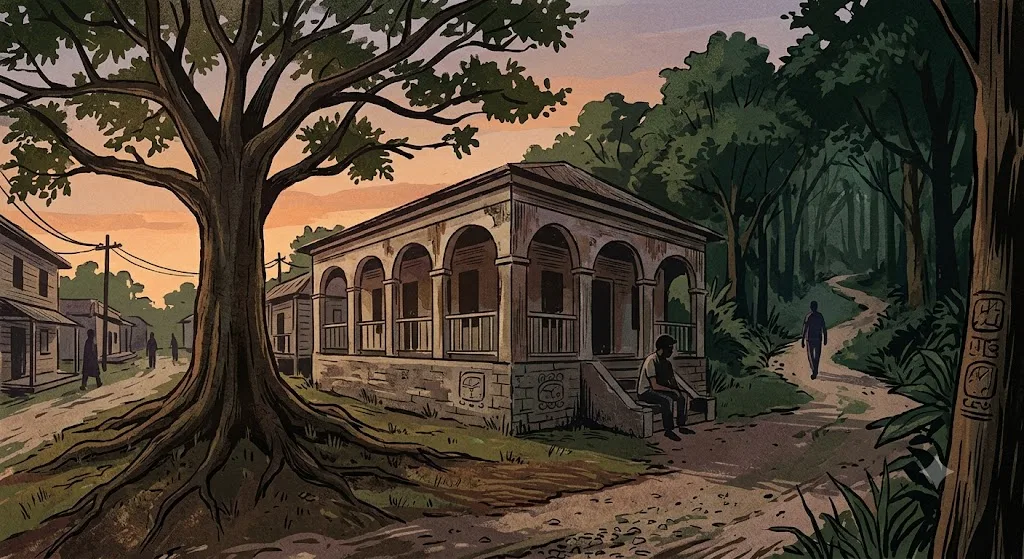
Belizean folklore contains many dangerous or uncanny beings, including the Xtabai, Tata Duende and stories of spirits encountered on roads, near forests or after dark. These traditions reflect Belize’s cultural connections with the Maya world, the Caribbean and neighbouring Central America. They are better understood as flexible social stories than as records of literal mass delusion.
The Xtabai is among the best-known figures. She is commonly portrayed as a beautiful supernatural woman who appears at night, lures men away from safety and may kill or ruin them. Belizean versions vary: some emphasise the forest, strange feet or an association with the ceiba tree; others warn drunken men, disobedient children or people travelling alone. The story is shared more widely across the Yucatán Peninsula rather than belonging exclusively to modern Belize.[wordpress.com]cushareejournal.wordpress.comOpen source on wordpress.com.
Such tales can act as informal rules. A story about a seductive spirit discourages night wandering, heavy drinking, sexual recklessness and entry into dangerous woodland. A warning that children may meet a supernatural being if they stay out late reinforces parental authority. The fear may be sincerely felt, especially when stories are learned early, but that does not make the belief an epidemic or mental disorder.
Folklore also changes as it is retold. Different narrators alter the creature’s appearance, victims and motives. Tourism websites may sharpen the horror elements because monsters are memorable attractions, while literary writers can use the same figure to examine gender, power and social exclusion. Scholarship on Belizean author Zee Edgell, for example, treats her use of the Xtabai tradition as a deliberate reworking of inherited myth rather than a straightforward endorsement of supernatural claims.[ResearchGate]researchgate.netOpen source on researchgate.net.
The most useful distinction is therefore between belief that influences behaviour and collective panic. A community may avoid a particular tree, road or forest path because of a story without entering a crisis. Folklore becomes relevant to panic history when a particular sighting or accusation produces pursuit, violence, school closure, medical intervention or official action. Firmly documented Belizean examples of that escalation remain scarce.
The 2012 “Maya apocalypse” that the Maya did not predict
Belize’s clearest connection to a modern apocalyptic scare came from abroad. In the years before 21 December 2012, books, television programmes, websites and films popularised the claim that the Maya calendar predicted the end of the world. Suggested catastrophes ranged from planetary collision and solar disaster to a sudden spiritual transformation.
The claim rested on a profound distortion of the Maya Long Count calendar. The date marked the completion of a major calendrical period, often described as the end of the thirteenth baktun. It did not mean that time itself stopped. Ancient Maya inscriptions include dates extending beyond 2012, while the limited inscriptional material connected with the end of the cycle does not describe the modern catalogue of planetary destruction attached to it. Belizean media interviewed specialists who stressed that only a very small amount of ancient evidence referred to the date and that the supposed doomsday message was a modern construction.[7newsbelize.com]7newsbelize.comOpen source on 7newsbelize.com.
This was therefore not simply an ancient prophecy that frightened modern people. It was a transnational media phenomenon assembled from archaeology, New Age spirituality, disaster entertainment and internet speculation. The authority of the Maya name gave the predictions an appearance of antiquity, although living Maya people and professional researchers repeatedly rejected the doomsday interpretation.
Belize occupied an awkward position within the scare. As part of the ancient Maya heartland and home to major sites such as Caracol, Lamanai and Xunantunich, it benefited from increased international attention and “end of the world” tourism. Travel operators and media organisations could market Belize as a place where visitors might encounter the supposedly prophetic civilisation. Some Christian evangelists also treated public curiosity about 2012 as an opportunity to promote their own end-times messages.[christianpost.com]christianpost.com2012 mayan apocalypse good for tourism and christian evangelism2012 mayan apocalypse good for tourism and christian evangelism
The commercial opportunity came with a cultural cost. The scare reduced a complex civilisation—and living Maya communities—to a mysterious vanished people obsessed with apocalypse. It encouraged outsiders to treat archaeological sites as stages for their own spiritual expectations. Similar tensions appeared elsewhere in the Maya region, where Indigenous representatives objected to official ceremonies and tourism campaigns that commercialised the calendar while marginalising living Maya voices.[Wikipedia]Wikipedia2012 phenomenon2012 phenomenon
Belize’s experience demonstrates how a moral or apocalyptic panic can be geographically displaced. The most extravagant fears were often produced in North American and European media rather than within Belize itself. Belize supplied the landscape, ruins and cultural name; foreign entertainment industries supplied much of the catastrophe.
When 21 December passed without disaster, the scare largely collapsed. Yet the episode remains important because it shows a familiar mechanism of contagious belief:
- A genuine but specialised fact—the ending of a calendrical cycle—was detached from its scholarly context.
- Ambiguous ancient material was presented as a prophecy.
- Repetition across books, documentaries and websites made the claim feel independently confirmed.
- Commercial interests benefited from keeping the mystery alive.
- Corrections from archaeologists and Maya commentators received less emotional attention than images of global destruction.
This was mythmaking with real social and economic effects, even though Belize itself did not descend into widespread panic.
Lev Tahor and the danger of the “cult” label
In February 2025, Belize became briefly involved in an international safeguarding case concerning Lev Tahor, a highly insular Jewish religious community. Belizean authorities detained three men, including a senior figure, after they crossed from Guatemala. They were returned to Guatemalan authorities, who had obtained warrants in an investigation involving suspected human trafficking and abuse.[mp.gob.gt]mp.gob.gtOpen source on gob.gt.
The border incident followed a much larger Guatemalan operation in December 2024, when prosecutors removed approximately 160 children and adolescents from a Lev Tahor settlement after allegations that included forced marriage, sexual violence and abuse. Guatemalan prosecutors said witness statements, evidence and medical examinations indicated possible trafficking offences. The investigation occurred against a longer history of allegations involving the group in several countries.[Reuters]reuters.comGuatemalan authorities rescue 160 children from Jewish Lev Tahor sectGuatemalan authorities rescue 160 children from Jewish Lev Tahor sect
This case belongs within Belize’s history of collective fear and contested religion, but it must be described carefully. News organisations and officials frequently call Lev Tahor a “sect” or “cult”. Those terms may communicate the group’s isolation and allegations of coercive control, but they can also encourage readers to treat unusual dress, strict theology or separation from mainstream society as proof of criminality.
The stronger basis for concern is not unfamiliar belief. It is specific alleged conduct: forced or under-age marriage, unlawful removal of children, physical abuse, sexual violence and obstruction of safeguarding authorities. Those claims can be tested through testimony, medical findings, border records and court proceedings. Labelling alone proves nothing.
The distinction also protects wider religious communities from collective blame. Jewish organisations in Guatemala publicly distanced themselves from Lev Tahor while supporting measures to protect children. The case was therefore not a confrontation between Belizean authorities and Judaism, but a cross-border investigation into particular people and alleged offences.[Reuters]reuters.comGuatemalan authorities rescue 160 children from Jewish Lev Tahor sectGuatemalan authorities rescue 160 children from Jewish Lev Tahor sect
Nor should the Belizean response be described as a moral panic on current evidence. Authorities did not appear to launch a sweeping campaign against unconventional religious minorities. They detained named individuals connected to an active investigation and transferred them to the neighbouring jurisdiction seeking them. Unless later evidence shows rumour-driven overreach, the episode is better understood as a safeguarding and law-enforcement case surrounded by emotionally charged “cult” language.
Christianity, minority belief and public authority
Belize’s religious landscape helps explain why supernatural claims can carry both everyday familiarity and social tension. Christianity remains highly influential, but the country contains Catholic, Protestant, evangelical, Mennonite, Maya, Garifuna and other religious traditions, alongside a growing or visible population reporting no religion. The 2022 census records substantial Protestant and non-religious populations as well as people belonging to other faiths.[Statistical Institute of Belize]sib.org.bzReligion 2022 webReligion 2022 web
Religion also has an institutional role in public life. Belize’s constitutional arrangements give recognised church bodies a voice in the appointment of a member of the Senate. At the same time, the Constitution protects freedom of conscience and the right to manifest and propagate religion, subject to restrictions framed around matters such as public safety, order, morality and health.[constituteproject.org]constituteproject.orgBelize 2011Belize 2011
That combination can produce difficult boundaries. A healing ceremony may be regarded by participants as religion, by a church leader as dangerous superstition, by a medical professional as a possible obstacle to treatment, and by the law as harmless unless money, coercion or injury is involved. A possession narrative may offer a culturally familiar explanation for distress but may also delay mental-health care. Conversely, dismissing every spiritual interpretation as ignorance can alienate the person seeking help and erase the cultural meaning of the experience.
Garifuna ancestral traditions illustrate why simplistic labels fail. Garifuna ritual life may involve drumming, dancing, mourning and communication with ancestors. These practices emerge from a history shaped by African and Indigenous Caribbean traditions, forced displacement and survival. They are not evidence of a “cult” or mass delusion. For many Garifuna people, ancestral presence is part of collective memory, identity and connection with a lost homeland.[The Guardian]theguardian.comOpen source on theguardian.com.
The same care is needed with Mennonite settlements and small evangelical churches. Separation from mainstream culture, conservative clothing or literal religious belief may appear unusual to outsiders, but difference alone does not establish manipulation. Useful scrutiny begins with measurable questions: Can members leave? Are children safe? Is medical care withheld? Are marriages genuinely consensual? Is labour coerced? Are allegations independently corroborated?
Disaster fear, rumour and the memory of hurricanes
Belize is repeatedly exposed to hurricanes, flooding and storm damage. The country’s modern history includes the catastrophic 1931 hurricane, Hurricane Hattie in 1961, Keith in 2000, Iris in 2001 and Dean in 2007. These events created genuine danger rather than imaginary panic, and any analysis must avoid treating urgent evacuation or fear of landfall as irrational.[Wikipedia]WikipediaList of Belize hurricanesList of Belize hurricanes
Nevertheless, disasters create ideal conditions for rumours. Electricity and communications fail, information becomes uneven, frightened people rely on neighbours and radio reports, and stories about looting, missing persons, contaminated supplies or another approaching storm can spread before verification. Belizean law’s long-standing prohibition on false reports that foster public alarm reflects official awareness that rumours can themselves cause harm.[Belize City Council]belizecitycouncil.orgBelize City Council CAP098 SUMMARY JURISDICTION (OFFENCES) ACTJanuary 7, 2001 — Pretence to tell fortunes. Spreading false news. Page 13. THE SUBSTANTIVE LAWS O…
The available record does not support a claim that Belize has repeatedly experienced spectacular hurricane-related mass panics. Reports following Hurricane Keith, for example, stated that a curfew had been imposed and that no fighting, looting or robbery had been reported after it took effect. That is evidence of preventive public-order action, not proof that widespread disorder had already occurred.[ReliefWeb]reliefweb.inthurricane keith belize post disaster stress managementhurricane keith belize post disaster stress management
Disaster history nevertheless shapes collective behaviour. People who remember destructive storms may respond rapidly to warnings because past experience has taught them that official forecasts can be matters of life and death. From outside, crowded shops, hurried evacuation or intense discussion may look panicked. Within Belize, the same conduct may be rational preparation informed by family memory.
The central question is therefore not whether fear was visible, but whether it was proportionate to credible danger. Hurricane anxiety becomes a panic only when false or exaggerated beliefs drive harmful behaviour beyond the threat itself.

What the Belizean record actually shows
Belize’s history does not justify a sensational list of “crazy mass hysterias”. Its value lies in several more subtle patterns.
First, power determines which supernatural beliefs receive legitimacy. Colonial Christianity was treated as religion, while African-derived ritual practices could be framed as witchcraft, fraud or vagrancy. The resulting laws outlasted the social order that produced them.[Scholarship Miami]scholarship.miami.eduWitchcraft Witchdoctors and Empire The ProscriptionThe Proscription and Prosecution of African Spiritual Practices…by DN Boaz · 2014 · Cited by 3 — In the Caribbean col…
Second, folklore can regulate conduct without becoming collective madness. Stories such as the Xtabai warn against night travel, drunkenness and disobedience. They transmit fear, but also identity, entertainment and practical caution.
Third, panics can be imported. The 2012 apocalypse narrative attached foreign New Age and media expectations to the Maya past. Belize became part of the spectacle because it possessed the ruins and cultural heritage that made the story marketable.
Fourth, the language of “cult” can both clarify and distort. It can draw attention to coercive authority, but it may also substitute strangeness for evidence. The Lev Tahor case is serious because of documented allegations and an active criminal investigation, not because the group’s beliefs are unfamiliar.[gob.gt]mp.gob.gtOpen source on gob.gt.
Finally, thin evidence is itself a finding. No strong published record currently establishes a major Belizean epidemic of contagious fainting, mass possession or coordinated witch prosecution. Future archival or local research may uncover overlooked episodes, particularly in schools, churches, villages or colonial courts. Until then, responsible history should resist converting ordinary religious diversity and folklore into pathology.
Why these stories still matter
Belize sits at a cultural crossroads, and its collective-belief history reflects that position. Maya calendrical traditions have been reshaped by global apocalypse culture. African-Caribbean practices inherited the stigma of colonial law. Garifuna ceremonies preserve memories of displacement and survival. Christian institutions remain publicly influential, while constitutional protections encompass a much wider field of conscience and belief.
The recurring danger is not belief itself. It is the movement from belief to accusation: from “this practice is unfamiliar” to “this practice is evil”; from “this community is secluded” to “everyone in it is criminal”; from “an ancient calendar cycle is ending” to “the world will be destroyed”; or from “people are frightened during a hurricane” to “the population has become irrational”.
Belize’s record therefore encourages a disciplined set of questions. Who first made the claim? What evidence exists beyond repetition? Did authorities investigate conduct or merely condemn belief? Were physical symptoms medically assessed? Did the press correct errors? Who gained money, status or political power from the fear? And were members of a minority allowed to describe their own practices?
Those questions do not drain strange history of its fascination. They reveal its real subject: how communities interpret uncertainty, how stories acquire authority, and how fear can protect, entertain, exploit or persecute depending on who controls the explanation.
Amazon book picks
Further Reading
Books and field guides related to When Belief Became Fear in Belize. Use these as the next step if you want deeper reading beyond the article.
Extraordinary Popular Delusions and the Madness of Crowds
Rating: 4.0/5 from 5 Google Books ratings
Useful framework for fear and rumor.


Myth of the Twelve Tribes of Israel
Encourages critical reading of historical traditions.
Endnotes
1.
Source: Wikipedia
Link:https://en.wikipedia.org/wiki/Obeah
2.
Source: scholarship.miami.edu
Title: Witchcraft Witchdoctors and Empire The Proscription
Link:https://scholarship.miami.edu/esploro/outputs/doctoral/Witchcraft-Witchdoctors-and-Empire-The-Proscription/991031447808402976
Source snippet
The Proscription and Prosecution of African Spiritual Practices...by DN Boaz · 2014 · Cited by 3 — In the Caribbean col...
3.
Source: jstor.org
Link:https://www.jstor.org/stable/26855622
Source snippet
obeah, vagrancy, and the boundaries of religious freedomby DN BOAZ · 2017 · Cited by 26 — The laws of Belize prescribe up to six mon...
4.
Source: researchgate.net
Link:https://www.researchgate.net/publication/352055159_Succouring_an_Ixtabai_Zee_Edgell%27s_Deployment_of_Belizean_Folklore_in_The_Festival_of_San_Joaquin_1997
5.
Source: 7newsbelize.com
Link:https://7newsbelize.com/sstory.php?nid=21494
6.
Source: Wikipedia
Title: 2012 phenomenon
Link:https://en.wikipedia.org/wiki/2012_phenomenon
7.
Source: researchgate.net
Link:https://www.researchgate.net/publication/223205225_If_you_dig_it_they_will_come_Archaeology_heritage_sites_and_tourism_development_in_Belize_Central_America
8.
Source: Wikipedia
Title: Tourism in Belize
Link:https://en.wikipedia.org/wiki/Tourism_in_Belize
9.
Source: mp.gob.gt
Link:https://www.mp.gob.gt/mp-en-ingle/public-ministry-coordinates-the-apprehension-of-leaders-of-the-lev-tahor-sect/
10.
Source: reuters.com
Title: belize send lev tahor jewish sect leader 2 others guatemala 2025 02 26
Link:https://www.reuters.com/world/americas/belize-send-lev-tahor-jewish-sect-leader-2-others-guatemala-2025-02-26/
11.
Source: reuters.com
Title: Guatemalan authorities rescue 160 children from Jewish Lev Tahor sect
Link:https://www.reuters.com/world/americas/guatemalan-authorities-rescue-160-children-jewish-lev-tahor-sect-2024-12-21/
12.
Source: Wikipedia
Title: List of Belize hurricanes
Link:https://en.wikipedia.org/wiki/List_of_Belize_hurricanes
13.
Source: reliefweb.int
Title: hurricane keith belize post disaster stress management
Link:https://reliefweb.int/report/belize/hurricane-keith-belize-post-disaster-stress-management
14.
Source: Wikipedia
Title: List of mass panic cases
Link:https://en.wikipedia.org/wiki/List_of_mass_panic_cases
15.
Source: Wikipedia
Title: Satanic panic
Link:https://en.wikipedia.org/wiki/Satanic_panic
16.
Source: Wikipedia
Title: Mass psychogenic illness
Link:https://en.wikipedia.org/wiki/Mass_psychogenic_illness
17.
Source: Wikipedia
Link:https://en.wikipedia.org/wiki/Duppy
18.
Source: Wikipedia
Link:https://en.wikipedia.org/wiki/Xtabay
19.
Source: Wikipedia
Title: Religion in Belize
Link:https://en.wikipedia.org/wiki/Religion_in_Belize
20.
Source: researchgate.net
Link:https://www.researchgate.net/publication/362530531_Settler_colonial_origins_of_intimate_partner_violence_in_Indigenous_communities
21.
Source: researchgate.net
Link:https://www.researchgate.net/publication/222532565_5000_year_sedimentary_record_of_hurricane_strikes_on_the_central_coast_of_Belize
22.
Source: belize.com
Title: belize census 2022
Link:https://belize.com/belize-census-2022/
23.
Source: obeahhistories.org
Title: Obeah Histories An Act to Remedy the Evils arising from Irregular
Link:https://obeahhistories.org/1760-jamaica-law/
Source snippet
Obeah HistoriesAn Act to Remedy the Evils arising from Irregular...November 12, 2012 — This extreme punishment highlights how the develo...
Published: November 12, 2012
24.
Source: historyworkshop.org.uk
Title: the racist history of jamaicas obeah laws
Link:https://www.historyworkshop.org.uk/empire-decolonisation/the-racist-history-of-jamaicas-obeah-laws/
Source snippet
History WorkshopThe Racist History of Jamaica's Obeah Laws21 Jan 2023 — On the first law against obeah, passed in 1760: Diana Paton, “Wit...
25.
Source: belizecitycouncil.org
Title: Belize City Council CAP
Link:https://belizecitycouncil.org/uploads/acts/7785-Summary_Jurisdiction_Offenses_Act.pdf
Source snippet
098 SUMMARY JURISDICTION (OFFENCES) ACTJanuary 7, 2001 — Pretence to tell fortunes. Spreading false news. Page 13. THE SUBSTANTIVE LAWS O...
Published: January 7, 2001
26.
Source: oas.org
Link:https://www.oas.org/ext/Portals/33/Files/Member-States/bel_intro_fund_en.pdf
27.
Source: constituteproject.org
Title: Belize 2011
Link:https://www.constituteproject.org/constitution/Belize_2011
28.
Source: cushareejournal.wordpress.com
Link:https://cushareejournal.wordpress.com/2018/10/31/if-you-see-her-you-must-never-tell-ghost-stories-and-folk-legends-from-rural-belize/
29.
Source: belize-travel-blog.chaacreek.com
Title: mayas never predicted december 2012 apocalypse
Link:https://belize-travel-blog.chaacreek.com/2011/12/mayas-never-predicted-december-2012-apocalypse/
Published: december 2012
30.
Source: christianpost.com
Title: 2012 mayan apocalypse good for tourism and christian evangelism
Link:https://www.christianpost.com/news/2012-mayan-apocalypse-good-for-tourism-and-christian-evangelism.html
31.
Source: sib.org.bz
Title: Religion 2022 web
Link:https://sib.org.bz/wp-content/uploads/Religion_2022_web.pdf
32.
Source: theguardian.com
Link:https://www.theguardian.com/world/2025/jan/13/garifuna-baliceaux-island-st-vincent
33.
Source: facebook.com
Title: Hurricane Hattie
Link:https://www.facebook.com/hotoffthepressbz/posts/hurricane-hattie-when-belize-changed-foreverarchival-footage-showing-the-afterma/1351625973646518/
34.
Source: state.gov
Link:https://www.state.gov/reports/2022-report-on-international-religious-freedom/belize
35.
Source: theguardian.com
Title: carol morley the falling mass hysteria is a powerful group activity
Link:https://www.theguardian.com/film/2015/mar/29/carol-morley-the-falling-mass-hysteria-is-a-powerful-group-activity
36.
Source: theguardian.com
Title: was ripon school gripped by mass psychogenic illness
Link:https://www.theguardian.com/science/2015/nov/14/was-ripon-school-gripped-by-mass-psychogenic-illness
37.
Source: mayabelize.wordpress.com
Title: obeah belizean black magic
Link:https://mayabelize.wordpress.com/2013/05/03/obeah-belizean-black-magic/
38.
Source: urbanapocalypsenow.wordpress.com
Title: belize 2012 a modern mayan experience
Link:https://urbanapocalypsenow.wordpress.com/2012/04/26/belize-2012-a-modern-mayan-experience/
39.
Source: belize-travel-blog.chaacreek.com
Title: belizean folklore the legends of belize
Link:https://belize-travel-blog.chaacreek.com/2013/04/belizean-folklore-the-legends-of-belize/
40.
Source: healthline.com
Title: mass hysteria
Link:https://www.healthline.com/health/mental-health/mass-hysteria
41.
Source: abcnews.com
Link:https://abcnews.com/US/secretive-christian-sect-sexual-abuse-decades-congregants-allege/story?id=111059778
42.
Source: sib.org.bz
Link:https://sib.org.bz/wp-content/uploads/CensusLaunch2022.pdf
Additional References
43.
Source: cambridge.org
Link:https://www.cambridge.org/core/books/cultural-politics-of-obeah/creole-slave-society-obeah-and-the-law/614D64A80BF1F8CCF008F662FC7AD8D3
Source snippet
obeah was both a form of witchcraft, and was genuinely powerful. The most detailed early obeah case I have found is that of George, prose...
44.
Source: youtube.com
Link:https://www.youtube.com/watch?v=xPA9ACyJGnc
Source snippet
The Cultural History of Ancient Maya Cave Use in Belize” with Holley Moyes...
45.
Source: science.nasa.gov
Link:https://science.nasa.gov/earth/earth-observatory/hurricane-iris-hits-belize-1827/
46.
Source: youtube.com
Link:https://www.youtube.com/watch?v=LSVP-tcNrgU
Source snippet
Mayan Copal Ceremony in Belize | Ancient Maya Ritual Explained...
47.
Source: ambergriscaye.com
Link:https://ambergriscaye.com/25years/laxtabai.html
48.
Source: gfdrr.org
Link:https://www.gfdrr.org/sites/default/files/Belize.pdf
49.
Source: facebook.com
Link:https://www.facebook.com/belizelivenews/posts/news-headlines-dont-tell-full-storiesthey-tell-fragments-moments-and-often-the-w/1412826677531779/
50.
Source: joshuaproject.net
Link:https://joshuaproject.net/countries/bh
51.
Source: facebook.com
Link:https://www.facebook.com/groups/Belizeelections/posts/3155205484658034/
52.
Source: facebook.com
Link:https://www.facebook.com/breakingbelizenews/posts/religion-the-constitution-and-your-rights-in-belizethe-views-expressed-in-this-a/781996183958985/
Topic Tree
Follow this branch
Related pages 192
- Antigua and Barbuda
- Argentina Belief Scares
- Azerbaijan Belief
- Bahrain Beliefs
- North Korea
- +187 more in sidebar