Within Turkey's Collective Fears
Why Menemen Became a Republican Trauma
A small Mahdist uprising became a lasting national warning about religious revolt and the fragility of secular reform.
On this page
- The rising and the killing of Kubilay
- Mahdist belief and republican upheaval
- Trials, commemoration and political memory
Page outline Jump by section
Introduction
The Menemen Rising of 23 December 1930 was a small, localised religious revolt, but its political and cultural impact on modern Turkey was enormous. Led by the self-proclaimed Mahdi Dervish Mehmed and a handful of followers, the uprising ended with the brutal killing and beheading of the young reserve officer and schoolteacher Mustafa Fehmi Kubilay. The rebellion itself was quickly crushed, yet it became a defining symbol of the danger that the new Turkish Republic believed religious counter-revolution posed to its survival. Ever since, the “Menemen Incident” has occupied a central place in debates about secularism, political Islam, state authority and collective memory. Historians generally agree that the immediate revolt involved only a small group, but they continue to debate whether the government’s interpretation of a broad organised conspiracy reflected the available evidence or amplified the threat for political purposes.[doaj.org]doaj.orgDirectory of Open Access JournalsLe madhisme en Turquie: L’« incident de Menemen » en 1930 – DOAJ…
The rising and the killing of Kubilay
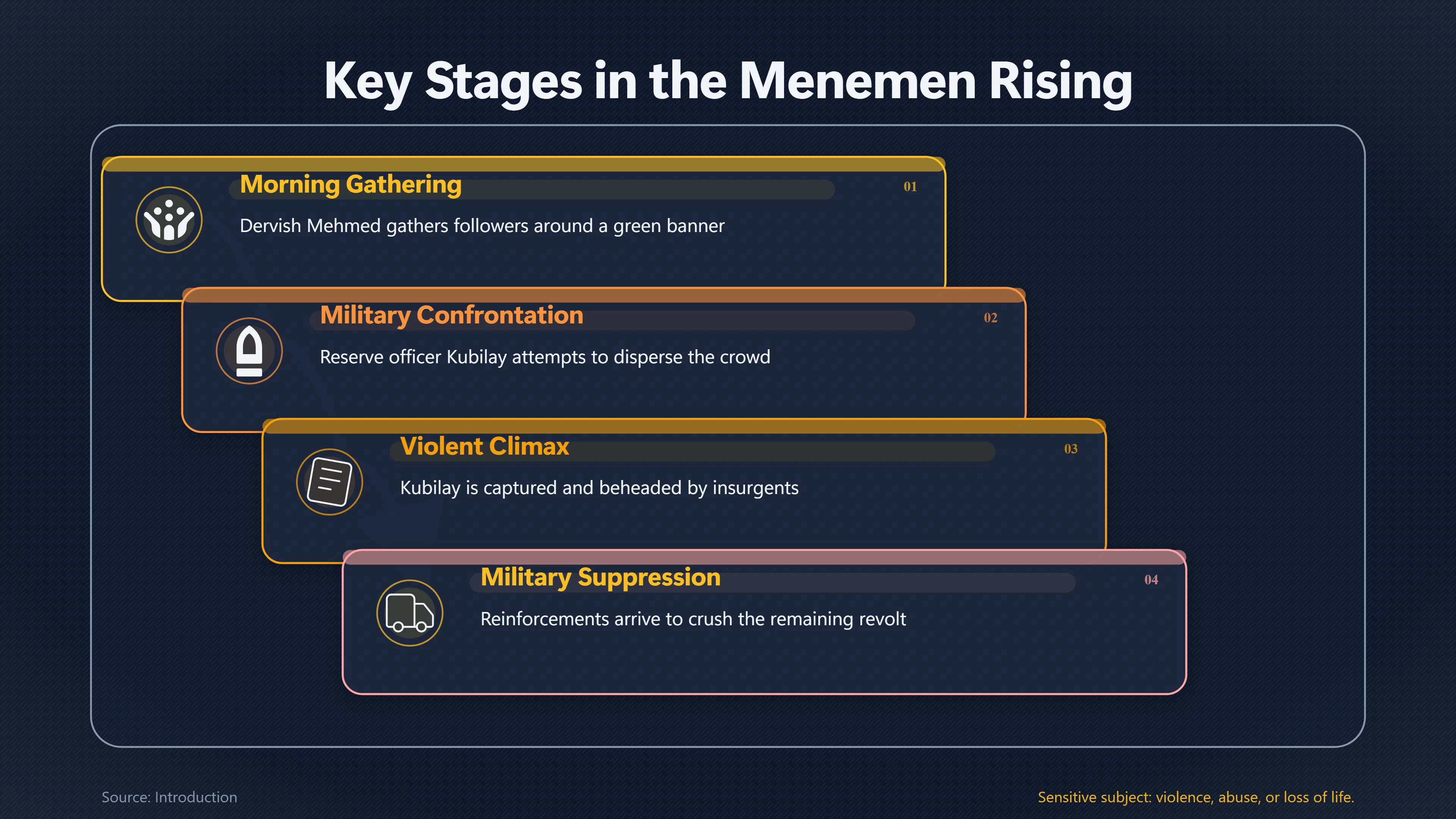
On the morning of 23 December 1930, Dervish Mehmed arrived in the town of Menemen, north of İzmir, accompanied by several armed followers. He declared himself a divinely chosen figure and called for the restoration of Islamic law and the Caliphate, gathering people around a green religious banner in the town square. His message drew on Mahdist expectations: the belief that a divinely guided redeemer would appear to rescue the faithful during a period of moral decline.[Directory of Open Access Journals]doaj.orgDirectory of Open Access JournalsLe madhisme en Turquie: L’« incident de Menemen » en 1930 – DOAJ…
Mustafa Fehmi Kubilay, a primary-school teacher performing his compulsory military service as a reserve officer, was sent with a small detachment to disperse the gathering. The soldiers initially carried training ammunition rather than live rounds, leaving them unable to halt the demonstrators effectively. Kubilay was wounded, captured and beheaded. His severed head was reportedly displayed on a pole beneath the green banner. Two municipal watchmen, Hasan and Şevki, were also killed before military reinforcements arrived and suppressed the revolt.[docslib.org]docslib.orgthe menemen incident 1930 in modern turkish historyThe Menemen Incident (1930) in Modern Turkish History - DocsLib…
Although only a handful of insurgents took part, the extreme violence of Kubilay’s death shocked the country. Newspapers portrayed the incident as an assault on the Republic itself rather than simply a local disturbance, ensuring that Menemen immediately became a national political crisis.[DergiPark]dergipark.org.trOpen source on dergipark.org.tr.
Why such a small revolt created such a large fear
The Menemen Rising occurred during a particularly sensitive period for the young Republic. Turkey had recently experimented with limited political pluralism through the short-lived Liberal Republican Party, while the global economic depression was increasing social discontent. Only five years had passed since the suppression of the Sheikh Said rebellion, another challenge in which religion had played an important role. Republican leaders therefore viewed any organised religious mobilisation as a potential existential threat.[dergipark.org.tr]dergipark.org.trDergi Park Yasak Bir Hafızayla Yüzleşmek: Menemen Olayı İrtica mı, Komplo mu?Yasak Bir Hafızayla Yüzleşmek: Menemen Olayı İrtica mı, Komplo mu? - FSM İlmi Araştırmalar İnsan ve Toplum Bilimleri DergisiJu…
For the government, the Menemen violence confirmed fears that opposition to secular reforms had not disappeared. Measures such as abolishing the Caliphate, closing religious lodges and introducing civil legal reforms had fundamentally reshaped public life. Officials interpreted Dervish Mehmed’s appeal not as an isolated act of fanaticism but as evidence that hidden reactionary networks might still be capable of mobilising resistance.[Cambridge University Press & Assessment]cambridge.orgCambridge University Press & AssessmentSufi leaders in the early Turkish Republic: profession, privilege, and persecution (1925–1950) | N…
The event therefore became more than a criminal incident. It evolved into a cautionary narrative about how quickly religious symbolism, charismatic leadership and public uncertainty could combine into a direct challenge to state authority.
Mahdist belief and republican upheaval
The ideology behind the uprising centred on Mahdist expectations rather than a sophisticated political programme. Dervish Mehmed claimed extraordinary religious authority, presenting himself as the expected redeemer whose appearance would overturn the existing order. Such beliefs have appeared at different moments across the Islamic world, particularly during periods of political instability or social distress.[Directory of Open Access Journals]doaj.orgDirectory of Open Access JournalsLe madhisme en Turquie: L’« incident de Menemen » en 1930 – DOAJ…
Historian Hamit Bozarslan argues that the Menemen movement cannot be understood purely as religious extremism or purely as social protest. Instead, it emerged from the interaction between growing social tensions and an increasingly radical religious environment. In this interpretation, millenarian belief gave social dissatisfaction an apocalyptic language through which rejection of the Republican state could be expressed.[Directory of Open Access Journals]doaj.orgDirectory of Open Access JournalsLe madhisme en Turquie: L’« incident de Menemen » en 1930 – DOAJ…
This helps explain why historians distinguish the Menemen Rising from a simple case of mass hysteria. The participants did not experience a contagious psychological episode. Rather, a small group acted on sincere messianic convictions while the wider political significance arose from the state’s interpretation and the national reaction that followed.
Trials, executions and the expansion of state power
The government declared martial law in the region and established special military tribunals to investigate the uprising. The trials extended far beyond the men directly involved, examining alleged links with members of the banned Naqshbandi Sufi order and other religious networks. Numerous defendants were prosecuted, with dozens receiving death sentences or lengthy prison terms after convictions.[Docslib]docslib.orgthe menemen incident 1930 in modern turkish historyThe Menemen Incident (1930) in Modern Turkish History - DocsLib…
At the time, officials presented the prosecutions as essential for protecting the Republic against organised counter-revolution. The military court concluded that the revolt had been planned as part of a broader conspiracy against the secular state.[Docslib]docslib.orgthe menemen incident 1930 in modern turkish historyThe Menemen Incident (1930) in Modern Turkish History - DocsLib…
Later historians have questioned how well this conclusion matched the available evidence. Some research based on court records and contemporary reporting argues that the rebellion itself remained extremely small and that the government’s portrayal of an extensive organised network reflected political assumptions as much as demonstrable proof. This revisionist interpretation does not minimise the brutality of the murders but challenges whether the incident justified such sweeping conclusions about nationwide religious conspiracy.[yok.gov.tr]acikbilim.yok.gov.trAcik BilimThe making and treatment of an iconic event: The Menemen incident (1930) in modern Turkish history…
Why Menemen became a republican trauma
The symbolic importance of Menemen soon exceeded the historical event itself. Kubilay came to represent the ideal Republican citizen: an educated teacher, a young officer and a defender of secular reform. His death was commemorated as a sacrifice for the Republic, and memorial ceremonies became an enduring feature of official civic culture. The Kubilay Monument, erected in 1932, reinforced this interpretation by embedding the event into the physical landscape of national remembrance.[DergiPark]dergipark.org.trOpen source on dergipark.org.tr.
Over subsequent decades, references to Menemen repeatedly appeared whenever politicians, military leaders or commentators warned that religious extremism threatened Turkey’s secular constitutional order. The event became part of a broader narrative in which the closure of Sufi orders and close state supervision of organised religion were presented as necessary safeguards rather than temporary emergency measures.[Cambridge University Press & Assessment]cambridge.orgCambridge University Press & AssessmentSufi leaders in the early Turkish Republic: profession, privilege, and persecution (1925–1950) | N…
Because of this symbolic role, Menemen remains politically sensitive. Different ideological traditions continue to interpret it in contrasting ways: as proof of the continuing danger of religious reaction, as an example of state overreaction, or as an event whose later political uses became more influential than the uprising itself.

Historical interpretation today
Modern scholarship generally agrees on several core points. A genuine uprising occurred; Kubilay and two watchmen were murdered; the government responded with exceptional severity; and the incident profoundly influenced the Republic’s understanding of threats to secular rule.[doaj.org]doaj.orgDirectory of Open Access JournalsLe madhisme en Turquie: L’« incident de Menemen » en 1930 – DOAJ…
The principal historical debate concerns scale and interpretation rather than the basic facts. Some historians emphasise the revolt as a real manifestation of organised religious opposition during a fragile period of state-building. Others argue that the rebellion was carried out by only a very small group and that official narratives transformed it into evidence of a much broader counter-revolutionary movement than the surviving evidence can confidently support.[yok.gov.tr]acikbilim.yok.gov.trAcik BilimThe making and treatment of an iconic event: The Menemen incident (1930) in modern Turkish history…
For the study of collective fear, Menemen is therefore significant not because it illustrates mass hysteria, but because it demonstrates how a limited violent incident can reshape a nation’s political imagination. The fear of counter-revolution generated by the uprising influenced legal policy, public memory and debates over religion and the state for generations, making Menemen one of the defining symbolic events in the history of the Turkish Republic.[doaj.org]doaj.orgDirectory of Open Access JournalsLe madhisme en Turquie: L’« incident de Menemen » en 1930 – DOAJ…
Amazon book picks
Further Reading
Books and field guides related to Why Menemen Became a Republican Trauma. Use these as the next step if you want deeper reading beyond the article.

The emergence of modern Turkey
Covers the transition from empire to republic and state-building.

Ataturk
Explains the political and ideological environment in which Menemen became symbolically important.
TURKEY: A MODERN HISTORY
Provides essential context for the early Republic, secularism and the Menemen Incident.
Endnotes
1.
Source: cambridge.org
Link:https://www.cambridge.org/core/journals/new-perspectives-on-turkey/article/sufi-leaders-in-the-early-turkish-republic-profession-privilege-and-persecution-19251950/0AE3FDB4C227E6448670BEF84C638514
Source snippet
Cambridge University Press & AssessmentSufi leaders in the early Turkish Republic: profession, privilege, and persecution (1925–1950) | N...
2.
Source: docslib.org
Title: the menemen incident 1930 in modern turkish history
Link:https://docslib.org/doc/7975916/the-menemen-incident-1930-in-modern-turkish-history
Source snippet
The Menemen Incident (1930) in Modern Turkish History - DocsLib...
3.
Source: youtube.com
Title: MENEMEN INCIDENT
Link:https://www.youtube.com/watch?v=rRN6b-xijxU
Source snippet
Menemen: The City Atatürk Almost Declared 'CURSED'...
4.
Source: doaj.org
Link:https://doaj.org/article/4e699b908b0e4ac29bb7635e1696a178
Source snippet
Directory of Open Access JournalsLe madhisme en Turquie: L’« incident de Menemen » en 1930 – DOAJ...
5.
Source: acikbilim.yok.gov.tr
Link:https://acikbilim.yok.gov.tr/handle/20.500.12812/632171?show=full
Source snippet
Acik BilimThe making and treatment of an iconic event: The Menemen incident (1930) in modern Turkish history...
6.
Source: dergipark.org.tr
Link:https://dergipark.org.tr/en/pub/aamd/issue/44062/542880
7.
Source: dergipark.org.tr
Title: Dergi Park Yasak Bir Hafızayla Yüzleşmek: Menemen Olayı İrtica mı, Komplo mu?
Link:https://dergipark.org.tr/tr/pub/fsmia/article/85641
Source snippet
Yasak Bir Hafızayla Yüzleşmek: Menemen Olayı İrtica mı, Komplo mu? - FSM İlmi Araştırmalar İnsan ve Toplum Bilimleri DergisiJu...
8.
Source: Wikipedia
Title: Menemen Incident
Link:https://en.wikipedia.org/wiki/Menemen_Incident
9.
Source: dergipark.org.tr
Link:https://dergipark.org.tr/en/pub/sde/article/1127625
10.
Source: dergipark.org.tr
Link:https://dergipark.org.tr/en/pub/opus/article/460821
11.
Source: dergipark.org.tr
Link:https://dergipark.org.tr/en/pub/fsmia/issue/6477/85641
12.
Source: dergipark.org.tr
Title: Çankırı’da Yayınlanan Gazetelere Göre Menemen Olayı
Link:https://dergipark.org.tr/tr/pub/aamd/article/542880
13.
Source: acikbilim.yok.gov.tr
Link:https://acikbilim.yok.gov.tr/handle/20.500.12812/332612
14.
Source: atamdergi.gov.tr
Link:https://atamdergi.gov.tr/eng/abstarct/84/tur
15.
Source: atamdergi.gov.tr
Link:https://atamdergi.gov.tr/eng/abstarct/84/eng
16.
Source: atamdergi.gov.tr
Link:https://atamdergi.gov.tr/ozet/84/eng
Additional References
17.
Source: istanbulbarosu.org.tr
Title: Laik Cumhuriyete Suikast Girişimi: Menemen’deki Gerici Ayaklanma ve Kubilay
Link:https://www.istanbulbarosu.org.tr/HaberDetay.aspx?Desc=Laik-Cumhuriyete-Suikast-Giri%C5%9Fimi%3A-Menemen%E2%80%99deki-Gerici-Ayaklanma-ve-Kubilay&ID=20109
Source snippet
December 23, 2025 — * Son Güncelleme: 23.12.2025 16:25 * Haber Giriş: 23.12.2025 16:15 * Etkinlik: 23.12.2025 Image LAIK CUMHURIYETE S...
Published: December 23, 2025
18.
Source: turkishnews.com
Title: menemen kubilay olayi 23 aralik 1930
Link:https://www.turkishnews.com/2025/12/23/menemen-kubilay-olayi-23-aralik-1930/
Source snippet
MENEMEN–KUBİLAY OLAYI (23 ARALIK 1930) – Turkish ForumDecember 23, 2025 — 23 Aralık 1930 Menemen Olayı Mustafa Fehmi Kubilay * * * MENEME...
Published: December 23, 2025
19.
Source: youtube.com
Title: THE SHEIKH SAID REBELLION: Was it a British plan that led to the loss of Mosul?
Link:https://www.youtube.com/watch?v=7OienV3ZaqE
Source snippet
How Ataturk's 'Modernization' Changed Turkey Forever...
20.
Source: youtube.com
Title: A Heartbreaking Day in Menemen
Link:https://www.youtube.com/watch?v=xMFIF6EW5PY
Source snippet
THE SHEIKH SAID REBELLION: Was it a British plan that led to the loss of Mosul?...
Published: December 23, 1930
21.
Source: youtube.com
Title: Menemen: The City Atatürk Almost Declared ‘CURSED’
Link:https://www.youtube.com/watch?v=IVtx1zXIWs4
Source snippet
A Heartbreaking Day in Menemen December 23, 1930 #kubilay...
Published: December 23, 1930
22.
Source: researchgate.net
Link:https://www.researchgate.net/publication/280326108Yonetsel_Alanda_Degisimler_ve_Devrim_Hareketlerine_Karsi_Gerici_Tepkiler_Serbest_Cumhuriyet_Firkasi-_Menemen_Olayi
23.
Source: en-academic.com
Link:https://en-academic.com/dic.nsf/enwiki/5919702/6050375
24.
Source: tezara.org
Link:https://tezara.org/theses/618888
25.
Source: researchgate.net
Link:https://www.researchgate.net/publication/236727404_Islam_and_Secularism_in_Turkey_Kemalism_Religion_and_the_Nation_State_review
26.
Source: arastirmax.com
Title: Yasak Bir Hafızayla Yüzleşmek: Menemen Olayı İrtica mı, Komplo mu?
Link:https://arastirmax.com/en/publication/fsm-ilmi-arastirmalar-insan-toplum-bilimleri-dergisi/1/5/409-440-yasak-bir-hafizayla-yuzlesmek-menemen-olayi-irtica-mi-komplo-mu/arid/f913bf07-eb1a-4b6a-89bf
Topic Tree