Within Estonia
How Witch Accusations Became State Violence
Local fears about illness and harmful magic became deadly when courts imposed demonology, coercion and unequal power.
On this page
- From neighbourly suspicion to criminal charge
- How courts reshaped stories under pressure
- Why prosecutions declined but belief survived
Page outline Jump by section
Introduction
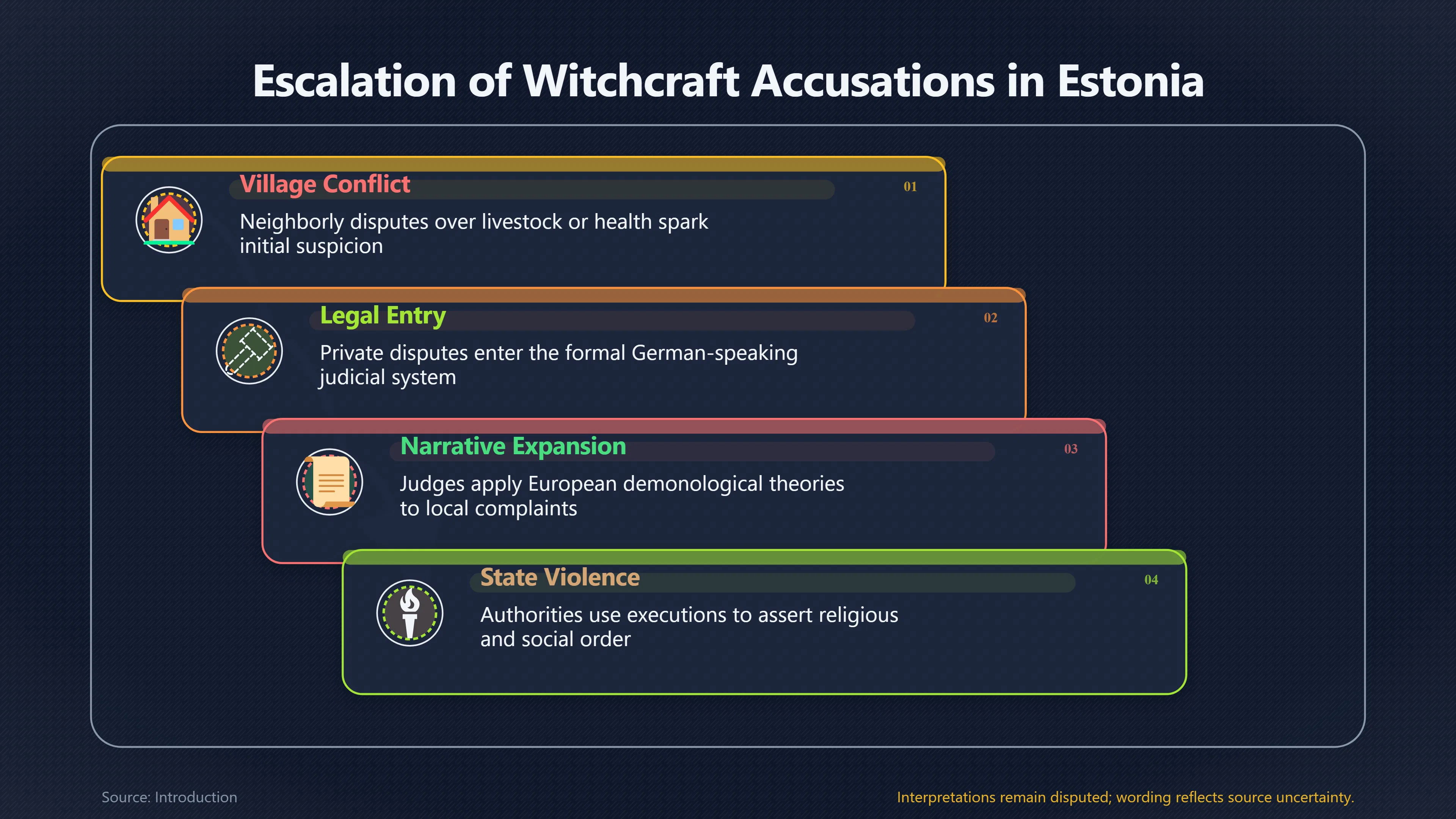
Witch trials in the territory of present-day Estonia were not simply outbreaks of irrational fear. They became deadly because local suspicions were transformed into criminal prosecutions by courts that combined European demonological ideas with unequal political power. Most accusations began with familiar problems—a sick child, dying livestock, failed crops or a quarrel between neighbours—but once officials became involved, these disputes could be reframed as crimes against religion and society. During the sixteenth and seventeenth centuries, this process turned ordinary village conflicts into acts of state violence, leading to executions, torture and lasting fear. Historians today see the Estonian witch trials as an example of how legal institutions, rather than popular belief alone, escalated accusations into persecution.[ResearchGate]researchgate.net345478659 Witch Hunts in and around ParnuWitch Hunts in and around Pärnu 1641–1642…
From neighbourly suspicion to criminal charge
The surviving records show that Estonian witchcraft accusations usually emerged from everyday life rather than fears of a secret satanic organisation. A neighbour might be blamed after livestock died following an argument, a healer might be accused when a patient failed to recover, or someone known for magical knowledge could become a suspect after repeated misfortune within a community. These accusations reflected genuine beliefs that harmful magic could injure people, animals or property.
What made the situation especially dangerous was the legal system. Estonia was governed by a German-speaking elite of landlords, clergy and officials who exercised authority over an overwhelmingly Estonian peasant population. Estate courts and county courts possessed broad powers to investigate suspected witchcraft. Once an accusation entered this judicial system, it ceased to be a private dispute and became a criminal matter backed by the coercive authority of the state.[Wikipedia]WikipediaWitch trials in Latvia and EstoniaWitch trials in Latvia and Estonia
Unlike some of the largest witch panics elsewhere in Europe, Estonia experienced relatively modest numbers of documented prosecutions. Historians estimate roughly 140 surviving recorded cases between the early sixteenth century and 1725, although the true number cannot be known because many estate courts failed to preserve their records. The comparatively small scale does not reduce the seriousness of the violence experienced by those accused.[ResearchGate]researchgate.net345478659 Witch Hunts in and around ParnuWitch Hunts in and around Pärnu 1641–1642…
How courts reshaped stories under pressure
One of the clearest findings from modern research is that village beliefs and courtroom narratives were often very different.
Local communities generally spoke about harmful sorcery: poisoned food, enchanted drink, stolen milk, unexplained illness or magical revenge after personal conflict. Judges and clergy, however, were familiar with wider European demonological theories that portrayed witches as servants of the Devil engaged in organised attacks on Christian society.
During interrogations, especially where torture or its threat was used, accusations frequently expanded to include confessions that reflected these imported legal expectations rather than the original complaint. Stories about causing illness might become admissions of making pacts with the Devil, attending supernatural gatherings or learning magic from demonic teachers. Historians therefore treat many recorded confessions cautiously, recognising that they were produced within an unequal legal process rather than freely volunteered.[ResearchGate]researchgate.net345478659 Witch Hunts in and around ParnuWitch Hunts in and around Pärnu 1641–1642…
This distinction is important because it challenges two common misconceptions. The trials do not demonstrate that organised satanic groups existed in early modern Estonia, nor can they be dismissed as simple outbreaks of peasant superstition. Instead, they reveal an interaction between local belief, judicial procedure and state authority.
Pärnu shows how authority intensified persecution
The best documented Estonian example comes from the witch hunt around Pärnu in 1641–1642. Because unusually detailed court records survive, historians have been able to reconstruct how one accusation generated a wider chain of prosecutions.
Research suggests that the proceedings reflected tensions within a rigid social hierarchy. Economic dependence, conflicts between peasants and local authorities, and longstanding personal grievances all contributed to the spread of accusations. Rather than emerging from collective panic alone, the prosecutions developed through legal procedures that encouraged further denunciations and expanded investigations.
The Pärnu records also demonstrate how a single suspect could become the starting point for multiple accusations. Under pressure, defendants identified additional alleged witches, allowing investigations to widen through a self-reinforcing cycle. This pattern resembles many European witch hunts, where judicial methods helped create new suspects instead of resolving uncertainty.[ResearchGate]researchgate.net345478659 Witch Hunts in and around ParnuWitch Hunts in and around Pärnu 1641–1642…
Punishment as an expression of state power
The violence of the trials extended well beyond conviction. Early modern courts treated witchcraft as a capital offence, and those found guilty could face execution. Surviving legal records describe burnings and other exceptionally severe punishments intended not only to kill but also to demonstrate public authority over supposed supernatural threats.
Although spectacular punishments were uncommon, the possibility of torture, execution and public humiliation gave enormous weight to accusations. The legal process itself became a mechanism through which governments asserted religious and social order. For ordinary villagers, this meant that rumours and neighbourly conflict could ultimately bring the full coercive power of the courts into their lives.[Rongabutiik]rongabutiik.eeEstonian Folklore, Witchcraft and Magical Practices: A Complete OverviewEstonian Folklore, Witchcraft and Magical Practices: A Complete Overview - RongabutiikMay 7, 2026…
Modern historians therefore increasingly describe these prosecutions as state violence rather than merely episodes of popular fear. The decisive factor was not simply belief in magic but the willingness of legal institutions to criminalise that belief and impose lethal punishments.
Why prosecutions declined but belief survived
By the late seventeenth century, executions for witchcraft became less common in Estonia, reflecting wider legal and intellectual changes across northern Europe. Courts gradually demanded stronger evidence, scepticism towards confessions increased, and judicial authorities became less willing to accept accusations based solely on rumour or supernatural claims.
The end of executions did not mean that belief in magic disappeared. Folk traditions concerning healers, charms, protective rituals and harmful sorcery continued well into later centuries. What changed was the state’s response. Behaviour that had once been prosecuted as a capital crime increasingly became a matter of local custom, church discipline or social disapproval rather than criminal justice. The last known death sentence for witchcraft in Estonia dates from the end of the seventeenth century, while lesser prosecutions continued into the eighteenth century with punishments other than execution.[Rongabutiik]rongabutiik.eeEstnische Folklore, Hexerei und magische Praktiken: Ein vollständiger ÜberblickEstnische Folklore, Hexerei und magische Praktiken: Ein vollständiger Überblick - RongabutiikMay 7, 2026…
Why the trials still matter
The Estonian witch trials remain significant because they illustrate how collective belief alone does not explain persecution. Fear certainly played a role, but fear became lethal only when reinforced by legal institutions, unequal social relationships and official theories about hidden enemies.
They also challenge the popular image of European witch hunts as uniform campaigns against imagined satanic conspiracies. In Estonia, many accusations began with practical disputes over health, livestock, property and neighbourly conflict. The courtroom transformed those everyday tensions into crimes carrying the authority of the state.
For historians of collective fear, the Estonian experience offers a clear lesson: persecution was produced through the interaction of sincere local belief, imported religious ideas and coercive legal systems. Understanding that interaction helps explain not only why witch trials occurred, but also why they eventually ended even though popular belief in magic endured.[ResearchGate]researchgate.net345478659 Witch Hunts in and around ParnuWitch Hunts in and around Pärnu 1641–1642…
Amazon book picks
Further Reading
Books and field guides related to How Witch Accusations Became State Violence. Use these as the next step if you want deeper reading beyond the article.
The witch-hunt in early modern Europe
Explains how legal systems escalated accusations.

Endnotes
1.
Source: researchgate.net
Title: 345478659 Witch Hunts in and around Parnu 1641 1642
Link:https://www.researchgate.net/publication/345478659_Witch_Hunts_in_and_around_Parnu
Source snippet
Witch Hunts in and around Pärnu 1641–1642...
2.
Source: Wikipedia
Title: Witch trials in Latvia and Estonia
Link:https://en.wikipedia.org/wiki/Witch_trials_in_Latvia_and_Estonia
3.
Source: rongabutiik.ee
Title: Estonian Folklore, Witchcraft and Magical Practices: A Complete Overview
Link:https://rongabutiik.ee/en/eesti-rahvaparimus-noidus-ja-maagilised-praktikad-taielik-ulevaade/
Source snippet
Estonian Folklore, Witchcraft and Magical Practices: A Complete Overview - RongabutiikMay 7, 2026...
Published: May 7, 2026
4.
Source: rongabutiik.ee
Title: Estnische Folklore, Hexerei und magische Praktiken: Ein vollständiger Überblick
Link:https://rongabutiik.ee/de/eesti-rahvaparimus-noidus-ja-maagilised-praktikad-taielik-ulevaade/
Source snippet
Estnische Folklore, Hexerei und magische Praktiken: Ein vollständiger Überblick - RongabutiikMay 7, 2026...
Published: May 7, 2026
5.
Source: rongabutiik.ee
Title: Folklore, sorcellerie et pratiques magiques estoniennes: un aperçu complet
Link:https://rongabutiik.ee/fr/eesti-rahvaparimus-noidus-ja-maagilised-praktikad-taielik-ulevaade/
Source snippet
May 7, 2026 — PROCÈS DE SORCIÈRES EN LIVONIE ET EN ESTONIE Aujourd'hui, lorsqu'on évoque les procès de sorcellerie en Europe...
Published: May 7, 2026
Additional References
6.
Source: deepdyve.com
Link:https://www.deepdyve.com/browse/journals/2161-2196/2019/v8/i1?rows=10&start=0
Source snippet
Preternature: Critical and Historical Studies on the Preternatural | DeepDyveWitches' spells similarly charm and confuse their targe...
7.
Source: youtube.com
Link:https://www.youtube.com/watch?v=plN6onTiJpw
Source snippet
The Secret History of Witches | Witch Trials and Fear in History Produced by BBC Ideas, this video explores the reality behind witchcraft...
8.
Source: youtube.com
Link:https://www.youtube.com/watch?v=HvNHzeM3EjU
Source snippet
The Terror of History: The Witch Hunt in Early Modern Europe, UCLA This lecture from UCLA, features Professor Teofilo Ruiz. It offers a d...
9.
Source: youtube.com
Link:https://www.youtube.com/watch?v=LOQND4fVF_w
Source snippet
Witches Witch-Hunting and Magic in Early-Modern Europe (FIA Lecture) Presented by ESOTERICA, this lecture provides an introductive histor...
10.
Source: youtube.com
Link:https://www.youtube.com/watch?v=oY–nodAvU8
Source snippet
A History of Witchcraft and Magic in Europe Part 7: The Early Modern Witch Trials From the Hejkallocain channel, this video is a part of...
11.
Source: dokumen.pub
Title: witchcraft mythologies and persecutions 9786155211508
Link:https://dokumen.pub/witchcraft-mythologies-and-persecutions-9786155211508.html
Source snippet
1, 2008 — It is possible that he was reticent to reveal such “superstitious” beliefs to the court, since it was not likely they would tak...
12.
Source: independent.academia.edu
Title: Aarne Ruben
Link:https://independent.academia.edu/AarneRuben
Source snippet
Ruben - Independent ResearcherDownload Witch Hunts in and around Pärnu 1641–1642 Preternature: Critical and Historical Studies on the Pre...
13.
Source: eurekamag.com
Link:https://eurekamag.com/research/103/722/103722549.php
Source snippet
* * * PRETERNATURE 8(1): 35-89 2019 ISSN/ISBN: 2161-2196 Accession: 103722549 FULL-TEXT ARTICLE EMAILED WITHIN 1 WORKDAY SUMMARY This art...
14.
Source: ceeol.com
Title: CEEO L
Link:https://www.ceeol.com/search/article-detail?id=149605
Source snippet
Article DetailImage: Witch Prosecutions from the Archives of Pärnu County Court, before 1642 Cover Image Download NÕIAPROTSESSE P...
15.
Source: digar.ee
Link:https://www.digar.ee/arhiiv/en/books/228980
Source snippet
Nõiaprotsesse Pärnu Maakohtu Arhiivist kuni 1642 | DIGARImage: Nõiaprotsesse Pärnu Maakohtu Arhiivist kuni 1642 DOWNLOAD Downloaded 393 t...
Topic Tree