Within Singapore Panics
Why Did Singapore's Koro Panic Spread So Fast?
A pork rumour turned private bodily anxiety into a city-wide panic before targeted medical reassurance helped stop it.
On this page
- How the pork rumour began
- Why ordinary sensations became alarming
- How public reassurance broke the panic
Page outline Jump by section
Introduction
In late October and early November 1967, Singapore experienced one of the best-documented episodes of contagious fear in modern history. Within little more than a week, hundreds of people—mostly ethnic Chinese men—became convinced that their genitals were retracting into the body and that, unless this process was stopped, they would die. The trigger was not a genuine medical threat but a false rumour that pork from pigs vaccinated against swine fever caused the condition. The resulting wave of panic, known as the 1967 koro epidemic, remains an important case study because it shows how rapidly a convincing rumour can transform ordinary bodily sensations into a public health emergency—and how precise, credible public reassurance can halt the spread just as quickly.[sma.org.sg]smj.sma.org.sgVol. 10, No. 4June 29, 2017…

How the pork rumour became a city-wide panic
The panic emerged against a backdrop of genuine concern about swine fever in Singapore’s pig industry. Government discussion of pig vaccination and reduced public confidence in pork had already made food safety a topic of conversation. Into this atmosphere came a rumour claiming that vaccinated pigs caused a fatal genital-retraction disorder in people who ate their meat.
Newspaper reports repeated stories that appeared to support the rumour, including accounts suggesting that vaccinated pigs had suffered genital retraction before dying. Although these reports were false or unverified, they gave the rumour an appearance of legitimacy. Instead of remaining an isolated piece of gossip, it spread rapidly through conversations among families, neighbours, markets and workplaces.
By 29 October 1967 hospitals were beginning to receive frightened patients. Over the following days attendance increased dramatically. Singapore General Hospital, which normally encountered perhaps one koro patient every few months, saw numbers climb rapidly, reaching 97 cases in a single day on 3 November. Across the outbreak, medical surveys documented 469 patients, although researchers have long suggested that the true number was probably higher because many people sought help from traditional practitioners rather than Western hospitals.[sma.org.sg]smj.sma.org.sgVol. 10, No. 4June 29, 2017…
Why ordinary sensations suddenly became frightening
The remarkable feature of the outbreak was not that hundreds of people developed the same physical illness—they did not—but that hundreds interpreted ordinary bodily sensations in the same alarming way.
Koro involves an overwhelming fear that the genitals are shrinking into the abdomen and that complete retraction will lead to death or catastrophic loss of health. Anxiety itself can produce muscle tension, increased attention to bodily sensations and temporary changes caused by temperature or stress. Once people had heard the rumour, these entirely normal sensations could be interpreted as evidence that the feared process had begun.
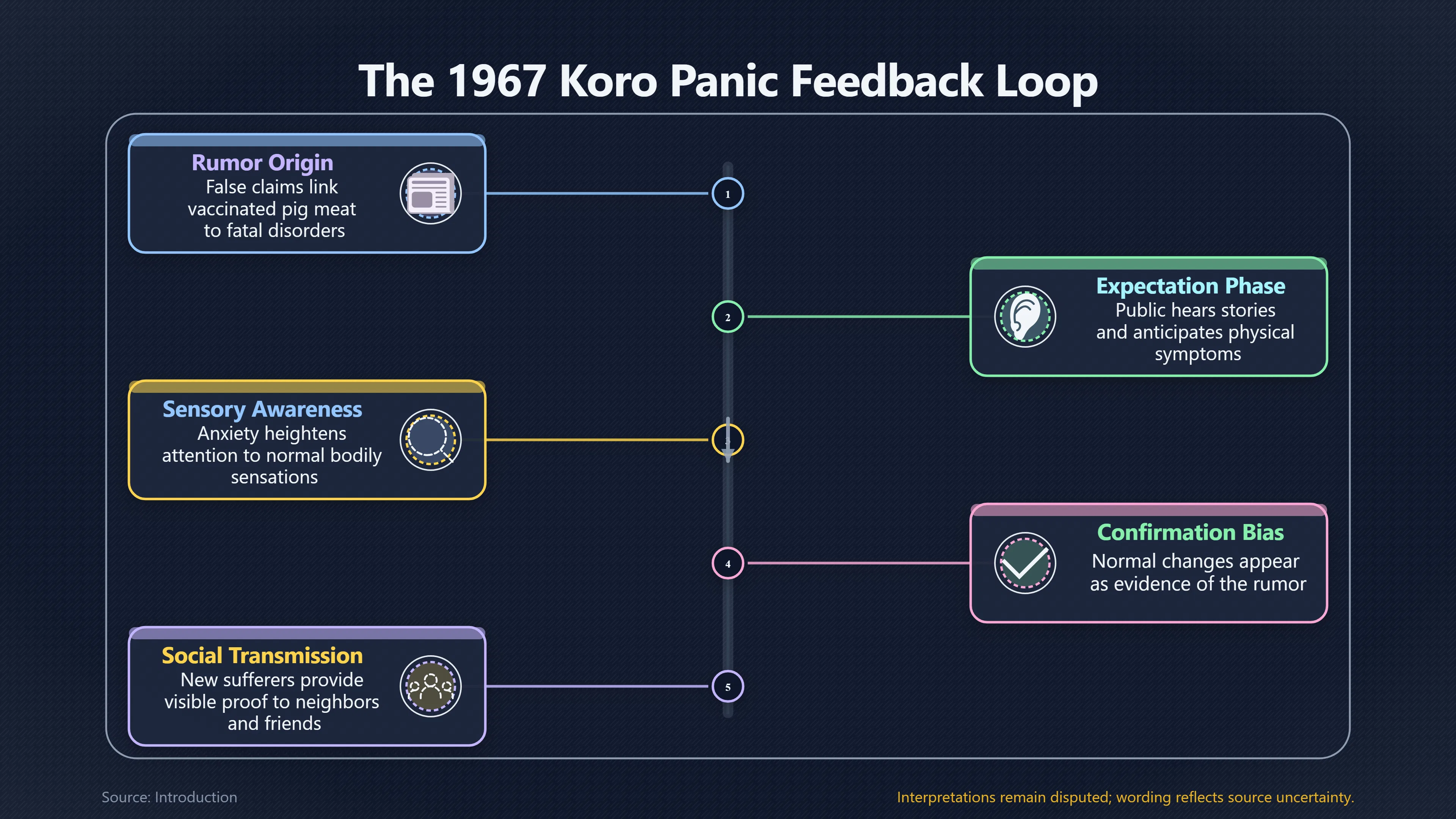
Every confirmed case interviewed during the Singapore outbreak had previously heard stories about genital retraction before experiencing symptoms themselves. This pattern strongly suggests that social transmission of belief, rather than exposure to contaminated food, drove the epidemic. Researchers later described the outbreak as a feedback loop:
- a frightening rumour created expectation;
- expectation heightened awareness of normal bodily changes;
- those changes appeared to confirm the rumour;
- each new sufferer became further evidence for friends, relatives and neighbours.
Many patients attempted to prevent the imagined retraction by physically holding the penis, tying it with string, attaching clamps or asking relatives to keep pulling it forward. These measures reflected the sincerity of their fear and occasionally caused minor injuries, even though doctors found no anatomical process capable of producing the disappearance that patients believed was occurring.[sma.org.sg]smj.sma.org.sgVol. 10, No. 4June 29, 2017…

Why the panic spread so quickly
Several factors combined to make the outbreak unusually contagious.
First, the rumour attached itself to a real public issue. Swine fever and pig vaccination were genuine news stories, making the false claim seem plausible rather than fantastical.
Second, the feared symptom was intensely private. People could not easily compare their experience with objective evidence. A momentary sensation of contraction caused by cold weather, anxiety or normal physiology could easily be interpreted as confirmation of the rumour.
Third, the belief already existed in parts of the local Chinese cultural tradition. Researchers have stressed that this did not make people irrational. Instead, existing ideas about genital retraction provided a familiar framework for interpreting ambiguous sensations once the rumour appeared. Modern historians and psychiatrists therefore emphasise an interaction between cultural expectations, psychological processes and social communication, rather than a simple explanation based on “superstition”.[sagepub.com]journals.sagepub.comSage Journals A Conceptual History of KoroSage JournalsA Conceptual History of Koro - Chris Buckle, Y.M. Lisa Chuah, Calvin S.L. Fones, Albert H.C. Wong, 2007…
Finally, visible evidence reinforced the panic. Crowded hospital waiting rooms full of anxious men appeared to confirm that something extraordinary was happening. Each patient’s arrival validated the fears of others, accelerating the cycle.
How public reassurance broke the epidemic
The same mechanisms that spread the panic also made it vulnerable to targeted intervention.
Early official statements from agricultural authorities emphasised that swine fever and pig vaccination were harmless to humans. Ironically, these reassurances did little at first because they still focused public attention on pigs and vaccination, allowing some people to interpret the government’s response as confirmation that there really was something to worry about.
The decisive change came when medical authorities directly challenged the rumour’s central claim. Doctors from the Singapore Medical Association and the Ministry of Health used newspapers, radio and television to explain that:
- eating pork could not cause genital retraction;
- the anatomy of the penis made the feared disappearance impossible;
- the condition reflected fear rather than poisoning;
- no one had died from genital retraction.
By addressing the specific belief driving the panic instead of merely urging calm, officials removed the rumour’s credibility. Hospital admissions fell sharply almost immediately, and within days the epidemic had effectively ended. The episode has since become an influential example of effective crisis communication: successful reassurance worked because it confronted the precise mechanism of the rumour rather than issuing vague appeals against panic.[sma.org.sg]smj.sma.org.sgVol. 10, No. 4June 29, 2017…
Why the 1967 outbreak still matters
The Singapore koro epidemic remains important because it demonstrates how collective fear can spread through entirely ordinary social processes. No coercive organisation, charismatic leader or supernatural event was required. A believable rumour, widespread conversation and shared interpretation of ambiguous bodily sensations proved sufficient.
The episode has also shaped later scholarship. Earlier psychiatric writing often described koro simply as a “culture-bound syndrome”, implying that it reflected unusual local beliefs. More recent historians, psychologists and cultural psychiatrists argue for a broader interpretation. They see the 1967 epidemic as an example of how culture provides the language through which anxiety is expressed, while rumour, media coverage, interpersonal trust and heightened attention to the body determine how rapidly that anxiety spreads.
For Singapore, the outbreak remains a striking reminder that misinformation can produce genuine suffering even without an underlying physical disease. It also illustrates that carefully targeted, scientifically credible communication can interrupt a contagious cycle of fear remarkably quickly.[nih.gov]pubmed.ncbi.nlm.nih.govMaking up koro: multiplicity, psychiatry, culture, and penis-shrinking anxieties - PubMed…
Amazon book picks
Further Reading
Books and field guides related to Why Did Singapore's Koro Panic Spread So Fast?. Use these as the next step if you want deeper reading beyond the article.
Extraordinary Popular Delusions and the Madness of Crowds
Rating: 4.0/5 from 5 Google Books ratings
Background on contagious belief.

The Man Who Mistook His Wife for a Hat
Introduces unusual neurological and psychological experiences.


Endnotes
1.
Source: smj.sma.org.sg
Title: Vol. 10, No. 4
Link:https://smj.sma.org.sg/1004/1004smj5.pdf
Source snippet
June 29, 2017...
Published: June 29, 2017
2.
Source: smj.sma.org.sg
Title: sma.org.sg Singapore Medical Association
Link:https://smj.sma.org.sg/smjmainpages/1004main.html
3.
Source: smj.sma.org.sg
Title: sma.org.sg Singapore Medical Association
Link:https://smj.sma.org.sg/smjmainpages/0804main.html
4.
Source: youtube.com
Title: Episode 71. Frenzy – The Turmoil of Mass Psychogenic Illness
Link:https://www.youtube.com/watch?v=e2AdorYLDF8
Source snippet
Koro - Shrinking Penis Syndrome - What is it? Short Documentary...
5.
Source: youtube.com
Link:https://www.youtube.com/watch?v=VjDQ28pnRZk
Source snippet
JUDITH'S AESTHETIC TRAUMA IN THE OLYMPUS OF THE GODDESSES with HENAR ÁLVAREZ and JUDITH TIRAL...
6.
Source: journals.sagepub.com
Title: Sage Journals A Conceptual History of Koro
Link:https://journals.sagepub.com/doi/10.1177/1363461507074967
Source snippet
Sage JournalsA Conceptual History of Koro - Chris Buckle, Y.M. Lisa Chuah, Calvin S.L. Fones, Albert H.C. Wong, 2007...
7.
Source: pubmed.ncbi.nlm.nih.gov
Link:https://pubmed.ncbi.nlm.nih.gov/21511718/
Source snippet
Making up koro: multiplicity, psychiatry, culture, and penis-shrinking anxieties - PubMed...
8.
Source: journals.sagepub.com
Link:https://journals.sagepub.com/doi/pdf/10.1177/0073275314567439
9.
Source: journals.sagepub.com
Link:https://journals.sagepub.com/doi/10.1177/0073275314567439
10.
Source: journals.sagepub.com
Link:https://journals.sagepub.com/doi/10.1177/136346157100800108
11.
Source: pmc.ncbi.nlm.nih.gov
Link:https://pmc.ncbi.nlm.nih.gov/articles/PMC11859200/
12.
Source: pubmed.ncbi.nlm.nih.gov
Link:https://pubmed.ncbi.nlm.nih.gov/5371145/
13.
Source: pmc.ncbi.nlm.nih.gov
Link:https://pmc.ncbi.nlm.nih.gov/articles/PMC1985281/
14.
Source: pubmed.ncbi.nlm.nih.gov
Link:https://pubmed.ncbi.nlm.nih.gov/5688940/
15.
Source: pmc.ncbi.nlm.nih.gov
Link:https://pmc.ncbi.nlm.nih.gov/articles/PMC1985281/?page=0
16.
Source: pmc.ncbi.nlm.nih.gov
Link:https://pmc.ncbi.nlm.nih.gov/articles/PMC1985281/?page=1
17.
Source: pubmed.ncbi.nlm.nih.gov
Link:https://pubmed.ncbi.nlm.nih.gov/5301571/
Additional References
18.
Source: research.ed.ac.uk
Link:https://www.research.ed.ac.uk/en/publications/making-up-koro-multiplicity-psychiatry-culture-and-penis-shrinkin/
Source snippet
inburgh ResearchMaking up Koro: Multiplicity, Psychiatry, Culture and Penis-Shrinking Anxieties - University of Edinburgh Research Expl...
19.
Source: straitstimes.com
Link:https://www.straitstimes.com/singapore/light-in-dark-times
Source snippet
July 15, 2025 — ‘SPANISH’ FLU On July 3, 1918, as a mysterious virus started sweeping the world, The Straits Times reported that Singapor...
Published: July 15, 2025
20.
Source: straitstimes.com
Link:https://www.straitstimes.com/singapore/three-times-that-the-world-coughed-and-singapore-caught-the-bug
Source snippet
June 28, 2026 — COVID-19 SPECIAL: One hundred years of pandemics THREE TIMES THAT THE WORLD COUGHED, AND SINGAPORE CAUGHT THE BUG Be it '...
Published: June 28, 2026
21.
Source: resolve.cambridge.org
Title: Seabra, I. Lopes, J. Moura, J. Leal, T. Rocha, J. Cunha, S
Link:https://resolve.cambridge.org/core/journals/european-psychiatry/article/unveiling-koros-diverse-conceptualizations-across-cultures/64473C1CBD02862C4A8BB3EF594E1FCD
Source snippet
Koro’s diverse conceptualizations across cultures | European Psychiatry | Cambridge CoreAugust 27, 2024 — UNVEILING KORO’S DIVERSE CONCEP...
Published: August 27, 2024
22.
Source: straitstimes.com
Title: from the archives sts coverage of past pandemics
Link:https://www.straitstimes.com/singapore/from-the-archives-sts-coverage-of-past-pandemics
Source snippet
From the archives: ST's coverage of past pandemics | The Straits TimesApril 18, 2020 — FROM THE ARCHIVES: ST'S COVERAGE OF PAST PANDEMICS...
Published: April 18, 2020
23.
Source: link.springer.com
Link:https://link.springer.com/book/10.1007/978-3-030-87962-4
Source snippet
springer.comKoro: Clinical and Historical Developments of the Culturally Defined Genital Retraction Disorder | Springer Nature LinkDecemb...
24.
Source: localnewsingapore.com
Link:https://localnewsingapore.com/from-the-straits-times-archives-past-mass-hysteria-cases-in-singapore/
25.
Source: researchgate.net
Link:https://www.researchgate.net/publication/275240277_Translating_culture_and_psychiatry_across_the_Pacific_How_Koro_became_culture-bound
26.
Source: youtube.com
Title: This crazy rumor triggered a real panic
Link:https://www.youtube.com/watch?v=5S7BTSmeOI0
Source snippet
Episode 71. Frenzy – The Turmoil of Mass Psychogenic Illness...
27.
Source: mothership.sg
Link:https://mothership.sg/2016/11/sporean-men-panicked-in-1967-over-strange-case-of-shrinking-genitals-known-as-koro/
Topic Tree