Within Uganda Belief and Fear
How a Spirit Led Army Marched South
Alice Lakwena's movement turned spiritual purification, wartime fear and strict discipline into a powerful armed rebellion.
On this page
- Alice Lakwena and the Holy Spirit Movement
- Why war and insecurity made the message powerful
- From spiritual rebellion to the Lord's Resistance Army
Page outline Jump by section
Introduction
The story of Uganda’s “spirit armies” is not one of irrational mass belief alone, nor simply one of military rebellion. It is the story of how spiritual authority, political collapse, ethnic insecurity and civil war became tightly intertwined in northern Uganda during the late 1980s. The best-known movement was Alice Lakwena’s Holy Spirit Movement, whose followers believed that spiritual purification, strict moral discipline and obedience to divine instructions could transform ordinary people into a victorious army. Although the movement was militarily defeated within little more than a year, its ideas profoundly influenced later armed groups, most notably the Lord’s Resistance Army (LRA).
For historians and anthropologists, these movements are important because they reveal how communities under extreme pressure can combine existing religious traditions with new Christian teachings to make sense of violence, loss and political upheaval. Rather than dismissing them as examples of simple fanaticism, most modern scholarship places them within the wider social crisis that engulfed Acholi society after years of civil war.[cambridge.org]cambridge.orgCambridge University Press & AssessmentUnderstanding Alice: Uganda's Holy Spirit Movement in context | Africa | Cambridge CoreDecember 7…
Alice Lakwena and the Holy Spirit Movement
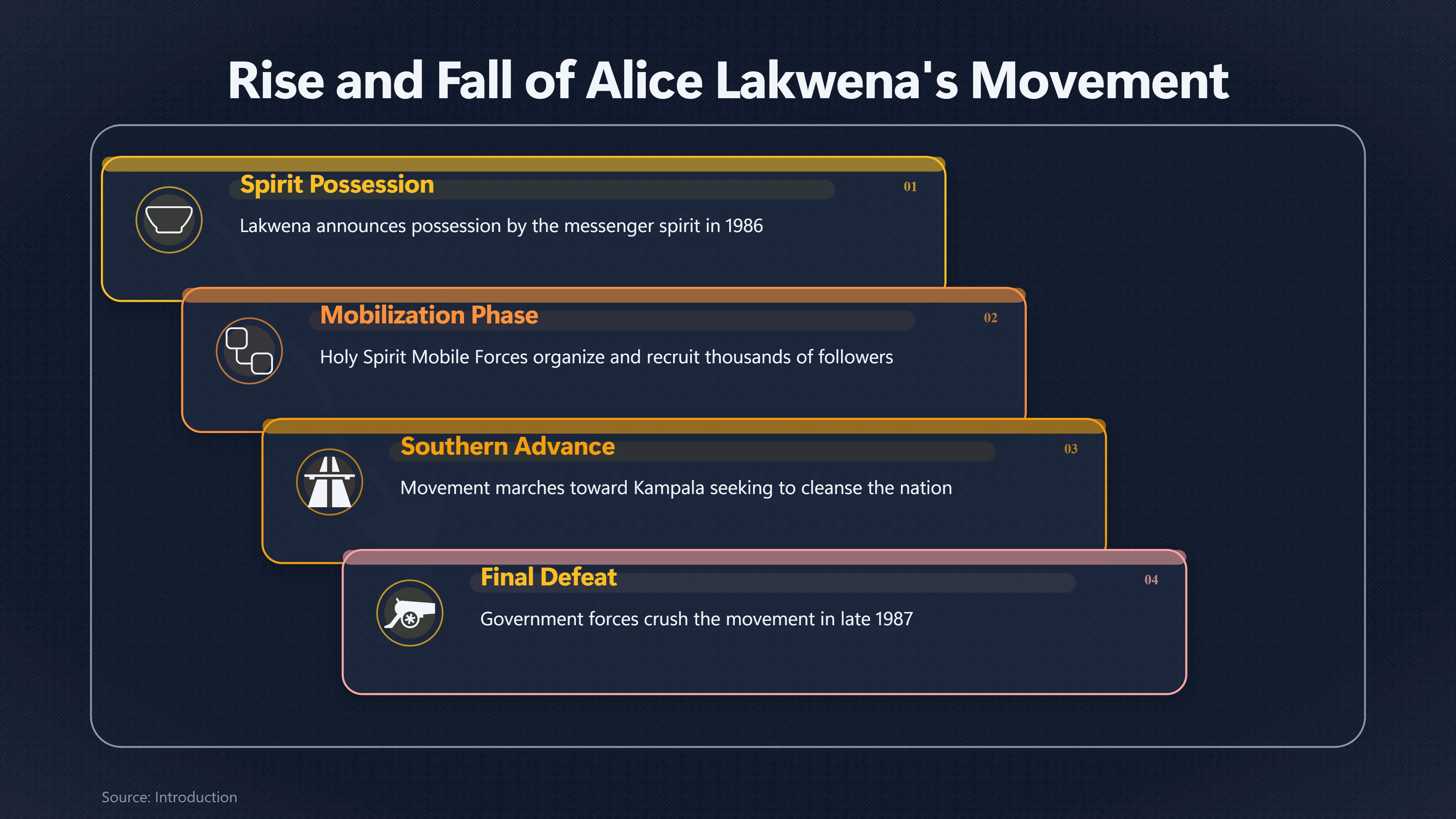
Alice Auma, later known as Alice Lakwena, was an Acholi woman who worked as a healer before announcing in 1986 that she had become possessed by a spirit called Lakwena, meaning “messenger”. According to her followers, the spirit instructed her to abandon healing and lead a campaign to cleanse Uganda of sin, corruption and violence. She organised what became known as the Holy Spirit Mobile Forces, combining military organisation with elaborate religious rituals.[OUP Academic]academic.oup.comOUP AcademicLakwena, Alice | Oxford Research Encyclopedia of African History | Oxford Academic…
The movement emerged immediately after the National Resistance Army (NRA), led by Yoweri Museveni, had taken power. Many Acholi people feared revenge because previous governments and armies had been closely associated with Acholi soldiers. Thousands of former soldiers returned home defeated, armed and uncertain of their future. The Holy Spirit Movement offered not only resistance to the new government but also a moral explanation for why disaster had befallen the community.[cambridge.org]cambridge.orgCambridge University Press & AssessmentUnderstanding Alice: Uganda's Holy Spirit Movement in context | Africa | Cambridge CoreDecember 7…
Unlike a conventional military force, the movement viewed warfare as a spiritual struggle. Defeat was explained as the result of impurity or disobedience rather than poor tactics alone. Success depended upon maintaining ritual discipline as much as battlefield skill.[BiblioVault]bibliovault.orgAlice Lakwena and the Holy Spirits: War in Northern Uganda, 1985–97 (9780821445709): Heike Behrend - BiblioVault…
Holy Spirit tactics and discipline
Members underwent purification ceremonies before joining the army. Lakwena introduced what she called “Holy Spirit Tactics” together with numerous behavioural rules, often described as “Holy Spirit Safety Precautions”. These regulations governed almost every aspect of daily life.
Followers were expected to:
- obey strict moral rules and avoid theft, sexual misconduct and alcohol;
- confess sins and undergo purification rituals;
- reject witchcraft and harmful spiritual practices;
- maintain absolute obedience to spiritual instructions;
- believe that ritual purity increased divine protection in battle.
Some accounts describe the use of blessed water, oil, shea butter and symbolic objects during military preparations. Outsiders often focused on reports that followers believed bullets could be transformed or rendered harmless. Modern researchers caution that such beliefs varied within the movement and should be understood within its wider religious system rather than treated as isolated examples of irrationality. The movement combined Christian imagery, Acholi spirit possession traditions and military discipline into a coherent worldview for its followers.[bibliovault.org]bibliovault.orgAlice Lakwena and the Holy Spirits: War in Northern Uganda, 1985–97 (9780821445709): Heike Behrend - BiblioVault…
Why war and insecurity made the message powerful
The Holy Spirit Movement cannot be understood without the crisis facing northern Uganda during the mid-1980s.
Years of civil conflict had shattered normal social structures. Families had been displaced, former government soldiers were returning home without livelihoods, and trust in political leaders had collapsed. Violence had become an everyday reality, while many people struggled to explain why their communities had suffered repeated military defeats.
Alice Lakwena’s message answered several pressing questions at once.[academic.oup.com]academic.oup.comOUP AcademicLakwena, Alice | Oxford Research Encyclopedia of African History | Oxford Academic…
First, it transformed military failure into a moral problem. Defeat did not necessarily mean that God had abandoned the Acholi people; instead, it reflected the need for collective purification.
Second, it provided a disciplined organisation at a time when armed groups were often fragmented and poorly coordinated. Spiritual authority became a means of enforcing military obedience.
Third, it drew upon religious ideas already familiar within Acholi society. Spirit possession, healing and communication with invisible beings had long existed alongside Christianity rather than being completely separate from it. Lakwena’s movement blended these traditions instead of replacing either one. Tim Allen argues that Western accounts often exaggerated the movement’s strangeness while overlooking these local historical and religious continuities.[Cambridge University Press & Assessment]cambridge.orgCambridge University Press & AssessmentUnderstanding Alice: Uganda's Holy Spirit Movement in context | Africa | Cambridge CoreDecember 7…
Anthropologist Heike Behrend similarly argues that the Holy Spirit Movement was rooted in local experiences of war and displacement rather than emerging from inexplicable mass delusion. Its spiritual claims made sense within the social and religious landscape of Acholi communities facing extraordinary violence.[OUP Academic]academic.oup.comOUP AcademicLakwena, Alice | Oxford Research Encyclopedia of African History | Oxford Academic…

The march towards Kampala
The Holy Spirit Movement expanded rapidly during 1986 and 1987. Initial victories against government forces enhanced Alice Lakwena’s reputation as a divinely protected leader and attracted recruits from beyond the Acholi heartland. Soldiers, civilians, students, teachers and others joined the movement as it advanced southwards.[Cambridge University Press & Assessment]cambridge.orgUniversity Press & Assessment The Troubles of an Anthropologist (Chapter 1Cambridge University Press & AssessmentThe Troubles of an Anthropologist (Chapter 1) - Alice Lakwena and the Holy Spirits…
Its most ambitious objective became a march towards Kampala, Uganda’s capital. At its height the movement fielded several thousand fighters and came significantly closer to the capital than many observers expected.
However, the movement ultimately proved unable to overcome the government’s better-equipped forces. Major defeats during late 1987 shattered confidence in the army’s spiritual protection. Alice fled into exile in Kenya, where she remained until her death many years later.[BiblioVault]bibliovault.orgAlice Lakwena and the Holy Spirits: War in Northern Uganda, 1985–97 (9780821445709): Heike Behrend - BiblioVault…
For believers, military defeat required explanation. Some concluded that followers had violated spiritual rules. Others believed that enemies possessed their own supernatural powers or that the spirits had withdrawn their protection because of human failings. Such interpretations allowed the broader religious framework to survive even after battlefield failure.[BiblioVault]bibliovault.orgAlice Lakwena and the Holy Spirits: War in Northern Uganda, 1985–97 (9780821445709): Heike Behrend - BiblioVault…
From spiritual rebellion to the Lord’s Resistance Army
The defeat of Alice Lakwena did not end spirit-led armed resistance in northern Uganda.[academic.oup.com]academic.oup.comOUP AcademicLakwena, Alice | Oxford Research Encyclopedia of African History | Oxford Academic…
Several successor movements emerged, drawing upon similar ideas of spirit possession, divine guidance and moral purification. The most significant was the Lord’s Resistance Army under Joseph Kony, who claimed spiritual authority of his own and presented himself as continuing a holy struggle.
Modern historians emphasise that the LRA was not simply the Holy Spirit Movement under a new name. There were important continuities but also profound differences.
Continuities included:
- claims that leaders communicated with spirits;
- emphasis on spiritual purification;
- religious explanations for military success and failure;
- emergence from the same political crisis in Acholi society.
Important differences included:
- the LRA became far more durable, surviving for decades rather than months;
- it increasingly relied on coercion, including the widespread abduction of children;
- its military strategy and treatment of civilians became considerably more brutal;
- its political objectives became less coherent over time.[lse.ac.uk]eprints.lse.ac.ukLSE Research Online Joseph Kony and the Lord’s Resistance ArmyLSE Research OnlineJoseph Kony and the Lord’s Resistance Army - LSE Research Online…
Tim Allen and other scholars argue that understanding this relationship requires recognising both continuity and change. The LRA inherited elements of Alice Lakwena’s spiritual framework but developed into a substantially different organisation with its own leadership, methods and history.[LSE Research Online]eprints.lse.ac.ukLSE Research Online Joseph Kony and the Lord’s Resistance ArmyLSE Research OnlineJoseph Kony and the Lord’s Resistance Army - LSE Research Online…
Why the spirit armies still matter
The spirit armies remain one of the most studied examples of religiously framed armed rebellion in modern Africa because they challenge simple explanations.
They were neither merely “cults” nor simply military insurgencies. They combined spiritual experience, ethnic identity, political protest, moral reform and armed conflict in ways that reflected the extreme conditions facing northern Uganda during the 1980s.
The movements also illustrate the dangers of reducing complex historical events to stereotypes about irrational belief. Contemporary research instead shows how religious language became a practical way for traumatised communities to interpret war, rebuild authority and organise resistance under conditions of profound uncertainty. Understanding the Holy Spirit Movement therefore helps explain not only the origins of the Lord’s Resistance Army but also how collective belief can become intertwined with political violence during periods of social collapse.
Amazon book picks
Further Reading
Books and field guides related to How a Spirit-Led Army Marched South. Use these as the next step if you want deeper reading beyond the article.

Endnotes
1.
Source: cambridge.org
Link:https://www.cambridge.org/core/services/aop-cambridge-core/content/view/DE89E3724443D29715DE5303EC10CE5B/S000197200005734Xa.pdf/div-class-title-understanding-alice-uganda-s-holy-spirit-movement-in-context-div.pdf
Source snippet
Cambridge University Press & AssessmentUnderstanding Alice: Uganda's Holy Spirit Movement in context | Africa | Cambridge CoreDecember 7...
2.
Source: academic.oup.com
Link:https://academic.oup.com/edited-volume/61663/chapter-abstract/553497155
Source snippet
OUP AcademicLakwena, Alice | Oxford Research Encyclopedia of African History | Oxford Academic...
3.
Source: bibliovault.org
Link:https://www.bibliovault.org/BV.book.epl?ISBN=9780821445709
Source snippet
Alice Lakwena and the Holy Spirits: War in Northern Uganda, 1985–97 (9780821445709): Heike Behrend - BiblioVault...
4.
Source: academic.oup.com
Link:https://academic.oup.com/afraf/article-abstract/98/390/5/32908
Source snippet
OUP AcademicKONY'S MESSAGE: A NEW KOINE?THE LORD'S RESISTANCE ARMY IN NORTHERN UGANDA | African Affairs | Oxford Academic...
5.
Source: cambridge.org
Title: University Press & Assessment The Troubles of an Anthropologist (Chapter 1)
Link:https://www.cambridge.org/core/books/abs/alice-lakwena-and-the-holy-spirits/troubles-of-an-anthropologist/A477DC98587B2D7EFBB4C52DBBC8FCE8
Source snippet
Cambridge University Press & AssessmentThe Troubles of an Anthropologist (Chapter 1) - Alice Lakwena and the Holy Spirits...
6.
Source: academic.oup.com
Link:https://academic.oup.com/book/25314/chapter/192310104
7.
Source: cambridge.org
Title: Alice Lakwena and the Holy Spirits
Link:https://www.cambridge.org/core/books/alice-lakwena-and-the-holy-spirits/C6B1550B5A6FD3FD6197D36325AB9DA2
8.
Source: cambridge.org
Title: The Holy Spirit Movement as a Regional Cult (Chapter 5)
Link:https://www.cambridge.org/core/books/abs/alice-lakwena-and-the-holy-spirits/holy-spirit-movement-as-a-regional-cult/CC985B63B80B8AF74E1EDD3CB2D4BF63
9.
Source: cambridge.org
Link:https://www.cambridge.org/core/books/abs/alice-lakwena-and-the-holy-spirits/preface/F50809B2824817BF67A5BA2D669DD6E2
10.
Source: cambridge.org
Title: The War of the Holy Spirit Mobile Forces (Chapter 4)
Link:https://www.cambridge.org/core/books/alice-lakwena-and-the-holy-spirits/war-of-the-holy-spirit-mobile-forces/A54493239EB9AD081CC37DC7D14E8FB2
11.
Source: cambridge.org
Title: The Texts of the Holy Spirit Movement (Chapter 9)
Link:https://www.cambridge.org/core/books/abs/alice-lakwena-and-the-holy-spirits/texts-of-the-holy-spirit-movement/4FBAB5BBEC762D2F43555F2F7617F168
12.
Source: cambridge.org
Link:https://www.cambridge.org/core/journals/africa/article/abs/understanding-alice-ugandas-holy-spirit-movement-in-context/DE89E3724443D29715DE5303EC10CE5B
13.
Source: bibliovault.org
Link:https://www.bibliovault.org/BV.book.epl?ISBN=9780821413111
14.
Source: eprints.lse.ac.uk
Title: LSE Research Online Joseph Kony and the Lord’s Resistance Army
Link:https://eprints.lse.ac.uk/125027/
Source snippet
LSE Research OnlineJoseph Kony and the Lord’s Resistance Army - LSE Research Online...
15.
Source: military-history.fandom.com
Title: Holy Spirit Movement
Link:https://military-history.fandom.com/wiki/Holy_Spirit_Movement
Additional References
16.
Source: degruyterbrill.com
Title: Alice Lakwena and the Holy Spirits
Link:https://www.degruyterbrill.com/de/document/doi/10.1515/9781782049845/html
Source snippet
Ihre Dokumente können jetzt angezeigt werden. Behrend, Heike. Alice Lakwena and the Holy Spirits: War in Northern Uganda, 1986-97, Boydel...
17.
Source: degruyterbrill.com
Title: Alice Lakwena and the Holy Spirits
Link:https://www.degruyterbrill.com/document/doi/10.1515/9781782049845/html
Source snippet
Your documents are now available to view. Behrend, Heike. Alice Lakwena and the Holy Spirits: War in Northern Uganda, 1986-97, Boydell an...
18.
Source: degruyterbrill.com
Title: Alice Lakwena and the Holy Spirits
Link:https://www.degruyterbrill.com/document/doi/10.1515/9781782049845/html?lang=en
Source snippet
Your documents are now available to view. Behrend, Heike. Alice Lakwena and the Holy Spirits: War in Northern Uganda, 1986-97, Boydell an...
19.
Source: youtube.com
Title: Jinja; The fierce battle that ended Alice Lakwena’s rebellion
Link:https://www.youtube.com/watch?v=FJ1S7XFHzio
Source snippet
Alice Lakwena Shouldn't Be Blamed for the Suffering of the Acholi People says Younger Sister...
20.
Source: youtube.com
Link:https://www.youtube.com/watch?v=9lu7nQTLq7Y
Source snippet
Jinja; The fierce battle that ended Alice Lakwena's rebellion...
21.
Source: youtube.com
Title: History of Alice Auma Lakwena?
Link:https://www.youtube.com/watch?v=Wu5P3HZBCIc
Source snippet
"Army of God: Joseph Kony's War in Central Africa" -- David Axe and Tim Hamilton with Rona Peligal...
22.
Source: youtube.com
Link:https://www.youtube.com/watch?v=67rdDFQLyCE
Source snippet
History of Alice Auma Lakwena?...
23.
Source: africabib.org
Link:https://www.africabib.org/rec.php?DB=p&RID=182983285
24.
Source: africabib.org
Link:https://www.africabib.org/rec.php?DB=p&RID=090025148
25.
Source: pascal-francis.inist.fr
Link:https://pascal-francis.inist.fr/vibad/index.php?action=getRecordDetail&idt=6154236
Topic Tree