Within China
How Did a Soul Stealing Rumour Grip China?
Rumours of stolen souls became a national witch hunt as frightened communities, forced confessions and imperial suspicion reinforced one another.
On this page
- What people feared and who became suspects
- How torture and confession manufactured a conspiracy
- Why the emperor turned rumour into a political crisis
Page outline Jump by section
Introduction
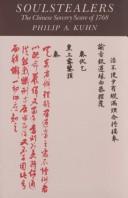
In 1768, one of the Qing dynasty’s most remarkable episodes of collective fear swept across eastern and central China. Rumours claimed that wandering sorcerers could steal a person’s soul by cutting off a lock of hair, clipping the mandatory queue braid, or secretly obtaining personal items to use in magical rituals. What began as scattered local accusations rapidly developed into a nationwide panic involving frightened villagers, travelling monks, beggars, craftsmen, provincial officials and eventually the Qianlong Emperor himself. Although no evidence ever demonstrated the existence of an organised network of “soul stealers”, the panic generated arrests, torture, forced confessions and widespread suspicion. Historians regard the episode as one of the clearest documented examples of popular rumour combining with state coercion to manufacture an imaginary conspiracy.[Google Books]books.google.comGoogle BooksSoulstealers: The Chinese Sorcery Scare of 1768 - Philip A. Kuhn - Google BooksJuly 1, 2009…
What People Feared and Who Became Suspects
The rumours centred on a belief that a person’s vital essence could be stolen through acts of sorcery. Hair had symbolic power because it was understood to retain a connection with its owner. Even a small clipping could supposedly allow a magician to weaken or control the victim.
The panic became especially explosive because Qing law required Han Chinese men to wear the queue hairstyle imposed after the Manchu conquest. Cutting the queue was therefore more than an alleged magical attack. It also suggested disrespect for imperial authority and hinted at political rebellion. An assault on a queue could be interpreted simultaneously as witchcraft and sedition.[Google Books]books.google.comGoogle BooksSoulstealers: The Chinese Sorcery Scare of 1768 - Philip A. Kuhn - Google BooksJuly 1, 2009…
Those most likely to attract suspicion were people who already stood outside village society:
- itinerant monks and religious wanderers;
- beggars;
- travelling craftsmen, particularly masons working on bridges and buildings;
- fortune tellers and healers;
- strangers passing through unfamiliar communities.
Many accusations claimed these travellers asked for names, touched clothing or cut hair while victims slept. Others alleged that builders buried enchanted objects inside construction projects so that labourers’ souls would strengthen new bridges or walls. Such beliefs drew upon much older Chinese traditions concerning ritual power and construction magic, making the rumours sound plausible to frightened communities even though no physical evidence supported them.[Google Books]books.google.comGoogle BooksSoulstealers: The Chinese Sorcery Scare of 1768 - Philip A. Kuhn - Google BooksJuly 1, 2009…
How Torture and Confession Manufactured a Conspiracy
The strongest evidence that the supposed conspiracy never existed comes from the way investigators produced their “proof”.
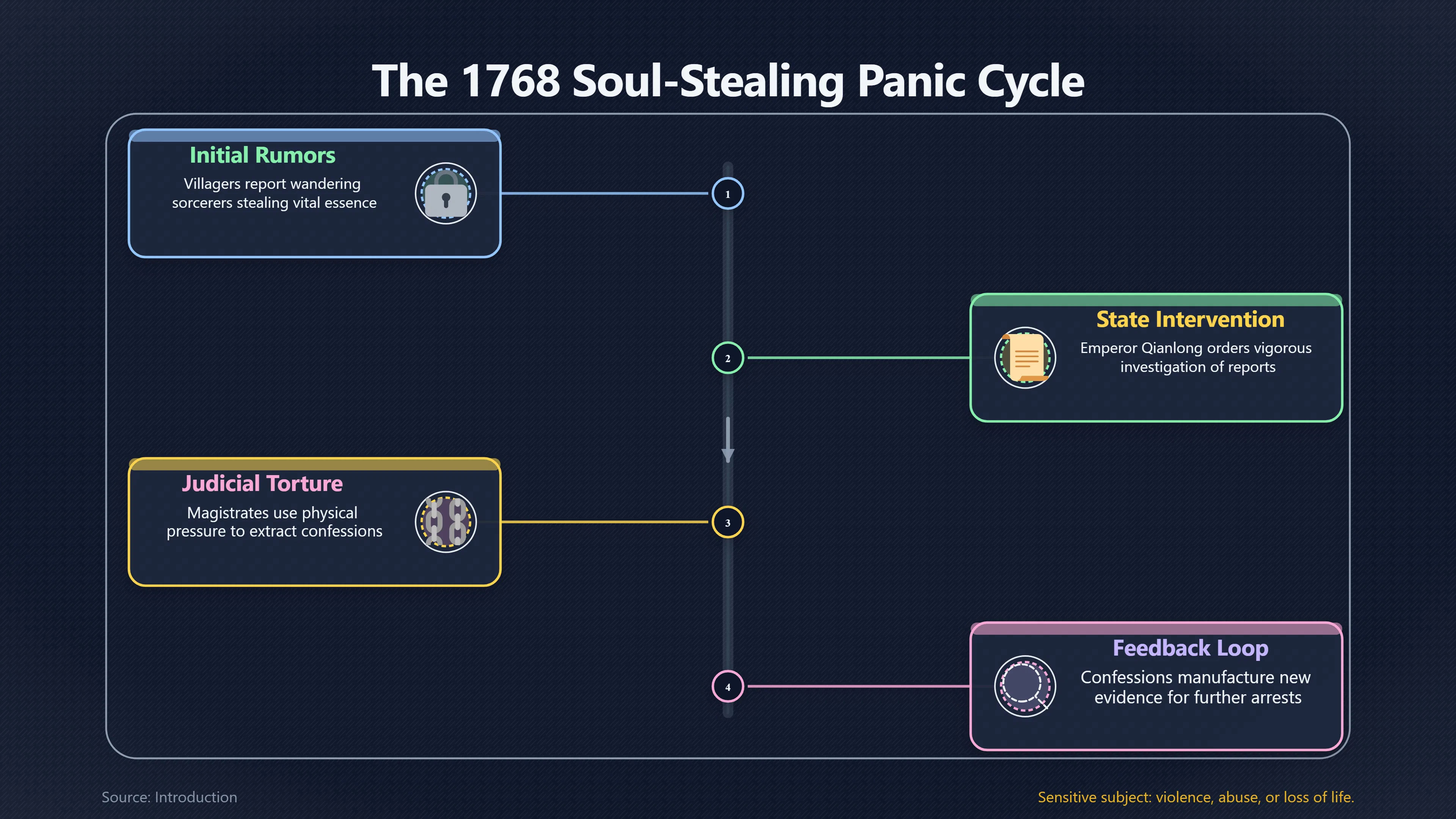
Local magistrates were expected to solve alarming cases quickly. Once suspects were arrested, many were interrogated under judicial torture, which was legally permitted within prescribed limits in Qing criminal procedure for serious offences. Under extreme physical pressure, prisoners frequently admitted impossible crimes or implicated additional suspects simply to stop the pain.
The resulting confessions displayed several revealing features:
- different suspects repeated inconsistent stories;
- alleged conspiracies constantly changed shape;
- new “master sorcerers” appeared only because previous prisoners named them;
- no independent evidence ever confirmed the magical acts being described.
Instead of exposing a real organisation, each confession expanded the investigation into another chain of arrests. Modern historians see this as a classic feedback loop in which coercive questioning transformed rumour into apparently official evidence.[Google Books]books.google.comGoogle BooksSoulstealers: The Chinese Sorcery Scare of 1768 - Philip A. Kuhn - Google BooksJuly 1, 2009…
Philip A. Kuhn’s influential reconstruction of the panic relies heavily on surviving memorials, interrogation records, provincial correspondence and imperial documents preserved in Qing archives. These records allow historians to compare accusations across different provinces and reveal how stories evolved during repeated questioning rather than pointing towards any genuine underground network.[Google Books]books.google.comGoogle BooksSoulstealers: The Chinese Sorcery Scare of 1768 - Philip A. Kuhn - Google BooksJuly 1, 2009…

Why the Emperor Turned Rumour into a Political Crisis
One reason the panic became so extensive was the personal intervention of the Qianlong Emperor.
Many provincial officials initially regarded the accusations as local superstition. They attempted to calm communities or dismissed cases for lack of evidence. The emperor, however, interpreted reports differently. He feared that apparent sorcery might conceal organised political subversion or expose failures by local administrators.
As imperial orders became increasingly urgent, officials found themselves under conflicting pressures. If they dismissed accusations, they risked appearing complacent or disloyal. If they pursued them aggressively, they generated more arrests and more dubious confessions.
This transformed the character of the crisis. The emperor’s insistence on vigorous investigation encouraged provincial administrations to search ever harder for hidden conspirators. Bureaucratic incentives therefore reinforced popular fear instead of reducing it. What had begun as scattered village rumours became an empire-wide political investigation.[Google Books]books.google.comGoogle BooksSoulstealers: The Chinese Sorcery Scare of 1768 - Philip A. Kuhn - Google BooksJuly 1, 2009…
Kuhn argues that the emperor’s response also reflected broader concerns about governing an enormous empire. The campaign allowed him to test the loyalty and competence of provincial officials while reinforcing central authority over the bureaucracy. Whether or not soul stealers existed became less important than demonstrating that officials were responding energetically to perceived threats.[Google Books]books.google.comGoogle BooksSoulstealers: The Chinese Sorcery Scare of 1768 - Philip A. Kuhn - Google BooksJuly 1, 2009…
What the Historical Evidence Actually Shows
The soul-stealing panic is unusually well documented because Qing administrators generated extensive paperwork during the investigations.
Several kinds of evidence survive:
- imperial edicts and memorials exchanged between the throne and provincial governors;
- judicial records describing arrests and interrogations;
- reports tracking the spread of rumours between provinces;
- official correspondence revealing disagreement among administrators.
Taken together, these documents support several conclusions.
First, the panic itself was real. Thousands of people genuinely feared soul theft, and officials devoted enormous resources to investigating the reports. Second, innocent people unquestionably suffered. Travellers were arrested, beaten and sometimes tortured because they matched popular stereotypes rather than because reliable evidence existed against them. Third, despite exhaustive investigations, officials never uncovered a coherent organisation of sorcerers capable of carrying out the alleged crimes.[Google Books]books.google.comGoogle BooksSoulstealers: The Chinese Sorcery Scare of 1768 - Philip A. Kuhn - Google BooksJuly 1, 2009…
The archives therefore document not supernatural activity but the social processes through which fear spread. They show rumours travelling along commercial routes, accusations concentrating on outsiders, and official investigations amplifying rather than correcting mistaken beliefs.

Why the Rumours Spread So Easily
Historians generally reject explanations based on simple irrationality. Instead, they emphasise several overlapping social pressures.
The lower Yangtze region was prosperous but also highly mobile. Seasonal labour, long-distance trade and growing populations meant villages regularly encountered unfamiliar people. Outsiders therefore became convenient targets when unexplained anxieties arose.[Google Books]books.google.comGoogle BooksSoulstealers: The Chinese Sorcery Scare of 1768 - Philip A. Kuhn - Google BooksJuly 1, 2009…
The panic also reflected broader political uncertainty. The queue symbolised obedience to Qing rule, so rumours involving hair naturally carried political overtones. Meanwhile, memories of earlier rebellions and secret societies made both ordinary people and imperial officials unusually sensitive to signs of hidden conspiracies.
Finally, the judicial system itself unintentionally encouraged escalation. Confessions extracted through torture appeared to validate rumours, while imperial demands for results discouraged scepticism. Fear produced arrests, arrests produced confessions, and confessions appeared to confirm the original fears.
Why the Soul-Stealing Panic Still Matters
The events of 1768 remain one of China’s best-studied episodes of collective fear because the surviving evidence reveals the interaction between popular belief and state power in exceptional detail.
Rather than demonstrating the existence of widespread sorcery, the records show how ordinary rumours can become politically significant when authorities interpret them as threats to public order. The panic illustrates enduring features found in many historical witch hunts and moral panics: suspicion falls on outsiders, coercive investigations generate false evidence, and official efforts to eliminate an imagined conspiracy inadvertently strengthen belief that the conspiracy exists.
For historians, the episode is valuable precisely because it is so thoroughly documented. The archival record allows researchers to trace, almost step by step, how fear spread through communities, entered government bureaucracy and became an imperial crisis without ever producing credible evidence that the alleged soul-stealing network was real.[google.com]books.google.comGoogle BooksSoulstealers: The Chinese Sorcery Scare of 1768 - Philip A. Kuhn - Google BooksJuly 1, 2009…
Amazon book picks
Further Reading
Books and field guides related to How Did a Soul-Stealing Rumour Grip China?. Use these as the next step if you want deeper reading beyond the article.
Extraordinary Popular Delusions and the Madness of Crowds
Rating: 4.0/5 from 5 Google Books ratings
Offers comparative perspective on mass rumor.

Endnotes
1.
Source: books.google.com
Link:https://books.google.com/books/about/Soulstealers.html?id=fpNB3OFHU04C
Source snippet
Google BooksSoulstealers: The Chinese Sorcery Scare of 1768 - Philip A. Kuhn - Google BooksJuly 1, 2009...
Published: July 1, 2009
2.
Source: play.google.com
Link:https://play.google.com/store/books/details?id=fpNB3OFHU04C
3.
Source: books.google.com
Link:https://books.google.com/books/about/Soulstealers.html?id=MReOAAAAMAAJ
4.
Source: books.google.com
Link:https://books.google.com/books/about/Soulstealers.html?id=CrZ9CEpuzsoC
5.
Source: books.google.com
Link:https://books.google.com/books/about/Soulstealers.html?id=B0JNwRuFdXUC
6.
Source: degruyterbrill.com
Title: De Gruyter Brill Soulstealers
Link:https://www.degruyterbrill.com/document/doi/10.4159/9780674039773/html
7.
Source: degruyterbrill.com
Link:https://www.degruyterbrill.com/document/doi/10.4159/9780674039773/html?lang=en
8.
Source: books.google.com.ec
Link:https://books.google.com.ec/books?id=fpNB3OFHU04C
9.
Source: books.google.com.tn
Link:https://books.google.com.tn/books?id=LcfmEAAAQBAJ
10.
Source: openlibrary.org
Link:https://openlibrary.org/works/OL4464278W/Soulstealers
Additional References
11.
Source: mikedashhistory.com
Link:https://mikedashhistory.com/2016/05/30/sorcerers-and-soulstealers-hair-cutting-panics-in-old-china/
Source snippet
May 30, 2016 — BY MIKE DASH SORCERERS AND SOULSTEALERS: HAIR-CUTTING PANICS IN OLD CHINA 30 May 20168 October 2016 / Mike Dash A Chinese...
Published: May 30, 2016
12.
Source: lewisrhystwiby.wordpress.com
Title: the making of today the 1768 sorcery scare in china july september 1768
Link:https://lewisrhystwiby.wordpress.com/2026/04/19/the-making-of-today-the-1768-sorcery-scare-in-china-july-september-1768/
Source snippet
Making of Today: The 1768 Sorcery Scare in China, July-September 1768 – Lewis Twiby's Past and PresentApril 19, 2026 — THE MAKING OF TODA...
Published: september 1768
13.
Source: youtube.com
Link:https://www.youtube.com/watch?v=VJc_sakNweY
Source snippet
What was the Soulstealing scare of 1768?。 叫魂。 SoulStealers. by Kuhn (book review). Part 2 of 2...
14.
Source: youtube.com
Link:https://www.youtube.com/watch?v=7snRUT_-QLA
Source snippet
Yupeng Jiao: Chinese Martial Arts Ritual Groups in the Mid-Twentieth Century...
15.
Source: youtube.com
Link:https://www.youtube.com/watch?v=fmwhho-9sO4
Source snippet
Chinese Sorcery Scare: The Black Magic Awakening Era of the Qing Dynasty | Yach's Case | Untitled Podcast...
16.
Source: gsgriffin.com
Title: China’s Soulstealers | Griffin
Link:https://gsgriffin.com/2017/05/22/soulstealers/
Source snippet
GRIFFIN CHINA’S SOULSTEALERS Posted on May 22, 2017 by G.S. Griffin under History Kuhn, Philip. “The Roots of Sorcery Fear” p. 94-118 in...
Published: May 22, 2017
17.
Source: youtube.com
Link:https://www.youtube.com/watch?v=stX_YtKk4pY
Source snippet
The 1768 Soul Stealing Panic: How Superstition Became a Political Purge...
18.
Source: lithub.com
Link:https://lithub.com/hair/
Source snippet
Literary Hub » HairJuly 28, 2016 — Despite the exalted state of the human head in Hindu purity laws—few places on the body are more sacre...
Published: July 28, 2016
19.
Source: thechinaproject.com
Link:https://thechinaproject.com/2020/08/12/the-emperor-investigates-soulstealing/
20.
Source: bibliovault.org
Link:https://www.bibliovault.org/BV.book.epl?ISBN=9780674039773
Source snippet
Soulstealers: The Chinese Sorcery Scare of 1768 (9780674039773): Philip A. Kuhn - BiblioVault...
Topic Tree