When Fear, Faith and Power Collided in Gabon
Gabon does not have a well-documented history of classic “mass hysteria” episodes such as dancing plagues or school-wide fainting outbreaks. Its strongest contribution to the history of contagious belief and collective fear lies elsewhere: anti-sorcery movements, colonial scares about indigenous religion, and modern public alarm over alleged ritual killings.
Page outline Jump by section
Introduction
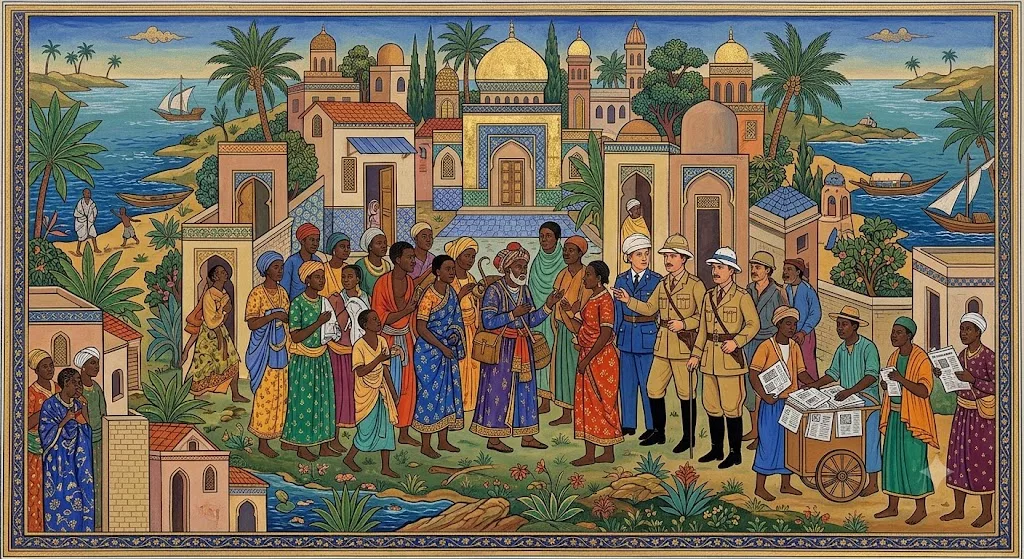
The clearest historical example is the Mademoiselle movement of the 1950s, whose travelling healers promised to expose hidden sorcery and cleanse communities shortly before independence. A second is the colonial treatment of Bwiti, an initiatory Gabonese religion that missionaries and officials often portrayed as sinister or subversive. More recently, real murders involving mutilated bodies have fed a wider fear that powerful people obtain human organs for occult purposes. The crimes, accusations and rumours cannot simply be collapsed into one category: some violence is documented, while many claims about secret sponsors remain unproved.
When anti-sorcery became a mass movement
During the mid-1950s, an anti-sorcery campaign commonly known as Mademoiselle spread through north-eastern and central Gabon. It was associated particularly with the healer Emane Boncoeur, who travelled with ritual specialists and spiritual objects said to identify harmful occult forces, neutralise them and restore communities damaged by jealousy, illness or unexplained misfortune.
The movement was not merely a collection of private healing consultations. It arrived publicly, attracted crowds and placed villages under intense moral scrutiny. People were expected to surrender objects suspected of carrying dangerous power, confess concealed wrongdoing or submit to cleansing. Supporters understood the campaign as protection from sorcery. Yet the same process could create new fears: neighbours might be suspected, family tensions reinterpreted as occult attack, and resistance treated as evidence of guilt.
Anthropologist John Cinnamon describes Mademoiselle as an anti-“fetish” movement that swept through north-eastern Gabon in the years just before independence. Oral accounts connected its arrival with the expansion of electoral politics after the Second World War and with a growing sense that remote northern communities were losing influence over the emerging Gabonese state. The movement therefore expressed not only fear of sorcery but anxiety about who would possess power in the approaching postcolonial order.[Cambridge University Press & Assessment]cambridge.orgCambridge University Press & AssessmentSPIRITS, POWER AND THE POLITICAL IMAGINATION IN…by JM Cinnamon · 2012 · Cited by 12 — Through n…
A campaign supported from above
Mademoiselle complicates the familiar picture of a spontaneous rural panic opposed by a rational state. Colonial administrators monitored the campaign, but some also tolerated or facilitated it because they hoped it would maintain order. Gabonese political figures were involved in arranging or encouraging Emane’s journey. The movement was consequently both popular and politically managed: villagers used it to confront local fears, while administrators and emerging politicians saw opportunities to extend their influence.[SciSpace]scispace.compresent article brings together discussion of late coloniali…
This support did not make the movement controllable. Ritual cleansing could reinforce the very world of occult danger it claimed to abolish. Every supposed discovery demonstrated that hidden sorcery existed; every confiscated object became evidence that communities had been infiltrated. Cinnamon therefore describes its legacy as ambivalent. It promised release from occult domination, but its methods could also subject people to healers who claimed special power to identify invisible wrongdoing.[ResearchGate]researchgate.netAnti-Sorcery and Occult Subjugation in Late Colonial GabonDecember 1, 2002 — Ambivalent Power: Anti-Sorcery and Occult Subjug…
Comparable anti-witchcraft movements circulated across colonial Africa during periods of commercial, political and demographic upheaval. What makes the Gabonese case distinctive is the degree to which spiritual cleansing became linked to the arrival of elections, the changing authority of chiefs and the uneven reach of the colonial state. Mademoiselle was not simply an irrational eruption. It offered a language through which people could argue about inequality, declining local influence and the dangers of newly concentrated political power.
Bwiti and the panic of the colonial authorities
Bwiti is sometimes described casually as a “cult”, but that label is misleading without explanation. It is better understood as a family of Gabonese initiatory religious traditions. Different forms developed among several communities, combining older spiritual practices, healing, ancestor relationships, music and initiation. Some Fang congregations also incorporated Christian symbols and teachings. The psychoactive plant iboga has an important ceremonial role, although Bwiti cannot be reduced to drug use.
Missionaries and French colonial officials frequently viewed the religion through a hostile lens. Its secrecy, night-time ceremonies, initiatory discipline and independent religious authority made it appear dangerous to outsiders. Christian missionaries also saw its adoption of Christian imagery as competition rather than harmless cultural borrowing. Historical research records particularly severe missionary and administrative opposition during the period from the 1930s to the 1950s, when Bwiti was spreading among Fang communities.[Antrocom]antrocom.net20, 2025 — by G Samorini · 2025 · Cited by 5 — Although there was already a clear missionary intolerance towards the traditional Bwiti, t…
The resulting scare was partly religious and partly political. Congregations created forms of solidarity outside mission churches and official chiefly structures. Colonial observers could therefore interpret a healing or initiation society as evidence of secret political organisation. Research on late-colonial Gabon places Bwiti’s growth amid forced labour, abusive guards, weakened chiefs and profound uncertainty about masculine and community authority. Its ceremonies helped people make sense of disruption, but officials often treated that response itself as a threat.[OpenEdition Journals]journals.openedition.orgOpen Edition Journals Cruel Guards and Anxious ChiefsOpen Edition Journals Cruel Guards and Anxious Chiefs
There is no sound basis for equating Bwiti with human sacrifice or the modern crimes commonly called ritual killings. That association often results from placing very different practices—healing, sorcery accusations, secret societies, initiation and criminal mutilation—under one sensational heading. The history of colonial suspicion shows why such distinctions matter. Calling an unfamiliar religion a dangerous cult can reveal more about the fears of missionaries and officials than about the people being described.
Ritual killings: documented crimes and expanding fear
Since at least the late twentieth century, Gabonese campaigners and journalists have reported murders in which victims, often children or young people, were found with body parts removed. These cases are commonly described as “ritual crimes” because organs, blood or bones are believed to be sought for ceremonies intended to obtain wealth, protection or political success.
The underlying murders are not merely folklore. Police investigations, arrests and criminal cases demonstrate that mutilation killings have occurred. In 2013, for example, a Gabonese senator was arrested during an investigation into the killing of a 12-year-old girl. Reuters described it as the first detention of a senior politician in such a case, although arrest did not by itself prove the broader claim that political elites systematically commissioned ritual murders.[Reuters]reuters.comGabon senator arrested in ritual killing caseGabon senator arrested in ritual killing case
Fear intensified in Libreville during the first months of 2013 after mutilated bodies were reportedly discovered on or near beaches. Public anger focused not only on the killings but on the perceived failure of courts and police to identify those ultimately responsible. Thousands joined an anti-crime march in May, and President Ali Bongo announced tougher punishment for murders involving the removal of organs.[Reuters]reuters.comAnger rises in Gabon after rash of ritual killingsAnger rises in Gabon after rash of ritual killings
Concern was already established before that crisis. Ahead of local elections in April 2008, campaigners warned that children could be targeted by people seeking occult assistance for political advancement. Reuters reported widespread allegations that candidates or officials might use ritual specialists to improve their chances of gaining office. These claims circulated most strongly around elections, when competition, money and uncertainty made rumours about concealed power especially persuasive.[Reuters]reuters.comFEATURE-Gabon election raises fears of ritual killingsFEATURE-Gabon election raises fears of ritual killings
What is proven and what remains alleged
Three levels of claim must be kept separate.
First, murders and mutilations have been documented. Bodies have been recovered, families have reported missing children, suspects have been investigated and civil-society organisations have campaigned for stronger protection. Gabon’s reports to United Nations bodies have acknowledged work involving UNICEF and the Association against Ritual Crimes, including research and public-awareness activity concerning violence against children.[OHCHR Document Store]docstore.ohchr.orgDocument Store Convention against Torture and Other Cruel, Inhuman orDocument Store Convention against Torture and Other Cruel, Inhuman or
Second, ritual motivation is sometimes inferred rather than demonstrated. The removal of particular body parts may indicate an occult or commercial purpose, but a mutilated body does not automatically establish the beliefs of the killer. Poor investigations, missing forensic evidence and sensational reporting can leave motive uncertain.
Third, claims that named or unnamed elites ordered the crimes are frequently difficult to prove. Public suspicion is understandable where powerful suspects appear protected or cases remain unresolved. Nevertheless, repeated allegations do not establish that every unexplained killing belongs to a coordinated political network. The gap between visible harm and invisible sponsors is precisely where rumours grow.
This does not make the fear imaginary. A moral panic can develop around real danger. The important question is whether public claims remain proportionate to the available evidence or begin to identify whole religions, professions or social groups as collectively guilty.
Why rumours gather around elections and elites
Stories of occult violence in Gabon often portray power as something acquired through hidden exchange: one person rises because another person has secretly been sacrificed. Such rumours give moral shape to inequality. Sudden wealth, long political careers and apparently untouchable officials become explicable through a narrative in which success has an unseen human cost.
Gabon’s concentration of oil wealth and political authority has made this interpretation especially powerful. Where institutions appear opaque and prosecutions rare, an occult explanation can seem no less plausible than an official denial. Rumours flourish because they connect observable facts—inequality, patronage, unexplained deaths and impunity—into a single story.
The election connection also follows a recognisable pattern:
- political competition raises the perceived value of supernatural protection;
- unexplained disappearances are interpreted through existing stories of sacrifice;
- newspapers and campaign groups repeat earlier allegations;
- warnings cause families to watch for suspicious activity;
- every new discovery is understood as confirmation of the wider pattern.
Rumour in this setting is not simply false information passed between gullible people. Anthropological research treats gossip and sorcery accusation as ways of discussing conflicts that may be dangerous to express directly. Stories about occult clients can communicate an accusation that powerful people exploit the vulnerable, even when the supposed ritual transaction cannot be independently demonstrated.
That symbolism should not distract from practical failures. Families need competent missing-person investigations, forensic examination and transparent trials. When authorities respond only by dismissing public belief as superstition, they may deepen mistrust. When they accept every occult allegation uncritically, they risk misdirecting investigations and encouraging accusations against innocent people.
A history of competing explanations
Researchers have proposed several overlapping explanations for Gabon’s anti-sorcery movements and ritual-crime scares.
Social disruption. Colonial conquest, forced labour, migration, mission education and electoral change altered older forms of authority. Movements such as Mademoiselle translated uncertainty into a struggle between hidden attackers and spiritual cleansers.
Political marginalisation. In north-eastern Gabon, memories of the 1950s movement are closely tied to perceptions that the region was being neglected as political institutions became concentrated elsewhere. Spiritual narratives offered a means of imagining access to distant state power.[Cambridge University Press & Assessment]cambridge.orgCambridge University Press & AssessmentSPIRITS, POWER AND THE POLITICAL IMAGINATION IN…by JM Cinnamon · 2012 · Cited by 12 — Through n…
Inequality and impunity. Modern stories about elite-sponsored sacrifice express mistrust of people who appear able to accumulate wealth without accountability. Unresolved cases reinforce the belief that influential organisers are protected.
Religious competition. Missionaries labelled independent Gabonese practices as primitive or demonic, while indigenous movements could portray rivals as spiritually dangerous. Later churches and healers have sometimes used accusations of witchcraft to explain illness, family conflict or failed fortunes. UNICEF’s wider research on children accused of witchcraft in Africa cautions that such accusations are diverse, historically changing and often wrongly presented as a timeless feature of “African tradition”.[UNICEF]unicef.orgChildren Accused of WitchcraftChildren Accused of Witchcraft
A search for understandable causes. Sorcery beliefs can transform random illness, death or failure into intentional harm. This gives suffering an explanation and identifies possible action, but it may also redirect anger towards neighbours, relatives or marginalised people.
No single theory explains every episode. Mademoiselle involved sincere religious conviction, local conflict and political organisation at the same time. Modern ritual-crime fears combine documented violence with rumours whose scale and sponsorship are much harder to verify.
What Gabon’s cases teach us about collective fear
Gabon’s history cautions against using “mass hysteria” as a catch-all term. There is little firm evidence of a nationally significant outbreak of contagious physical symptoms with no identified medical cause. The better-documented pattern is collective interpretation: communities repeatedly use ideas about hidden spiritual power to explain changing authority, suspicious deaths and unequal access to wealth.
It also shows that panic can move in more than one direction. Villagers may fear sorcerers; healers may intensify that fear while promising protection; missionaries may panic about an indigenous religion; and the public may suspect politicians of commissioning occult crimes. Each group claims to expose a hidden danger, and each can benefit from being recognised as the authority capable of defeating it.
The most responsible reading neither mocks spiritual belief nor treats every occult allegation as established fact. It recognises the reality of bereavement, criminal violence and institutional mistrust while asking what evidence connects a particular crime to a particular belief, practitioner or sponsor. It also distinguishes Bwiti and other religious traditions from criminal acts merely described with the same vocabulary.
Gabon remains culturally important to the study of panics and contagious belief because its cases expose the relationship between fear and government. The central question is not simply whether people believe in sorcery. It is why claims about invisible power become most convincing when visible power is distant, unequal or unaccountable.
Amazon book picks
Further Reading
Books and field guides related to When Fear, Faith and Power Collided in Gabon. Use these as the next step if you want deeper reading beyond the article.

The Golden Bough
Useful background on comparative ideas about ritual, magic and social belief.
African Religions A Very Short Introduction
Explains indigenous belief systems often misunderstood by colonial authorities.
The fate of Africa
Helps readers understand political conditions shaping public fears and power.

African traditional religions in contemporary society
First published 1991. Subjects: Religion, Study and teaching, Congresses, Étude et enseignement, PRO Shaw, Gwendolyn Dubois, 1968- (donor).
Endnotes
1.
Source: cambridge.org
Link:https://www.cambridge.org/core/journals/africa/article/spirits-power-and-the-political-imagination-in-latecolonial-gabon/51C136E4EEB332571E60C16B1F1C22CA
Source snippet
Cambridge University Press & AssessmentSPIRITS, POWER AND THE POLITICAL IMAGINATION IN...by JM Cinnamon · 2012 · Cited by 12 — Through n...
2.
Source: scispace.com
Link:https://scispace.com/pdf/spirits-power-and-the-political-imagination-in-late-colonial-b7516b9mxo.pdf
Source snippet
present article brings together discussion of late coloniali...
3.
Source: researchgate.net
Link:https://www.researchgate.net/publication/236701282_Ambivalent_Power_Anti-Sorcery_and_Occult_Subjugation_in_Late_Colonial_Gabon
Source snippet
Anti-Sorcery and Occult Subjugation in Late Colonial GabonDecember 1, 2002 — Ambivalent Power: Anti-Sorcery and Occult Subjug...
Published: December 1, 2002
4.
Source: antrocom.net
Link:https://antrocom.net/wp/wp-content/uploads/2025/06/samorini-iboga-cults-v-historical-aspects.pdf
Source snippet
20, 2025 — by G Samorini · 2025 · Cited by 5 — Although there was already a clear missionary intolerance towards the traditional Bwiti, t...
5.
Source: researchgate.net
Title: Research Gate Studies on the iboga cults V
Link:https://www.researchgate.net/publication/392496835_Studies_on_the_iboga_cults_V_Historical_aspects
Source snippet
Historical aspects7 Jun 2025 — A historical overview of the religious cults of the Bwiti is then described, both the traditional ones, an...
6.
Source: journals.openedition.org
Title: Open Edition Journals Cruel Guards and Anxious Chiefs
Link:https://journals.openedition.org/etudesafricaines/pdf/15582
7.
Source: reuters.com
Title: Gabon senator arrested in ritual killing case
Link:https://www.reuters.com/article/world/gabon-senator-arrested-in-ritual-killing-case-idUSBRE95707F/
8.
Source: reuters.com
Title: Anger rises in Gabon after rash of ritual killings
Link:https://www.reuters.com/article/lifestyle/anger-rises-in-gabon-after-rash-of-ritual-killings-idUSBRE92P0SG/
9.
Source: reuters.com
Title: FEATURE-Gabon election raises fears of ritual killings
Link:https://www.reuters.com/article/economy/feature-gabon-election-raises-fears-of-ritual-killings-idUSL0964543/
10.
Source: docstore.ohchr.org
Title: Document Store Convention against Torture and Other Cruel, Inhuman or
Link:https://docstore.ohchr.org/SelfServices/FilesHandler.ashx?enc=qpOeOlLMODhInxpfsvVUneBnxBHvdVb273z7cjWYOcM2OAT%2BzWKRCzCwtRWVWTEMli%2BQVqo5WrNLzcyYc0n4Kw%3D%3D
11.
Source: docstore.ohchr.org
Link:https://docstore.ohchr.org/SelfServices/FilesHandler.ashx?enc=TA1vG5u56l%2FQB8sKD0tDT%2FN%2BHOz4quZl17CVVwZByGMtJndSRApTulM7I3WTNvVJNIyCuDGxp9k67ynrC%2FRj4Q%3D%3D
12.
Source: unicef.org
Title: Children Accused of Witchcraft
Link:https://www.unicef.org/nigeria/media/1326/file/%20Children-accused-of-witchcraft-in-Africa.pdf.pdf
13.
Source: researchgate.net
Link:https://www.researchgate.net/publication/342898556_Who%27s_the_witch_Social_exclusion_of_older_Mossi_women_accused_of_Witchcraft_in_Burkina_Faso_Africa
14.
Source: researchgate.net
Link:https://www.researchgate.net/publication/289784863_Witchcraft_Sorcery_Rumors_and_Gossip
15.
Source: researchgate.net
Link:https://www.researchgate.net/publication/329922829_Homosexuality_Witchcraft_and_Power_the_Politics_of_Ressentiment_in_Cameroon
16.
Source: researchgate.net
Title: 399408606 African Science Witchcraft Vodun and Healing in Southern Benin
Link:https://www.researchgate.net/publication/399408606_African_Science_Witchcraft_Vodun_and_Healing_in_Southern_Benin
17.
Source: researchgate.net
Link:https://www.researchgate.net/publication/271759288_Mass_hysteria_among_South_African_primary_school_learners_in_Kwa-Dukuza_KwaZulu-Natal
18.
Source: researchgate.net
Link:https://www.researchgate.net/publication/368419648_Between_Pragmatism_and_Order_Medical_Organization_and_Daily_Routine
19.
Source: ohchr.org
Link:https://www.ohchr.org/sites/default/files/2022-12/PAP-Guidelines-EN.pdf
20.
Source: ohchr.org
Title: human rights council adoptsuniversal periodic review outcomes gabon ghana
Link:https://www.ohchr.org/en/press-releases/2018/03/human-rights-council-adoptsuniversal-periodic-review-outcomes-gabon-ghana
21.
Source: ohchr.org
Title: witchcraft beliefs triggers attacks against people albinism un expert warns
Link:https://www.ohchr.org/en/press-releases/2016/03/witchcraft-beliefs-triggers-attacks-against-people-albinism-un-expert-warns
22.
Source: ohchr.org
Link:https://www.ohchr.org/sites/default/files/Documents/Publications/HR%20PUB_16_2_HR_and_Traditional_Justice_Systems_in_Africa.pdf
23.
Source: ohchr.org
Title: UP R of Guinea-Bissau
Link:https://www.ohchr.org/sites/default/files/lib-docs/HRBodies/UPR/Documents/Session21/GW/GuineaBissauMatriceRecommendations.pdf
24.
Source: docstore.ohchr.org
Title: Files Handler.ashx
Link:https://docstore.ohchr.org/SelfServices/FilesHandler.ashx?enc=G8iP%2BD9RpEH608hHORQF5poyRwKmcpUxOp0uwTCvY8CBsbrGBsjpmXxhVGuanrf3zvkUpZYUHu3W89%2BM2DjoMA%3D%3D
25.
Source: ohchr.org
Link:https://www.ohchr.org/Documents/HRBodies/HRCouncil/RegularSession/Session20/A-HRC-20-16-Add4_en.pdf
26.
Source: ohchr.org
Title: Moving Away from the Death Penalty 2015 web
Link:https://www.ohchr.org/en/newyork/Documents/Moving-Away-from-the-Death-Penalty-2015-web.pdf
27.
Source: ohchr.org
Title: subm colonialism sexual orientation oth university pretoria input 1
Link:https://www.ohchr.org/sites/default/files/documents/cfi-subm/2308/subm-colonialism-sexual-orientation-oth-university-pretoria-input-1.pdf
28.
Source: 2021-2025.state.gov
Link:https://2021-2025.state.gov/report/custom/10d58a46cb/
29.
Source: state.gov
Link:https://www.state.gov/report/custom/7dc0430f48
30.
Source: state.gov
Link:https://www.state.gov/report/custom/6a7d975678
31.
Source: unicef.org
Link:https://www.unicef.org/sites/default/files/2020-04/Hidden-in-plain-sight.pdf
32.
Source: unicef.org
Title: SYMPOSIUM REPORT EN clean final.pdf
Link:https://www.unicef.org/wca/media/11176/file/SYMPOSIUM%20REPORT_EN_clean%20final.pdf.pdf
33.
Source: data.unicef.org
Title: SOWC 2013 75
Link:https://data.unicef.org/wp-content/uploads/2015/12/SOWC_2013_75.pdf
34.
Source: unicef.org
Link:https://www.unicef.org/wcaro/english/WCARO_Nigeria_Factsheets_ChildTrafficking.pdf
35.
Source: unicef.org
Title: Progress For Nations 2000
Link:https://www.unicef.org/media/85576/file/Progress-For-Nations-2000.pdf
36.
Source: unicef.org
Title: WCARO Khamis Final Koranic Pre Schools Briefing Paper
Link:https://www.unicef.org/mauritania/media/1781/file/WCARO%20Khamis%20Final%20Koranic%20Pre-Schools%20Briefing%20Paper.pdf
37.
Source: unicef.org
Title: Progress For Nations 1997
Link:https://www.unicef.org/media/85591/file/Progress-For-Nations-1997.pdf
38.
Source: unicef.org
Title: SITUATION ANALYSIS OF CHILDREN’S RIGHTS AND WELL BEING IN GUINEA BISSAU 2019
Link:https://www.unicef.org/guineabissau/media/1316/file/SITUATION%20ANALYSIS%20OF%20CHILDREN%E2%80%99S%20RIGHTS%20AND%20WELL-BEING%20IN%20GUINEA-BISSAU%202019.pdf
39.
Source: unicef.org
Title: Spotlight Ending Violence Against Women andGirls v2 15062020 WEB 0
Link:https://www.unicef.org/malawi/sites/unicef.org.malawi/files/2020-07/Spotlight_Ending_Violence_Against_Women_andGirls_v2_15062020_WEB_0.pdf
40.
Source: resolve.cambridge.org
Link:https://resolve.cambridge.org/core/services/aop-cambridge-core/content/view/E665904A0795F20D23D7367714E87E3B/9780511616310bib_p205-216_CBO.pdf/references.pdf
41.
Source: cambridge.org
Link:https://www.cambridge.org/core/journals/history-in-africa/article/missionary-expertise-social-science-and-the-uses-of-ethnographic-knowledge-in-colonial-gabon/EC5DD98282A41152D29A20464E5BA7DC
42.
Source: antrocom.net
Title: samorini iboga cults vii traditional bwiti
Link:https://antrocom.net/wp/wp-content/uploads/2025/11/samorini-iboga-cults-vii-traditional-bwiti.pdf
43.
Source: shs.cairn.info
Link:https://shs.cairn.info/article/E_CEA_231_0573/pdf?lang=en
Additional References
44.
Source: academia.edu
Link:https://www.academia.edu/9320338/Ambivalent_Power_Anti_Sorcery_and_Occult_Subjugation_in_Late_Colonial_Gabon
Source snippet
Ambivalent Power: Anti-Sorcery and Occult Subjugation in...This paper examines the complex legacy of Emane Boncoeur's anti-witch...
45.
Source: youtube.com
Link:https://www.youtube.com/watch?v=CXpdvMCUtig
Source snippet
Witchcraft? Rituals at Gabon President's inauguration that shocked African Presidents...
46.
Source: youtube.com
Title: Iboga & Bwiti in Gabon: The National Temple Registration Initiative Begins
Link:https://www.youtube.com/watch?v=moJCzHJUEYc
Source snippet
The Punu People and Their Fight to Protect Gabon's Sacred Forests | SLICE | FULL DOCUMENTARY...
47.
Source: youtube.com
Title: Iboga in Gabon: Spirituality, Tradition and Scientific Interest | Documentary
Link:https://www.youtube.com/watch?v=Z-JkkyxlFGg
Source snippet
Iboga & Bwiti in Gabon: The National Temple Registration Initiative Begins...
48.
Source: jstor.org
Link:https://www.jstor.org/stable/41485039
Source snippet
SPIRITS, POWER AND THE POLITICAL IMAGINATION IN...by JM Cinnamon · 2012 · Cited by 12 — In north-eastern Gabon during the years pri...
49.
Source: academia.edu
Link:https://www.academia.edu/9473485/Body_Power_and_Sacrifice_in_Equatorial_Africa
50.
Source: facebook.com
Link:https://www.facebook.com/karolporwich/posts/bwiti-fang-is-a-spiritual-discipline-by-the-fang-people-of-gabon-and-cameroon-mo/660314782806052/
51.
Source: dokumen.pub
Link:https://dokumen.pub/colonial-transactions-imaginaries-bodies-and-histories-in-gabon-9781478002666.html
52.
Source: apothecaries.org
Link:https://www.apothecaries.org/wp-content/uploads/2019/06/Mass-psychogenic-illness-and-how-to-respond.pdf
53.
Source: jstor.org
Link:https://www.jstor.org/stable/j.ctv11hpk7z
Topic Tree
Follow this branch
Related pages 192
- Antigua and Barbuda
- Argentina Belief Scares
- Azerbaijan Belief
- Bahrain Beliefs
- North Korea
- +187 more in sidebar