Within Sudan
Why Zar Possession Was Not Mass Hysteria
Zar ceremonies gave many Sudanese women structured ways to manage distress, identity and spirit relationships rather than an uncontrolled epidemic.
On this page
- What happens in a zar ceremony
- Women's distress, autonomy and ritual community
- Slavery, racial hierarchy and official repression
Page outline Jump by section
Introduction
Zar spirit possession in Sudan is often misunderstood by outsiders as an example of “mass hysteria”. Anthropological and historical research paints a very different picture. Rather than an uncontrolled outbreak of irrational behaviour, zar has traditionally provided many Sudanese women with a recognised way to express distress, negotiate difficult family relationships, seek healing and build supportive ritual communities. It combines music, drumming, dance, trance, sacrifice and spirit relationships within an established cultural framework that participants understand and manage over time, not as a sudden contagious epidemic. Far from being evidence of collective delusion, zar illustrates how religious practice, social identity and emotional suffering can become intertwined in ways that make sense within a particular society.[wiley.com]anthrosource.onlinelibrary.wiley.comspirits and selves in Northern Sudan: the cultural therapeutics of possession and trance - BODDY - 1988 - American Ethnologis…
Although versions of zar exist across north-east Africa and parts of the Middle East, Sudan developed particularly rich traditions, including both the better-known women’s zar ceremonies and the related tumbura tradition. These traditions became entangled with histories of slavery, race, Islam, colonial rule and later state attempts to suppress practices considered un-Islamic. Understanding that history is essential to explaining why describing zar as “mass hysteria” obscures far more than it reveals.[ekt.gr]ejournals.epublishing.ekt.grSpirit possession and witchcraft in modern Sudan|The Greek Review of Social ResearchDecember 31, 2013…
Why zar does not fit the mass hysteria model
Mass psychogenic illness usually describes the rapid spread of physical symptoms through a group without an identifiable medical cause. Typical examples occur in schools, factories or workplaces, spread quickly through social contact and generally disappear once the triggering situation ends.
Sudanese zar traditions do not resemble that pattern. They are long-standing religious and therapeutic institutions with recognised specialists, established ceremonies, inherited musical traditions and accepted rules governing relationships between humans and spirits. Participation is generally voluntary and often continues over many years rather than emerging suddenly during periods of panic.[wiley.com]anthrosource.onlinelibrary.wiley.comspirits and selves in Northern Sudan: the cultural therapeutics of possession and trance - BODDY - 1988 - American Ethnologis…
Researchers therefore analyse zar through different lenses:
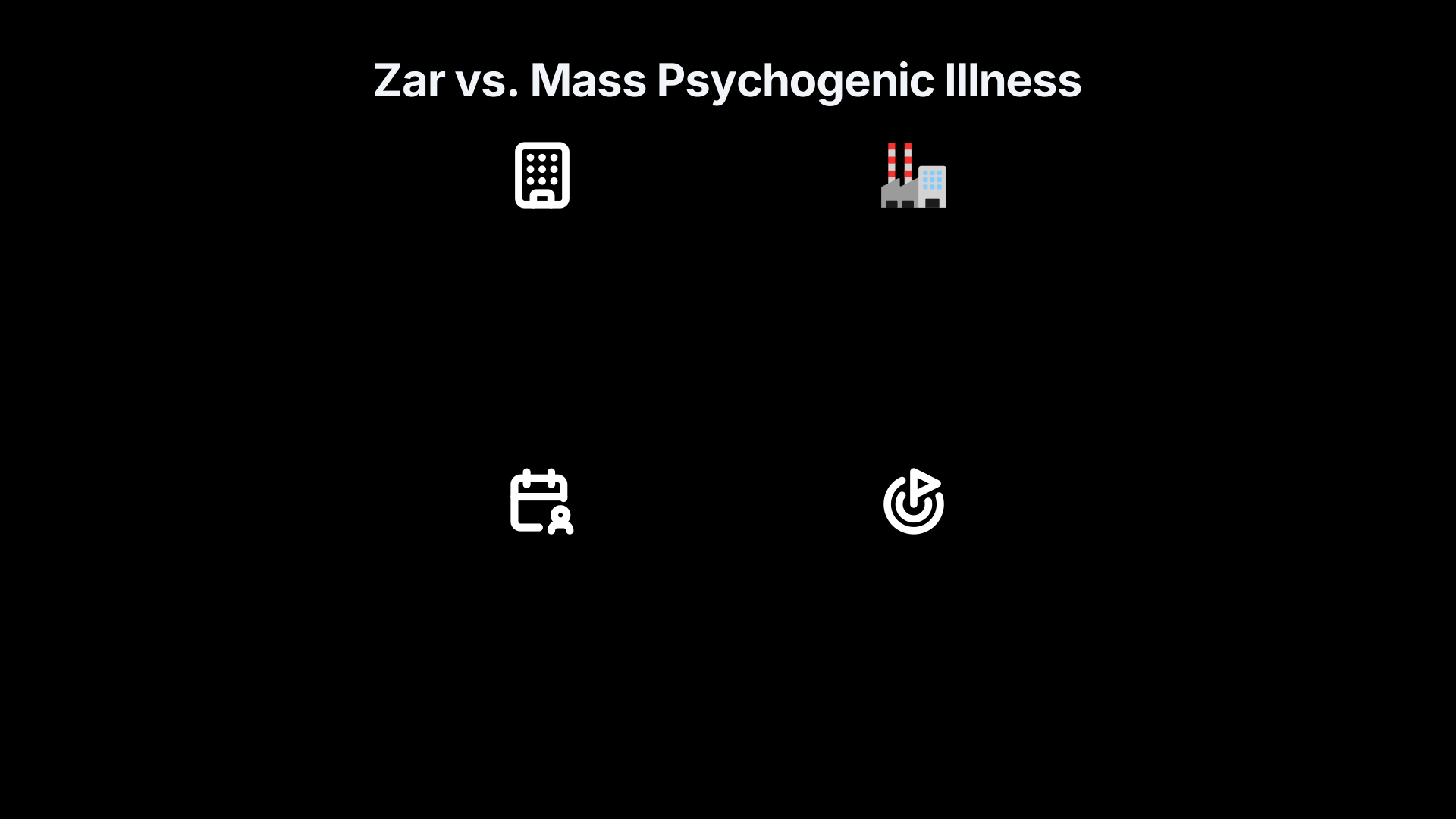
- as a culturally recognised healing system;
- as a way of expressing psychological or social distress;
- as a religious practice existing alongside Islam rather than simply outside it;
- as a means of negotiating family conflict and personal identity; and
- as a social institution shaped by Sudan’s history of slavery and inequality.[wiley.com]anthrosource.onlinelibrary.wiley.comspirits and selves in Northern Sudan: the cultural therapeutics of possession and trance - BODDY - 1988 - American Ethnologis…
This does not require accepting the literal existence of spirits. Anthropologists instead examine how belief structures influence lived experience while avoiding the assumption that unfamiliar religious practices are pathological.
What happens in a zar ceremony
A zar ceremony is not intended to expel a spirit permanently. Instead, many Sudanese traditions understand the possessing spirit as a lasting relationship that must be recognised and managed.
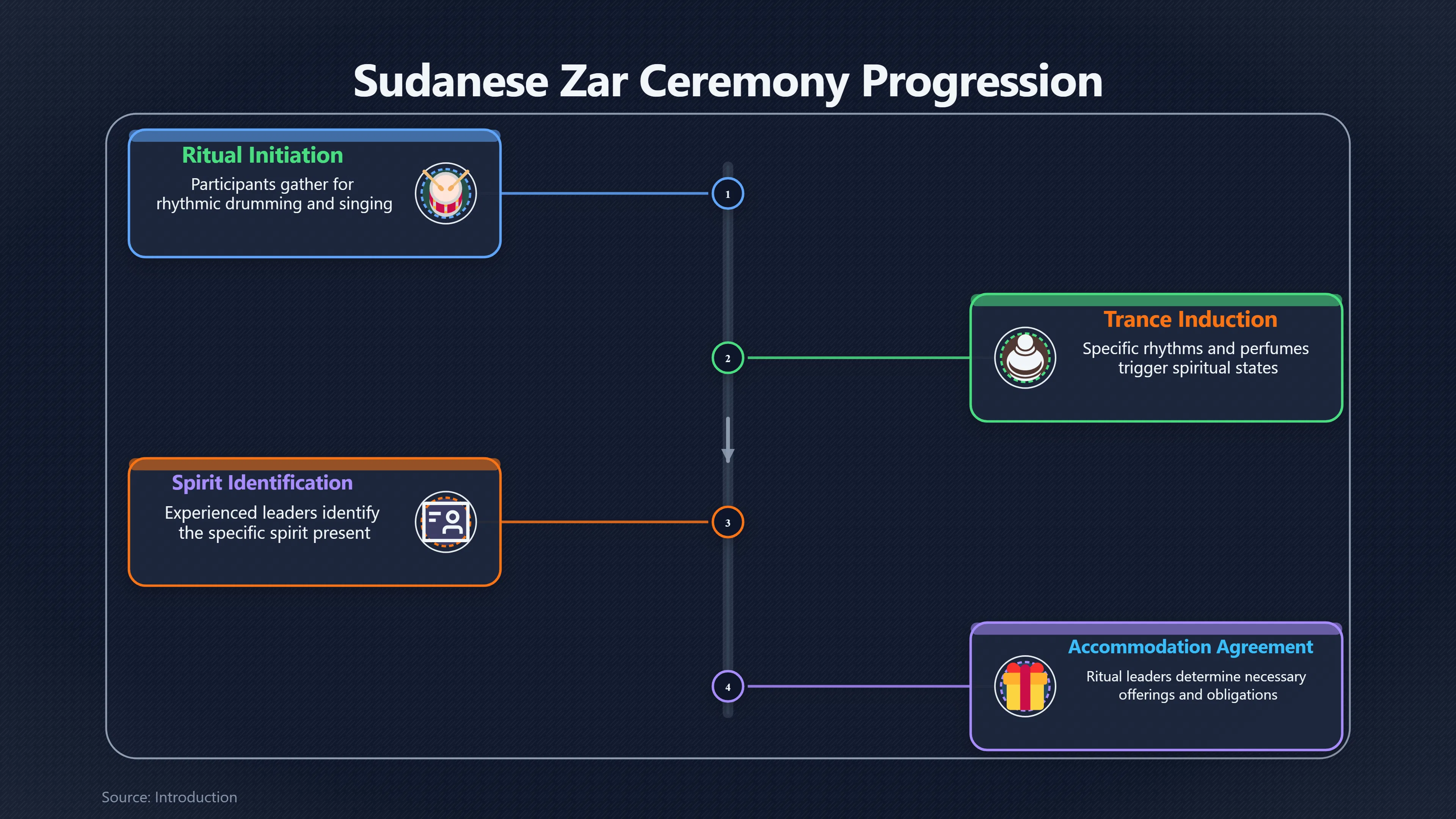
Ceremonies typically involve rhythmic drumming, singing, dancing and incense. Particular musical rhythms, colours, perfumes, clothing or foods may be associated with specific spirits. During trance, participants may display behaviours understood to reflect the personality and preferences of the spirit believed to be present. Experienced ritual leaders guide the ceremony, identify the spirit involved and determine what offerings or ongoing obligations are expected.[wiley.com]anthrosource.onlinelibrary.wiley.comspirits and selves in Northern Sudan: the cultural therapeutics of possession and trance - BODDY - 1988 - American Ethnologis…
The aim is therefore accommodation rather than dramatic exorcism. If the spirit’s demands are acknowledged, the afflicted person may regain physical wellbeing, emotional balance or improved family relationships. Within this worldview, successful treatment depends on restoring a workable relationship between person, spirit and community rather than eliminating possession altogether.[AnthroSource]anthrosource.onlinelibrary.wiley.comspirits and selves in Northern Sudan: the cultural therapeutics of possession and trance - BODDY - 1988 - American Ethnologis…
Women’s distress, autonomy and ritual community
One reason zar attracted sustained anthropological attention is its close relationship with women’s social lives.
Janice Boddy’s influential fieldwork in northern Sudan argued that possession often emerged among women facing tensions surrounding marriage, fertility, domestic obligations and restrictive expectations of female behaviour. Rather than dismissing these experiences as illness, zar gave women a culturally legitimate language through which suffering could be recognised publicly.[AnthroSource]anthrosource.onlinelibrary.wiley.comspirits and selves in Northern Sudan: the cultural therapeutics of possession and trance - BODDY - 1988 - American Ethnologis…
Importantly, this did not simply provide emotional release. Participation could also create practical changes:
- relatives might become more attentive to a woman’s needs;
- husbands could be expected to fund ceremonies or fulfil ritual obligations;
- women developed supportive networks outside immediate family structures; and
- experienced ritual leaders gained recognised authority within their communities.[wiley.com]anthrosource.onlinelibrary.wiley.comspirits and selves in Northern Sudan: the cultural therapeutics of possession and trance - BODDY - 1988 - American Ethnologis…
For these reasons, some scholars describe zar as offering a limited form of agency within otherwise restrictive social conditions. The ceremonies did not overturn gender hierarchies, but they created socially acceptable spaces in which women could voice frustration, negotiate relationships and temporarily adopt identities unavailable in everyday life.[BiblioVault]bibliovault.orgWombs and Alien Spirits: Women, Men, and the Zar Cult in Northern Sudan (9780299123147): Janice Boddy - BiblioVault…
Slavery, racial hierarchy and the tumbura tradition
The tumbura tradition highlights another reason why reducing zar to “mass hysteria” misses its historical significance.
Ethnographic research shows that tumbura became closely associated with communities descended from enslaved Africans in Sudan. Songs, spirit genealogies and ritual histories preserved memories of displacement, servitude and marginalisation long after formal slavery ended. Rather than merely preserving supernatural beliefs, tumbura also became a way for historically subordinated communities to construct positive identities within a society marked by Arab-African racial hierarchies.[northwestern.edu]nupress.northwestern.eduUniversity Press Changing MastersNorthwestern University PressChanging Masters - Northwestern University PressJuly 1, 2000…
Anthropologist Gerasimos Makris argues that tumbura functioned as a counter-history. Through possession rituals, participants affirmed dignity, belonging and Islamic identity while challenging narratives imposed by dominant social groups. In this interpretation, spirits became part of a broader conversation about memory, ancestry and status rather than simply symptoms of psychological disturbance.[northwestern.edu]nupress.northwestern.eduUniversity Press Changing MastersNorthwestern University PressChanging Masters - Northwestern University PressJuly 1, 2000…
This connection between spirit practice and the legacy of slavery also explains why tumbura deserves separate attention within Sudanese history. Its significance extends well beyond questions of possession into the long afterlife of enslavement and racial inequality.
Why officials often tried to suppress zar
Colonial administrators, Islamic reformers and later Sudanese governments frequently viewed zar with suspicion, although their reasons differed.
Colonial officials often regarded possession ceremonies as superstition incompatible with modern administration. Reformist Muslim movements criticised many zar practices as religious innovations inconsistent with orthodox Islam. Under later Islamist governments, increased pressure was placed on ritual traditions seen as insufficiently Islamic or associated with marginalised populations.[wiley.com]onlinelibrary.wiley.comOnline Library Spirits and Selves Revisited: Zār and Islam in Northern SudanWiley Online LibrarySpirits and Selves Revisited: Zār and Islam in Northern Sudan - A Companion to the Anthropology of Religion - Wiley O…
Yet suppression rarely eliminated zar altogether. Instead, practices adapted, became more private or changed form while continuing to meet needs that official institutions often failed to address. Boddy’s later work notes that some northern Sudanese communities abandoned public zar ceremonies amid rapid political, economic and religious change, illustrating how the tradition has evolved rather than simply disappeared.[Wiley Online Library]onlinelibrary.wiley.comOnline Library Spirits and Selves Revisited: Zār and Islam in Northern SudanWiley Online LibrarySpirits and Selves Revisited: Zār and Islam in Northern Sudan - A Companion to the Anthropology of Religion - Wiley O…
What zar reveals about belief in Sudan
Zar demonstrates why collective religious experience should not automatically be classified as irrational contagion. Its persistence over generations, structured ritual organisation and consistent social functions distinguish it from episodes of rumour panic or mass psychogenic illness.
Instead, zar reveals several overlapping realities. It is simultaneously a healing tradition, a religious practice, a social network, a language for emotional suffering and, in traditions such as tumbura, a repository of historical memory shaped by slavery and racial inequality. Participants may genuinely experience possession while anthropologists interpret those experiences through social, psychological or cultural frameworks without dismissing them as mere fantasy.[wiley.com]anthrosource.onlinelibrary.wiley.comspirits and selves in Northern Sudan: the cultural therapeutics of possession and trance - BODDY - 1988 - American Ethnologis…
For Sudan’s wider history of collective belief, zar therefore serves as an important reminder that not every striking religious phenomenon belongs under the label of “mass hysteria”. Careful historical and anthropological research shows that some forms of collective belief are better understood as enduring cultural institutions that help communities interpret suffering, identity and social change.
Amazon book picks
Further Reading
Books and field guides related to Why Zar Possession Was Not Mass Hysteria. Use these as the next step if you want deeper reading beyond the article.

The anthropology of religion, magic, and witchcraft
Explains ritual and possession without sensationalism.
The river war
First published 1899. Subjects: History, Sudan, history, British, Egypt, history, Military history.
The scramble for Africa,
First published 1990. Subjects: History, Colonies, Colonization, Colonización, Kolonisatie.
Endnotes
1.
Source: anthrosource.onlinelibrary.wiley.com
Link:https://anthrosource.onlinelibrary.wiley.com/doi/abs/10.1525/ae.1988.15.1.02a00020
Source snippet
spirits and selves in Northern Sudan: the cultural therapeutics of possession and trance - BODDY - 1988 - American Ethnologis...
2.
Source: bibliovault.org
Link:https://www.bibliovault.org/BV.book.epl?ISBN=9780299123147
Source snippet
Wombs and Alien Spirits: Women, Men, and the Zar Cult in Northern Sudan (9780299123147): Janice Boddy - BiblioVault...
3.
Source: onlinelibrary.wiley.com
Title: Online Library Spirits and Selves Revisited: Zār and Islam in Northern Sudan
Link:https://onlinelibrary.wiley.com/doi/abs/10.1002/9781118605936.ch24
Source snippet
Wiley Online LibrarySpirits and Selves Revisited: Zār and Islam in Northern Sudan - A Companion to the Anthropology of Religion - Wiley O...
4.
Source: routledge.com
Title: The Sudanese Zār Ṭumbura Cult: Slaves, Armies, Spirits and History
Link:https://www.routledge.com/The-Sudanese-Zar-Tumbura-Cult-Slaves-Armies-Spirits-and-History/Makris/p/book/9781032394039
Source snippet
The Sudanese Zār Ṭumbura Cult: Slaves, Armies, Spirits and History...
5.
Source: nupress.northwestern.edu
Title: University Press Changing Masters
Link:https://nupress.northwestern.edu/9780810121379/changing-masters/
Source snippet
Northwestern University PressChanging Masters - Northwestern University PressJuly 1, 2000...
Published: July 1, 2000
6.
Source: ejournals.epublishing.ekt.gr
Link:https://ejournals.epublishing.ekt.gr/index.php/ekke/article/view/6751
Source snippet
Spirit possession and witchcraft in modern Sudan|The Greek Review of Social ResearchDecember 31, 2013...
Published: December 31, 2013
Additional References
7.
Source: open.library.ubc.ca
Link:https://open.library.ubc.ca/cIRcle/collections/ubctheses/831/items/1.0095104
Source snippet
UBC Open LibraryParallel worlds: humans, spirits, and ZAR possession in rural northern Sudan - UBC Library Open Collections...
8.
Source: link.springer.com
Link:https://link.springer.com/book/10.1057/9781137027504
Source snippet
Spirits and Slaves in Central Sudan: The Red Wind of Sennar | Springer Nature Link...
9.
Source: youtube.com
Title: Virtual book discussion of ‘Zar’ with its author Hager El Hadidi
Link:https://www.youtube.com/watch?v=XmK-CcDbT5s
Source snippet
Zar ritual: using music to heal - Horniman Museum and Gardens...
10.
Source: youtube.com
Title: How can a Zar be removed?
Link:https://www.youtube.com/watch?v=Za0IfOIQMJc
Source snippet
SUDANESE FOLKLORE - THE ZAR THAT WOULD NOT LEAVE...
11.
Source: youtube.com
Title: Zar ritual: using music to heal
Link:https://www.youtube.com/watch?v=h81tvI56DFU
Source snippet
The Zar (የዛር ባህል)...
12.
Source: youtube.com
Title: SUDANESE FOLKLORE
Link:https://www.youtube.com/watch?v=2BC_BxUFfs4
13.
Source: youtube.com
Title: The Zar (የዛር ባህል)
Link:https://www.youtube.com/watch?v=2tuz4VsX518
Source snippet
How can a Zar be removed?...
Topic Tree