Within Angola Belief and Fear
Why Did Colonial Angola Fear Tokoism?
Simão Toko's movement became politically threatening to colonial authorities because an African-led church could organise outside missionary control.
On this page
- Simão Toko and the birth of an independent church
- Prophecy, persecution and expectations of change
- How colonial rule turned religion into a security issue
Page outline Jump by section
Introduction
Tokoism became one of the most important African-founded Christian movements in Angola not because it preached armed revolt, but because it demonstrated that an independent African church could organise thousands of followers beyond the supervision of colonial missionaries and the Portuguese state. Founded by Simo Toko after a charismatic religious experience in 1949, the movement combined Christian prophecy with African religious leadership at a time when Portugal’s colonial authorities viewed almost any autonomous African organisation as a potential political threat. As a result, Tokoism was repeatedly monitored, dispersed, imprisoned and portrayed as subversive. Historians now argue that this reaction reveals as much about colonial fears as it does about the movement itself: religion became a security issue because it offered a space where Angolans could gather, communicate and imagine a future outside colonial control.[uneb.br]revistas.uneb.brEXPANSO DO TOCOSMO EM ANGOLA E AS RELAES COM A ADMINISTRAO COLONIAL (1950-1974) | Cadernos de frica ContemporneaFebruary 10, 2024…
Simo Toko and the birth of an independent church
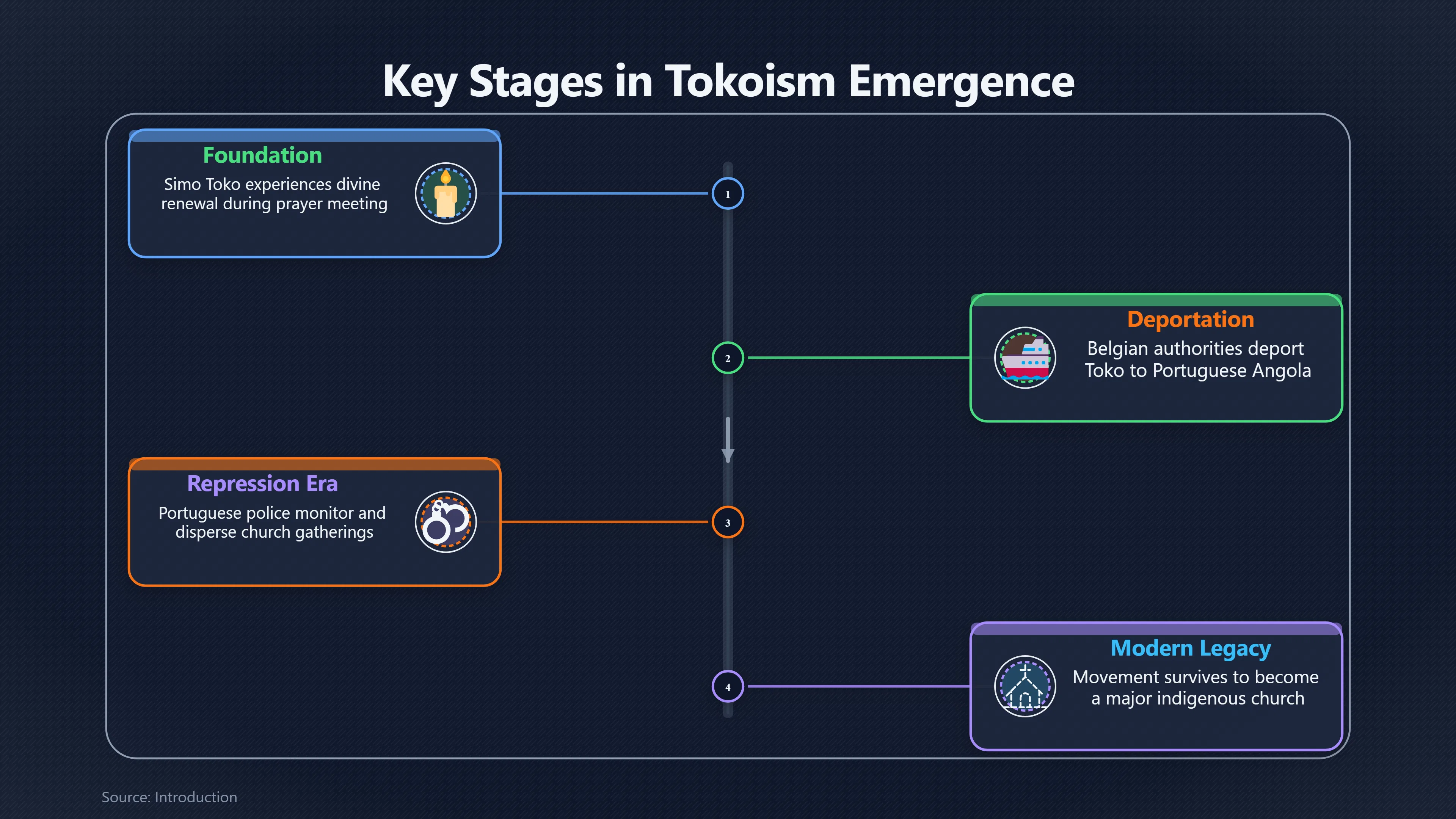
Simo Toko (19181984) was educated through Baptist missions and spent time in Leopoldville (now Kinshasa), where he worked among Angolan migrants. On 25 July 1949, during a prayer meeting, he and a group of followers reported dramatic manifestations of the Holy Spirit, including prophecy, speaking in tongues and healing. For believers, this marked a divine renewal of Christianity in Africa rather than the creation of an entirely new religion.[Springer]link.springer.comThe Prophetic Skill: Learning to Discern and De-Scale in the Angolan Tokoist Church | Springer Nature LinkJanuary 31, 2026…
What made the movement unusual was not simply its charismatic worship but its leadership. Toko was an African prophet directing an African-led church that did not depend on European missionary authority. The movement spread rapidly among Bakongo communities divided by colonial borders between the Belgian Congo and Portuguese Angola, creating networks that crossed frontiers and colonial jurisdictions.[ulisboa.pt]repositorio.ulisboa.ptRepositrio de LisboaO tokoismo como elemento da identidade angolana: 1950-1965…
Colonial officials and some missionaries interpreted this rapid growth very differently from believers. Rather than seeing an indigenous Christian revival, they increasingly described the movement as disorderly, politically suspect or potentially nationalist. Belgian authorities first deported Toko and many followers to Portuguese Angola in 1950, where Portuguese officials continued the repression.[uneb.br]revistas.uneb.brEXPANSO DO TOCOSMO EM ANGOLA E AS RELAES COM A ADMINISTRAO COLONIAL (1950-1974) | Cadernos de frica ContemporneaFebruary 10, 2024…
Prophecy, persecution and expectations of change
The attraction of Tokoism rested partly in its promise that Africans could experience God’s guidance directly without colonial mediation. Its emphasis on prophecy, healing and spiritual gifts gave followers a powerful sense that divine authority could operate through ordinary African believers rather than imported church hierarchies.[Springer]link.springer.comThe Prophetic Skill: Learning to Discern and De-Scale in the Angolan Tokoist Church | Springer Nature LinkJanuary 31, 2026…
This message inevitably acquired political overtones, even when followers understood it primarily in religious terms. Colonial governments frequently interpreted prophetic language about justice, renewal or God’s coming kingdom as coded political resistance. Because prophetic movements elsewhere in Central and Southern Africa had sometimes overlapped with anti-colonial mobilisation, Portuguese officials tended to assume similar intentions in Angola.[uneb.br]revistas.uneb.brEXPANSO DO TOCOSMO EM ANGOLA E AS RELAES COM A ADMINISTRAO COLONIAL (1950-1974) | Cadernos de frica ContemporneaFebruary 10, 2024…
The movement’s experience of persecution also became central to its identity. Simo Toko was repeatedly arrested, exiled and isolated from his followers, while members were dispersed across different regions to prevent the church from consolidating. Instead of destroying the movement, these policies strengthened its collective memory of suffering and reinforced the belief that persecution confirmed the truth of its religious mission. Scholars describe exile, imprisonment and forced separation as defining experiences that shaped Tokoist theology and communal identity for decades afterwards.[scielo.pt]scielo.ptOpen source on scielo.pt.
How colonial rule turned religion into a security issue
Portuguese colonial policy did not fear every Christian church equally. Long-established churches that cooperated with colonial administration were generally treated more favourably than independent African religious organisations. Tokoism challenged this arrangement because it combined spiritual authority, African leadership and extensive social networks beyond official control.[revistas.ufpr.br]revistas.ufpr.brDecember 13, 2021…
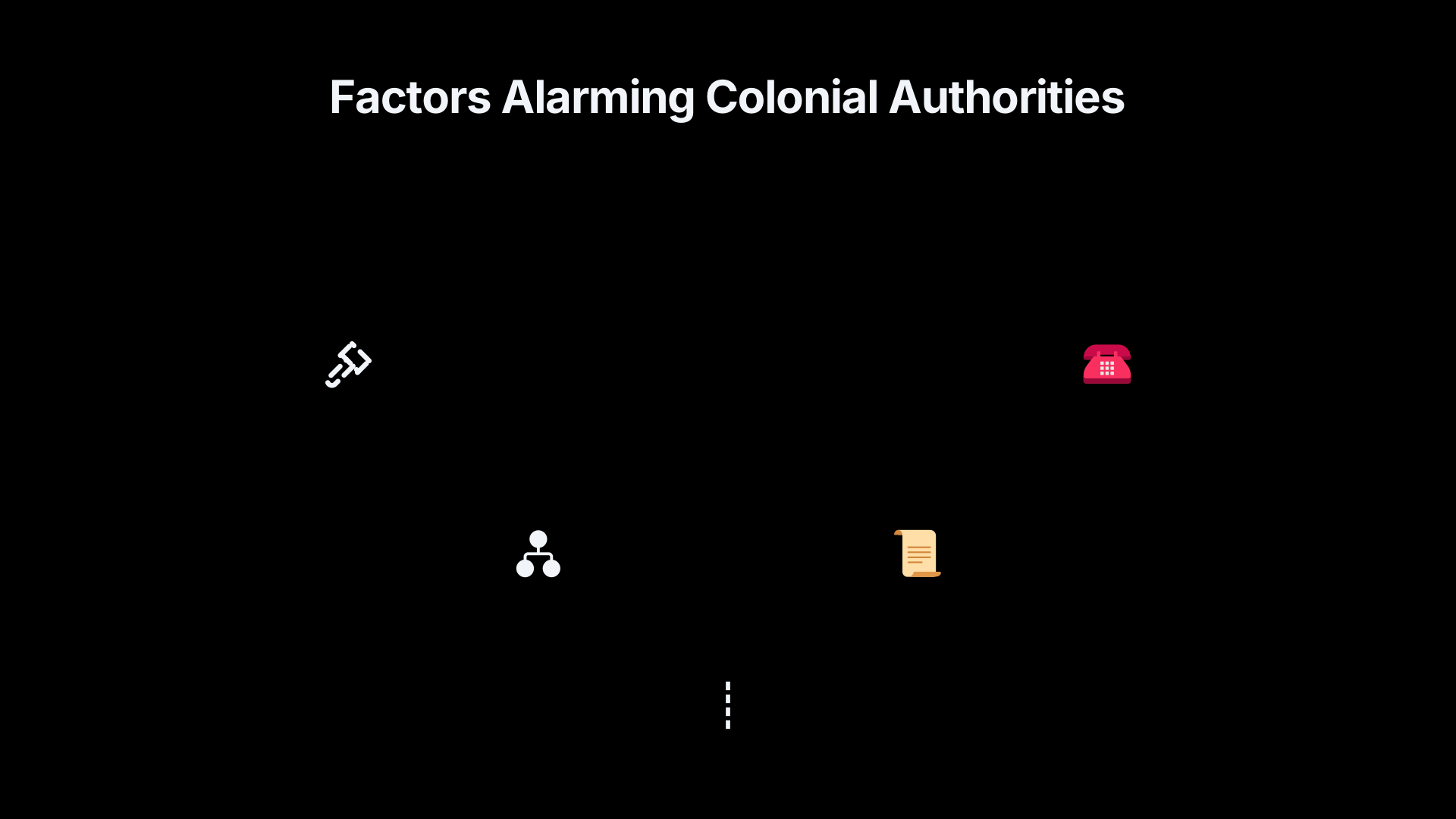
Several features alarmed the colonial authorities:
- Independent leadership: Simo Toko answered neither to Portuguese officials nor to European missionary organisations.
- Mass organisation: The movement attracted large gatherings and maintained communication across dispersed communities.
- Cross-border links: Followers moved between the Belgian Congo and Angola, making surveillance more difficult.
- Prophetic authority: Colonial police often struggled to distinguish religious prophecy from possible political mobilisation.[uneb.br]revistas.uneb.brEXPANSO DO TOCOSMO EM ANGOLA E AS RELAES COM A ADMINISTRAO COLONIAL (1950-1974) | Cadernos de frica ContemporneaFebruary 10, 2024…
Portuguese political police, including the PIDE security service, monitored the church closely, interpreting many of its activities through a security rather than a religious lens. Archival studies show that officials frequently classified the movement as capable of disturbing public order or encouraging anti-colonial sentiment, even when concrete evidence of organised rebellion was limited.[revistas.uneb.br]revistas.uneb.brEXPANSO DO TOCOSMO EM ANGOLA E AS RELAES COM A ADMINISTRAO COLONIAL (1950-1974) | Cadernos de frica ContemporneaFebruary 10, 2024…
Modern historians therefore caution against accepting colonial descriptions at face value. Labels such as “subversive”, “messianic” or even “terrorist” often reflected administrative fears and political assumptions rather than neutral assessments of the church’s beliefs or actions.[lse.ac.uk]blogs.lse.ac.ukLSE Blogs Political and religious lines redrawn in post-war AngolaLSE BlogsPolitical and religious lines redrawn in post-war Angola - Africa at LSEJuly 1, 2011…
Was Tokoism a political movement?
This remains one of the main historical debates.
Many researchers argue that Tokoism was fundamentally a Christian prophetic movement whose primary concerns were spiritual renewal, worship and moral transformation. At the same time, they recognise that any large-scale African institution operating independently under colonial rule inevitably acquired political significance, whether or not its leaders intended it.[researchonline.lse.ac.uk]researchonline.lse.ac.ukOpen source on lse.ac.uk.
Other historians emphasise that the movement contributed indirectly to Angolan nationalism by strengthening African self-confidence, promoting indigenous leadership and creating networks of solidarity that colonial authorities could not easily control. In this interpretation, Tokoism did not need to organise armed resistance to become politically important. Simply demonstrating that Africans could govern their own religious institutions challenged colonial assumptions about authority and dependency.[ufpr.br]revistas.ufpr.brDecember 13, 2021…
Most contemporary scholarship therefore avoids reducing Tokoism to either a purely religious revival or a disguised political organisation. It occupied the boundary where religion, identity and colonial power inevitably overlapped.[lse.ac.uk]researchonline.lse.ac.ukOpen source on lse.ac.uk.
Why Tokoism remains important
Tokoism occupies a distinctive place in Angola’s history of contested belief because it illustrates how governments can transform religious independence into a perceived security threat. Unlike episodes centred on rumours, witchcraft accusations or moral panics, the fear surrounding Tokoism came largely from the colonial state itself. Officials regarded an African-led church as dangerous because it represented an autonomous source of authority that escaped missionary and governmental control.[revistas.uneb.br]revistas.uneb.brEXPANSO DO TOCOSMO EM ANGOLA E AS RELAES COM A ADMINISTRAO COLONIAL (1950-1974) | Cadernos de frica ContemporneaFebruary 10, 2024…
The movement survived imprisonment, exile and repeated attempts at suppression, eventually becoming one of Angola’s largest indigenous Christian churches. Its history reminds readers that accusations of subversion against minority religious movements must be examined carefully. Colonial records reveal genuine official anxiety, but historians increasingly distinguish between documented security concerns and broader colonial fears that any independent African organisation might become a vehicle for political change.[springer.com]link.springer.comThe Prophetic Skill: Learning to Discern and De-Scale in the Angolan Tokoist Church | Springer Nature LinkJanuary 31, 2026…
Amazon book picks
Further Reading
Books and field guides related to Why Did Colonial Angola Fear Tokoism?. Use these as the next step if you want deeper reading beyond the article.
African religions and philosophy
Essential background for understanding prophetic movements like Tokoism.
Christianity in Africa
Explains independent African churches and prophetic leadership.
Endnotes
1.
Source: revistas.uneb.br
Link:https://www.revistas.uneb.br/index.php/cac/article/view/19583
Source snippet
EXPANSO DO TOCOSMO EM ANGOLA E AS RELAES COM A ADMINISTRAO COLONIAL (1950-1974) | Cadernos de frica ContemporneaFebruary 10, 2024...
Published: February 10, 2024
2.
Source: researchonline.lse.ac.uk
Link:https://researchonline.lse.ac.uk/28388/
3.
Source: scielo.pt
Link:https://scielo.pt/scielo.php?pid=S0003-25732015000400010&script=sci_arttext
4.
Source: link.springer.com
Link:https://link.springer.com/chapter/10.1007/978-3-662-72097
Source snippet
The Prophetic Skill: Learning to Discern and De-Scale in the Angolan Tokoist Church | Springer Nature LinkJanuary 31, 2026...
Published: January 31, 2026
5.
Source: revistas.ufpr.br
Link:https://revistas.ufpr.br/relegens/article/view/82299
Source snippet
December 13, 2021...
Published: December 13, 2021
6.
Source: revistas.uneb.br
Link:https://www.revistas.uneb.br/index.php/cac/article/view/14260
7.
Source: scielo.pt
Title: Da confuso ironia: Expectativas e legados da PIDE em Angola
Link:https://scielo.pt/scielo.php?lng=pt&nrm=isoCircula&pid=S0003-25732013000100002&script=sci_arttext
8.
Source: repositorio.ulisboa.pt
Link:https://repositorio.ulisboa.pt/entities/publication/ace376a6-5519-4b7a-93bd-380323e87358
Source snippet
Repositrio de LisboaO tokoismo como elemento da identidade angolana: 1950-1965...
9.
Source: blogs.lse.ac.uk
Title: LSE Blogs Political and religious lines redrawn in post-war Angola
Link:https://blogs.lse.ac.uk/africaatlse/2011/07/01/political-and-religious-lines-redrawn-in-post-war-angola/
Source snippet
LSE BlogsPolitical and religious lines redrawn in post-war Angola - Africa at LSEJuly 1, 2011...
Published: July 1, 2011
10.
Source: revistas.uepg.br
Link:https://revistas.uepg.br/index.php/tel/pt_BR/article/view/21594
11.
Source: ijrf.org
Link:https://www.ijrf.org/index.php/home/article/view/156
12.
Source: countrystudies.us
Link:https://countrystudies.us/angola/77.htm
Additional References
13.
Source: youtube.com
Title: The Untold Story of Nigeria’s First Healing Prophet
Link:https://www.youtube.com/watch?v=mjOsU6A78BQ
Source snippet
This documentary on Simon Kimbangu is highly relevant as it details how colonial authorities suppressed independent African prophetic mov...
14.
Source: youtube.com
Link:https://www.youtube.com/watch?v=rO6RlB9aFgQ
Source snippet
The Forbidden Story of Simon Kimbangu: Between Faith, Prison and Prophecy...
15.
Source: youtube.com
Title: The Forbidden Story of Simon Kimbangu: Between Faith, Prison and Prophecy
Link:https://www.youtube.com/watch?v=_A9l1k3G6U0
Source snippet
S3E31 Learning from the African Church about Prayer, with Dr Harvey Kwiyani...
16.
Source: youtube.com
Title: S3E31 Learning from the African Church about Prayer, with Dr Harvey Kwiyani
Link:https://www.youtube.com/watch?v=ulPgvz8EMms
Source snippet
Bois Caman: How African Religion Became a Weapon against Slavery...
17.
Source: youtube.com
Title: Bois Caman: How African Religion Became a Weapon against Slavery
Link:https://www.youtube.com/watch?v=8BgrfediTbo
Source snippet
The Untold Story of Nigeria's First Healing Prophet - Garrick Braide...
18.
Source: researchgate.net
Link:https://www.researchgate.net/publication/286799548_A_prophetic_trajectory_Ideologies_of_place_time_and_belonging_in_an_Angolan_religious_movement
19.
Source: africabib.org
Link:https://www.africabib.org/rec.php?RID=192758144
20.
Source: worldhistory.biz
Link:https://www.worldhistory.biz/sundries/40862-angola-new-colonial-period-christianity-missionaries-independent-churches.html
21.
Source: tandfonline.com
Link:https://www.tandfonline.com/doi/full/10.1080/00141844.2013.806946
22.
Source: tandfonline.com
Link:https://www.tandfonline.com/doi/full/10.1080/02757206.2011.546854
Topic Tree