Within Brunei Panics
Why Did Possession Symptoms Spread So Fast?
Mass psychogenic illness explains how genuine symptoms can travel through fear, expectation and social contact without conscious imitation.
On this page
- What mass psychogenic illness means
- How fear, attention and expectation shape symptoms
- Why possession became the shared explanation
Page outline Jump by section
Introduction
The school possession outbreaks reported in Brunei are best understood as examples of how genuine physical and emotional symptoms can spread through a closely connected group without requiring conscious imitation or deliberate deception. Researchers commonly describe this process as mass psychogenic illness (MPI), a well-documented phenomenon in which stress, expectation, fear and social interaction combine to produce real symptoms in multiple people when no infectious, toxic or structural cause can be identified.[PMC]pmc.ncbi.nlm.nih.govPMCThe spread of mind: psychological contagion in theory and critiqueNovember 21, 2025…
This explanation does not dismiss the experiences of those involved. Pupils who screamed, fainted, shook or felt overwhelmed were experiencing genuine distress. In Brunei, where belief in spirit disturbance forms part of the wider cultural and religious landscape, reports of possession provided a familiar way of understanding experiences that might otherwise have been confusing or frightening. That shared interpretation helped shape how the outbreak developed, even though it does not establish that a supernatural cause existed.
Why did possession symptoms spread so fast?
The Brunei school episodes occurred in conditions that researchers have repeatedly found to favour group outbreaks: pupils spent long periods together, examination pressure was high, friendships were close, and unusual behaviour was immediately visible to others.
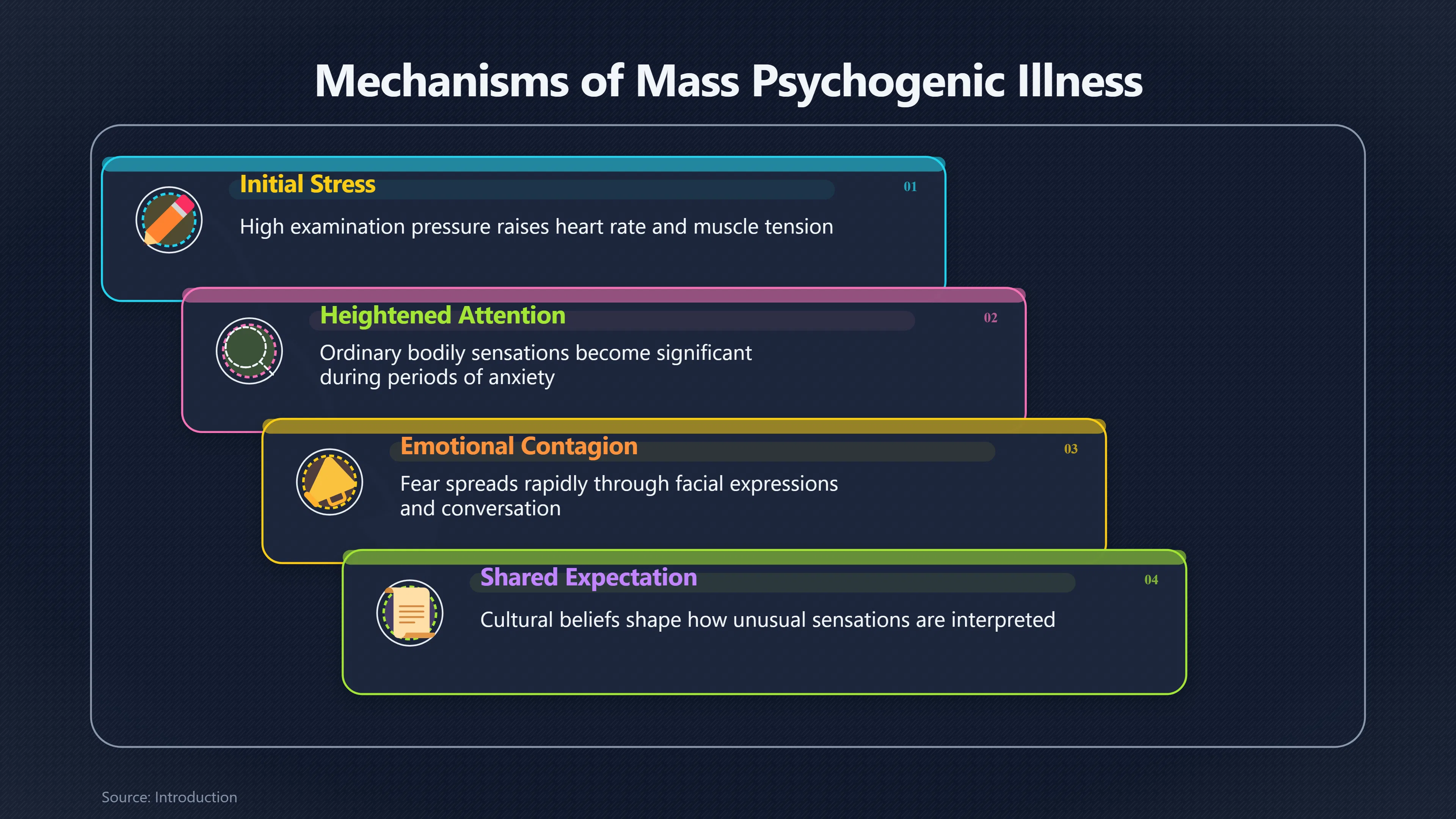
Once one student became distressed, several reinforcing processes could occur almost simultaneously:
- Observation: classmates saw someone screaming, collapsing or shaking.
- Heightened attention: ordinary bodily sensations suddenly felt significant.
- Expectation: if others believed spirits were present, new symptoms were interpreted through that belief.
- Emotional contagion: fear spread rapidly through conversation, facial expressions and shared emotional reactions.
- Confirmation: each additional affected pupil appeared to confirm that something extraordinary was happening.
Mass psychogenic illness does not spread like a virus. Instead, it spreads through shared attention, shared expectations and shared emotional responses within an already connected group. Studies of numerous outbreaks have found that symptoms often travel most quickly between people who are physically close and able to observe one another directly.[nejm.org]nejm.orgOpen source on nejm.org.
What mass psychogenic illness means
The older expression “mass hysteria” is now used less often because it can imply that sufferers are irrational or pretending. Most researchers instead prefer mass psychogenic illness or mass sociogenic illness.
Several features appear repeatedly across documented outbreaks:
- symptoms are genuine rather than consciously invented;
- medical investigation fails to identify a sufficient infectious or toxic cause;
- symptoms spread rapidly through social contact;
- recovery is often equally rapid once anxiety decreases;
- schools are among the most common settings.
Typical symptoms include fainting, dizziness, shaking, crying, hyperventilation, weakness, headaches and temporary difficulty speaking or moving. None of these require conscious imitation. Stress alone can alter breathing, muscle tension, balance and perception strongly enough to produce convincing physical symptoms.[nejm.org]nejm.orgOpen source on nejm.org.
How fear, attention and expectation shape symptoms
Psychologists emphasise that the brain constantly interprets signals from the body. Under ordinary circumstances, small sensations are ignored. During periods of heightened anxiety, however, the same sensations may be experienced as evidence that something serious is happening.
Several mechanisms reinforce one another.
Stress increases physical sensitivity. Examination pressure, social conflict or uncertainty can raise heart rate, muscle tension and breathing changes. These sensations are entirely real but may be interpreted differently depending on circumstances.[New England Journal of Medicine]nejm.orgOpen source on nejm.org.
Attention amplifies symptoms. When everyone watches for signs of danger, normal sensations become much harder to ignore. A slight feeling of dizziness or rapid breathing may become frightening once it is interpreted as the beginning of possession.
Expectation shapes experience. Research across medicine shows that expectations can influence how symptoms are experienced. In possession outbreaks, people who expect spirit disturbance are more likely to interpret unusual sensations within that framework than as stress alone.[PMC]pmc.ncbi.nlm.nih.govPMCThe spread of mind: psychological contagion in theory and critiqueNovember 21, 2025…
Social reassurance can fail. If friends appear frightened, reassurance from authority figures may initially carry less emotional weight than what pupils are seeing with their own eyes.
These mechanisms explain why symptoms can spread despite the absence of a contagious disease.
Why possession became the shared explanation in Brunei
The symptoms themselves do not determine how an outbreak is understood. Culture provides the explanation.
In Brunei, Islamic belief, local traditions concerning unseen spiritual beings and established practices of religious healing all influence how unusual experiences may be interpreted. During the 2010 school incidents, reports circulated that spirits had been encountered, and recognised religious healers were invited into schools to perform Qur’anic recitation and other accepted spiritual interventions. Within that cultural setting, possession was therefore a familiar explanation rather than an unusual one.
This differs from outbreaks elsewhere in the world. In other countries, identical patterns of fainting, dizziness or shaking have instead been blamed on toxic chemicals, contaminated food, vaccines, mysterious odours or other perceived threats. Researchers argue that while the physical mechanisms of mass psychogenic illness remain broadly similar, the explanation adopted by those affected usually reflects the surrounding culture and current social concerns.[nih.gov]pubmed.ncbi.nlm.nih.govProtean nature of mass sociogenic illness: from possessed nuns to chemical and biological terrorism fears - PubMed…
Why schools are especially vulnerable
Schools appear repeatedly in international reviews of mass psychogenic illness.
Several characteristics make them susceptible:
- pupils spend many hours together in close proximity;
- adolescents are particularly responsive to peer influence and social evaluation;
- academic pressure creates underlying stress;
- rumours spread rapidly through friendship networks;
- authority responses become highly visible to everyone at once.
Recent systematic reviews continue to identify stress, rumours, misinformation, perceived threats and close social interaction as the factors most consistently associated with school outbreaks across different countries and cultures.[UAE Ministry of Health]nchr.elsevierpure.comUAE Ministry of HealthFactors related to the occurrence of mass psychogenic illness in schools: a systematic review - United Arab Emirate…

Why the symptoms were real even without a confirmed physical cause
One of the most persistent misunderstandings is that psychological explanations imply that sufferers were pretending.
The evidence points in the opposite direction.
During documented episodes, affected individuals often show genuine physical changes such as altered breathing, trembling, dizziness, weakness or fainting. These are authentic bodily responses to stress and heightened emotional arousal. Medical investigations are important because environmental hazards, infections and toxic exposures must first be ruled out before an outbreak is interpreted as psychogenic.
This careful approach explains why public health investigations often begin by looking for environmental causes. Only when testing fails to identify a sufficient physical explanation does mass psychogenic illness become the most likely interpretation.[New England Journal of Medicine]nejm.orgOpen source on nejm.org.
What Brunei’s outbreaks show
The Brunei school incidents illustrate that collective possession experiences need not be understood simply as either supernatural events or deliberate fabrication. Research suggests a more nuanced picture in which genuine distress, examination stress, close social networks and culturally familiar beliefs interacted to produce rapidly spreading symptoms.
Understanding these mechanisms does not invalidate participants’ experiences or religious beliefs. Instead, it explains why outbreaks can develop so quickly within one group, why similar symptoms appear across many cultures despite different explanations, and why school-based possession episodes remain one of the clearest examples of how psychology, culture and social interaction can combine to produce powerful collective experiences.
Amazon book picks
Further Reading
Books and field guides related to Why Did Possession Symptoms Spread So Fast?. Use these as the next step if you want deeper reading beyond the article.
Extraordinary Popular Delusions and the Madness of Crowds
Rating: 4.0/5 from 5 Google Books ratings
Provides historical examples of contagious beliefs.

The Spirit Catches You and You Fall Down
Shows how cultural beliefs shape interpretations of illness.


Mistakes Were Made (But Not by Me)
Explores belief reinforcement and cognitive processes.
Endnotes
1.
Source: pmc.ncbi.nlm.nih.gov
Title: PMCThe spread of mind: psychological contagion in theory and critique
Link:https://pmc.ncbi.nlm.nih.gov/articles/PMC12679345/
Source snippet
November 21, 2025...
Published: November 21, 2025
2.
Source: pmc.ncbi.nlm.nih.gov
Link:https://pmc.ncbi.nlm.nih.gov/articles/PMC3536509/
3.
Source: nejm.org
Link:https://www.nejm.org/doi/full/10.1056/NEJM200001133420206
4.
Source: pubmed.ncbi.nlm.nih.gov
Link:https://pubmed.ncbi.nlm.nih.gov/11925351/
Source snippet
Protean nature of mass sociogenic illness: from possessed nuns to chemical and biological terrorism fears - PubMed...
5.
Source: nchr.elsevierpure.com
Link:https://nchr.elsevierpure.com/en/publications/factors-related-to-the-occurrence-of-mass-psychogenic-illness-in-/
Source snippet
UAE Ministry of HealthFactors related to the occurrence of mass psychogenic illness in schools: a systematic review - United Arab Emirate...
6.
Source: pubmed.ncbi.nlm.nih.gov
Title: Pub Med Frequency and predictors of mass psychogenic illness
Link:https://pubmed.ncbi.nlm.nih.gov/20592616/
Source snippet
Frequency and predictors of mass psychogenic illness - PubMed...
7.
Source: pmc.ncbi.nlm.nih.gov
Link:https://pmc.ncbi.nlm.nih.gov/articles/PMC3828262/
8.
Source: researchportal.ukhsa.gov.uk
Title: ukhsa.gov.uk Frequency and predictors of mass psychogenic illness
Link:https://researchportal.ukhsa.gov.uk/en/publications/frequency-and-predictors-of-mass-psychogenic-illness/
Additional References
9.
Source: dergipark.org.tr
Link:https://dergipark.org.tr/en/pub/jnbs/article/1741021
Source snippet
Institutional Context, Triggers and Symptoms of Mass Psychogenic Illness: A Literature-Based Content Analysis - The Journal of Neurobehav...
10.
Source: lifescience.net
Link:https://www.lifescience.net/publications/1339932/factors-related-to-the-occurrence-of-mass-psychoge/
Source snippet
Created on 20 Jun 2025 * Publication details * Citations * Page views * * Reviews * * * * All pu...
11.
Source: youtube.com
Title: Can Emotional Contagion Really Spread Emotions In Groups?
Link:http://www.youtube.com/watch?v=Sp0D1ZFjUzU
Source snippet
Mass psychogenic illness explanation Teens' uncontrollable mystery illness CNN...
12.
Source: youtube.com
Title: Episode 71. Frenzy – The Turmoil of Mass Psychogenic Illness
Link:http://www.youtube.com/watch?v=e2AdorYLDF8
Source snippet
Mass Hysteria in Le Roy, New York? | Mass Psychogenic Illness...
13.
Source: youtube.com
Title: Mass Hysteria: When Entire Groups Lose Control
Link:http://www.youtube.com/watch?v=eSIJ_uU8QUs
Source snippet
Can Emotional Contagion Really Spread Emotions In Groups? - Real Life Curriculum...
14.
Source: youtube.com
Title: Mass Hysteria in Le Roy, New York? | Mass Psychogenic Illness
Link:http://www.youtube.com/watch?v=ZvLtO6ObLsw
Source snippet
The Bizarre Phenomenon of Mass Psychogenic Illness...
15.
Source: taylorfrancis.com
Link:https://www.taylorfrancis.com/chapters/edit/10.4324/9781315825694-13/theories-contagion-relate-mass-psychogenic-illness-jonathan-freedman
16.
Source: youtu.be
Title: The Mental Wellbeing College
Link:https://youtu.be/EJThxrXX5WA
Source snippet
Episode 71. Frenzy – The Turmoil of Mass Psychogenic Illness The Neurology Lounge...
17.
Source: youtube.com
Title: The Bizarre Phenomenon of Mass Psychogenic Illness
Link:http://www.youtube.com/watch?v=e898xSzxOhk
Source snippet
Mass Hysteria: When Entire Groups Lose Control...
18.
Source: sciencedirect.com
Link:https://www.sciencedirect.com/science/article/abs/pii/S0003448712000959
Topic Tree