When Fear Became Law in Luxembourg
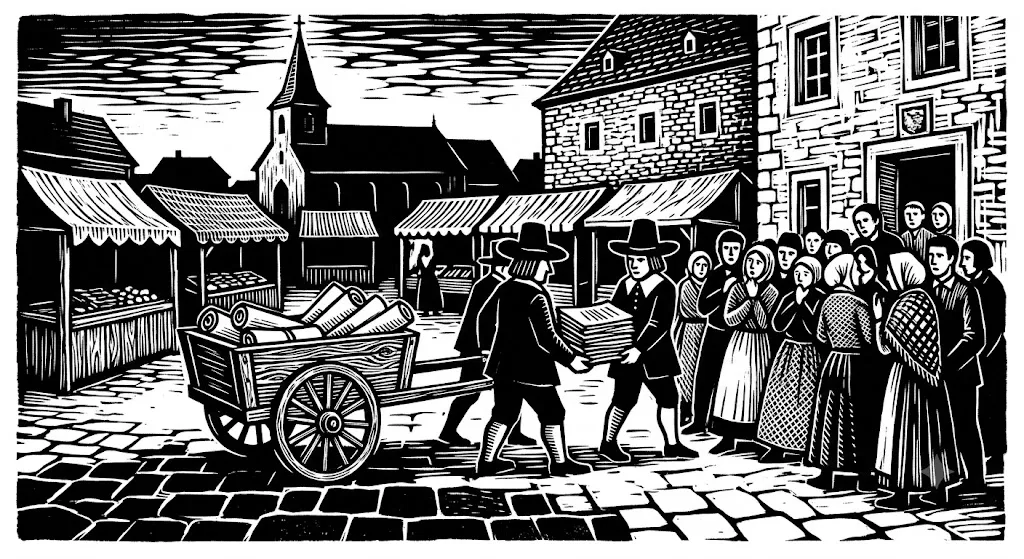
Luxembourg’s clearest documented episode of contagious supernatural fear was not a modern “cult panic” or unexplained outbreak of mass illness, but the early modern persecution of alleged witches. From the fifteenth century to the 1680s, accusations of harmful magic moved through villages, courts and territories in repeated waves.
Page outline Jump by section
Introduction
Other Luxembourg traditions require more careful handling. The national pilgrimage to Our Lady of Luxembourg arose amid plague, war and famine, but it was an organised Catholic response to catastrophe rather than a proven episode of mass hysteria. Echternach’s famous hopping procession is likewise a religious and communal tradition, not reliable evidence of a medieval dancing plague. Modern Luxembourg has experienced debates about minority religions and the proper relationship between faith and the state, but the available evidence does not support a major, distinctively Luxembourgish satanic panic, UFO cult scare or outbreak of mass psychogenic illness. The country’s history is therefore most revealing when it shows how genuine danger, religious belief, judicial power and later folklore can become entangled.
Why Luxembourg’s witch persecutions became so severe
Witchcraft prosecutions are documented in the Duchy of Luxembourg from around the middle of the fifteenth century. The deadliest sustained phase began in about 1586, with successive waves continuing in different localities until 1636. Proceedings declined during the Thirty Years’ War and a major plague epidemic, but persecution revived sharply in the late seventeenth century, most notably around Echternach in 1679–80. French legal influence after the occupation of 1684 helped bring the remaining trials to an end by restricting the circumstances in which alleged sorcery could be punished by death.[Deutsches Historisches Museum (DHM)]dhm.deJahrhunderts nachweisbar sind, setzte die opferreichste Phase der Verfolgungen circa 1586 ein. Von…Read more…
Some popular accounts claim that at least 2,000 people died in the duchy’s witch hunts. That figure should be treated as an estimate rather than a complete archival count. Borders changed, many records were lost, and historical references may describe the old Duchy of Luxembourg rather than the much smaller territory of the modern Grand Duchy. The surviving evidence is nevertheless strong enough to show unusually intense persecution, especially when measured against the size and scattered population of the region.[atavist-archive.wort.lu]atavist-archive.wort.lu“Die Zauberinnen sollst du nicht leben lassen” (Ex22, 17)- Hexenprozesse im Herzogtum Luxemburg: Echternach 1679/1680. Von Sonja Kmec, in Hémecht: Zeitung für Luxemburger Geschichte 54/Nr…
The fear at the centre of these trials was more elaborate than a belief in everyday charms. Authorities increasingly treated accused people as members of a secret anti-Christian conspiracy. Suspects were said to have made pacts with the Devil, attended nocturnal assemblies, damaged crops, caused storms, spread sickness or killed animals and neighbours by supernatural means. In this worldview, an unexplained misfortune was not merely bad luck: it could be evidence that an invisible enemy was operating inside the community.
That belief became deadly because courts were willing to use the full machinery of criminal justice against it. Historians of European witch-hunting stress that local rumours alone rarely produced large persecutions. Escalation required magistrates who accepted demonological ideas, procedures that permitted coercive interrogation and a willingness to treat accusations extracted under torture as credible intelligence.[atusyd.dk]atusyd.dkAB C-CLIO e Book CollectionABC-CLIO eBook CollectionAugust 12, 2014 — Witch hunts could occur only when the authorities were willing to make the full apparatus of t…
Luxembourg was especially vulnerable to this combination of pressures. The duchy lay in a politically fragmented border region shaped by competing jurisdictions, military movement and close connections with other heavily affected areas, including Trier and Lorraine. War, taxation, subsistence crises and epidemic disease made ordinary calamities feel both relentless and difficult to explain. Witchcraft offered an apparently personal cause: someone could be blamed for a dead child, spoiled harvest or diseased cow when no convincing natural explanation was available.
How accusation spread from neighbour to neighbour
Witch hunts often began with tensions that were local and recognisable. A healer failed to cure an illness. A quarrel was followed by a death. A neighbour issued a threat before livestock became sick. Someone known for unusual remedies was accused of causing the very harm they had been asked to prevent. These incidents gained a supernatural meaning only after families, clergy or officials placed them within the wider story of diabolical witchcraft.
The Echternach proceedings of 1679–80 show how this process worked in practice. Historian Sonja Kmec’s study of the surviving trial material examines Gaspar Back, a healer and reputed breaker of witchcraft, alongside four other accused people. The records reveal a world in which learned demonology, folk healing, religious belief and village conflict overlapped. A person could be consulted as protection against magic and later be reclassified as a magician working with the Devil.[orbilu.uni.lu]orbilu.uni.luKMEC, Sonja. 2002 • In Hemecht: Zeitschrift für Luxemburger Geschichte = Revue d'Histoire…Read more…
Once a suspect entered custody, the investigation could expand rapidly. Interrogators expected a witch to belong to a network, so a confession was considered incomplete unless it identified accomplices. Torture, fear of renewed torture and leading questions encouraged prisoners to repeat details already familiar to judges. Every new name then appeared to confirm the existence of the conspiracy that the interrogation process itself was helping to construct.
This does not mean every witness was consciously lying. People interpreted events through assumptions widely accepted in their society. A person who genuinely believed that witchcraft caused illness might reinterpret years of quarrels, gestures and coincidences as proof. Dreams, rumours and coerced confessions could reinforce one another until the accusation seemed supported by many independent sources, even when all of them ultimately arose from the same circulating story.
The proceedings therefore resemble a moral panic more closely than mass psychogenic illness. A moral panic forms when a person or group is represented as a profound threat to the community’s values and safety, leading to demands for exceptional control. Mass psychogenic illness, by contrast, involves clusters of genuine physical symptoms without an identified organic cause, often spreading through stress, observation and expectation. Luxembourg’s witch hunts primarily involved persecution through shared belief and law, not a medically documented epidemic of contagious symptoms.
Echternach’s last great prosecution wave
The late trials at Echternach are particularly important because they took place after witch-hunting had already begun to decline in much of Western Europe. Rather than representing the height of a universal medieval frenzy, they were a late regional resurgence produced by specific institutions, disputes and beliefs. Kmec’s research dates the central proceedings to 1679 and 1680, while local persecution continued into the early 1680s.[orbilu.uni.lu]orbilu.uni.luKMEC, Sonja. 2002 • In Hemecht: Zeitschrift für Luxemburger Geschichte = Revue d'Histoire…Read more…
The surviving records preserve the categories through which officials interpreted the accused. Healing practices might be treated as evidence of forbidden supernatural knowledge. Claims of protection against witches could be turned against the practitioner: if someone knew how magic worked, interrogators could argue that the knowledge came from demonic involvement. This blurred the line between the alleged witch and the person whom neighbours had previously trusted to counter witchcraft.
Such trials also demonstrate why the word “hysteria” can be misleading. The prosecutions were not simply an uncontrolled crowd suddenly losing reason. They involved formal complaints, written records, legal officials and recognised procedures. The beliefs were false and the methods profoundly unjust, but the persecution was administered through institutions. Calling it mere hysteria risks hiding the responsibility of magistrates, clergy and political authorities who converted suspicion into imprisonment, torture and death.
The prosecutions eventually stopped not because belief in magic vanished overnight, but because the legal environment changed. Scepticism about the reliability of confessions, concern about procedural abuse and tighter restrictions on capital punishment made it harder to sustain chain-reaction trials. After the French occupation of 1684, an ordinance associated with Louis XIV’s legal regime sharply limited death sentences for sorcery. Once courts no longer treated every supernatural accusation as proof of a capital conspiracy, village fear lost its most dangerous amplifier.[atavist-archive.wort.lu]atavist-archive.wort.lu“Die Zauberinnen sollst du nicht leben lassen” (Ex22, 17)- Hexenprozesse im Herzogtum Luxemburg: Echternach 1679/1680. Von Sonja Kmec, in Hémecht: Zeitung für Luxemburger Geschichte 54/Nr…
Who was accused, and why simple explanations fail
Across Europe, most people prosecuted for witchcraft were women, and gender mattered in Luxembourg as well. Early modern teaching frequently portrayed women as spiritually, intellectually or morally more vulnerable to the Devil. Poverty, widowhood, dependence on neighbours and work involving healing or childcare could also make particular women vulnerable to accusation.
It would still be too simple to describe Luxembourg’s persecutions as a campaign against one uniform category of elderly women. Men were also accused, especially healers, magical specialists and people implicated by previous prisoners. Gaspar Back’s case is a reminder that reputation and social function could matter as much as sex. The identities of the accused varied between jurisdictions and prosecution waves.[orbilu.uni.lu]orbilu.uni.luKMEC, Sonja. 2002 • In Hemecht: Zeitschrift für Luxemburger Geschichte = Revue d'Histoire…Read more…
Nor were the trials merely a disguised programme for stealing property. Confiscation, inheritance and local advantage could influence individual cases, but historians generally reject a single-cause explanation. Accusations emerged from a shifting mixture of personal hostility, religious conviction, economic insecurity, official policy and the effects of coercive interrogation.
The same caution applies to claims that witch-hunting was simply a spontaneous revolt by an ignorant rural population. Pressure sometimes came “from below”, as neighbours demanded action against suspected witches. Yet large prosecution waves depended on cooperation from above. Courts determined whether accusations would be dismissed, investigated cautiously or transformed into a search for an organised satanic network.
Plague, pilgrimage and the Our Lady devotion
Seventeenth-century Luxembourg faced dangers that were entirely real. War, epidemic disease and famine devastated communities and weakened confidence in ordinary forms of protection. The pilgrimage now known as the Octave arose in this setting. In 1624, Jesuits promoted devotion to a statue of Mary as the Comforter of the Afflicted, and annual pilgrimages developed around the Glacis chapel outside Luxembourg City. Mary was recognised as protector of the city in 1666 and of the duchy in 1678.[public.lu]luxembourg.public.luThe Oktav: pilgrimage in honour of Luxembourg's patron…24 Apr 2026 — The pilgrimage dates back to 1624, when the coun…
Participants sought healing and protection, and stories of answered prayers and miracles helped enlarge the devotion. Father Jacques Brocquart, associated with the early pilgrimage, reportedly encouraged accounts of miracles connected with the statue. These narratives gave frightened communities a language of hope and intervention during a period when medicine offered little defence against epidemic infection.[Chronicle.lu]chronicle.lu49448 uni lu professor delves into 400 years of octave pilgrimage history49448 uni lu professor delves into 400 years of octave pilgrimage history
It would be wrong, however, to classify the Octave itself as a mass delusion. A pilgrimage may include supernatural beliefs without becoming a panic. It can also serve practical social functions: organising charity, mourning the dead, renewing community ties and providing a shared ritual during prolonged uncertainty. The historical question is not whether seventeenth-century claims of miraculous protection meet modern scientific standards, but how the devotion helped people interpret and survive collective trauma.
The contrast with the witch hunts is revealing. Both drew upon a supernatural understanding of illness and misfortune, but they directed emotion differently. Marian devotion offered a protective figure and a communal practice. Witch prosecution identified supposedly malignant people within society and empowered the state to punish them. One response channelled fear into prayer and pilgrimage; the other converted fear into accusation and execution.
The Octave remains one of Luxembourg’s central religious traditions, now taking place over roughly two weeks rather than its original eight days. Its survival shows how a ritual born during crisis can outlive the fears that produced it and become part of civic identity, family memory and national heritage.[public.lu]luxembourg.public.luThe Oktav: pilgrimage in honour of Luxembourg's patron…24 Apr 2026 — The pilgrimage dates back to 1624, when the coun…
Was Echternach’s hopping procession a dancing plague?
Echternach’s annual hopping procession is visually unusual: participants move rhythmically through the town on Whit Tuesday in honour of Saint Willibrord. Because medieval and early modern Europe also produced reports of compulsive dancing, the procession is sometimes loosely linked in popular retellings to dancing mania, epilepsy or attempts to cure mysterious movement disorders.
The surviving evidence does not justify presenting it as a Luxembourgish dancing plague. UNESCO describes the event as a religious procession rooted in the Echternach community, transmitted between generations and associated with devotion to Saint Willibrord. It was placed on the Representative List of the Intangible Cultural Heritage of Humanity in 2010.[ICH UNESCO]ich.unesco.orgOpen source on unesco.org.
Its movements and meanings have changed over time, and earlier participants may have prayed for relief from illness or nervous disorders. That is different from evidence that crowds involuntarily danced for days under a contagious compulsion. Medieval dancing epidemics elsewhere in the region have their own disputed documentary histories; they should not be imported into Luxembourg simply because a modern procession includes coordinated hopping.
The distinction matters because picturesque explanations tend to displace social history. The procession is better understood as an evolving ritual joining pilgrimage, music, bodily movement and local identity. Its strangeness to an outside observer is not evidence of collective pathology. Treating every unfamiliar religious practice as “hysteria” repeats the habit of judging minority or historical behaviour by appearance rather than context.
From living fear to legends of witches
After the trials ended, witches remained present in Luxembourgish folklore. Stories attached supernatural figures to villages, ruins, forests and castles. Shape-shifting animals, magical objects, night-flying women and dangerous healers survived as entertainment and local memory long after courts stopped prosecuting alleged witchcraft.[RTL Today]today.rtl.lutales of luxembourgish witches and wizards 2098986tales of luxembourgish witches and wizards 2098986
Folklore is valuable evidence of cultural memory, but it is not a court record. A tale collected in the nineteenth or twentieth century may preserve an older motif without accurately describing a particular prosecution. Stories also change to suit new audiences: an accused person may become an obvious sorceress, a tragic victim, a rebellious heroine or a tourist attraction.
Modern retellings sometimes reverse the old moral judgement. Where seventeenth-century authorities portrayed witches as members of a satanic conspiracy, contemporary commemorations tend to present the accused as victims of fear, misogyny and judicial violence. That reversal is ethically understandable, but it can produce new myths if every accused person is imagined as a secret herbalist, religious dissenter or independent woman. The records show more varied lives and more complicated local conflicts.
The most responsible approach keeps three layers separate:
- Documented prosecution: what surviving indictments, interrogations, sentences and administrative records establish.
- Historical interpretation: what scholars infer about gender, law, religion, poverty and community conflict.
- Later legend: stories, symbols and local traditions shaped after the prosecutions had ended.
Keeping those layers distinct does not make the history less compelling. It reveals how a real persecution can be remembered through stories that answer later generations’ needs as much as those of the original community.
Why Luxembourg has no clear modern equivalent
Luxembourg’s modern religious landscape includes established churches, minority faiths and newer religious organisations, but evidence for a major home-grown “cult panic” is limited. Public debate has concentrated more on legal recognition, funding, equality and the relationship between religious communities and the state than on allegations of a vast hidden sectarian conspiracy. A government-appointed expert process examined relations between the state and religious or philosophical communities, receiving responses from political parties, recognised faiths, secular organisations and other interested bodies.[Government of Luxembourg]me.gouvernement.luOpen source on gouvernement.lu.
Luxembourg law regulates formal relations with recognised religious communities, but legal recognition is not a scientific test of whether a belief is true, nor does lack of recognition prove that a group is dangerous. Harmful conduct—fraud, coercion, violence, abuse or unlawful detention—can be investigated through ordinary law without assuming that an unconventional theology is itself evidence of criminality.[Legilux]legilux.public.luLegilux CultesLegilux Cultes
This is particularly important when using the word “cult”. In everyday speech it may imply manipulation, isolation and abuse; in sociology, “new religious movement” is often preferred because it does not presume guilt. Governments, campaigners, former members, journalists and scholars may classify the same organisation differently. A careful account therefore identifies who applied the label and whether the available evidence concerns actual harm, disputed religious practice or simply social unfamiliarity.
Neighbouring France and Belgium have experienced prominent controversies over groups described as sects, while European courts based in Strasbourg and Luxembourg have repeatedly had to balance religious freedom against public order and other rights. These wider disputes undoubtedly influence Luxembourg’s media environment, but they should not be mistaken for proof of a distinct national panic.[University of Padua Research]research.unipd.itOpen source on unipd.it.
Likewise, there is no well-supported Luxembourg case comparable to the large satanic ritual-abuse scares reported in the United States, Britain or the Netherlands. Absence of a famous case does not mean that rumours, isolated accusations or imported media stories never circulated. It means that the available evidence does not justify manufacturing a national episode where none has been adequately documented.
What the Luxembourg cases reveal about collective fear
Luxembourg’s history shows that collective fear becomes most harmful when several mechanisms reinforce one another.
A real crisis creates a search for agency. Plague, warfare, hunger and infant mortality were not imaginary. What changed was the explanation. Misfortune could be attributed either to impersonal conditions or to a person deliberately working hidden harm.
Rumour becomes evidence through repetition. Once a neighbour was widely suspected, every quarrel or coincidence could be fitted into the accusation. Repetition created familiarity, and familiarity could be mistaken for independent confirmation.
Institutions determine the scale of damage. Belief in witchcraft existed in many places where few executions occurred. Large hunts required courts prepared to arrest, torture and prosecute. Fear became lethal when officials gave it procedural authority.
Coerced testimony creates self-confirming networks. Interrogators expected conspiracies and demanded names. The resulting accusations appeared to reveal a network, although the network was partly produced by the questioning itself.
Ritual can relieve fear without targeting an enemy. The Octave pilgrimage emerged from the same broad landscape of suffering but offered consolation rather than prosecution. Shared supernatural belief does not automatically produce a moral panic; direction, leadership and institutional response matter.
Later storytelling simplifies complex events. Folklore turns trials into tales of obvious villains and heroes. Modern language can do the same when it calls every persecution “mass hysteria” or every unfamiliar movement a “cult”.
Why this history still matters
The witch trials remain culturally important because they show how ordinary systems of knowledge and justice can make extraordinary errors. The participants did not generally believe they were staging a panic. Accusers believed they were identifying danger; judges believed they were uncovering concealed crime; confessions seemed to validate the investigation. The injustice emerged from the interaction of sincere belief, coercive methods and institutions unable to test their own assumptions.
That pattern has modern relevance without requiring a crude claim that every contemporary scare is “another witch hunt”. The useful comparison is structural. Are allegations being independently verified, or merely repeated? Does questioning introduce the story it later claims to confirm? Are officials distinguishing evidence of harm from dislike of a group’s beliefs? Is an invisible conspiracy being used to explain why supporting evidence cannot be found?
Luxembourg also offers a warning against treating all collective belief as pathology. Its plague-era pilgrimages and Echternach procession carried religious meanings, created solidarity and became cultural heritage. They should be studied critically, including the historical claims of miracle and healing, but not dismissed simply because modern secular observers do not share their theology.
The country’s most defensible history of panics and contagious belief is therefore uneven rather than spectacular. It contains a devastating, well-documented witch persecution; crisis-born religious traditions that should not be confused with hysteria; folklore that reshaped memories of accusation; and a modern public sphere in which debates over minority religion have generally remained questions of law and pluralism rather than exploding into a clearly documented national cult scare. That unevenness is itself the lesson: collective fear is not a permanent national trait, but a particular outcome produced when belief, crisis and power align.
Amazon book picks
Further Reading
Books and field guides related to When Fear Became Law in Luxembourg. Use these as the next step if you want deeper reading beyond the article.
The witch-hunt in early modern Europe
Provides the best broad context for Luxembourg's witch persecutions.
Europe's inner demons
Shows how ideas of hidden enemies evolved before the witch hunts.

The Oxford illustrated history of witchcraft and magic
Introduces witchcraft traditions and persecutions across Europe.
Witch craze
Explains the social and religious dynamics behind Central European witch hunts.
Endnotes
1.
Source: dhm.de
Link:https://www.dhm.de/archiv/ausstellungen/hexenwahn/aufsaetze/12.htm
Source snippet
Jahrhunderts nachweisbar sind, setzte die opferreichste Phase der Verfolgungen circa 1586 ein. Von...Read more...
2.
Source: atavist-archive.wort.lu
Title: “Die Zauberinnen sollst du nicht leben lassen” (Ex
Link:https://atavist-archive.wort.lu/hexenverfolgung/index.html
Source snippet
22, 17)- Hexenprozesse im Herzogtum Luxemburg: Echternach 1679/1680. Von Sonja Kmec, in Hémecht: Zeitung für Luxemburger Geschichte 54/Nr...
3.
Source: orbilu.uni.lu
Link:https://orbilu.uni.lu/handle/10993/6322
Source snippet
KMEC, Sonja. 2002 • In Hemecht: Zeitschrift für Luxemburger Geschichte = Revue d'Histoire...Read more...
4.
Source: atusyd.dk
Title: AB C-CLIO e Book Collection
Link:https://atusyd.dk/sites/default/files/media/activity/voltmer_ew_witch_hunts.pdf
Source snippet
ABC-CLIO eBook CollectionAugust 12, 2014 — Witch hunts could occur only when the authorities were willing to make the full apparatus of t...
Published: August 12, 2014
5.
Source: luxembourg.public.lu
Link:https://luxembourg.public.lu/en/society-and-culture/festivals-and-traditions/oktav.html
Source snippet
The Oktav: pilgrimage in honour of Luxembourg's patron...24 Apr 2026 — The pilgrimage dates back to 1624, when the coun...
6.
Source: luxembourg-city.com
Link:https://www.luxembourg-city.com/en/what-s-on/event/octave
7.
Source: chronicle.lu
Title: 49448 uni lu professor delves into 400 years of octave pilgrimage history
Link:https://chronicle.lu/category/religion-churches/49448-uni-lu-professor-delves-into-400-years-of-octave-pilgrimage-history
8.
Source: ich.unesco.org
Link:https://ich.unesco.org/doc/src/07486-EN.pdf
9.
Source: ich.unesco.org
Link:https://ich.unesco.org/en/decisions/5.COM/6.27
10.
Source: ich.unesco.org
Title: luxembourg LU
Link:https://ich.unesco.org/en/state/luxembourg-LU
11.
Source: today.rtl.lu
Title: tales of luxembourgish witches and wizards 2098986
Link:https://today.rtl.lu/luxembourg-insider/history/tales-of-luxembourgish-witches-and-wizards-2098986
12.
Source: legilux.public.lu
Title: Legilux Cultes
Link:https://legilux.public.lu/eli/etat/leg/recueil/cultes/20180501
13.
Source: today.rtl.lu
Link:https://today.rtl.lu/luxembourg-insider/history/double-double-toil-and-trouble-witchcraft-in-luxembourg-1997152
14.
Source: history.uni.lu
Title: lu Curriculum Vitae Sonja Kmec
Link:https://history.uni.lu/wp-content/uploads/sites/55/2024/05/Sonja-Kmec-CV_April-2024.pdf
15.
Source: humanities.uni.lu
Title: lu Curriculum Vitae Sonja Kmec
Link:https://humanities.uni.lu/sites/default/files/user-resume/CV_master%20version%20for%20homepage%202019.pdf
16.
Source: humanities.uni.lu
Title: lu Curriculum Vitae Sonja Kmec
Link:https://humanities.uni.lu/sites/default/files/user-resume/CV_master%20version%20for%20homepage_2022.pdf
17.
Source: orbilu.uni.lu
Title: Spirinelli Dissertation
Link:https://orbilu.uni.lu/bitstream/10993/44681/1/Spirinelli_Dissertation.pdf
18.
Source: publications.uni.lu
Title: lu Hexenprozesse im Herzogtum Luxemburg
Link:https://publications.uni.lu/handle/10993/6322
19.
Source: ich.unesco.org
Title: hopping procession of echternach 00392
Link:https://ich.unesco.org/en/RL/hopping-procession-of-echternach-00392
20.
Source: ich.unesco.org
Link:https://ich.unesco.org/en/lists
21.
Source: ich.unesco.org
Link:https://ich.unesco.org/en/video/4046
22.
Source: unesdoc.unesco.org
Link:https://unesdoc.unesco.org/ark%3A/48223/pf0000217212
23.
Source: unesdoc.unesco.org
Link:https://unesdoc.unesco.org/ark%3A/48223/pf0000235543
24.
Source: unesdoc.unesco.org
Link:https://unesdoc.unesco.org/ark%3A/48223/pf0000217211
25.
Source: unesdoc.unesco.org
Link:https://unesdoc.unesco.org/ark%3A/48223/pf0000217032
26.
Source: ich.unesco.org
Title: U010 v2.0 FN EN ICH policies and institutions.docx
Link:https://ich.unesco.org/doc/src/U010-v2.0-FN-EN_ICH_policies_and_institutions.docx
27.
Source: unesdoc.unesco.org
Link:https://unesdoc.unesco.org/ark%3A/48223/pf0000221154
28.
Source: ich.unesco.org
Title: hopping procession of echternach 00392
Link:https://ich.unesco.org/en/RL/hopping-procession-of-echternach-00392?RL=00392&id=04046&include=film_inc.php
29.
Source: ich.unesco.org
Link:https://ich.unesco.org/doc/src/ITH-10-5.COM-CONF.202-6-EN.pdf
30.
Source: ich.unesco.org
Title: photo pop up 00973
Link:https://ich.unesco.org/en/photo-pop-up-00973?photoID=02340
31.
Source: ich.unesco.org
Title: LHE 23 18.CO M INF.7.c EN.docx
Link:https://ich.unesco.org/doc/src/LHE-23-18.COM-INF.7.c_EN.docx
32.
Source: ich.unesco.org
Title: photo pop up 00973
Link:https://ich.unesco.org/en/photo-pop-up-00973?photoID=02343
33.
Source: ich.unesco.org
Title: ITH 11 6.CO M CONF.206 4 EN Rev.doc
Link:https://ich.unesco.org/doc/src/ITH-11-6.COM-CONF.206-4-EN_Rev.doc
34.
Source: ich.unesco.org
Title: luxembourg LU
Link:https://ich.unesco.org/en-state/luxembourg-LU?info=periodic-reporting
35.
Source: state.gov
Link:https://www.state.gov/report/custom/ff30c32ab6
36.
Source: history.com
Title: what was satanic panic 1980s
Link:https://www.history.com/articles/what-was-satanic-panic-1980s
37.
Source: history.com
Title: mysterious illnesses mass hysteria
Link:https://www.history.com/articles/mysterious-illnesses-mass-hysteria
38.
Source: luxembourg.public.lu
Title: our lady fatima
Link:https://luxembourg.public.lu/en/society-and-culture/festivals-and-traditions/our-lady-fatima.html
39.
Source: wort.lu
Link:https://www.wort.lu/luxemburg/echternach-1679-als-hexerei-noch-als-verbrechen-galt/100898463.html
40.
Source: religion.info
Title: 2016 11 nrms
Link:https://www.religion.info/pdf/2016_11_nrms.pdf
41.
Source: catholic.com
Title: the marian apparitions you dont know about
Link:https://www.catholic.com/magazine/print-edition/the-marian-apparitions-you-dont-know-about
42.
Source: luxtimes.lu
Link:https://www.luxtimes.lu/yourluxembourg/luxembourgguide/luxembourgs-oktav-procession/1323371.html
43.
Source: visitluxembourg.com
Link:https://www.visitluxembourg.com/event/octave
44.
Source: me.gouvernement.lu
Link:https://me.gouvernement.lu/fr/actualites.gouvernement2024%2Bfr%2Bactualites%2Btoutes_actualites%2Bcommuniques%2B2012%2B11-novembre%2B30-rapport-etat-cultes.html
45.
Source: research.unipd.it
Link:https://www.research.unipd.it/handle/11577/3378531
46.
Source: Wikipedia
Title: Satanic panic
Link:https://en.wikipedia.org/wiki/Satanic_panic
47.
Source: Wikipedia
Title: Our Lady of Luxembourg
Link:https://en.wikipedia.org/wiki/Our_Lady_of_Luxembourg
48.
Source: Wikipedia
Title: Dancing mania
Link:https://en.wikipedia.org/wiki/Dancing_mania
49.
Source: Wikipedia
Link:https://en.wikipedia.org/wiki/Oktav
50.
Source: facebook.com
Link:https://www.facebook.com/groups/113480959325980/posts/1901043577236367/
51.
Source: facebook.com
Link:https://www.facebook.com/groups/1506275899585323/posts/3743007685912122/
52.
Source: ebsco.com
Link:https://www.ebsco.com/research-starters/communication-and-mass-media/satanic-panic
53.
Source: ebsco.com
Link:https://www.ebsco.com/research-starters/social-sciences-and-humanities/mass-hysteria
54.
Source: gouvernement.lu
Link:https://gouvernement.lu/dam-assets/fr/actualites/communiques/2012/11-novembre/30-rapport-etat-cultes/dei-lenk.pdf
55.
Source: senate.mo.gov
Link:https://www.senate.mo.gov/LegislativeLibrary/Panic.html
Additional References
56.
Source: law.berkeley.edu
Link:https://www.law.berkeley.edu/research/the-robbins-collection/exhibitions/witch-trials-in-early-modern-europe-and-new-england/
Source snippet
UC Berkeley LawWitch Trials in Early Modern Europe and New EnglandHistorians have identified a number of crucial legal developments that...
57.
Source: researchgate.net
Title: Witchcraft trials in the Duchy of Luxembourg Echternach 1679 80
Link:https://www.researchgate.net/profile/Sonja-Kmec/publication/26269700_Witchcraft_trials_in_the_Duchy_of_Luxembourg_Echternach_1679-80/links/612741552b40ec7d8bc4c319/Witchcraft-trials-in-the-Duchy-of-Luxembourg-Echternach-1679-80.pdf
Source snippet
Die. Angeklagten waren Gaspar Back, ein Heiler und Hexenbanner, und vier angebliche.Read more...
58.
Source: youtube.com
Title: The White Queen’s Mother, Jacquetta of Luxembourg, Accused of Witchcraft
Link:https://www.youtube.com/watch?v=ziHUbZiZHJ8
Source snippet
Jacquetta of Luxembourg: The Woman Behind the Tudors...
59.
Source: youtube.com
Title: I investigated Luxembourg’s forgotten medieval story: Willibrord & Echternach
Link:https://www.youtube.com/watch?v=tCPrv2vRMts
Source snippet
Luxembourg Procession In Echternach (1957)...
60.
Source: govinfo.gov
Link:https://www.govinfo.gov/content/pkg/CPRT-108JPRT20429/html/CPRT-108JPRT20429.htm
61.
Source: facebook.com
Link:https://www.facebook.com/sciencekonek/posts/sciotd-%F0%9D%97%AA%F0%9D%97%9B%F0%9D%97%98%F0%9D%97%A1-%F0%9D%97%A3%F0%9D%97%98%F0%9D%97%A2%F0%9D%97%A3%F0%9D%97%9F%F0%9D%97%98-%F0%9D%97%A6%F0%9D%97%A8%F0%9D%97%97%F0%9D%97%97%F0%9D%97%98%F0%9D%97%A1%F0%9D%97%9F%F0%9D%97%AC-%F0%9D%97%97%F0%9D%97%94%F0%9D%97%A1%F0%9D%97%96%F0%9D%97%98%F0%9D%97%97-%F0%9D%97%A8%F0%9D%97%A1%F0%9D%97%A7%F0%9D%97%9C%F0%9D%97%9F-%F0%9D%97%A7%F0%9D%97%9B%F0%9D%97%98%F0%9D%97%AC-%F0%9D%97%97%F0%9D%97%9C%F0%9D%97%98on-this-day-in-1374-the-first-m/1052904750597014/
62.
Source: reddit.com
Link:https://www.reddit.com/r/Luxembourg/comments/dmnqdf/187_witches_in_luxembourg_accused_and_about_13/
63.
Source: historysnob.com
Link:https://www.historysnob.com/war-and-historical-events/20-chilling-cases-mass-hysteria-throughout-history
64.
Source: uni-trier.de
Link:https://www.uni-trier.de/fileadmin/fb5/inst/IEVR/Arbeitsmaterialien/Staatskirchenrecht/Staat_und_Kirche_in_der_EU/14-Luxembourg.pdf
65.
Source: visit-eislek.lu
Link:https://www.visit-eislek.lu/place/bourscheid
Topic Tree
Follow this branch
Related pages 192
- Antigua and Barbuda
- Argentina Belief Scares
- Azerbaijan Belief
- Bahrain Beliefs
- North Korea
- +187 more in sidebar