Within Cameroon Panics
Did Hidden Labour Explain Sudden Wealth?
Nyongo stories turned sudden prosperity into suspicion that relatives had been sacrificed or forced into invisible labour.
On this page
- The working dead and invisible plantations
- Plantation history, inequality and suspicion
- What evidence supports the nyongo accounts
Page outline Jump by section
Introduction
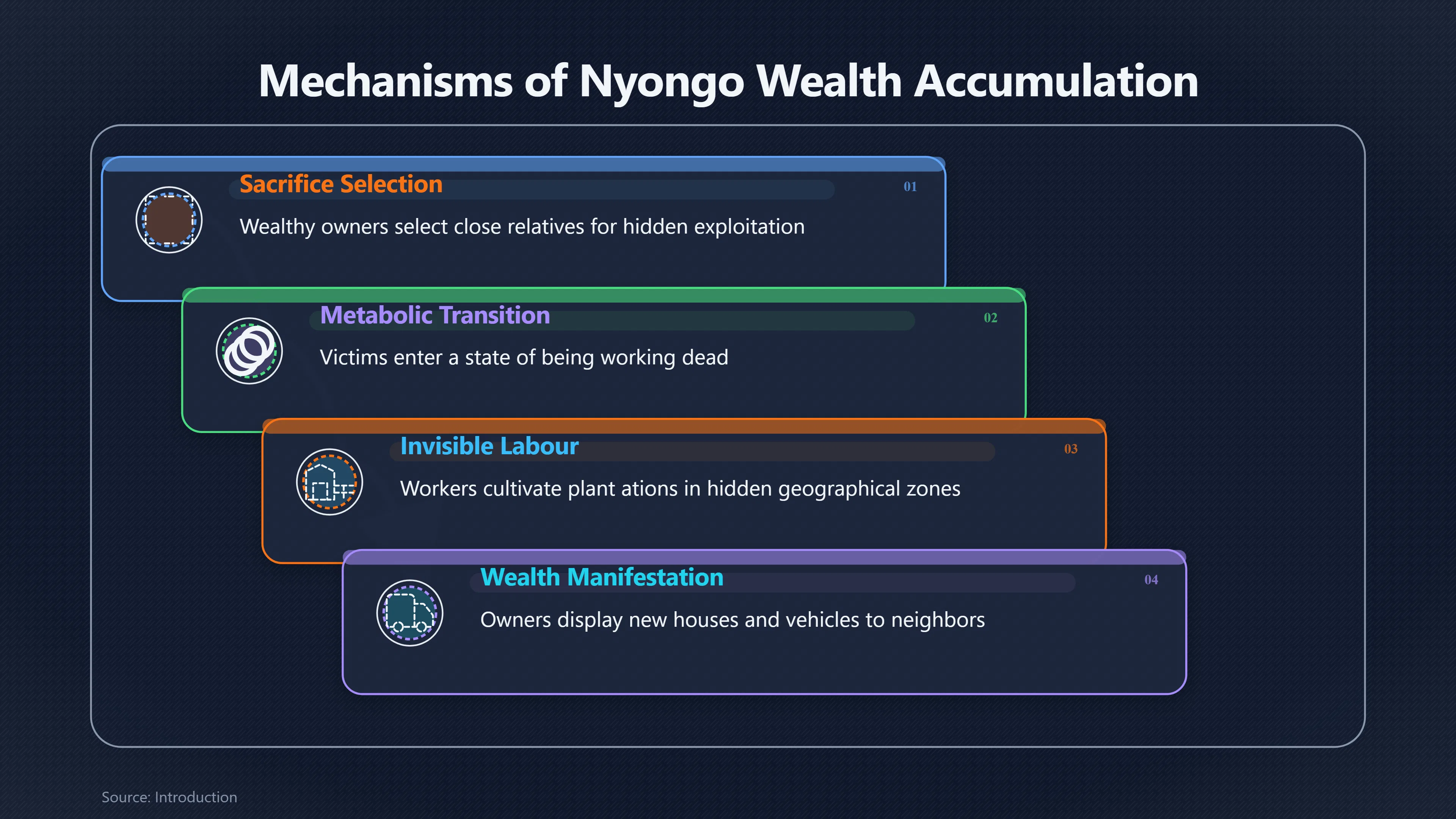
Nyongo is one of Cameroon’s best-known beliefs about the hidden cost of wealth. Rather than treating sudden prosperity as a simple sign of hard work or good fortune, nyongo stories ask a disturbing question: what if someone else’s life paid for that success? According to these accounts, wealthy individuals secretly sacrifice relatives or close associates, who are believed to continue existing as “working dead” on invisible plantations or in hidden settlements, producing wealth for their occult masters. Anthropologists do not present these claims as evidence that such events literally occurred. Instead, they argue that nyongo became a powerful way of explaining economic inequality, suspicious enrichment and the moral consequences of rapid social change.[sagepub.com]journals.sagepub.comSage Journals Sorcery, Witchcraft and AccumulationSage JournalsSorcery, Witchcraft and Accumulation - Cyprian F. Fisiy, Peter Geschiere, 1991…
The importance of nyongo lies less in whether invisible plantations existed than in what the stories reveal about everyday life. They express anxieties about labour, family obligations, colonial history, capitalism and unequal access to wealth. They also show how rumours can become persuasive when official explanations for inequality seem inadequate.[Sage Journals]journals.sagepub.comSage Journals Sorcery, Witchcraft and AccumulationSage JournalsSorcery, Witchcraft and Accumulation - Cyprian F. Fisiy, Peter Geschiere, 1991…
Did hidden labour explain sudden wealth?
The central mechanism in nyongo belief is simple but morally devastating. Prosperity is never free. If someone accumulates wealth unusually quickly, neighbours may suspect that the fortune has been purchased through the hidden exploitation of others.
Unlike many older forms of witchcraft in which victims were believed to be killed or consumed, nyongo stories often describe victims as continuing to work after their apparent death. Their bodies may be buried, yet their true existence continues in an invisible economy where they cultivate plantations, build settlements or generate wealth that only their occult owners enjoy. These labourers are frequently described as relatives, reflecting the idea that genuine wealth requires sacrificing one’s closest social obligations rather than strangers.[sagepub.com]journals.sagepub.comSage Journals Sorcery, Witchcraft and AccumulationSage JournalsSorcery, Witchcraft and Accumulation - Cyprian F. Fisiy, Peter Geschiere, 1991…
This made ordinary signs of success open to reinterpretation. A new house, successful business, vehicle or expanding plantation could become evidence not simply of achievement but of concealed exploitation. Suspicion became strongest when prosperity appeared disconnected from visible labour or followed unexplained illness or deaths within a family.[ecoi.net]ecoi.netACCORD – Austrian Centre for Country of Origin and Asylum Research and Documentation (Author): “a-5433 (ACC-CMR-5433)”, Document #1053387…
The working dead and invisible plantations
Descriptions of the “working dead” are remarkably consistent across many recorded accounts.
According to narratives documented by anthropologists, people allegedly taken through nyongo were not entirely dead nor fully alive. Instead, they became obedient workers deprived of normal human agency. They laboured endlessly in invisible farms or settlements that ordinary people could not enter. Their work enriched the owners while their families mourned them as deceased.[dvkjournals.in]dvkjournals.inOpen source on dvkjournals.in.
Mount Kupe frequently appears in these traditions as the location of one such hidden world, although details vary between communities and over time. Early accounts recorded among the Bakweri in the 1950s describe invisible settlements connected with secret societies, while later versions expanded geographically and incorporated new economic settings.[dvkjournals.in]dvkjournals.inJournal of Dharma 37, 4 (October-December 2012), 427-440January 7, 2013…
The emphasis on labour is particularly striking. The invisible workers are not portrayed as ghosts wandering aimlessly. They are productive labourers whose efforts create real wealth for others. That focus distinguishes nyongo from many other supernatural traditions and explains why scholars often describe it as an “occult economy” rather than simply a ghost story.[wiley.com]onlinelibrary.wiley.comWiley Online LibraryGlobalization and the Power of Indeterminate Meaning: Witchcraft and Spirit Cults in Africa and East Asia - Geschiere…
Plantation history, inequality and suspicion
Researchers argue that nyongo cannot be understood without considering the economic history of southern and western Cameroon.
During the colonial period, large plantations transformed local society. Wage labour, forced labour in some contexts, land alienation and highly unequal ownership created visible examples of wealth generated through other people’s work. For many communities, labour disappeared into estates controlled by distant owners while the benefits accumulated elsewhere. Anthropologists such as Peter Geschiere and Cyprian Fisiy argue that nyongo adapted these experiences into a supernatural explanation of modern accumulation. Invisible plantations mirrored real plantations; hidden workers reflected anxieties about exploitative labour systems.[Sage Journals]journals.sagepub.comSage Journals Sorcery, Witchcraft and AccumulationSage JournalsSorcery, Witchcraft and Accumulation - Cyprian F. Fisiy, Peter Geschiere, 1991…
Economic crises reinforced these fears. During the late twentieth century, particularly after severe economic difficulties and the devaluation of the CFA franc in the 1990s, accusations reportedly increased as unemployment, declining living standards and widening inequality intensified public concern about unexplained wealth. When legitimate paths to prosperity became harder to see, occult explanations often appeared more convincing to some communities.[dvkjournals.in]dvkjournals.inOpen source on dvkjournals.in.
Migration also complicated relationships between successful urban residents and relatives who remained in rural communities. Returning migrants with visible signs of prosperity could become targets of suspicion precisely because their earnings were difficult for neighbours to evaluate directly.[Cambridge University Press & Assessment]cambridge.orgCambridge University Press & AssessmentWitchcraft as an Issue in the “Politics of Belonging”: Democratization and Urban Migrants' Involve…

Why relatives mattered
One of the most unsettling features of nyongo stories is that victims are usually relatives rather than strangers.
This reflects a broader moral principle found in much anthropological work on Cameroon: wealth is expected to strengthen family networks through generosity, employment and mutual support. Someone who becomes rich while appearing selfish, secretive or detached from kin risks attracting suspicion because their behaviour violates expectations about how prosperity should circulate.
Within nyongo narratives, sacrificing relatives symbolises the ultimate inversion of family responsibility. Success no longer benefits the wider kin group; instead, the family itself becomes the raw material from which private wealth is produced. Even where no accusation is made, the stories warn against allowing personal enrichment to override obligations to others.[sagepub.com]journals.sagepub.comSage Journals Sorcery, Witchcraft and AccumulationSage JournalsSorcery, Witchcraft and Accumulation - Cyprian F. Fisiy, Peter Geschiere, 1991…
What evidence supports the nyongo accounts?
There is extensive evidence that nyongo beliefs have existed and influenced social behaviour. There is no reliable empirical evidence demonstrating that invisible plantations or working dead literally existed.
Most evidence comes from several complementary sources:
- Anthropological fieldwork, beginning with Edwin Ardener’s observations among the Bakweri in the 1950s and expanded by later researchers including Peter Geschiere, Cyprian Fisiy and Francis Nyamnjoh.
- Interviews documenting what participants believed, feared or reported hearing within their communities.
- Historical studies tracing how rumours changed alongside colonialism, plantation agriculture, migration and economic crisis.
- Legal and journalistic records showing that accusations sometimes produced serious social conflict.[sagepub.com]journals.sagepub.comSage Journals Sorcery, Witchcraft and AccumulationSage JournalsSorcery, Witchcraft and Accumulation - Cyprian F. Fisiy, Peter Geschiere, 1991…
Importantly, anthropologists generally treat interview accounts as evidence of belief rather than proof of supernatural events. Their research explains why these stories became persuasive and how they affected people’s actions without claiming that the occult mechanisms themselves were objectively verified.[Sage Journals]journals.sagepub.comSage Journals Sorcery, Witchcraft and AccumulationSage JournalsSorcery, Witchcraft and Accumulation - Cyprian F. Fisiy, Peter Geschiere, 1991…

Why the stories remain important
Nyongo continues to attract scholarly attention because it illustrates how communities explain inequality when ordinary economic explanations appear incomplete or morally unsatisfying.
Rather than dismissing the stories as mere superstition, researchers argue that they express genuine concerns about exploitation, unequal opportunity and hidden power. The invisible plantation serves as a metaphor for wealth whose origins cannot easily be observed. The working dead embody fears that some people’s prosperity depends upon the unseen suffering of others.[wiley.com]onlinelibrary.wiley.comWiley Online LibraryGlobalization and the Power of Indeterminate Meaning: Witchcraft and Spirit Cults in Africa and East Asia - Geschiere…
At the same time, these beliefs can have harmful consequences. Suspicion directed at successful individuals, relatives or neighbours may damage reputations, deepen family conflicts or contribute to accusations of witchcraft. For that reason, modern scholarship distinguishes carefully between documenting the social reality of nyongo belief and endorsing its supernatural claims.
Viewed in this way, nyongo is less a story about zombies than a social theory expressed through folklore. It asks enduring questions that remain recognisable far beyond Cameroon: Why do some people become rich while others remain poor? Who benefits from hidden labour? And how should a community judge wealth whose origins are difficult to see?[sagepub.com]journals.sagepub.comSage Journals Sorcery, Witchcraft and AccumulationSage JournalsSorcery, Witchcraft and Accumulation - Cyprian F. Fisiy, Peter Geschiere, 1991…
Amazon book picks
Further Reading
Books and field guides related to Did Hidden Labour Explain Sudden Wealth?. Use these as the next step if you want deeper reading beyond the article.
Purity and danger
Helps explain symbolic systems behind pollution, danger and accusation.
The devil and commodity fetishism in South America
Directly explores occult explanations for wealth and labour.
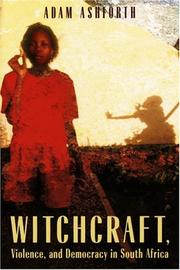
Witchcraft, Violence, and Democracy in South Africa
Shows how accusations intersect with inequality and social tension.
Endnotes
1.
Source: onlinelibrary.wiley.com
Link:https://onlinelibrary.wiley.com/doi/full/10.1111/1467-7660.00100
Source snippet
Wiley Online LibraryGlobalization and the Power of Indeterminate Meaning: Witchcraft and Spirit Cults in Africa and East Asia - Geschiere...
2.
Source: dvkjournals.in
Link:https://dvkjournals.in/index.php/jd/article/view/479
3.
Source: cambridge.org
Link:https://www.cambridge.org/core/journals/african-studies-review/article/witchcraft-as-an-issue-in-the-politics-of-belonging-democratization-and-urban-migrants-involvement-with-the-home-village/9C8C250ECE0A8C28DAB79115557E68CD
Source snippet
Cambridge University Press & AssessmentWitchcraft as an Issue in the “Politics of Belonging”: Democratization and Urban Migrants' Involve...
4.
Source: dvkjournals.in
Link:https://dvkjournals.in/index.php/jd/article/download/479/374/951
Source snippet
Journal of Dharma 37, 4 (October-December 2012), 427-440...
Published: December 2012
5.
Source: ecoi.net
Link:https://www.ecoi.net/en/document/1053387.html
Source snippet
ACCORD – Austrian Centre for Country of Origin and Asylum Research and Documentation (Author): “a-5433 (ACC-CMR-5433)”, Document #1053387...
6.
Source: dvkjournals.in
Link:https://www.dvkjournals.in/index.php/jd/article/download/479/374
Source snippet
Journal of Dharma 37, 4 (October-December 2012), 427-440January 7, 2013...
Published: January 7, 2013
7.
Source: onlinelibrary.wiley.com
Title: 1467 7660.00100
Link:https://onlinelibrary.wiley.com/doi/pdf/10.1111/1467-7660.00100
8.
Source: journals.sagepub.com
Title: Sage Journals Sorcery, Witchcraft and Accumulation
Link:https://journals.sagepub.com/doi/pdf/10.1177/0308275X9101100304
Source snippet
Sage JournalsSorcery, Witchcraft and Accumulation - Cyprian F. Fisiy, Peter Geschiere, 1991...
9.
Source: journals.sagepub.com
Link:https://journals.sagepub.com/doi/10.1177/0308275X9101100304
Additional References
10.
Source: sciencedirect.com
Link:https://www.sciencedirect.com/science/article/abs/pii/S0962629815000268
Source snippet
WITCHCRAFT, DEVELOPMENT AND PARANOIA IN CAMEROON: INTERACTIONS BETWEEN POPULAR, ACADEMICS AND STATE DISCOURSES * J. Galtung VIOLENCE, PEA...
11.
Source: youtube.com
Link:https://www.youtube.com/watch?v=OYPc4h_Ncb0
Source snippet
OBINNA SHOW LIVE: DARK SECRETS OF WEALTH, MARRIAGE & BETRAYAL- Dr. Mwaka...
12.
Source: youtube.com
Title: Coming out of The Nkuta | Trailer | Available Now
Link:https://www.youtube.com/watch?v=7CK8mQNQEpI
Source snippet
A Murder Spanning Two Continents: Child Sacrifice in London | Crime and Witchcraft Documentary...
13.
Source: scribd.com
Link:https://www.scribd.com/document/864928392/Python
14.
Source: youtube.com
Title: Witchcraft in Bamenda (Cameroon) | Documentary
Link:https://www.youtube.com/watch?v=80YVsORQH2E
Source snippet
Coming out of The Nkuta | Trailer | Available Now...
15.
Source: researchgate.net
Link:https://www.researchgate.net/publication/287087678The%27working-dead%27_in_nyongo_occult_economy_in_cameroonian_society
16.
Source: youtube.com
Title: On Intimacy–with Peter Geschiere
Link:https://www.youtube.com/watch?v=AtD4ABTpSeE
Source snippet
Witchcraft in Bamenda (Cameroon) | Documentary...
17.
Source: youtube.com
Title: OBINNA SHOW LIVE: DARK SECRETS OF WEALTH, MARRIAGE & BETRAYAL- Dr. Mwaka
Link:https://www.youtube.com/watch?v=iiqpxoKpWIE
18.
Source: academic.oup.com
Title: suppl 3
Link:https://academic.oup.com/past/article-abstract/199/suppl_3/271/1480116
Topic Tree