Within Marshall Islands
Why Castle Bravo Fear Was Not Hysteria
Castle Bravo created a real invisible hazard whose delayed warnings and lasting contamination transformed daily life across affected atolls.
On this page
- The blast, fallout and delayed evacuation
- How invisible contamination changed everyday decisions
- Why official uncertainty deepened public fear
Page outline Jump by section
Introduction
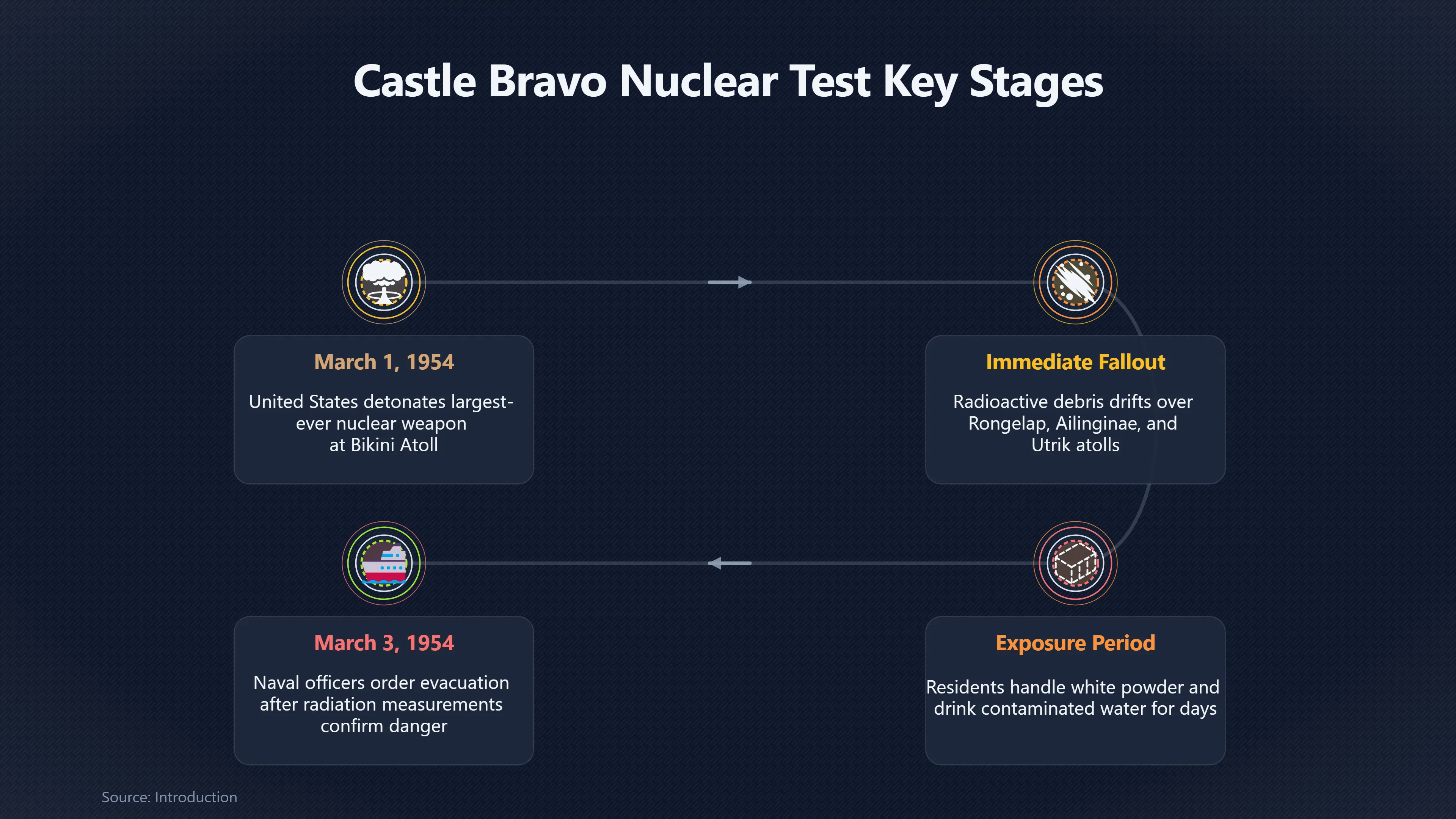
The fear that followed the 1954 Castle Bravo nuclear test in the Marshall Islands was not a case of mass hysteria. It was a rational response to a danger that people could neither see nor fully understand. On 1 March 1954, the United States detonated its largest-ever nuclear weapon at Bikini Atoll. The explosion was far more powerful than expected, and radioactive fallout drifted over inhabited atolls including Rongelap, Ailinginae and Utrik. Residents watched white, ash-like particles fall from the sky without being told they were radioactive. Many handled the material, drank contaminated water and continued everyday activities before evacuation came almost two days later.[nih.gov]ncbi.nlm.nih.govNCBIAn Overview of the U.S. Nuclear Weapons Testing ProgramThe Five Series Study - NCBI Bookshelf…

Castle Bravo became the defining event in Marshallese nuclear memory because it transformed an invisible scientific hazard into a permanent feature of daily life. Fear spread not through rumour alone but through direct experience: unexplained illness, uncertainty about food and water, repeated relocations and conflicting official reassurances. The lasting importance of the episode lies in how genuine danger, delayed information and damaged trust combined to shape generations of public anxiety.
The blast, fallout and delayed evacuation
Castle Bravo was designed as part of the United States’ Operation Castle thermonuclear testing programme. Scientists expected a yield of around six megatons, but the weapon produced approximately 15 megatons because of an unexpectedly large contribution from lithium-7 reactions in the fuel. It remains the largest nuclear explosion ever conducted by the United States.[NCBI]ncbi.nlm.nih.govNCBIAn Overview of the U.S. Nuclear Weapons Testing ProgramThe Five Series Study - NCBI Bookshelf…
The greater-than-expected yield, combined with changing upper-level winds, carried radioactive debris eastwards instead of keeping it within the anticipated danger zone. Fallout reached inhabited islands where no immediate warning had been given.
On Rongelap, residents described a fine white powder settling onto houses, coconut trees, water containers and people’s skin. Children reportedly played in it because they had never seen anything similar. Fishing, collecting rainwater and preparing food continued because no one knew the material was dangerous. Within hours and days, many people developed symptoms including nausea, vomiting, skin burns and later hair loss, all consistent with acute radiation exposure.[nih.gov]pubmed.ncbi.nlm.nih.govPub Med Protracted exposure to fallout: the Rongelap and Utirik experienceProtracted exposure to fallout: the Rongelap and Utirik experience - PubMed…
Evacuation did not occur until 3 March, roughly 48 hours after the detonation. Official records show that radiation measurements taken on Rongelap convinced naval officers that immediate evacuation was necessary, but by then the population had already received substantial exposure.[National Security Archive]nsarchive.gwu.eduOpen source on gwu.edu.
The delay became one of the central reasons why Marshallese communities later questioned official assurances. Fear was rooted not only in the explosion itself but in the realisation that people had unknowingly lived inside a contaminated environment while authorities were assessing the situation.
How invisible contamination changed everyday decisions
Castle Bravo introduced a new kind of uncertainty into ordinary life. Radioactivity could not be detected through sight, smell or taste, making everyday choices deeply unsettling.
Questions that had once been routine became sources of anxiety:
- Was rainwater safe to drink?
- Could locally grown fruit or coconuts be eaten?
- Were fish contaminated?
- Was it safe for children to play outdoors?
- Could families return home permanently?
Unlike visible storm damage or wartime destruction, radioactive fallout left landscapes looking largely unchanged while making parts of them hazardous. This mismatch between appearance and risk encouraged continual caution.
The uncertainty continued long after the initial emergency. Residents of Rongelap were allowed to return in 1957 after official assessments judged the atoll safe. However, contamination from long-lived radioactive isotopes remained in soils and entered local food chains. Decades later, continuing concerns over radiation led the Rongelap community to leave again in 1985, reflecting persistent disagreement over what level of risk was acceptable.[National Academies]nationalacademies.orgOpen source on nationalacademies.org.
The practical consequence was that ordinary decisions about eating, farming and raising children became linked to questions of scientific expertise that local communities could not independently verify.

Why official uncertainty deepened public fear
One of the most important features of the Castle Bravo story is that uncertainty came from institutions as well as from the hazard itself.
The unexpected yield showed that scientists had underestimated the weapon’s behaviour. Fallout patterns also proved more extensive than predicted. As a result, officials were forced to respond to an emergency that had not been fully anticipated.[NCBI]ncbi.nlm.nih.govNCBIAn Overview of the U.S. Nuclear Weapons Testing ProgramThe Five Series Study - NCBI Bookshelf…
For affected communities, however, the distinction between scientific surprise and official failure mattered less than the experience of delayed warning and inconsistent reassurance. Over the following decades, people heard repeated statements that particular islands were safe for resettlement, only for contamination concerns to continue or later increase. This cycle reinforced suspicion that official assessments might change again.
Medical monitoring also became controversial. Shortly after the exposure, US researchers began studying the health effects on exposed Marshallese populations through what became known as Project 4.1. While the programme also provided medical treatment, later historians and ethicists criticised aspects of the research, particularly questions surrounding informed consent and the relationship between medical care and scientific observation. These debates further strengthened local distrust of outside authorities.[Nuclear Museum]ahf.nuclearmuseum.orgNuclear Museum Castle BravoNuclear MuseumCastle Bravo - Nuclear Museum…
Fear therefore spread through experience rather than exaggeration. Communities had evidence from their own lives that official certainty could later prove incomplete.
Fear grounded in evidence rather than panic
Castle Bravo demonstrates an important distinction between collective fear and collective delusion.
Many historical panics involve threats that are exaggerated, imagined or unsupported by evidence. Castle Bravo was different because the central danger was objectively real. Independent medical studies documented significant radiation exposure among residents of Rongelap and Utrik, while environmental monitoring confirmed long-term contamination of some islands and food sources.[nih.gov]pubmed.ncbi.nlm.nih.govPub Med Protracted exposure to fallout: the Rongelap and Utirik experienceProtracted exposure to fallout: the Rongelap and Utirik experience - PubMed…
At the same time, uncertainty about individual risk created understandable psychological strain. Residents could not easily judge whether illness, infertility, thyroid disease or cancer might be linked to radiation exposure. Not every later health problem could be attributed directly to Castle Bravo, but the absence of certainty itself became part of the burden.
For many Marshallese families, fear became embedded in memory because it was continually reinforced by relocation, health screening, compensation debates and ongoing environmental surveys rather than fading after a single crisis.
Why Castle Bravo remains central to Marshallese memory
Castle Bravo continues to shape Marshallese identity because it represents more than one disastrous nuclear test. It symbolises the moment when trust in official protection was fundamentally shaken.
The event left several enduring legacies:
- Invisible danger: radioactive contamination challenged traditional ways of judging environmental safety.
- Intergenerational memory: survivors passed stories of the white fallout and its consequences to younger generations.
- Political significance: nuclear justice, compensation and environmental restoration remain central issues in relations between the Marshall Islands and the United States.
- Public understanding of nuclear risk: internationally, Castle Bravo helped demonstrate that fallout could travel far beyond test sites, influencing debates over atmospheric nuclear testing.[NCBI]ncbi.nlm.nih.govNCBIAn Overview of the U.S. Nuclear Weapons Testing ProgramThe Five Series Study - NCBI Bookshelf…
Within the wider history of collective fear in the Marshall Islands, Castle Bravo stands apart because the anxiety it produced was evidence-based. People feared contamination because they had witnessed unexplained illness, experienced forced displacement and lived through repeated uncertainty about whether their homes, food and water were truly safe. The defining lesson is not that fear overwhelmed reason, but that incomplete information and delayed official action made an already real danger even more difficult to live with.
Amazon book picks
Further Reading
Books and field guides related to Why Castle Bravo Fear Was Not Hysteria. Use these as the next step if you want deeper reading beyond the article.

Endnotes
1.
Source: ncbi.nlm.nih.gov
Title: NCBIAn Overview of the U.S. Nuclear Weapons Testing Program
Link:https://www.ncbi.nlm.nih.gov/books/NBK225000/
Source snippet
The Five Series Study - NCBI Bookshelf...
2.
Source: cancer.gov
Title: National Cancer Institute American Scientist reprint
Link:https://www.cancer.gov/about-cancer/causes-prevention/risk/radiation/fallout-pdf
3.
Source: dceg.cancer.gov
Title: nci dose estimation predicted cancer risk residents marshall islands
Link:https://dceg.cancer.gov/research/how-we-study/exposure-assessment/nci-dose-estimation-predicted-cancer-risk-residents-marshall-islands
4.
Source: pubmed.ncbi.nlm.nih.gov
Title: Pub Med Protracted exposure to fallout: the Rongelap and Utirik experience
Link:https://pubmed.ncbi.nlm.nih.gov/6421771/
Source snippet
Protracted exposure to fallout: the Rongelap and Utirik experience - PubMed...
5.
Source: nsarchive.gwu.edu
Link:https://nsarchive.gwu.edu/document/31251-document-6-commanding-officer-uss-phillip-commander-task-group-73-evacuation
6.
Source: ahf.nuclearmuseum.org
Title: Nuclear Museum Castle Bravo
Link:https://ahf.nuclearmuseum.org/ahf/history/castle-bravo/
Source snippet
Nuclear MuseumCastle Bravo - Nuclear Museum...
7.
Source: nationalacademies.org
Link:https://www.nationalacademies.org/read/2352/chapter/3
8.
Source: nsarchive.gwu.edu
Link:https://nsarchive.gwu.edu/media/34021/ocr
Source snippet
of the Document | National Security ArchiveMay 21, 2026 — OCR OF THE DOCUMENT View the Document >> How a U S Bomb Test Became a Nuclear D...
Published: May 21, 2026
9.
Source: nsarchive.gwu.edu
Title: castle bravo 70 worst nuclear test us history
Link:https://nsarchive.gwu.edu/briefing-book/nuclear-vault/2024-02-29/castle-bravo-70-worst-nuclear-test-us-history
Source snippet
History | National Security ArchiveFebruary 29, 2024 — CASTLE BRAVO AT 70: THE WORST NUCLEAR TEST IN U.S. HISTORY A still frame from the...
Published: February 29, 2024
10.
Source: ahf.nuclearmuseum.org
Title: atomic culture
Link:https://ahf.nuclearmuseum.org/ahf/history/atomic-culture/
11.
Source: wikidoc.org
Title: Project 4.1
Link:https://www.wikidoc.org/index.php/Project_4.1
12.
Source: ncbi.nlm.nih.gov
Link:https://www.ncbi.nlm.nih.gov/books/NBK597564/?report=printable
13.
Source: pmc.ncbi.nlm.nih.gov
Link:https://pmc.ncbi.nlm.nih.gov/articles/PMC4358182/
14.
Source: encyclopedia.pub
Link:https://encyclopedia.pub/entry/history/show/72439
15.
Source: military-history.fandom.com
Title: Castle Bravo
Link:https://military-history.fandom.com/wiki/Castle_Bravo
16.
Source: nsarchive.gwu.edu
Link:https://nsarchive.gwu.edu/index.php/document/31256-document-11-gordon-dunning-division-biology-and-medicine-dr-john-c-bugher-director
17.
Source: nsarchive.gwu.edu
Link:https://nsarchive.gwu.edu/document/31253-document-8-k-gilbert-commander-task-unit-13-usaf-commander-eugene-p-cronkite-8-march
18.
Source: nsarchive.gwu.edu
Link:https://nsarchive.gwu.edu/document/31247-document-2-memorandum-record-lt-col-ra-house-usaf-radsafe-officer-command-briefing-1
Additional References
19.
Source: legalclarity.org
Title: Marshall Islands Nuclear Testing: Legacy and Compensation
Link:https://legalclarity.org/marshall-islands-nuclear-testing-legacy-and-compensation/
Source snippet
government established what became known as Project 4.1, formally titled “Study of Response of Human Beings Exposed to Sig...
20.
Source: onlinelibrary.wiley.com
Title: The relationship between the Republic
Link:https://onlinelibrary.wiley.com/doi/10.1111/1467-9566.13452
Source snippet
in sociology and community‐based participatory research with Marshallese - McElfish - 2022 - Sociology of Health & Illness - Wiley Online...
21.
Source: youtube.com
Title: Nuclear Tests Changed Life Forever in the Marshall Islands
Link:https://www.youtube.com/watch?v=3V_lK1fYE5Y
Source snippet
Massive Nuclear Test Triggers Fallout Fears Across the Pacific...
22.
Source: youtube.com
Title: Massive Nuclear Test Triggers Fallout Fears Across the Pacific
Link:https://www.youtube.com/watch?v=jkgsJPh7HjY
Source snippet
The Castle Bravo Nuclear Test/Lucky Dragon No. 5...
23.
Source: youtube.com
Link:https://www.youtube.com/watch?v=TFZu3imK1JA
Source snippet
Nuclear Tests Changed Life Forever in the Marshall Islands...
24.
Source: undergroundhistory.com
Link:https://www.undergroundhistory.com/stories/castle-bravo/
25.
Source: armscontrol.org
Link:https://www.armscontrol.org/act/2014-03/no-promised-land-shared-legacy-castle-bravo-nuclear-test
26.
Source: youtube.com
Title: Castle Bravo Disaster
Link:https://www.youtube.com/watch?v=ew064gt2thY
Source snippet
Surviving the Atomic Bomb 1000x Stronger Than Hiroshima...
27.
Source: congress.gov
Title: ional Record | Congress.gov | Library of Congress
Link:https://www.congress.gov/congressional-record/volume-150/issue-34/house-section/article/H1135-1
28.
Source: marshallislands.llnl.gov
Link:https://marshallislands.llnl.gov/
Topic Tree