Within Mexico Panics
Why Did Hundreds of Schoolgirls Fall Ill?
The Villa de las Ninas outbreak explains how genuine symptoms can spread through a stressed group without a confirmed infection or toxin.
On this page
- The outbreak and its symptoms
- What medical investigations ruled out
- How mass psychogenic illness spreads
Page outline Jump by section
Introduction
Between late 2006 and 2007, hundreds of girls at Villa de las Niñas, a Catholic boarding school in Chalco, in the State of Mexico, developed alarming symptoms including difficulty walking, nausea, headaches, fever-like sensations and, in some cases, temporary weakness or paralysis of the legs. The outbreak prompted fears of an infectious disease, environmental poisoning or abuse within the school. Yet repeated investigations by Mexican health and environmental authorities failed to identify any infectious agent, toxin or other physical cause. The episode is now widely discussed as one of the best-known modern examples in Mexico of mass psychogenic illness, also called mass sociogenic illness: a genuine outbreak of physical symptoms spreading through a closely connected group without evidence of a contagious disease or toxic exposure.[Taipei Times]taipeitimes.comTaipei Times Mexican school's mysterious illness is psychosomaticTaipei TimesMexican school's mysterious illness is psychosomatic - Taipei TimesApril 7, 2007…
The Villa de las Niñas case is important because it demonstrates how real suffering can spread through a stressed community even when no conventional medical cause is found. Rather than suggesting that the girls were pretending or imagining their symptoms, the episode illustrates the powerful interaction between psychological stress, social environments and human biology.
Why Did Hundreds of Schoolgirls Fall Ill?
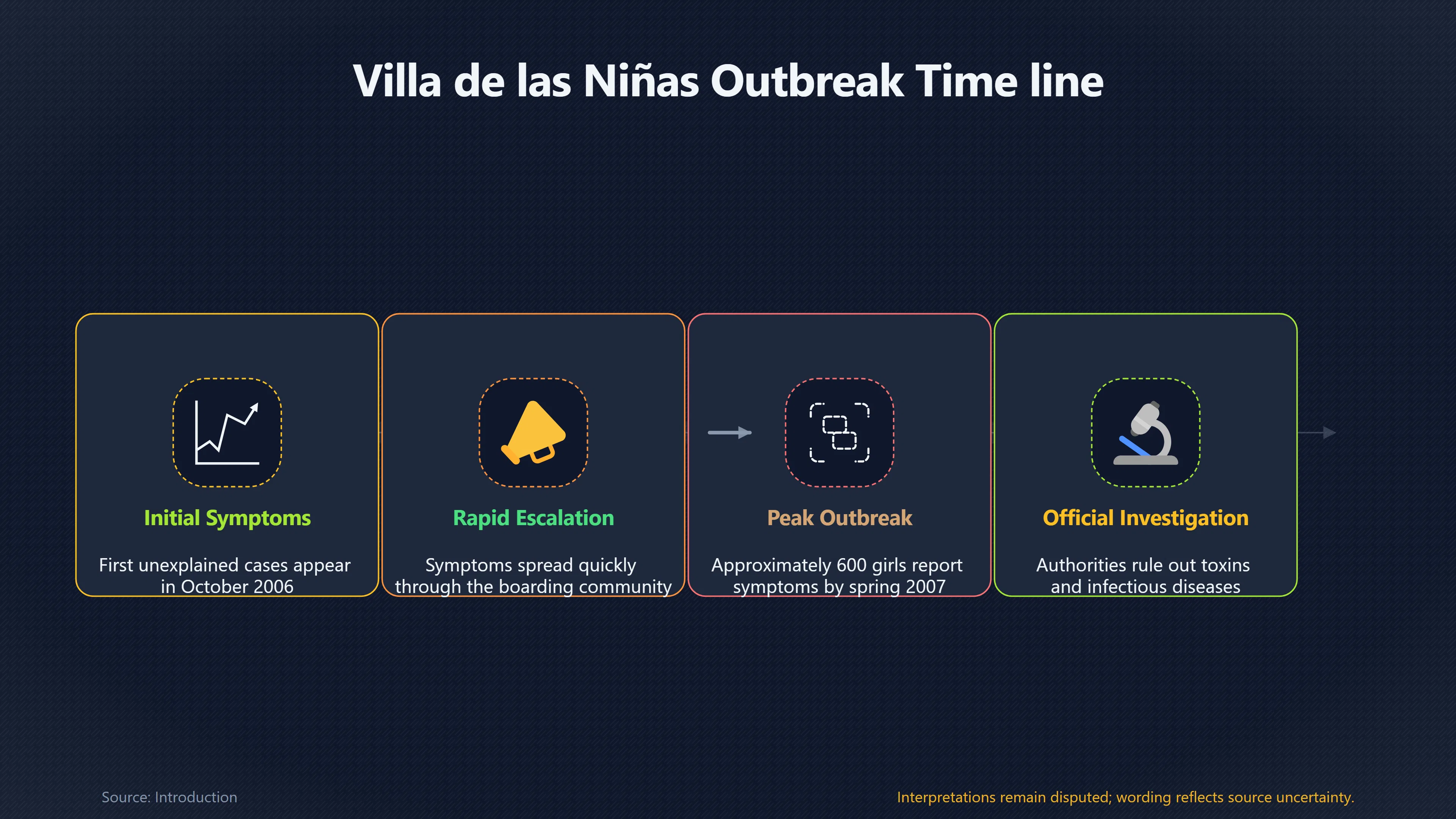
Villa de las Niñas was a boarding school operated by Catholic nuns that mainly educated girls from disadvantaged families across Mexico. According to school officials, the first unexplained cases appeared in October 2006. Over the following months, the number of affected pupils rose dramatically until roughly 600 girls had reported similar symptoms by spring 2007.[Taipei Times]taipeitimes.comTaipei Times Mexican school's mysterious illness is psychosomaticTaipei TimesMexican school's mysterious illness is psychosomatic - Taipei TimesApril 7, 2007…
Although individual symptoms varied, reports commonly described:
- Difficulty walking or sudden weakness in the legs.
- Nausea and headaches.
- Dizziness.
- Fever-like sensations despite inconsistent clinical findings.
- Fatigue and occasional temporary inability to stand.
Television images of girls struggling to walk attracted national and international attention. The highly visible nature of the illness encouraged speculation that the school was experiencing an epidemic or that something within the institution was harming pupils. Rumours ranged from contaminated food or water to mistreatment by school staff, adding further anxiety to an already stressful situation.[Taipei Times]taipeitimes.comTaipei Times Mexican school's mysterious illness is psychosomaticTaipei TimesMexican school's mysterious illness is psychosomatic - Taipei TimesApril 7, 2007…
What Medical Investigations Ruled Out
Because so many children became ill in a relatively short period, authorities initially treated the situation as a potential public health emergency.
Investigations involved state and federal health agencies, environmental specialists and medical experts. They examined possible infectious diseases, analysed environmental conditions around the school and looked for contamination of water, soil and food supplies. According to official statements reported at the time, these investigations failed to identify any infectious organism, toxic chemical or environmental hazard capable of explaining the outbreak.[Taipei Times]taipeitimes.comTaipei Times Mexican school's mysterious illness is psychosomaticTaipei TimesMexican school's mysterious illness is psychosomatic - Taipei TimesApril 7, 2007…
Doctors also found that the symptoms did not fit the pattern expected from a contagious disease. There was no single laboratory abnormality linking patients, no evidence of poisoning and no environmental exposure that consistently matched where or when pupils became ill.
This absence of an identifiable physical cause did not mean that the symptoms were unreal. The affected girls experienced genuine weakness, pain and distress. The challenge for investigators was explaining why these very real symptoms appeared simultaneously in such a large group.
How Mass Psychogenic Illness Spreads
The Villa de las Niñas outbreak closely resembles patterns recognised in medical research on mass psychogenic illness.
Mass psychogenic illness refers to the rapid spread of genuine physical symptoms within a socially connected group when no infectious or toxic explanation can be demonstrated. The symptoms are involuntary and are not consciously produced. They often emerge in schools, boarding institutions or workplaces where people share close daily contact and common sources of stress.[PubMed]pubmed.ncbi.nlm.nih.govPub Med Frequency and predictors of mass psychogenic illnessFrequency and predictors of mass psychogenic illness - PubMed…
Several features commonly found in documented outbreaks also appeared at Villa de las Niñas:
- A close-knit community. Boarding schools create constant social interaction, allowing concern about illness to spread rapidly.
- Adolescents as the main affected group. Many well-documented outbreaks occur predominantly among teenage girls, although boys and adults can also be affected.
- High levels of emotional stress. Academic pressure, separation from family, strict routines and uncertainty can increase vulnerability, although they are not sufficient by themselves to cause illness.
- Observation of other cases. Seeing classmates become ill or hearing reports of illness can unintentionally increase anxiety and contribute to the spread of symptoms.
- Media attention. Extensive news coverage may reinforce fears by making the event appear even more threatening, even when reporting is accurate.[nih.gov]pubmed.ncbi.nlm.nih.govPub Med Frequency and predictors of mass psychogenic illnessFrequency and predictors of mass psychogenic illness - PubMed…
Researchers emphasise that these mechanisms are not unique to Mexico. Comparable outbreaks have occurred in schools across many countries, often following rumours of poisoning, unusual odours or suspected infectious disease.[PubMed]pubmed.ncbi.nlm.nih.govPub Med Frequency and predictors of mass psychogenic illnessFrequency and predictors of mass psychogenic illness - PubMed…
Why Stress Can Produce Physical Symptoms
One of the most misunderstood aspects of mass psychogenic illness is the assumption that a psychological explanation means the illness is “all in the mind”. Medical evidence does not support that interpretation.
Stress and anxiety can activate the autonomic nervous system—the body’s automatic response system—producing measurable physical effects such as dizziness, nausea, weakness, rapid breathing, muscle tension and faintness. In group settings, these symptoms may become reinforced as individuals observe one another, increasing vigilance towards ordinary bodily sensations and unintentionally amplifying them.[PMC]pmc.ncbi.nlm.nih.govPMCMass Psychogenic Illness: Demography and Symptom Profile of an EpisodePMCMass Psychogenic Illness: Demography and Symptom Profile of an Episode
This process does not require deliberate imitation or conscious deception. People experiencing mass psychogenic illness generally believe they are physically ill because they are experiencing genuine symptoms.
Public Reaction and Lasting Significance
The Villa de las Niñas outbreak became one of Mexico’s best-known modern examples of unexplained collective illness because it combined dramatic visual symptoms with uncertainty about the cause. Public discussion included allegations of hidden environmental hazards, institutional abuse and official cover-ups before investigations had reached conclusions.[Taipei Times]taipeitimes.comTaipei Times Mexican school's mysterious illness is psychosomaticTaipei TimesMexican school's mysterious illness is psychosomatic - Taipei TimesApril 7, 2007…
For public health professionals, the case illustrates an important balance. Authorities must investigate possible infections and toxic exposures thoroughly because overlooking a genuine hazard would have serious consequences. At the same time, prolonged uncertainty, conflicting rumours and sensational reporting can unintentionally sustain outbreaks of mass psychogenic illness by increasing community anxiety. Medical literature therefore recommends coordinated investigations, clear communication and reassurance once dangerous causes have been reasonably excluded.[PubMed]pubmed.ncbi.nlm.nih.govPub Med Frequency and predictors of mass psychogenic illnessFrequency and predictors of mass psychogenic illness - PubMed…
Within the broader history of collective fear and contagious belief in Mexico, Villa de las Niñas stands apart from religious panics or moral scares. It was not driven by belief in witches, miracles or conspiracies, but by the spread of genuine physical symptoms through a vulnerable community in the absence of a confirmed infectious or toxic cause. The episode remains an influential case study in how biological responses, social environments and uncertainty can interact to create a medical mystery without requiring a conventional epidemic.
Amazon book picks
Further Reading
Books and field guides related to Why Did Hundreds of Schoolgirls Fall Ill?. Use these as the next step if you want deeper reading beyond the article.



Interpretation of Cultures
First published 1973. Subjects: Culturele antropologie, Culture, Ethnology, Ethnologie, Ethnolo.
When Prophecy Fails
The study reported in this volume grew out of some theoretical work, one phase of which bore specifically on the behavior of individuals...
Endnotes
1.
Source: taipeitimes.com
Title: Taipei Times Mexican school’s mysterious illness is psychosomatic
Link:https://www.taipeitimes.com/News/world/archives/2007/04/07/2003355645
Source snippet
Taipei TimesMexican school's mysterious illness is psychosomatic - Taipei TimesApril 7, 2007...
Published: April 7, 2007
2.
Source: pubmed.ncbi.nlm.nih.gov
Title: Pub Med Frequency and predictors of mass psychogenic illness
Link:https://pubmed.ncbi.nlm.nih.gov/20592616/
Source snippet
Frequency and predictors of mass psychogenic illness - PubMed...
3.
Source: pubmed.ncbi.nlm.nih.gov
Title: Pub Med Mass sociogenic illness–real and imaginary
Link:https://pubmed.ncbi.nlm.nih.gov/15080215/
4.
Source: pmc.ncbi.nlm.nih.gov
Title: PMCMass Psychogenic Illness: Demography and Symptom Profile of an Episode
Link:https://pmc.ncbi.nlm.nih.gov/articles/PMC4884863/
5.
Source: pubmed.ncbi.nlm.nih.gov
Link:https://pubmed.ncbi.nlm.nih.gov/35747341/
Source snippet
2022 May 30:28:1671. doi: 10.4102/sajpsychiatry.v28i0.1671. eCollection 2022. PREDICTORS OF MASS PSYCHOGENIC ILLNESS IN A JUNIOR SECONDAR...
6.
Source: pubmed.ncbi.nlm.nih.gov
Link:https://pubmed.ncbi.nlm.nih.gov/24244685/
Source snippet
of mass sociogenic illness in a school feeding program in northwest Bangladesh, 2010 - PubMedNovember 14, 2013 — AFFILIATION * ^{1} Centr...
Published: November 14, 2013
7.
Source: pmc.ncbi.nlm.nih.gov
Link:https://pmc.ncbi.nlm.nih.gov/articles/PMC3536509/
Source snippet
December 1, 2012 — ^{2}King's College London, Department of Psychological Medicine, London SE5 8AF, UK ^{✉} Correspondence to: Robert...
Published: December 1, 2012
8.
Source: pmc.ncbi.nlm.nih.gov
Link:https://pmc.ncbi.nlm.nih.gov/articles/PMC543940/
Source snippet
2005 Jan 4;172(1):36. doi: 10.1503/cmaj.045027 MASS SOCIOGENIC ILLNESS Erica Weir ERICA WEIR ^{1}CMAJ Find articles by Erica Weir ^{1} *...
Additional References
9.
Source: nejm.org
Link:https://www.nejm.org/doi/abs/10.1056/NEJM200001133420206
Source snippet
Jones, M.D., Allen S. Craig, M.D., Debbie Hoy, R.N., Elaine W. Gunter, M.T., David L. Ashley, Ph.D., Dana B...
10.
Source: nejm.org
Link:https://www.nejm.org/doi/full/10.1056/NEJM200001133420206
Source snippet
Jones, M.D., Allen S. Craig, M.D., Debbie Hoy, R.N., Elaine W. Gunter, M.T., David L. Ashley, Ph.D., Dana B...
11.
Source: hero.epa.gov
Title: Five days later, after the school had reopened,
Link:https://hero.epa.gov/reference/11895/
Source snippet
psychogenic illness attributed to toxic exposure at a high schoolThe school was evacuated, and 80 students and 19 staff members went to t...
12.
Source: researchgate.net
Title: (PDF) La fábrica de la histeria
Link:https://www.researchgate.net/publication/345706319_La_fabrica_de_la_histeria
Source snippet
September 1, 2007 — Article PDF Available LA FÁBRICA DE LA HISTERIA * September 2007 Authors: Julio Ortega Bobadilla * University of Vera...
Published: September 1, 2007
13.
Source: youtube.com
Title: The Razor-Thin Line Between Contagion and Connection | Dan Taberski | TED
Link:https://www.youtube.com/watch?v=u0fFIJapsRY
Source snippet
Episode 71. Frenzy – The Turmoil of Mass Psychogenic Illness...
14.
Source: youtube.com
Title: Selects: What Is Collective Hysteria? | STUFF YOU SHOULD KNOW
Link:https://www.youtube.com/watch?v=gmK2hTmlaEQ
Source snippet
Stop that! It's not Tourette's but a new type of mass sociogenic illness...
15.
Source: youtube.com
Title: Episode 71. Frenzy – The Turmoil of Mass Psychogenic Illness
Link:https://www.youtube.com/watch?v=e2AdorYLDF8
Source snippet
Selects: What Is Collective Hysteria? | STUFF YOU SHOULD KNOW...
16.
Source: youtube.com
Title: 25 Cases of Mass Hysteria That Defy Explanation
Link:https://www.youtube.com/watch?v=Js8pYoFJZj0
Source snippet
The Razor-Thin Line Between Contagion and Connection | Dan Taberski | TED...
17.
Source: youtube.com
Title: Stop that! It’s not Tourette’s but a new type of mass sociogenic illness
Link:https://www.youtube.com/watch?v=-nsIZwlHUBM
Topic Tree