When Did Belief Become Fear in New Zealand?
New Zealand’s history of cults, panics and contagious belief is not dominated by a single witch hunt or spectacular outbreak of mass psychogenic illness.
Page outline Jump by section
Introduction
The central lesson is that collective alarm can attach itself to both imaginary and real dangers. The 1954 panic over teenage sexuality greatly exaggerated a supposed national collapse in morality. The Christchurch Civic Crèche case developed amid international fears about ritual abuse and ended with convictions being quashed. By contrast, investigations of Centrepoint and Gloriavale uncovered documented coercion, exploitation and abuse. Understanding New Zealand’s record therefore requires more than asking whether a belief was strange. The more useful questions are who held power, what evidence existed, how stories spread, and whether official intervention protected people or intensified injustice.
Why “cult” and “mass hysteria” can mislead
“Cult” is commonly used for an unpopular or highly controlled religious group, but it is not a precise legal or clinical category. It may describe a small new religion, an intentional community, a charismatic following or an organisation exercising severe coercive control. These are not automatically the same thing. New Zealand’s religious history includes many unconventional movements that were peaceful, alongside communities where leaders used spiritual or therapeutic claims to justify abuse.
“Mass hysteria” is equally blunt. Specialists generally distinguish several processes:[ebsco.com]ebsco.comSource details in endnotes.
- Moral panic: a threat is presented as endangering society, often through disproportionate media and political reaction.
- Mass psychogenic illness: real physical symptoms spread through a group without an identified toxic or infectious cause.
- Rumour panic: unverified claims circulate rapidly and alter behaviour before facts are established.
- Millenarian belief: a movement expects an approaching divine transformation, judgement or new age.
- Coercive control: leaders systematically restrict followers’ freedom, relationships, money, work or access to outside information.
- Persecution: authorities or majorities represent a minority belief as dangerous in ways that justify punishment or suppression.
New Zealand has clear examples of moral panic, millenarian movements and coercive communities. It has fewer well-documented cases of classic mass psychogenic illness than many countries. Claims that the country experienced widespread “hysteria” should therefore be treated cautiously rather than used as a catch-all explanation.
Prophets portrayed as political threats
Māori religious movements after colonisation
Some of New Zealand’s earliest “cult scare” narratives were created by colonial observers describing Māori prophetic movements. These religions emerged in a world of warfare, confiscation, missionary activity, population loss and rapid dispossession. Their teachings often combined biblical language with Māori authority, healing, resistance and hopes for restoration.
Pai Mārire, founded by Te Ua Haumēne in the 1860s, became closely associated in settler writing with the hostile label “Hauhau”. Although some followers took part in violent conflict, colonial accounts often treated the religion as a single fanatical conspiracy rather than a diverse movement shaped by land war. Later traditions connected with Te Kooti and the Ringatū faith were similarly interpreted through official fears of rebellion. New Zealand history sources note that accusations against Te Kooti could be politically convenient and that suspicions of Māori religious allegiance frequently overlapped with struggles over land and sovereignty.[NZHistory]nzhistory.govt.nzte kooti arikirangi te turukiTe Kooti6 Dec 2021 — In 1865 Te Kooti was among the few Ngāti Maru who did not convert to the Pai Mārire religion, which opposed…
This does not mean that every prophetic claim was metaphorical or that followers never committed violence. It means that “fanaticism” was also a colonial category: a way of making Māori resistance appear irrational while treating settler military and legal power as normal.

Rua Kēnana and Maungapōhatu
Rua Kēnana provides the clearest example of apocalyptic belief becoming entangled with state fear. A Tūhoe prophet influenced by Te Kooti’s teachings, Rua established a self-governing religious community at Maungapōhatu. Its buildings drew on biblical images of Zion and the New Jerusalem. Rua was regarded by followers as a messianic figure, promoted peace and opposed participation in the First World War. He also made millenarian predictions, including a later expectation that divine transformation would accompany falling stars.[Te Ara Encyclopedia of New Zealand]teara.govt.nzpage 6Te Ara Encyclopedia of New ZealandRua Kēnana – Tūhoe prophet25 Jun 2013 — The most well known was Rua Kēnana Hepetipa, from Tūhoe. Rua wa…
Officials regarded the autonomous settlement with suspicion. In April 1916, 57 armed police travelled to Maungapōhatu to arrest Rua following liquor-law proceedings and conflict over his refusal to appear in court. A gunfight followed, killing two Māori, including Rua’s son Toko. Government concern about his opposition to wartime recruitment was an important part of the background, while later historical analysis challenged the official presentation of Māori as having deliberately prepared an ambush.[NZHistory]nzhistory.govt.nzarrest of rua kenanaArrest of Rua Kēnana28 Apr 2021 — On Sunday 2 April 1916, 57 police raided the Ngāi Tūhoe settlement of Maungapōhatu in the Urew…
Rua’s case contains genuine millenarian religion, but it is not well explained as a simple cult confrontation. His community was also a response to dispossession and a claim to Tūhoe autonomy. The episode shows how easily unconventional belief can be framed as proof of political danger when authorities already see a minority community as disloyal.
The 1954 panic over “moral delinquency”
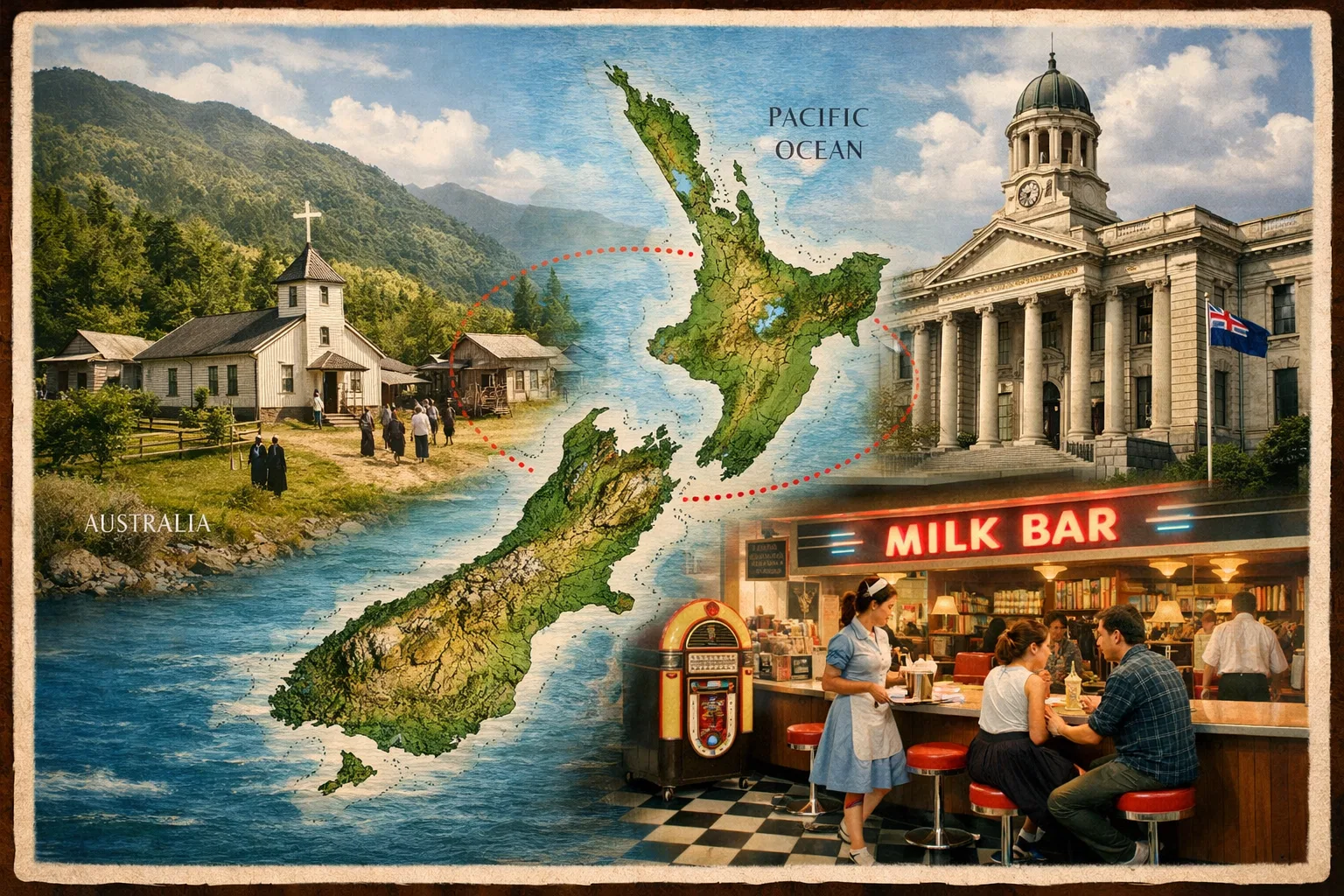
New Zealand’s classic modern moral panic began in 1954 with reports about teenage sexual activity in the Hutt Valley, followed by intense coverage of youth crime, milk bars, comics, films and changing social behaviour. The Parker–Hulme murder in Christchurch and other highly publicised crimes added to a sense that a new, undisciplined generation had appeared.
The government created the Special Committee on Moral Delinquency in Children and Adolescents, chaired by lawyer Oswald Mazengarb. Its terms of reference assumed that identifiable “conditions and influences” were undermining young people’s sexual morality. The committee worked rapidly, examining police information, submissions and hundreds of press cuttings. It acknowledged that reports might have magnified the scale of juvenile immorality, yet it also relied heavily on secondary or hearsay material and did not interview the children most directly involved.[abuseincare.org.nz]abuseincare.org.nzOpen source on abuseincare.org.nz.
The resulting Mazengarb Report discussed adolescent sexuality alongside allegedly harmful comics, films, weak parental supervision and inadequate moral education. A copy was distributed to households throughout the country, giving the inquiry an extraordinary reach. The episode helped create the popular image of 1950s New Zealand as a respectable society suddenly discovering bodgies, “milk-bar cowboys” and secret teenage vice.[govt.nz]nzhistory.govt.nzNZHistory Mazengarb report releasedMazengarb report released - NZ History…
Historians and legal scholars usually treat the affair as a moral panic because several features appeared together: a few vivid incidents became evidence of a national crisis; youth culture was portrayed as a coherent threat; imported popular culture became a convenient cause; and the political response moved faster than reliable social research. Contemporary official history notes that the Mazengarb Report and later inquiries had no observable effect on young people’s behaviour.[abuseincare.org.nz]abuseincare.org.nzMurder, Mazengarb and a Moral PanicMurder, Mazengarb and a Moral Panic
The panic nevertheless had consequences. It strengthened censorship, encouraged intrusive adult scrutiny of adolescents and fixed the idea that new media could transform otherwise ordinary teenagers into delinquents. The pattern would recur whenever comics, rock music, drugs, television, video games or the internet were blamed for broader changes in family life and social authority.
Satanic fears and the Christchurch Civic Crèche case
During the 1980s and early 1990s, claims of satanic ritual abuse travelled internationally through books, counselling networks, professional seminars, television reports and sensational court cases. The central allegation was that hidden groups were systematically abusing children during elaborate occult ceremonies. Investigations in several countries found serious child abuse but failed to establish the vast, organised satanic networks described by campaigners.
New Zealand absorbed this climate of belief. Publicity about ritual abuse was already circulating in Christchurch before allegations emerged at the city council’s Civic Crèche. Peter Ellis, a childcare worker, was arrested in 1992 and convicted in 1993 of sexual offences against children. Other staff members were accused, although charges against them did not proceed. Some accounts attributed to children involved bizarre journeys, animals, rituals and networks of offenders, placing the case within the broader international day-care abuse panic.[Wikipedia]WikipediaPeter Ellis (childcare workerPeter Ellis (childcare worker
The case remained disputed for nearly three decades. Critics argued that repeated questioning by adults, communication among parents and suggestive interviewing could have contaminated children’s accounts. Supporters of the prosecution stressed the need to take allegations by young children seriously and warned against treating inconsistencies as proof that no abuse occurred.
In 2022, the Supreme Court unanimously quashed Ellis’s remaining convictions after his death. It concluded that a substantial miscarriage of justice had resulted from expert evidence that improperly bolstered the complainants’ credibility and from inadequate treatment of the risk that their evidence had been contaminated. The judgment did not declare that children generally fabricate abuse, nor did it minimise the difficulty of investigating genuine offences. It found that the safeguards needed for a fair trial had failed in this particular case.[Courts of New Zealand]courtsofnz.govt.nzCourts of New ZealandCourts of New Zealand
The Civic Crèche affair remains culturally important because it shows how a worthy aim—protecting children—can become entangled with a contagious explanatory framework. Once ritual-abuse theories supplied the expected pattern, ordinary ambiguities could be interpreted as signs of a hidden network, while absence of physical evidence could itself be explained as proof of the offenders’ sophistication. The case also demonstrates why investigators must avoid both reflexive disbelief and unquestioning acceptance.
When the danger was real: Centrepoint and Gloriavale
Moral-panic analysis can reveal exaggeration, but it can also be misused to dismiss victims. New Zealand’s intentional communities provide an important counterweight: some public fears about powerful leaders were supported by convictions, survivor testimony and institutional findings.

Centrepoint
Centrepoint began in Auckland in the late 1970s as an intentional community devoted to shared living, therapeutic exploration and the teachings of Bert Potter. Residents pooled resources and rejected many conventional boundaries around privacy, family and sexuality. At its height, the community housed roughly 300 people, while an estimated 200 to 300 children lived there permanently or temporarily during its existence.[Te Ara Encyclopedia of New Zealand]teara.govt.nzpage 9page 9
Police raids and investigations during the 1980s and 1990s led to convictions for drug and sexual offences. Potter was imprisoned after being convicted of indecently assaulting girls. The trust associated with the community was terminated by court order in 2000. These outcomes were not merely products of outsiders disliking free love or communal living. They concerned abuse of authority, children’s safety and criminal conduct.[Wikipedia]WikipediaCentrepoint (communeCentrepoint (commune
A Massey University study based on retrospective accounts found that former Centrepoint children described a much wider environment of harm than the best-known prosecutions alone conveyed. Participants reported sexual abuse, exposure to drugs, blurred generational boundaries, psychological manipulation, neglect and uncertainty over whether their own perceptions could be trusted. Experiences differed, and not every former resident described the community in the same way, but the research documented enduring difficulties in relationships, identity and mental health among some survivors.[Massey University]massey.ac.nzMassey University
Centrepoint’s history illustrates why “alternative lifestyle” and “abusive system” are not mutually exclusive descriptions. The group offered belonging and a critique of conventional society, yet those ideals could also weaken protections by portraying boundaries, jealousy and parental authority as signs of personal repression.
Gloriavale
Gloriavale developed from an evangelical community founded by Neville Cooper, later known as Hopeful Christian. Its members live communally on the South Island’s West Coast under a strict theology of male leadership, collective ownership, obedience and separation from much of the outside world. Public discussion frequently calls it a cult, although “high-control Christian community” is more descriptive when analysing its structure.
The group has faced decades of scrutiny over sexual offending, labour practices, education, gender hierarchy and its treatment of those who leave. Evidence presented to the Royal Commission of Inquiry into Abuse in Care described internal practices in which allegations were handled through repentance, confession and forgiveness rather than prompt reporting to independent authorities. Gloriavale’s own institutional response acknowledged that complaints had historically been addressed within this religious framework.[abuseincare.org.nz]abuseincare.org.nzOpen source on abuseincare.org.nz.
The controversy cannot be reduced to panic about unusual clothing or conservative theology. Courts, inquiries and criminal proceedings have dealt with specific allegations of exploitation and abuse. In 2025, senior leader Howard Temple pleaded guilty to indecency and assault charges involving women and girls, after former members described fear of challenging those in authority. Reporting on the case also noted the Royal Commission’s finding that community rules had discouraged members from reporting crimes outside the group.[AP News]apnews.comTemple had denied original accusations but changed his plea three days into the trial. Former members and complainants testified about ye…
Gloriavale demonstrates the difference between hostile labelling and evidence-based criticism. A minority religion should not be condemned merely for being secluded or demanding. Scrutiny becomes justified where leaders control access to money, work, education, relationships and justice, particularly when children and dependent adults have little meaningful ability to leave.
Mākutu, death and the danger of cultural caricature
In 2007, 22-year-old Janet Moses died in Wainuiomata during an improvised attempt by members of her extended family to remove what they believed was a harmful spiritual influence. Water was repeatedly used during the prolonged ritual, and another young relative was injured. Five family members were later convicted of manslaughter; the coroner concluded that Moses had died by accidental drowning by way of manslaughter.[ABC News]abc.net.auABC News9 face NZ court over exorcism deathABC News9 face NZ court over exorcism death
The case generated intense coverage of mākutu, often translated simply as “curse”, “witchcraft” or “exorcism”. That shorthand risked presenting Māori belief as a single fixed practice. Evidence surrounding the case indicated that the family members conducting the ceremony were not recognised specialists and had improvised what they did. Māori scholars and elders publicly distinguished established healing knowledge from the fatal actions in the house. The coroner recommended consulting experienced cultural and spiritual experts rather than allowing frightened relatives to act without guidance.[Wikipedia]WikipediaKilling of Janet MosesKilling of Janet Moses
The death involved a sincerely held collective belief, but calling it a national witch panic would be misleading. It was a local tragedy in which grief, fear, family reinforcement and possible mental distress converged. Its wider significance lies in the reaction: the case exposed how quickly unfamiliar Indigenous concepts could be sensationalised, while also raising difficult questions about consent, medical care and responsibility when spiritual explanations shape emergency decisions.
It also recalled an older history of official suppression. The Tohunga Suppression Act 1907 was promoted in an era when Māori healers and prophets were often represented as obstacles to health and “progress”; Rua Kēnana was among the figures viewed with official suspicion. Modern responses therefore have to navigate two dangers at once: romanticising harmful conduct in the name of culture, and reviving a colonial habit of treating Māori spirituality itself as pathological.[NZHistory]nzhistory.govt.nzarrest of rua kenanaArrest of Rua Kēnana28 Apr 2021 — On Sunday 2 April 1916, 57 police raided the Ngāi Tūhoe settlement of Maungapōhatu in the Urew…
UFO belief without a national panic
New Zealand has a rich history of UFO sightings and contact beliefs, but these have usually produced fascination rather than sustained persecution. The best-known sighting episode, the Kaikōura lights of 1978, attracted international attention because television crews and pilots reported unexplained lights that were also detected on radar. Debate continued over astronomical, atmospheric and technical explanations, helping establish UFOs as part of New Zealand popular folklore rather than proof of a threatening movement.
New Zealand has also hosted followers of international UFO religions, including the Aetherius Society. The society teaches that spiritually advanced extraterrestrial beings guide humanity and regards Mount Wakefield near Aoraki/Mount Cook as one of its sacred mountains. Scholars generally describe the movement as a small, millenarian new religion rather than a dangerous organisation.[Wikipedia]WikipediaAetherius SocietyAetherius Society
This distinction matters. Belief in cosmic masters or sacred mountains may appear implausible to outsiders, but eccentric doctrine alone does not demonstrate coercion, fraud or violence. UFO religion belongs within New Zealand’s history of contagious and alternative belief, yet it has not generated harm or state confrontation on the scale associated with Centrepoint, Gloriavale or the Christchurch ritual-abuse panic.
How scares spread in New Zealand
Across these episodes, collective fear rarely arose from belief alone. It spread when several social mechanisms reinforced one another.
A vivid incident became a symbol. Hutt Valley teenagers stood for a supposedly delinquent generation; the Civic Crèche stood for fears of hidden organised abuse; Janet Moses’s death became a symbol onto which outsiders projected assumptions about Māori spirituality.
Imported narratives supplied ready-made explanations. American anxieties about comics, teenage rebellion and satanic ritual abuse travelled through newspapers, professional training and popular culture. New Zealand events were then fitted into scripts developed elsewhere.
Authorities validated the urgency. Government inquiries, large police operations and confident expert claims made threats appear settled before the evidence had been adequately tested. The Mazengarb inquiry and the raid on Maungapōhatu show different ways official action can magnify public alarm.[NZHistory]nzhistory.govt.nzNZHistory Mazengarb report releasedMazengarb report released - NZ History…
Closed communities controlled information. At Centrepoint and Gloriavale, internal authority and social dependence made allegations harder to report. In such cases, suspicion from outside did not manufacture the underlying harm, although sensational coverage could still simplify survivors’ experiences.
Later retellings tidied the story. Public memory tends to turn complicated events into morality plays: repressed 1950s adults versus rebellious teenagers, rational police versus a “fanatical” prophet, gullible parents versus falsely accused teachers. The historical record is usually less comfortable. People can act from legitimate concern while adopting unreliable methods; minority beliefs can be misunderstood while leaders within other minority groups commit serious offences.
What New Zealand’s cases teach
New Zealand’s history offers no simple rule that unusual belief is harmless or that public alarm is always irrational. Rua Kēnana’s community was treated as a political menace partly because it challenged colonial authority. The Mazengarb panic transformed scattered evidence into a story of national youth corruption. The Christchurch Civic Crèche prosecution was shaped by a wider ritual-abuse climate and ultimately failed the Supreme Court’s standards of fairness. Centrepoint and Gloriavale, however, show that charismatic communities can conceal documented exploitation behind ideals of spiritual growth, purity or obedience.
The most reliable approach is therefore behavioural rather than theological. Ask whether people can leave safely, retain outside relationships, control their own labour and money, obtain independent healthcare, report crimes and challenge leaders without punishment. Ask whether extraordinary allegations are supported by physical evidence, reliable testimony and interviewing methods that minimise contamination. Ask whose interests are served when a group is called primitive, satanic, deviant or cult-like.
That approach preserves two principles that New Zealand’s past repeatedly shows must be held together: unconventional beliefs deserve neither automatic ridicule nor automatic deference, and concern becomes useful only when it is proportionate, evidence-led and centred on the people most at risk.
Amazon book picks
Further Reading
Books and field guides related to When Did Belief Become Fear in New Zealand?. Use these as the next step if you want deeper reading beyond the article.

The Penguin History of New Zealand
First published 2012. Subjects: New zealand, history.
Cults in Our Midst
First published 1995. Subjects: Brainwashing, Controversial literature, Cults, Persuasion (Psychology), Psychology.
Ka whawhai tonu matou =
First published 1990. Subjects: Politics and government, Race relations, Maori (New Zealand people), Social conditions, History.
Endnotes
1.
Source: nzhistory.govt.nz
Title: te kooti arikirangi te turuki
Link:https://nzhistory.govt.nz/people/te-kooti-arikirangi-te-turuki
Source snippet
Te Kooti6 Dec 2021 — In 1865 Te Kooti was among the few Ngāti Maru who did not convert to the Pai Mārire religion, which opposed...
2.
Source: nzhistory.govt.nz
Title: rua kenana
Link:https://nzhistory.govt.nz/keyword/rua-kenana
Source snippet
Rua KenanaOn Sunday 2 April 1916, 57 police raided the Ngāi Tūhoe settlement of Maungapōhatu in the Urewera Ranges.... The main...
Published: April 1916
3.
Source: teara.govt.nz
Title: page 6
Link:https://teara.govt.nz/en/maori-prophetic-movements-nga-poropiti/page-6
Source snippet
Te Ara Encyclopedia of New ZealandRua Kēnana – Tūhoe prophet25 Jun 2013 — The most well known was Rua Kēnana Hepetipa, from Tūhoe. Rua wa...
4.
Source: nzhistory.govt.nz
Title: arrest of rua kenana
Link:https://nzhistory.govt.nz/arrest-of-rua-kenana
Source snippet
Arrest of Rua Kēnana28 Apr 2021 — On Sunday 2 April 1916, 57 police raided the Ngāi Tūhoe settlement of Maungapōhatu in the Urew...
Published: April 1916
5.
Source: nzhistory.govt.nz
Title: rua kenana resisting police
Link:https://nzhistory.govt.nz/media/photo/rua-kenana-resisting-police
Source snippet
Rua Kēnana, resisting police10 Jul 2018 — Rua was arrested in 1915 for selling alcohol illegally at Maungapōhatu and summonsed t...
6.
Source: nzhistory.govt.nz
Title: rua kenana
Link:https://nzhistory.govt.nz/people/rua-kenana
Source snippet
Rua Kēnana21 Mar 2023 — In 1916 he was arrested. In April 1916 a large force of heavily armed constables was sent to arrest him...
Published: April 1916
7.
Source: abuseincare.org.nz
Link:https://www.abuseincare.org.nz/__data/assets/pdf_file/0029/27875/mazengarb-o-report-of-the-special-committee-on-moral-delinquency-in-children-and-adolescents-wellington-1954.pdf
8.
Source: nzhistory.govt.nz
Title: NZHistory Mazengarb report released
Link:https://nzhistory.govt.nz/the-mazengarb-report-on-juvenile-moral-delinquency-is-released
Source snippet
Mazengarb report released - NZ History...
9.
Source: natlib.govt.nz
Link:https://natlib.govt.nz/records/23177982?search%5Bi%5D%5Bname_authority_id%5D=-85942&search%5Bpath%5D=items
10.
Source: blog.tepapa.govt.nz
Title: this month last century september 1954
Link:https://blog.tepapa.govt.nz/2011/09/16/this-month-last-century-september-1954/
Published: september 1954
11.
Source: abuseincare.org.nz
Title: Murder, Mazengarb and a Moral Panic
Link:https://www.abuseincare.org.nz/__data/assets/pdf_file/0017/28601/krzanich-a-murder-mazengarb-and-a-moral-panic-the-intersection-of-juvenile-delinquency-and-the-media-in-1950s-new-zealand-te-mata-koi-auckland-university-law-review-volume-16-2010.pdf
12.
Source: Wikipedia
Title: Peter Ellis (childcare worker)
Link:https://en.wikipedia.org/wiki/Peter_Ellis_%28childcare_worker%29
13.
Source: courtsofnz.govt.nz
Title: Courts of New Zealand
Link:https://www.courtsofnz.govt.nz/assets/cases/2022/MR-2022-NZSC-115.pdf
14.
Source: teara.govt.nz
Title: page 9
Link:https://teara.govt.nz/en/diverse-religions/page-9
15.
Source: teara.govt.nz
Title: centrepoint 1984
Link:https://teara.govt.nz/en/video/28121/centrepoint-1984
16.
Source: massey.ac.nz
Title: Massey University
Link:https://www.massey.ac.nz/massey/fms/Massey%20News/2010/05/docs/Centrepoint_Report_2010.pdf
17.
Source: Wikipedia
Title: Centrepoint (commune)
Link:https://en.wikipedia.org/wiki/Centrepoint_%28commune%29
18.
Source: abuseincare.org.nz
Link:https://www.abuseincare.org.nz/library/v/521/statements-of-the-gloriavale-christian-community-for-the-faith-based-institutional-response-hearing
19.
Source: abuseincare.org.nz
Title: 13 october 2022 royal commission opening statement by gloriavale
Link:https://www.abuseincare.org.nz/__data/assets/pdf_file/0017/25118/13-october-2022-royal-commission-opening-statement-by-gloriavale.pdf
Published: october 2022
20.
Source: abuseincare.org.nz
Link:https://www.abuseincare.org.nz/__data/assets/pdf_file/0019/27190/gloriavale-christian-community-response-to-ntp-521-for-the-faith-based-institutions-response-hearing.pdf
21.
Source: Wikipedia
Title: Killing of Janet Moses
Link:https://en.wikipedia.org/wiki/Killing_of_Janet_Moses
22.
Source: Wikipedia
Title: Aetherius Society
Link:https://en.wikipedia.org/wiki/Aetherius_Society
23.
Source: Wikipedia
Title: Moral panic
Link:https://en.wikipedia.org/wiki/Moral_panic
24.
Source: Wikipedia
Title: Mass psychogenic illness
Link:https://en.wikipedia.org/wiki/Mass_psychogenic_illness
25.
Source: Wikipedia
Title: Mazengarb Report
Link:https://en.wikipedia.org/wiki/Mazengarb_Report
26.
Source: Wikipedia
Title: Gloriavale Christian Community
Link:https://en.wikipedia.org/wiki/Gloriavale_Christian_Community
27.
Source: Wikipedia
Title: Satanic panic
Link:https://en.wikipedia.org/wiki/Satanic_panic
28.
Source: Wikipedia
Title: New Age
Link:https://en.wikipedia.org/wiki/New_Age
29.
Source: nzhistory.govt.nz
Title: employment organisations
Link:https://nzhistory.govt.nz/women-together/theme/employment-organisations
30.
Source: nzhistory.govt.nz
Link:https://nzhistory.govt.nz/sites/default/files/documents/dnzb-1940/scholefield-dnzb-v2.pdf
31.
Source: nzhistory.govt.nz
Link:https://nzhistory.govt.nz/sites/default/files/pdfs/adoption-panel-transcription.pdf
32.
Source: nzhistory.govt.nz
Link:https://nzhistory.govt.nz/sites/default/files/documents/Timeline.pdf
33.
Source: nzhistory.govt.nz
Link:https://nzhistory.govt.nz/keyword/new-zealand-wars
34.
Source: nzhistory.govt.nz
Link:https://nzhistory.govt.nz/sites/default/files/documents/public-service-at-war-articles-footnoted.pdf
35.
Source: nzhistory.govt.nz
Title: rua kenana 039 s arrest
Link:https://nzhistory.govt.nz/page/rua-kenana-039-s-arrest
36.
Source: nzhistory.govt.nz
Link:https://nzhistory.govt.nz/keyword/maungapohatu
37.
Source: nzhistory.govt.nz
Link:https://nzhistory.govt.nz/calendar/4
38.
Source: nzhistory.govt.nz
Title: ww1 stories
Link:https://nzhistory.govt.nz/keyword/ww1-stories
39.
Source: waitangitribunal.govt.nz
Title: Miles Urewera
Link:https://www.waitangitribunal.govt.nz/assets/Rangahaua-whanui/DISTRICT/Miles-Urewera.pdf
40.
Source: abuseincare.org.nz
Title: Survivor experience: Faithful Disciple Abuse in Care
Link:https://www.abuseincare.org.nz/reports/whanaketia/survivor-experiences/survivor-experience-faithful-disciple
41.
Source: abuseincare.org.nz
Link:https://www.abuseincare.org.nz/reports/whanaketia/preliminaries/recommendations
42.
Source: abuseincare.org.nz
Link:https://www.abuseincare.org.nz/our-progress/library?start_rank=61
43.
Source: abuseincare.org.nz
Title: Survivor experience: Zion Pilgrim Abuse in Care
Link:https://www.abuseincare.org.nz/reports/whanaketia/survivor-experiences/survivor-experience-zion-pilgrim
44.
Source: abuseincare.org.nz
Title: 13 october 2022 royal commission howard wendell temple
Link:https://www.abuseincare.org.nz/__data/assets/pdf_file/0022/24475/13-october-2022-royal-commission-howard-wendell-temple.pdf
Published: october 2022
45.
Source: abuseincare.org.nz
Link:https://www.abuseincare.org.nz/our-progress/library/v/514/media-release-gloriavale-and-dilworth-leaders-among-those-to-be-questioned-in-upcoming-abuse-in-care-public-hearing
46.
Source: abuseincare.org.nz
Title: chapter 6
Link:https://www.abuseincare.org.nz/reports/whanaketia/part-4/chapter-6
47.
Source: employmentcourt.govt.nz
Title: Employment Court
Link:https://www.employmentcourt.govt.nz/judgments/
48.
Source: teara.govt.nz
Link:https://teara.govt.nz/en/diverse-christian-churches/print
49.
Source: history.com
Title: what was satanic panic 1980s
Link:https://www.history.com/articles/what-was-satanic-panic-1980s
50.
Source: natlib.govt.nz
Link:https://natlib.govt.nz/records/47656889
51.
Source: people.com
Title: inside gloriavale cult 11990231
Link:https://people.com/inside-gloriavale-cult-11990231
52.
Source: apnews.com
Link:https://apnews.com/article/d58738461fa1bc016b03bdd9c3debe2b
Source snippet
Temple had denied original accusations but changed his plea three days into the trial. Former members and complainants testified about ye...
53.
Source: abc.net.au
Title: ABC News9 face NZ court over exorcism death
Link:https://www.abc.net.au/news/2007-12-12/9-face-nz-court-over-exorcism-death/986050
54.
Source: ebsco.com
Link:https://www.ebsco.com/research-starters/social-sciences-and-humanities/mass-hysteria
Additional References
55.
Source: youtube.com
Title: Introducing: Conviction: The Christchurch Civic Creche Case | Motive
Link:https://www.youtube.com/watch?v=rB6PehM0PTc
Source snippet
The Commune Episode 1: Open Day | Podcast Stuff | Stuff.co.nz...
56.
Source: youtube.com
Title: The Commune Episode 1: Open Day | Podcast Stuff | Stuff.co.nz
Link:https://www.youtube.com/watch?v=LrA8gZObqXY
Source snippet
2019: Angie Meiklejohn | Kim Hill Collection...
57.
Source: youtube.com
Link:https://www.youtube.com/watch?v=elqDQ3A3ZDc
Source snippet
Devotion: Obedience or Betrayal | Paramount+ Official Trailer...
58.
Source: researchgate.net
Link:https://www.researchgate.net/publication/264485058_At_the_Nexus_of_Science_and_Religion_UFO_Religions
59.
Source: facebook.com
Link:https://www.facebook.com/casefile/posts/case-341-the-christchurch-civic-creche1-peter-ellis-with-his-mother-lesley-follo/1614661497012284/
60.
Source: facebook.com
Link:https://www.facebook.com/groups/aotearoanzhistory/posts/1114119490410412/
61.
Source: nzgeo.com
Link:https://www.nzgeo.com/stories/crowded-skies-the-ufo-experience-in-new-zealand/
62.
Source: equip.org
Link:https://www.equip.org/articles/descending-masters-a-history-of-the-raelian-movement/
63.
Source: aph.gov.au
Link:https://www.aph.gov.au/DocumentStore.ashx?id=9d7726b7-ae8c-4326-b556-feba185ec66f
64.
Source: facebook.com
Link:https://www.facebook.com/Biography/posts/gloriavale-christian-community-is-new-zealands-most-notorious-fundamentalist-rel/1420404443462181/
Topic Tree
Follow this branch
Related pages 192
- Antigua and Barbuda
- Argentina Belief Scares
- Azerbaijan Belief
- Bahrain Beliefs
- North Korea
- +187 more in sidebar