Within Russia
Why Some Old Believers Chose Death by Fire
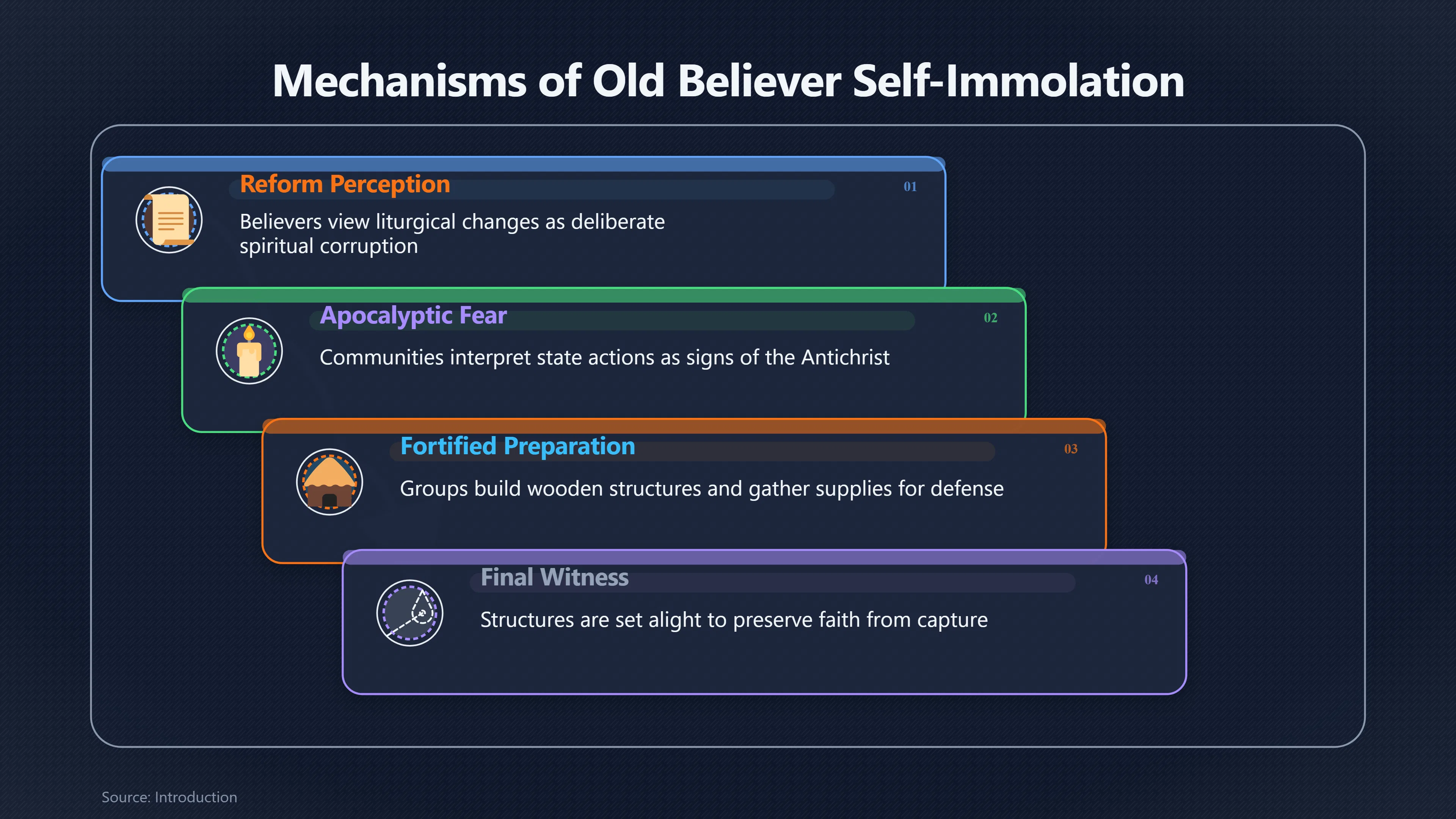
Some persecuted Old Believer communities chose collective death by fire, convinced that the Antichrist ruled the official Church and state.
On this page
- Church Reform and the Fear of the Antichrist
- Collective Fires, Survival and Disputed Death Tolls
- How State Repression Reinforced Apocalyptic Belief
Page outline Jump by section
Introduction
Some of the most striking episodes in Russian religious history were not massacres carried out by the state but collective deaths chosen by believers themselves. During the late seventeenth and early eighteenth centuries, groups of Old Believers shut themselves inside wooden buildings and set them alight, convinced that death was preferable to living under what they believed was the rule of the Antichrist. These events, often called the “Old Believer fires” or “burnings”, were not random acts of despair. They emerged from a powerful combination of apocalyptic belief, harsh state repression, rumours about the end of the world, and the conviction that the official Russian Orthodox Church had abandoned the true faith. Historians continue to debate how many people died and how representative these acts were of the wider Old Believer movement, but there is broad agreement that they illustrate how persecution and millenarian expectations can reinforce one another in devastating ways.[OUP Academic]academic.oup.comOUP AcademicReligious Mass Suicide before Jonestown: The Russian Old Believers | Sociology of Religion | Oxford AcademicMarch 1, 1986…
Church Reform and the Fear of the Antichrist
The collective fires cannot be understood without recognising how Old Believers interpreted the church reforms introduced under Patriarch Nikon in the 1650s. While the reforms altered rituals, liturgical books and ceremonial practices that church leaders regarded as corrections, many ordinary believers viewed them as proof that sacred tradition had been deliberately corrupted.
For the most radical opponents, the issue went far beyond disputes over ritual. They concluded that the official Church had become spiritually false and that the Russian state had become an instrument of the Antichrist foretold in the Book of Revelation. The coincidence of the church councils of the 1660s with widespread expectations surrounding the year 1666, long associated in popular imagination with the biblical number 666, strengthened apocalyptic fears among some communities, although these expectations were neither universal nor unique to Russia.[theoldbelievers.com]theoldbelievers.comHistory of Old Belief – The Old BelieversHistory of Old Belief – The Old Believers
These beliefs did not characterise every Old Believer. The movement quickly divided into numerous branches, many of which rejected self-destruction altogether. Some communities sought isolation, others organised new settlements, and others attempted to preserve older forms of worship while avoiding confrontation. The collective burnings were concentrated among particularly radical groups that believed earthly history had effectively reached its final stage.[EBSCO]ebsco.comSelf-Immolation of the Old Believers | Religion and Philosophy | Research Starters | EBSCO Research…
Why Death by Fire Was Seen as Salvation
To modern readers, voluntary death by fire appears almost impossible to comprehend. For participants, however, the act was not viewed as ordinary suicide.
Many believed that arrest would inevitably force them to accept the reformed Church, swear loyalty to illegitimate authorities or participate in sacraments they regarded as spiritually corrupted. Dying before this could happen was interpreted as preserving the true faith rather than abandoning life.
Religious leaders who promoted the burnings presented them as acts of ultimate witness. Communities often prepared carefully, gathering food, constructing fortified wooden buildings and praying together before setting the structures alight when government troops approached or when they believed capture was imminent. Some fortified themselves against attempts at rescue, convinced that survival would mean spiritual ruin rather than salvation.[PsyJournals]psyjournals.ru2012 n2Historical Suicidology: Investigating Self Immolation of the Old Believers // Cultural-Historical Psychology — 2012. Vol. 8, n…
Modern scholars generally avoid describing these events simply as irrational fanaticism. Instead, they examine how deeply held religious convictions interacted with genuine experiences of persecution. In this interpretation, apocalyptic expectations did not arise in isolation but developed within communities that already believed the state intended to eradicate their faith.[OUP Academic]academic.oup.comOUP AcademicReligious Mass Suicide before Jonestown: The Russian Old Believers | Sociology of Religion | Oxford AcademicMarch 1, 1986…
Collective Fires, Survival and Disputed Death Tolls
The self-immolations occurred repeatedly over many decades rather than in a single catastrophic event. Some involved dozens of people, while others reportedly involved hundreds.
Estimating the total number of victims remains difficult. Contemporary reports were often produced by hostile officials or later religious writers, both of whom had reasons to exaggerate or simplify events. Historians therefore treat precise figures cautiously.
Older scholarship sometimes suggested that tens of thousands died in collective fires between the late seventeenth and nineteenth centuries. Other researchers argue that many reported totals are uncertain because records are incomplete, duplicate events may have been counted more than once, and some communities disappeared without reliable documentation. Estimates therefore vary considerably, and no universally accepted figure exists.[oup.com]academic.oup.comOUP AcademicReligious Mass Suicide before Jonestown: The Russian Old Believers | Sociology of Religion | Oxford AcademicMarch 1, 1986…
Another point of debate concerns how widespread the practice actually was. The spectacular nature of the fires ensured they dominated both official reports and later historical memory, but most Old Believers neither participated in nor endorsed collective self-immolation. Many survived by creating stable religious communities that endured for centuries despite legal discrimination. Their continued existence demonstrates that the fires represented one extreme response within a much broader religious tradition.[EBSCO]ebsco.comSelf-Immolation of the Old Believers | Religion and Philosophy | Research Starters | EBSCO Research…
How State Repression Reinforced Apocalyptic Belief
The relationship between persecution and self-immolation was circular. Government authorities regarded dissenting communities as dangerous schismatics who threatened religious and political unity. Arrests, forced conversions, punitive taxation and military expeditions aimed to eliminate resistance.
For believers already convinced that the Antichrist ruled through the official Church and state, these measures appeared to confirm rather than undermine their worldview. Every new arrest could be interpreted as fulfilment of biblical prophecy. The expectation of persecution encouraged communities to withdraw further from society, while each confrontation made compromise seem even less possible.
Historians studying millenarian movements frequently point to this feedback loop. Rather than disproving apocalyptic expectations, external pressure often intensified them by providing apparent evidence that believers had correctly identified a hostile and corrupt world. The Old Believer fires remain one of the clearest historical examples of persecution strengthening catastrophic religious expectations instead of suppressing them.[OUP Academic]academic.oup.comOUP AcademicReligious Mass Suicide before Jonestown: The Russian Old Believers | Sociology of Religion | Oxford AcademicMarch 1, 1986…

Were the Fires Forced or Voluntary?
The answer is more complicated than either simple coercion or complete freedom.
Many communities clearly prepared collectively for self-immolation over extended periods, suggesting deliberate planning rather than panic. At the same time, preparation often occurred under the authority of charismatic religious mentors whose influence over isolated followers could be immense. Psychological commitment, shared expectation and fear of betraying fellow believers all reduced the possibility of individual dissent.[PsyJournals]psyjournals.ru2012 n2Historical Suicidology: Investigating Self Immolation of the Old Believers // Cultural-Historical Psychology — 2012. Vol. 8, n…
Some recent scholars have also challenged traditional assumptions about every reported burning. A controversial economic and historical interpretation proposes that, in certain cases, apparent mass immolations may have concealed escapes rather than universal deaths. This hypothesis has attracted attention but has not displaced the mainstream historical view that many genuine collective self-immolations unquestionably occurred.[Enlighten Publications]eprints.gla.ac.ukEnlighten Publications Self-immolationEnlighten PublicationsSelf-immolationMarch 2, 2020…
Why the Old Believer Fires Still Matter
The Old Believer burnings occupy a distinctive place in the history of collective belief because they do not fit neatly into familiar categories. They were not examples of a transient crowd panic, nor simply episodes of state violence, nor easily comparable with modern groups labelled as destructive cults.
Instead, they reveal how theological conviction, persecution and apocalyptic expectation can interact over many years. Communities that sincerely believed the world had fallen under demonic rule concluded that preserving spiritual integrity mattered more than physical survival. The Russian state’s attempts to enforce religious conformity unintentionally strengthened precisely the fears it hoped to eliminate.
Modern historians therefore treat the Old Believer fires not merely as extraordinary tragedies but as evidence of how collective belief is shaped by lived political and social experience. They remain one of the most powerful examples in Russian history of persecution and millenarian expectation reinforcing one another until resistance took its most extreme possible form.[oup.com]academic.oup.comOUP AcademicReligious Mass Suicide before Jonestown: The Russian Old Believers | Sociology of Religion | Oxford AcademicMarch 1, 1986…
Amazon book picks
Further Reading
Books and field guides related to Why Some Old Believers Chose Death by Fire. Use these as the next step if you want deeper reading beyond the article.
The pursuit of the millennium
Explains apocalyptic thinking behind collective sacrifice.
Endnotes
1.
Source: academic.oup.com
Link:https://academic.oup.com/socrel/article-abstract/47/1/1/1607906
Source snippet
OUP AcademicReligious Mass Suicide before Jonestown: The Russian Old Believers | Sociology of Religion | Oxford AcademicMarch 1, 1986...
Published: March 1, 1986
2.
Source: ebsco.com
Link:https://www.ebsco.com/research-starters/religion-and-philosophy/self-immolation-old-believers
Source snippet
Self-Immolation of the Old Believers | Religion and Philosophy | Research Starters | EBSCO Research...
3.
Source: theoldbelievers.com
Title: History of Old Belief – The Old Believers
Link:https://theoldbelievers.com/old-believer-work/history-of-old-belief/
4.
Source: psyjournals.ru
Title: 2012 n2
Link:https://psyjournals.ru/en/journals/chp/archive/2012_n2/52553
Source snippet
Historical Suicidology: Investigating Self Immolation of the Old Believers // Cultural-Historical Psychology — 2012. Vol. 8, n...
5.
Source: europeanproceedings.com
Link:https://www.europeanproceedings.com/article/10.15405/epsbs.2020.10.05.258
6.
Source: theoldbelievers.com
Title: Bloody Dispute
Link:https://theoldbelievers.com/old-believer-work/bloody-dispute-the-state-church-persecuted-old-believers-more-zealously-than-the-state-itself/
Source snippet
The State Church Persecuted Old Believers More Zealously Than the State Itself – The Old BelieversFebruary 28, 7534 — February 28, 7534 F...
Published: February 28, 7534
7.
Source: theoldbelievers.com
Title: The Filippovtsy – The Old Believers
Link:https://theoldbelievers.com/old-believer-work/the-filippovtsy/
Source snippet
Fearing persecution, 49 of them gathered in one house and burned on the morning of October 24. In 1747, another of Filipp’s followers...
8.
Source: ebsco.com
Link:https://www.ebsco.com/research-starters/history/patriarch-nikons-reforms
9.
Source: theoldbelievers.com
Link:https://theoldbelievers.com/old-believer-work/excerpts-from-the-holy-and-patristic-scriptures-and-the-works-of-the-holy-fathers-and-teachers-of-the-church-on-the-innovations-and-false-teaching-introduced-by-patriarch-nikon-and-his-successors/
10.
Source: eprints.gla.ac.uk
Title: Enlighten Publications Self-immolation
Link:https://eprints.gla.ac.uk/303604/
Source snippet
Enlighten PublicationsSelf-immolationMarch 2, 2020...
Published: March 2, 2020
11.
Source: proquest.com
Link:https://www.proquest.com/scholarly-journals/self-immolation/docview/2664669019/se-2
Additional References
12.
Source: theguardian.com
Title: But when the geologists offered them a loaf and some jam, t
Link:https://www.theguardian.com/world/2026/jan/22/forty-years-in-the-siberian-wilderness-the-old-believers-who-time-forgot
Source snippet
A century in the Siberian wilderness: the Old Believers who time forgot | Russia | The GuardianJanuary 22, 2026 — A century in the Siberi...
Published: January 22, 2026
13.
Source: youtube.com
Title: Surviving in the Siberian Wilderness for 70 Years (Full Length)
Link:https://www.youtube.com/watch?v=tt2AYafET68
Source snippet
The Extraordinary Life of Archpriest Avvakum covers the life and martyrdom of the leading figure of the Old Believer resistance, who was...
14.
Source: researchgate.net
Link:https://www.researchgate.net/publication/359620913_Archpriest_Avvakum_and_Patriarch_Nikon_Life_and_ministry_through_the_eyes_of_Old_Believers
15.
Source: spb.hse.ru
Link:https://spb.hse.ru/en/humart/chr/news/931598157.html
16.
Source: journals.rcsi.science
Link:https://journals.rcsi.science/2712-7591/article/view/276296
17.
Source: youtube.com
Title: The Extraordinary Life of Archpriest Avvakum
Link:https://www.youtube.com/watch?v=m_wXn5-MOB8
Source snippet
The Schism within the Russian Orthodox Church - Raskol...
18.
Source: youtube.com
Title: Old Believers in Imperial Russia
Link:https://www.youtube.com/watch?v=NlDArB0EAFM
Source snippet
Surviving in the Siberian Wilderness for 70 Years (Full Length)...
19.
Source: londonist.com
Title: Is It True That Only Six People Died In The Great Fire? | Londonist
Link:https://londonist.com/2016/08/is-it-true-that-only-six-people-died-in-the-great-fire
20.
Source: smithsonianmag.com
Title: The Great Fire of London Was Blamed on Religious Terrorism
Link:https://www.smithsonianmag.com/history/great-fire-london-was-blamed-religious-terrorism-180960332/
21.
Source: youtube.com
Title: The Schism within the Russian Orthodox Church
Link:https://www.youtube.com/watch?v=y4SrB2CbKhw
Source snippet
Who are the Old Believers? (clip)...
Topic Tree