Within Malta
How Malta's Youth Parties Became a National Scare
Coverage of SIN parties and teenage nightlife helped turn young partygoers into symbols of drugs, indecency and declining discipline.
On this page
- The press campaign around SIN parties
- Teenage nightlife and the making of folk devils
- Calls for regulation, policing and parental control
Page outline Jump by section
Introduction
From the early 1990s into the early 2010s, youth nightlife became one of Malta’s most persistent moral panic stories. Large dance events, especially the early SIN parties, and later teenage parties and club culture in places such as Paceville, were repeatedly portrayed as signs of social decline. Newspaper headlines, television coverage and public debate often linked these events with drug use, sexual permissiveness, violence and failing parental authority. While genuine concerns about safety, underage drinking and illegal drugs existed, researchers argue that the scale of the perceived threat frequently exceeded the available evidence, turning young partygoers into symbolic representatives of wider anxieties about modernisation and changing social values. Rather than documenting a single crisis, these episodes illustrate how Malta’s tightly connected media, political institutions and Catholic culture could amplify fears about youth behaviour and transform nightlife into a national debate.[L-Università ta' Malta]edu.mtL-Università ta' Malta OAR@UM: Youth moral panics in Malta : an explorationL-Università ta' Malta OAR@UM: Youth moral panics in Malta : an exploration
The press campaign around SIN parties
The best-known example emerged with the SIN parties, large dance music events that became popular during the early 1990s. These events arrived as Malta was becoming more exposed to international youth culture through tourism, satellite television and electronic dance music. To many participants they represented a new leisure scene, but to many commentators they symbolised an imported culture associated with drugs, sexual freedom and disrespect for traditional authority.
Academic research examining newspaper coverage from the period found that reports regularly framed SIN parties as a direct threat to society rather than simply entertainment events where some illegal behaviour might occur. Stories frequently highlighted allegations of widespread drug use, indecent behaviour and moral decay, while calls for stronger intervention from the authorities became increasingly prominent. According to Noel Zammit Pawley’s study of the period, the pattern closely matched Stanley Cohen’s classic theory of moral panic: the media identified a threat, amplified it, and encouraged demands for decisive action.[L-Università ta' Malta]edu.mtL-Università ta' Malta OAR@UM: Youth moral panics in Malta : an explorationL-Università ta' Malta OAR@UM: Youth moral panics in Malta : an exploration
Researchers also argue that media coverage did not develop in isolation. Church representatives, politicians and other influential organisations publicly expressed concern about youth culture, reinforcing the idea that the issue demanded urgent attention. The interaction between media reporting and public authority helped sustain the perception that Malta faced a broader moral crisis rather than a series of isolated incidents.[L-Università ta' Malta]edu.mtL-Università ta' Malta OAR@UM: Youth moral panics in Malta : an explorationL-Università ta' Malta OAR@UM: Youth moral panics in Malta : an exploration
Teenage nightlife and the making of folk devils
Moral panic theory describes the creation of “folk devils”—groups portrayed as embodying a wider social threat. In Malta, researchers argue that young partygoers repeatedly filled this role.
Rather than distinguishing between different kinds of nightlife, many reports treated youth culture as a single risky phenomenon. Clubbers, teenagers attending parties and young people in nightlife districts could all become symbols of irresponsible behaviour. Academic analyses of Maltese media coverage found two contrasting but complementary stereotypes:
- young people were portrayed as vulnerable victims easily corrupted by alcohol, drugs and peer pressure;
- at the same time they were presented as dangerous troublemakers responsible for declining public morality and disorder.
This contradiction strengthened calls for adult supervision regardless of whether youth were viewed as victims or offenders. Both images justified greater intervention by parents, schools, police and regulators.[L-Università ta' Malta]um.edu.mtOpen source on edu.mt.
Marilyn Clark’s analysis of Maltese media representations argues that news coverage has often focused disproportionately on youth risk and deviance. Stories about young people were more likely to emphasise danger, disorder or irresponsibility than ordinary everyday life, reinforcing existing assumptions that youth represented a social problem requiring control.[L-Università ta' Malta]um.edu.mtOpen source on edu.mt.
Why these stories resonated so strongly
Several features of Maltese society made these moral panics especially influential.
First, Malta’s relatively small population meant that local incidents could quickly become national news. A single controversial party, police raid or accident could dominate headlines and public discussion because audiences, journalists and policymakers all operated within a closely connected social environment.
Second, the period coincided with rapid cultural change. Malta experienced growing tourism, European integration, expanding consumer culture and changing attitudes towards sexuality and leisure. Nightlife became a visible arena in which older expectations of discipline encountered newer forms of youth identity.
Third, the country’s strong Catholic tradition gave questions of public morality unusual prominence. Public debates rarely focused only on crime or public order. They also concerned respectability, family authority, sexual behaviour and the perceived erosion of traditional values. Researchers argue that these broader anxieties helped explain why nightlife often became a symbol of much larger cultural changes.[L-Università ta' Malta]edu.mtL-Università ta' Malta OAR@UM: Youth moral panics in Malta : an explorationL-Università ta' Malta OAR@UM: Youth moral panics in Malta : an exploration
Calls for regulation, policing and parental control
The response to these perceived threats went well beyond criticism in newspaper columns.
Coverage regularly encouraged stronger regulation through measures such as:
- increased police monitoring of parties and nightlife districts;
- stricter licensing and supervision of venues;
- tighter age restrictions and enforcement against underage drinking;
- greater parental responsibility and supervision;
- public campaigns warning about drugs and risky behaviour.
Some of these measures addressed genuine safety concerns. Malta, like many countries, faced real issues involving illegal drugs, alcohol misuse and crowd management. Researchers emphasise, however, that moral panic does not require the underlying problem to be imaginary. Instead, it occurs when the response becomes disproportionate, treating an entire youth culture as a threat because of highly publicised incidents or symbolic fears.[L-Università ta' Malta]edu.mtL-Università ta' Malta OAR@UM: Youth moral panics in Malta : an explorationL-Università ta' Malta OAR@UM: Youth moral panics in Malta : an exploration
From SIN parties to Paceville
The pattern did not disappear after the controversy surrounding SIN parties faded.
Research examining later episodes—including intense media attention following incidents involving teenagers and nightclubs in Paceville—finds many of the same features. A 2022 case study of reporting after a serious nightclub accident concluded that media, political figures and public commentary often constructed young clubbers as reckless, uncontrollable and representative of wider social decline. Once again, the reaction extended beyond the specific event and became a debate about “today’s youth” more generally.[L-Università ta' Malta]um.edu.mtL-Università ta' Malta OAR@UM: Youth moral panic in Malta: a case studyL-Università ta' Malta OAR@UM: Youth moral panic in Malta: a case study
Similarly, research on the intense discussion surrounding teenage parties between 2011 and 2013 argues that concern spread rapidly through newspapers, television, politicians, professionals and public debate. Young people were increasingly associated with alcohol, drugs and antisocial behaviour even when coverage referred to different types of events. The studies conclude that youth themselves became the central object of concern rather than only the particular parties being discussed.[L-Università ta' Malta]um.edu.mtOpen source on edu.mt.
How historians and sociologists interpret the episode
The dominant scholarly interpretation is not that Malta invented concerns about nightlife or that every warning was exaggerated. Illegal drug use, underage drinking and venue safety were legitimate policy issues deserving attention.
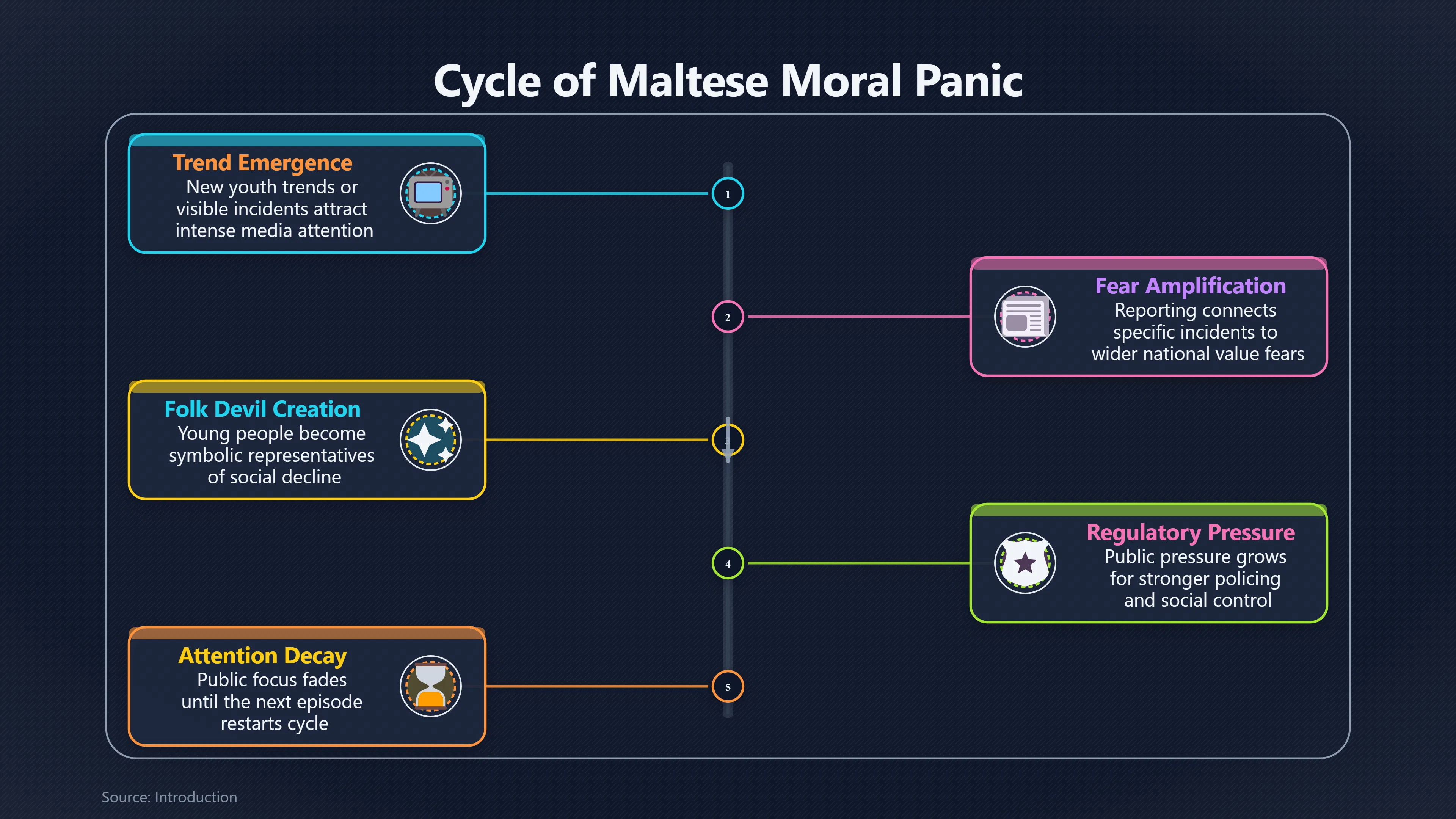
Instead, researchers argue that the public conversation frequently shifted from managing identifiable risks to constructing youth culture itself as a moral threat. Following Stanley Cohen’s framework, Maltese scholars describe a recurring cycle:
- A visible incident or new youth trend attracted intense media attention.
- Reporting connected the incident to wider fears about national values.
- Young people became symbolic “folk devils”.
- Public pressure grew for stronger regulation and control.
- Attention eventually faded until another episode restarted the cycle. L-Università ta’ Malta+2L-Università ta’ Malta
Seen in this light, Malta’s youth-party scares reveal less about the inherent dangers of dance events than about the ways societies negotiate rapid cultural change. Debates over SIN parties, teenage gatherings and nightlife became proxies for wider disagreements about modernity, family authority, religion and the boundaries of acceptable behaviour. As a result, these episodes remain an important case study in how media narratives can shape collective perceptions of risk and transform ordinary youth leisure into a recurring national moral panic. L-Università ta’ Malta+2L-Università ta’ Malta
Amazon book picks
Further Reading
Books and field guides related to How Malta's Youth Parties Became a National Scare. Use these as the next step if you want deeper reading beyond the article.

Folk Devils and Moral Panics the Creation of the Mods and Roc...
First published 1972. Subjects: Youth, great britain, Deviant behavior, Case studies, Subculture, Young adults.
Folk devils and moral panics
Directly explains youth panics, media amplification and social reaction.
Endnotes
2.
Source: um.edu.mt
Link:https://www.um.edu.mt/library/oar/handle/123456789/4944
3.
Source: um.edu.mt
Link:https://www.um.edu.mt/library/oar/handle/123456789/126748
4.
Source: um.edu.mt
Title: L-Università ta’ Malta OAR@UM: Youth moral panic in Malta: a case study
Link:https://www.um.edu.mt/library/oar/handle/123456789/101523
5.
Source: um.edu.mt
Link:https://www.um.edu.mt/library/oar/handle/123456789/86146
6.
Source: um.edu.mt
Link:https://www.um.edu.mt/library/oar/handle/123456789/85701
7.
Source: um.edu.mt
Link:https://www.um.edu.mt/library/oar/handle/123456789/76082
8.
Source: um.edu.mt
Link:https://www.um.edu.mt/library/oar/handle/123456789/56786
9.
Source: um.edu.mt
Link:https://www.um.edu.mt/library/oar/handle/123456789/33791
Additional References
10.
Source: researchgate.net
Title: 372986377 Public Consultation on the National Drug Policy for Malta 2023 2033
Link:https://www.researchgate.net/publication/372986377_Public_Consultation_on_the_National_Drug_Policy_for_Malta
Source snippet
Representing the voice of a small group of clubbers and people in the industry between the ages of 24 and 50, People and Dancefloors...
11.
Source: independent.com.mt
Title: Areas like Bugibba and Paceville ‘are more dangerous than ever before’
Link:https://www.independent.com.mt/articles/2019-08-04/local-news/Areas-like-Bugibba-and-Paceville-are-more-dangerous-than-ever-before-6736211791
Source snippet
The Malta IndependentAugust 4, 2019 — * ## Areas like Bugibba and Paceville ‘are more dangerous than ever before’ Albert Galea Sunday, 4...
Published: August 4, 2019
12.
Source: maltatoday.com.mt
Title: Electronic dance music: Evolution of a cultural identity | Karen Mamo
Link:https://www.maltatoday.com.mt/comment/opinions/137127/electronic_dance_music_evolution_of_a_cultural_identity__karen_mamo
Source snippet
September 25, 2025 — ELECTRONIC DANCE MUSIC: EVOLUTION OF A CULTURAL IDENTITY | KAREN MAMO One of these identities is that linked with el...
Published: September 25, 2025
13.
Source: maltadaily.mt
Title: 77% Of Maltese Youth Avoid Drugs Due To Lack Of Interest
Link:https://maltadaily.mt/articles/77-of-maltese-youth-avoid-drugs-due-to-lack-of-interest
Source snippet
February 21, 2025 — 77% OF MALTESE YOUTH AVOID DRUGS DUE TO LACK OF INTEREST Image: 77% Of Maltese Youth Avoid Drugs Due To Lack Of Inter...
Published: February 21, 2025
14.
Source: youtube.com
Link:https://www.youtube.com/watch?v=lIROUlQz1Ac
Source snippet
Paceville, St. Julians, Malta - 10th of July 2009 - Impressions of a night out...
Published: July 2009
15.
Source: youtube.com
Title: Interactionist Theories of Crime and Deviance
Link:https://www.youtube.com/watch?v=XXcIcrWueBI
Source snippet
Malta's Most Famous Region | Discover Paceville's Nightclubs and What the Island's Nightlife Is L...
16.
Source: youtube.com
Title: St. Julian’s, Malta: Balluta Bay, Spinola Bay, Paceville & St George’s Bay
Link:https://www.youtube.com/watch?v=wJx7xDI1bGs
Source snippet
Life in MALTA! - Land of EXTREMELY BEAUTIFUL women and PRISTINE MEDITERRANEAN ISLAND - DOCUMENTARY...
17.
Source: youtube.com
Title: Paceville, St. Julians, Malta
Link:https://www.youtube.com/watch?v=jgUuNk18VN4
Source snippet
St. Julian's, Malta: Balluta Bay, Spinola Bay, Paceville & St George's Bay...
Published: July 2009
18.
Source: academic.oup.com
Link:https://academic.oup.com/policy-press-scholarship-online/book/30664/chapter-abstract/260186332
Source snippet
oup.com‘Binge’ drinking devils and moral marginality: young people’s calculated hedonism in the Canterbury night-time economy | Youth Mar...
19.
Source: timesofmalta.com
Title: Women more sensitive to the deleterious impact of clubbing, substance abuse
Link:https://timesofmalta.com/article/females-more-sensitive-to-the-deleterious-impact-of-clubbing-substance.606731
Topic Tree