Within Estonia
How Estonia Rewrote Its Strangest Beliefs
Later monuments, folklore and literature recast accused healers and disappointed believers as symbols of injustice, hope and resistance.
On this page
- Kongla Ann from condemned healer to victim
- Eduard Vilde and the remaking of Maltsvet
- Where documented history ends and national myth begins
Page outline Jump by section
Introduction
Estonia’s most enduring stories of collective belief are remembered today less as warnings about irrationality than as reflections on injustice, hope and national survival. Over time, figures once condemned by courts or mocked by contemporaries were transformed into symbols of a people enduring foreign rule, social inequality and disappointment. The accused healer Kongla Ann came to represent the victims of witch persecutions, while the followers of the nineteenth-century prophet Juhan Leinberg, better known as Maltsvet, became linked to the powerful image of the “White Ship“—a metaphor for salvation that never quite arrives. These changes were not accidental. Writers, folklorists, local heritage groups and later commemorative projects reshaped historical events into stories that spoke to modern Estonian identity, often blurring the boundary between documented history and cultural memory.

Kongla Ann: from condemned healer to remembered victim
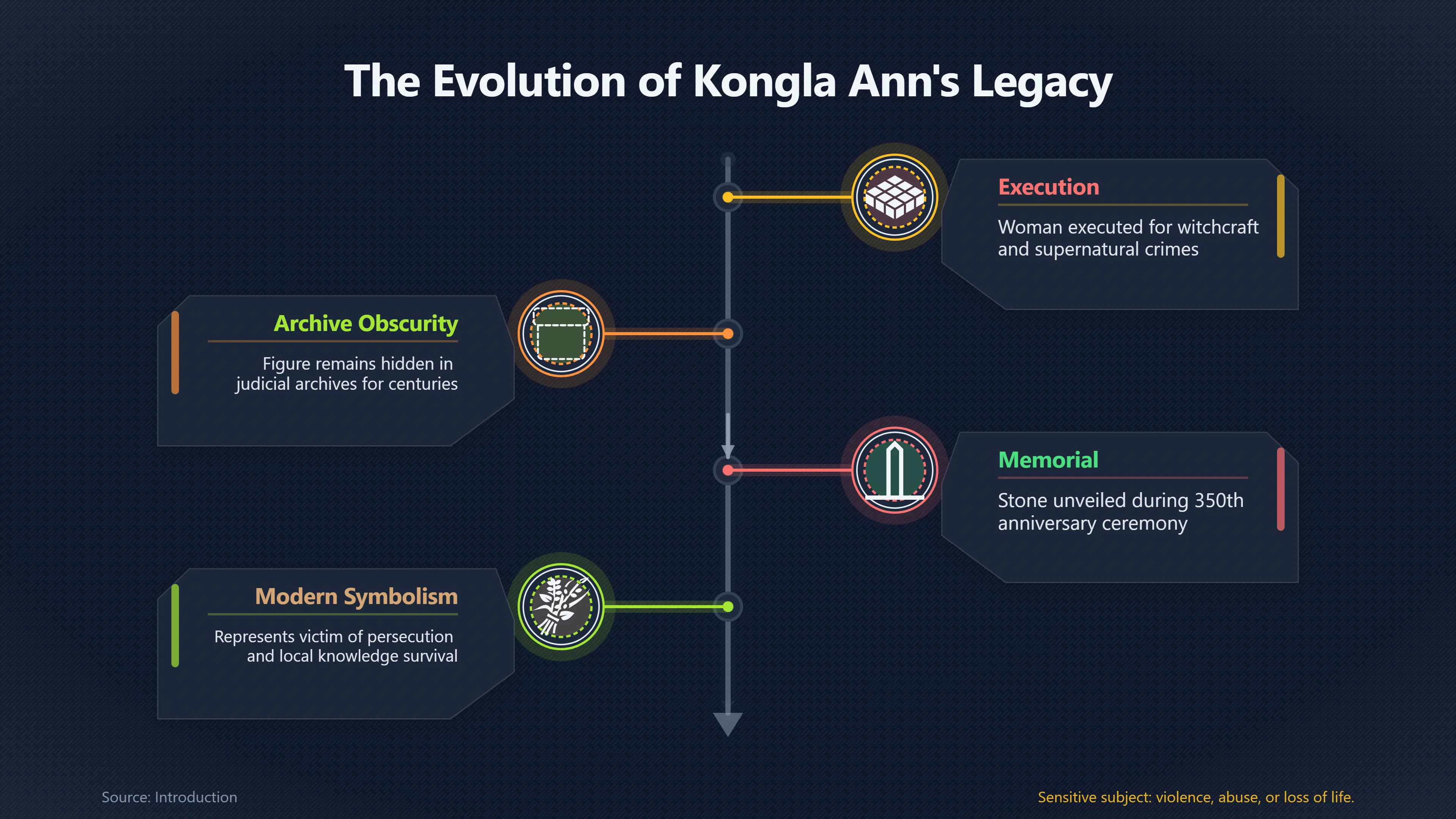
Kongla Ann was executed in 1640 after being accused of witchcraft and causing the death of a landlord’s child through supernatural means. Trial records suggest that, like many early modern witchcraft cases, her confession was almost certainly obtained under intense legal pressure rather than being reliable evidence of genuine belief or action. She was convicted not simply as a healer but within a legal culture that increasingly accepted imported European ideas about witches, shape-shifting and alliances with evil forces.[Wikipedia]WikipediaKongla AnnKongla Ann
For centuries, Ann was largely a forgotten figure in judicial archives. Her reputation changed dramatically during Estonia’s late twentieth-century cultural revival. Rather than treating her as a witch, heritage activists and followers of Estonia’s indigenous religious traditions presented her as an innocent victim of persecution and a representative of suppressed local knowledge. In 1990, on the 350th anniversary of her execution, a memorial stone was unveiled near Viru-Nigula church, accompanied by ceremonies emphasising remembrance rather than condemnation.[Wikipedia]WikipediaKongla AnnKongla Ann
This reinterpretation reflected broader changes in Estonian historical memory after decades of Soviet rule. Instead of celebrating state authorities or religious courts, public attention shifted towards ordinary people who had suffered under unequal systems of power. Kongla Ann became less a historical individual than a symbol of several overlapping themes:
- the vulnerability of village healers to accusation;
- the dangers of judicial persecution based on fear and forced confession;
- the survival of local traditions despite outside authority;
- the recovery of forgotten lives through local history and memorial culture.
The symbolism has sometimes generated fresh controversy. A 2006 commemorative event involving the burning of a straw figure was criticised by representatives of the indigenous religious organisation Maavalla Koda as a symbolic repetition of Ann’s execution, demonstrating how emotionally charged her memory remains. The debate was no longer about seventeenth-century evidence but about the meaning of persecution in modern Estonia.[Wikipedia]WikipediaKongla AnnKongla Ann
Eduard Vilde and the remaking of Maltsvet
If Kongla Ann illustrates the rehabilitation of an individual victim, the story of Maltsvet shows how literature can transform an entire movement into national mythology.
Juhan Leinberg, known as Prophet Maltsvet, inspired a religious movement among impoverished Estonian peasants during the late 1850s and early 1860s. Many followers hoped for divine deliverance from economic hardship and later emigrated to Crimea. One episode became especially famous: believers waiting near Tallinn for a promised “White Ship” that would carry them to a better future. Contemporary evidence suggests that the movement was considerably more complicated than the simplified legend that later emerged.[Folklore]folklore.eeKonverents Vilniuses okt. 2006October 17, 2006…
The decisive transformation came through Eduard Vilde’s historical novel Prohvet Maltsvet, published between 1905 and 1908. Vilde conducted extensive archival research and collected oral traditions, but he also reshaped events into a dramatic narrative about oppression, social injustice and peasant suffering under Baltic German landlords. His novel became far more influential than surviving historical documents in determining how later generations imagined the movement.[Estonian Writers' Online Dictionary]ewod.ut.eeOpen source on ut.ee.
Modern historians have argued that Vilde’s version should not be read as a literal reconstruction. Religious historian Riho Saard, among others, has shown that some of the movement’s best-known features—including aspects of the famous White Ship story and elements of Maltsvetian religious practice—were strengthened or reorganised through literary interpretation. Vilde effectively constructed a coherent national story from fragmentary memories, newspapers and folklore rather than reproducing events exactly as they occurred.[CEEOL]ceeol.comarticle detailarticle detail
This does not diminish the novel’s importance. Instead, it illustrates how cultural memory often operates: fiction can preserve historical experience while simultaneously reshaping it.

How the White Ship became a national metaphor
Perhaps no image demonstrates Estonia’s mythmaking more clearly than the White Ship itself.
For Maltsvet’s followers, expectations about miraculous rescue probably varied considerably. Contemporary accounts mention hopes involving ships, clouds, emigration and divine guidance rather than one fixed narrative. Yet over the twentieth century the White Ship became detached from its original religious context and evolved into a national metaphor for hoped-for deliverance.[Folklore]folklore.eeKonverents Vilniuses okt. 2006October 17, 2006…
Its symbolism proved remarkably adaptable. Cultural historians have connected the image with later moments of Estonian history, including:
- hopes for liberation during foreign occupation;
- expectations that outside powers might rescue Estonia during the First World War;
- the flight of refugees across the Baltic Sea during the Second World War;
- renewed connections with Finland after Soviet isolation;
- more general dreams of freedom, prosperity or political change.[Eesti Kunstnike Liit]eaa.eeJanuary 25, 2023…
In these later uses, the White Ship no longer referred primarily to Maltsvet’s religious movement. Instead, it became shorthand for the recurring experience of waiting for rescue that may never come. The symbol entered art, literature, music and public memory while shedding much of its original theological meaning.[Eesti Kunstnike Liit]eaa.eeJanuary 25, 2023…
Where documented history ends and national myth begins
These examples show that historical memory is not simply a record of past events. It is also a process of selecting, simplifying and assigning meaning.
The historical Kongla Ann was a woman known almost entirely through hostile court records. The remembered Kongla Ann is a symbol of judicial injustice and cultural survival.
The historical Maltsvet movement involved real migration, religious enthusiasm and social protest. The remembered Maltsvet movement centres on the White Ship, an image whose cultural importance now exceeds its historical certainty. Scholars have argued that the familiar version owes as much to newspapers, folklore and especially Eduard Vilde’s novel as it does to the original events themselves.[ceeol.com]ceeol.comarticle detailarticle detail
Neither transformation represents simple historical error. National communities often reinterpret difficult episodes to express broader truths about identity, suffering and resilience. In Estonia, stories once associated with supposed superstition gradually became stories about unequal power, disappointed hope and the endurance of ordinary people.
Why these myths still matter
Estonia’s remembered stories of persecution differ from sensational tales of mass hysteria because they focus less on extraordinary beliefs than on what later generations chose to remember.
The rehabilitation of Kongla Ann encourages reflection on the human cost of witch trials rather than on the reality of witchcraft. The continuing power of the White Ship invites discussion about hope, migration and national expectations rather than the literal fulfilment of prophecy.
Together, they demonstrate that collective memory can reverse historical judgement. Those once portrayed as dangerous, deluded or criminal may later become symbols of dignity, resistance and compassion. In Estonia, the enduring myths are therefore not celebrations of unusual beliefs themselves, but reminders of how societies repeatedly reinterpret persecution in light of changing values and national experience.
Amazon book picks
Further Reading
Books and field guides related to How Estonia Rewrote Its Strangest Beliefs. Use these as the next step if you want deeper reading beyond the article.

The pursuit of the millennium
Explores how prophetic movements become enduring cultural stories.
Endnotes
1.
Source: Wikipedia
Title: Kongla Ann
Link:https://en.wikipedia.org/wiki/Kongla_Ann
2.
Source: folklore.ee
Link:https://www.folklore.ee/rl/fo/konve/leedu06/
Source snippet
Konverents Vilniuses okt. 2006October 17, 2006...
Published: October 17, 2006
3.
Source: ceeol.com
Title: article detail
Link:https://www.ceeol.com/search/article-detail?id=280699
4.
Source: etera.ee
Title: TALLIN N UNIVERSITY
Link:https://www.etera.ee/api/oai2/download/28491.pdf
5.
Source: ojs.folklore.ee
Title: ee Healers: Who are They?
Link:https://ojs.folklore.ee/index.php/incantatio/article/view/146
Source snippet
IncantatioJuly 12, 2024 — HEALERS: WHO ARE THEY? AUTHORS * Mare Kõiva KEYWORDS: explanatory models, published books of magic, charm, fo...
Published: July 12, 2024
6.
Source: folklore.ee
Link:https://www.folklore.ee/folklore/vol2/docdoc.htm
7.
Source: ojs.folklore.ee
Link:https://ojs.folklore.ee/plugins/generic/pdfJsViewer/pdf.js/web/viewer.html?file=https%3A%2F%2Fojs.folklore.ee%2Fincantatio%2Farticle%2Fdownload%2F146%2F205%2F473
8.
Source: folklore.ee
Link:https://www.folklore.ee/pubte/rahvaarstid/summary.html
9.
Source: folklore.ee
Link:https://www.folklore.ee/rl/pubte/ee/usund/ingl/koivupuu.html
10.
Source: folklore.ee
Title: M Tagused 67
Link:https://www.folklore.ee/tagused/nr67/summ.htm
11.
Source: en.folklore.ee
Title: en relig
Link:https://en.folklore.ee/rl/fo/activ/en_relig.htm
12.
Source: ceeol.com
Title: CEEO L
Link:https://www.ceeol.com/search/article-detail?id=116849
13.
Source: ceeol.com
Title: CEEO L
Link:https://www.ceeol.com/search/search-result?f=%7B%22SortBy%22%3A2%2C%22SubjectIDs%22%3A%5B322%5D%2C%22Pagination%22%3A%7B%22PageNumber%22%3A1%2C%22PageRows%22%3A20%2C%22TotalRows%22%3A26%7D%2C%22SearchIdentifier%22%3A%22af0a572a-93be-4544-ade5-d8659b029f87%22%7D&page=831
14.
Source: ewod.ut.ee
Link:https://ewod.ut.ee/v/eduardvilde/
15.
Source: eaa.ee
Link:https://www.eaa.ee/ru/node/4289
Source snippet
January 25, 2023...
Published: January 25, 2023
16.
Source: folklore.usc.edu
Link:https://folklore.usc.edu/author/tomkow/
17.
Source: maavald.ee
Title: Kongla Ann
Link:https://www.maavald.ee/koda/usuvabadus/yldist/1102-kongla-ann
18.
Source: ewod.ut.ee
Title: ee Eduard Vilde
Link:https://ewod.ut.ee/v/eduardvilde/novels/
19.
Source: digiraamat.ee
Link:https://www.digiraamat.ee/product/Prohvet-Maltsvet-482
20.
Source: veebiraamatukogu.ee
Title: Prohvet Maltsvet
Link:https://www.veebiraamatukogu.ee/en/item/100496/Prohvet-Maltsvet/
21.
Source: veebiraamatukogu.ee
Title: Prohvet Maltsvet
Link:https://www.veebiraamatukogu.ee/et/item/100496/Prohvet-Maltsvet/
22.
Source: larousse.fr
Title: Eduard Vilde
Link:https://www.larousse.fr/encyclopedie/litterature/Eduard_Vilde/177813
Additional References
23.
Source: kultuur.err.ee
Title: rahvusarhiivi pusinaitusel saab ulevaate eesti noiaprotsessidest
Link:https://kultuur.err.ee/1609176742/rahvusarhiivi-pusinaitusel-saab-ulevaate-eesti-noiaprotsessidest
Source snippet
püsinäitusel saab ülevaate Eesti nõiaprotsessidest | Muuseumid | ERRNovember 26, 2023 — RAHVUSARHIIVI PÜSINÄITUSEL SAAB ÜLEVAATE EESTI NÕ...
Published: November 26, 2023
24.
Source: rmk.ee
Title: 2011 concert tour valge laev white ship of ensemble lindpriid
Link:https://rmk.ee/en/exploring-nature/hiking-route/100-stories-from-the-hiking-route/2011-concert-tour-valge-laev-white-ship-of-ensemble-lindpriid/
Source snippet
2011 – concert tour “Valge laev” (White Ship) of ensemble Lindpriid » 100 stories from the hiking route » State Forest Management Centre...
25.
Source: rus.err.ee
Title: Судебная хроника. Автор: ERR Эстония Одн
Link:https://rus.err.ee/1609176763/v-nacionalnom-arhive-otkrylas-vystavka-ob-osuzhdennyh-v-jestonii-vedmah
Source snippet
err.eeВ Национальном архиве открылась выставка об осужденных в Эстонии ведьмах | Эстония | ERRNovember 26, 2023 — В НАЦИОНАЛЬНОМ АРХИВЕ О...
Published: November 26, 2023
26.
Source: youtube.com
Title: The Estonian Singing Revolution: An Anthem of Independence
Link:https://www.youtube.com/watch?v=P6A4vYooRk4
Source snippet
The Singing Revolution | Official Trailer | Sky Films...
27.
Source: youtube.com
Title: The Cultural and Natural Beauty of Estonian Cinema
Link:https://www.youtube.com/watch?v=oThXbEZwu5A
Source snippet
The Estonian Singing Revolution: An Anthem of Independence...
28.
Source: sisu.ut.ee
Link:https://sisu.ut.ee/ewod/v/eduardvilde/
29.
Source: ojs.utlib.ee
Link:https://ojs.utlib.ee/index.php/JEF/article/view/22636
30.
Source: everything.explained.today
Link:https://everything.explained.today/Estonian_mythology/
31.
Source: youtube.com
Title: Music of the Baltics- Estonia | Explore Music
Link:https://www.youtube.com/watch?v=k6cgeLr1BzI
Source snippet
The Cultural and Natural Beauty of Estonian Cinema...
32.
Source: goodreads.com
Link:https://www.goodreads.com/book/show/2811954-white-ship
Topic Tree