When Fear Became Law in Dominica
Dominica’s clearest documented episode of collective fear was not a classic witch trial or outbreak of unexplained illness. It was the 1970s campaign against young people labelled “Dreads”: a loose and varied social current influenced by Rastafari, Black Power, anti-colonial politics and rural communal living.
Page outline Jump by section
Introduction
The island also has a long history of beliefs about obeah, spirits, divination and supernatural harm. These belong to a different category. They are best understood as religious practice, healing tradition, folklore and social fear rather than evidence of a single nationwide panic. Dominica’s history therefore shows why careful distinctions matter: between violence and identity, rumour and proof, folk belief and fraud, and public safety measures and persecution.
The Dread scare of the 1970s
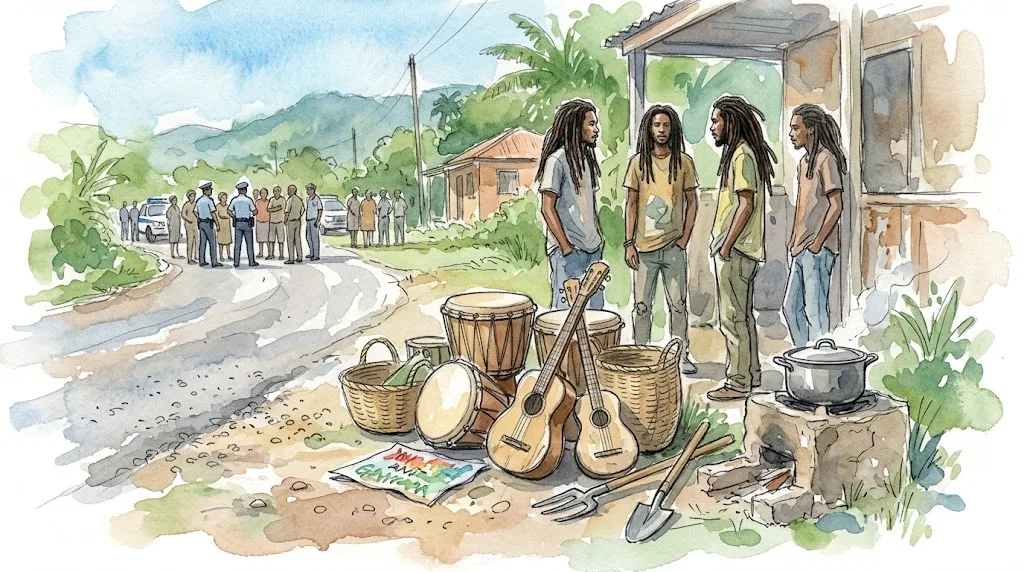
The people called Dreads were never one neatly organised body. Accounts describe a predominantly young male current that developed in the early 1970s, partly among educated Dominicans returning from study abroad and encountering Black Power and Rastafari ideas. The movement then spread beyond that original circle. Some participants adopted dreadlocks, rejected established churches and social conventions, criticised inequality, used cannabis, or withdrew into rural areas. Others were political radicals without being conventionally Rastafarian. Treating all of them as members of one disciplined “cult” obscures more than it explains.[omeka.net]domfari.omeka.netthe dreads· History of The RastafariansThe Dominican dread of the 1970's was a youthful (primarily male) adherent of black power thought. Rastafari…
Dominica at the time was experiencing unemployment, political polarisation and a generational challenge to colonial-era authority. Young activists attacked class and colour hierarchies, while farmers and rural householders worried about trespass, theft, crop destruction and intimidation. Some people associated with the Dread milieu were accused of serious offences. These incidents gave the public fear a factual core, but the label soon became much broader than the evidence against particular individuals. A study of the period describes the largely peaceful Dread current as provoking a “hysterical response” from the government, while later local historical accounts emphasise the mixture of genuine insecurity and indiscriminate repression.[essex.ac.uk]repository.essex.ac.ukEssex Open Access Research RepositoryIslands and Roads: Hesketh Bell, Jean Rhys, and Dominica's…July 9, 2012 — by P Hulme · 2000 · Cit…
That combination is characteristic of a moral panic. A recognisable problem exists, but it becomes attached to a simplified public enemy. Visible signs such as dreadlocks then serve as shortcuts for assumptions about criminality, political extremism and moral danger. The category expands faster than reliable evidence, and extraordinary measures become easier to justify.
How fear became law
In November 1974, Patrick John’s Labour government enacted the Prohibited and Unlawful Societies and Associations Act. Supporters presented it as a response to terror, threats, attacks on property and rural lawlessness. Critics argued that it effectively turned cultural appearance and suspected association into grounds for punishment. Contemporary and later accounts agree that the Act authorised unusually severe powers, including arrest without warrant, restrictions on bail and penalties for membership of or assistance to organisations deemed unlawful.[academia.edu]academia.eduTHE WAR ON DREADS IN DOMINICA FROM DEMOCRACY TO PAPADOCRACY 1Academia(PDF) THE WAR ON DREADS IN DOMINICAJanuary 1, 2020 — The Dread Act criminalized dreadlocks, enabling arrests without evidence and…
Its most notorious provision protected civilians and members of the security forces from legal liability in specified circumstances when they injured or killed a person classified as belonging to an unlawful group. This was not simply harsh sentencing after conviction. It weakened normal safeguards at the point where rumour, appearance and accusation could determine who was treated as dangerous. Accounts of the period describe arrests, beatings, forced cutting of dreadlocks, flight into the forest and deaths, although exact totals and the circumstances of individual cases are not consistently documented in accessible sources.[academia.edu]academia.eduTHE WAR ON DREADS IN DOMINICA FROM DEMOCRACY TO PAPADOCRACY 1Academia(PDF) THE WAR ON DREADS IN DOMINICAJanuary 1, 2020 — The Dread Act criminalized dreadlocks, enabling arrests without evidence and…
The parliamentary debate reveals how fear constrained political judgement. Opposition leader Eugenia Charles reportedly warned that constitutional rights were being removed, yet supported amended legislation because many citizens believed their own freedom from fear was under attack. That tension is central to understanding the episode: exceptional law did not arise from an invented concern alone. It arose when demands for security overwhelmed the requirement to distinguish proven offenders from a stigmatised population.[Academia]academia.eduTHE WAR ON DREADS IN DOMINICA FROM DEMOCRACY TO PAPADOCRACY 1Academia(PDF) THE WAR ON DREADS IN DOMINICAJanuary 1, 2020 — The Dread Act criminalized dreadlocks, enabling arrests without evidence and…
The press and political rhetoric helped harden the category. Government figures spoke of a threatening organisation with foreign or extremist roots, while even critics of the Act acknowledged the depth of public alarm. The result was a feedback loop. Reports of violence strengthened fear of every Dread; official repression encouraged some targeted people to hide or resist; concealment then appeared to confirm that they formed a secret criminal society.
Violence, rumour and political pressure
It would be misleading to portray the entire crisis as fantasy. Dominica did experience violent crime, rural confrontations and intense political conflict. The difficulty is that sources disagree over how far those offences reflected an organised Dread campaign, individual criminality, revolutionary politics or later exaggeration. The government’s language tended to merge these possibilities.
The case of Desmond Trotter became a focal point. Trotter, associated with Black Power politics and the Movement for a New Dominica, was convicted of murdering an American tourist and sentenced to death. His supporters maintained that he had been framed, and the case intensified hostility between the government and radical opponents. Later accounts of the decade treat it as part of a wider struggle over political legitimacy rather than an uncomplicated example of a dangerous sect being brought to justice.[DOM767]dom767.comdread act of dominicaDread ActThe Dread Act of Dominica, officially titled the Prohibited and Unlawful Societies and Associations Act of 1974, is one of…
A government-appointed committee led by the Reverend A. Didier reportedly concluded that most people described as Dreads were peaceful and recommended replacing the broad Act with legislation directed specifically at terrorism. The government did not immediately accept that distinction. This matters because it shows that contemporaries themselves recognised the central evidential problem: a security law aimed at violent conduct had become attached to an identity category.[Wikipedia]WikipediaThe Prohibited and Unlawful Societies and Associations ActThe Prohibited and Unlawful Societies and Associations Act
By the late 1970s, the Dread controversy had become part of a larger crisis of authority. Patrick John’s government faced opposition from trade unions, students, farmers, civil servants and left-wing organisations. On 29 May 1979, confrontation around proposed industrial-relations and libel legislation led to violent clashes in Roseau, two deaths and many injuries. The government subsequently lost its parliamentary majority. The uprising was not a Dread panic, but it grew from the same political atmosphere in which emergency powers, militant rhetoric and distrust of state institutions had become normal.[Dominica News Online]dominicanewsonline.comDominica News Online A Rain of StonesDominica News Online A Rain of Stones
The Dread Act was eventually repealed through the Prevention of Terrorism legislation of 1981. Its replacement followed the logic the Didier committee had urged: target specified acts of violence rather than a loosely defined social identity.[wikipedia.org]WikipediaThe Prohibited and Unlawful Societies and Associations ActThe Prohibited and Unlawful Societies and Associations Act
Obeah, law and supernatural fear
Dominica’s longer history of collective belief centres on obeah, a broad and contested term for African-derived spiritual practices that may include protection, healing, divination, charms and attempts to influence events through supernatural means. Colonial officials and Christian authorities frequently described these practices as witchcraft, fraud or dangerous superstition. Scholars caution that “obeah” was never a single organised religion with uniform doctrine. It was also a legal category imposed on many different activities.[miami.edu]scholarship.miami.eduWitchcraft Witchdoctors and Empire The ProscriptionWitchcraft Witchdoctors and Empire The Proscription
Dominica’s Obeah Act originated in 1904. The version published on the government’s laws website defines obeah broadly to include witchcraft, spells and professed occult or supernatural power. It criminalises practising obeah, consulting a practitioner, possessing supposed instruments of obeah and publishing material considered to promote it. It also authorises searches and arrest without warrant on suspicion of practice. The published consolidation records amendments through 1990, although that document alone does not establish how often the law has recently been enforced.[Government of Dominica]dominica.gov.dmernment of Dominicaernment of Dominica
The wording illustrates how law can create a panic category. Healing, fortune-telling, intimidation, deception and alleged supernatural harm are placed within the same statutory frame. Some conduct covered by such a law may involve fraud, poisoning, coercion or exploitation. Yet those harms can be prosecuted as conduct without assuming that an entire African-derived tradition is inherently criminal.
Historians of Caribbean obeah law argue that colonial governments often treated spiritually authoritative practitioners as political threats, especially when enslaved or formerly enslaved communities used rituals, medicines or oaths outside church and state control. Over time, legal emphasis shifted unevenly from fears of supernatural power towards claims of fraud, but the older association with danger remained embedded in legislation and public language.[cambridge.org]cambridge.orgOpen source on cambridge.org.
Folklore is not the same as panic
Dominican oral tradition contains many stories about ghosts, bush spirits, magical harm and spiritually powerful healers. A 1945 anthropological account recorded practices combining prayer, herbal knowledge, massage and divination, alongside beliefs in ghosts of the dead and independent spiritual beings. It also noted that terms translated as obeah or sorcery could cover several different practices rather than one coherent system.[tiboko.com]tiboko.comCarib Folk-Beliefs and Customs from Dominica, B. W. ICarib Folk-Beliefs and Customs from Dominica, B. W. I
These stories could certainly produce fear. Ghosts might be understood as dissatisfied dead relatives, while forest spirits could be blamed for unsettling sounds, smells, illness or dangerous encounters. Such beliefs helped people explain misfortune, regulate behaviour and make sense of places beyond ordinary control. They also shaped warnings told to children and expectations surrounding wakes, burial and respect for the dead.
But folklore should not automatically be described as mass hysteria. A frightening story may be widely known without producing accusation, persecution or contagious illness. Belief in spirits may coexist with scepticism, humour, Christianity and practical medicine. The historically responsible question is not simply whether Dominicans “believed in witchcraft”, but what people did when such beliefs became attached to a particular neighbour, healer, dissenter or social group.
The same caution applies to figures such as the soucouyant, the skin-shedding, blood-drinking woman of wider Caribbean folklore. Such stories can reflect anxieties about ageing, female independence, envy, illness and nocturnal danger. Yet there is little strong evidence of a Dominica-wide soucouyant panic comparable to a European witch hunt. The cultural presence of a supernatural being is not proof of mass persecution.[De Gruyter Brill]degruyterbrill.comOpen source on degruyterbrill.com.

What Dominica’s history reveals
Dominica’s best-documented panic history is therefore a history of labelling. The Dread crisis shows how quickly a varied youth movement can be recast as one conspiratorial threat when visible difference, real crime, political radicalism and public insecurity overlap. It also shows that moral panic does not mean “nothing happened”. Its defining feature is disproportion and category failure: evidence about some individuals is used to justify suspicion of everyone who resembles them.
The obeah tradition reveals a related but older process. Colonial law translated diverse spiritual and healing practices into a single criminal category, often without separating harmful acts from religious expression or folk medicine. That legacy survives in the language of “superstition”, “witchcraft” and occult danger.
Neither story fits the easy image of irrational crowds suddenly losing their minds. Dominica’s episodes developed through institutions: laws, speeches, churches, newspapers, police powers and inherited colonial classifications. Fear became most harmful when those institutions stopped asking precise questions about conduct and began treating identity, appearance or inherited belief as evidence in itself.
That is why the Dread Act remains culturally important. It is remembered not merely as an unusual law against Rastafarians, but as a warning about what can happen when a society facing genuine insecurity allows a broad public label to replace individual proof.
Amazon book picks
Further Reading
Books and field guides related to When Fear Became Law in Dominica. Use these as the next step if you want deeper reading beyond the article.
The Black Jacobins
First published 1935. Subjects: History, Biography, Revolutionaries, Generals, Revolution, 1791-1804.
The Serpent and the Rainbow
First published 1985. Subjects: Social life and customs, Description and travel, Zombiism, Bizango (Cult), Religious life and customs.


Caribbean history
First published 2011. Subjects: Race relations, History, Caribbean area, history, West indies, race relations, HISTORY.
Endnotes
1.
Source: domfari.omeka.net
Title: the dreads
Link:https://domfari.omeka.net/exhibits/show/rastahistory/the-dreads
Source snippet
· History of The RastafariansThe Dominican dread of the 1970's was a youthful (primarily male) adherent of black power thought. Rastafari...
2.
Source: dom767.com
Title: rastafari in dominica
Link:https://www.dom767.com/dompedia/rastafari-in-dominica/
Source snippet
RastafariIn the early 1970s, the adherents in Dominica were more commonly referred to as Dreads rather than Rastafarians. This dist...
3.
Source: dom767.com
Title: rastafarian movement in dominica
Link:https://www.dom767.com/dompedia/rastafarian-movement-in-dominica/
Source snippet
RastafarianIn the 1970s, Dominica experienced the Rastafarian movement as a complex saga of cultural resistance, state-sanctioned p...
4.
Source: dom767.com
Title: dread act of dominica
Link:https://www.dom767.com/dompedia/dread-act-of-dominica/
Source snippet
Dread ActThe Dread Act of Dominica, officially titled the Prohibited and Unlawful Societies and Associations Act of 1974, is one of...
5.
Source: domfari.omeka.net
Title: the dread act
Link:https://domfari.omeka.net/exhibits/show/rastahistory/the-dread-act
Source snippet
· History of The RastafariansIn November 1974, the Labour government, which was headed by Patrick John, had passed The Prohibited and Unl...
Published: November 1974
6.
Source: academia.edu
Title: THE WAR ON DREADS IN DOMINICA FROM DEMOCRACY TO PAPADOCRACY 1
Link:https://www.academia.edu/44917135/THE_WAR_ON_DREADS_IN_DOMINICA_FROM_DEMOCRACY_TO_PAPADOCRACY_1
Source snippet
Academia(PDF) THE WAR ON DREADS IN DOMINICAJanuary 1, 2020 — The Dread Act criminalized dreadlocks, enabling arrests without evidence and...
Published: January 1, 2020
7.
Source: dom767.com
Link:https://www.dom767.com/dompedia/prohibited-and-unlawful-societies-and-associations-act-1974-of-dominica/
8.
Source: Wikipedia
Title: The Prohibited and Unlawful Societies and Associations Act
Link:https://en.wikipedia.org/wiki/The_Prohibited_and_Unlawful_Societies_and_Associations_Act
9.
Source: academia.edu
Title: THE WAR ON DREADS IN DOMINICA FROM DEMOCRACY TO PAPADOCRACY1
Link:https://www.academia.edu/44931045/THE_WAR_ON_DREADS_IN_DOMINICA_FROM_DEMOCRACY_TO_PAPADOCRACY1
10.
Source: dom767.com
Title: dread era in dominica
Link:https://www.dom767.com/dompedia/dread-era-in-dominica/
11.
Source: scholarship.miami.edu
Title: Witchcraft Witchdoctors and Empire The Proscription
Link:https://scholarship.miami.edu/esploro/outputs/doctoral/Witchcraft-Witchdoctors-and-Empire-The-Proscription/991031447808402976
12.
Source: dominica.gov.dm
Title: ernment of Dominica
Link:https://dominica.gov.dm/laws/chapters/chap10-38.pdf
13.
Source: cambridge.org
Link:https://www.cambridge.org/core/books/cultural-politics-of-obeah/creole-slave-society-obeah-and-the-law/614D64A80BF1F8CCF008F662FC7AD8D3
14.
Source: tiboko.com
Title: Carib Folk-Beliefs and Customs from Dominica, B. W. I
Link:https://tiboko.com/wp-content/uploads/2023/07/Carib-Folk-beliefs-and-Customs-from-Dominica.pdf
15.
Source: dom767.com
Link:https://www.dom767.com/dompedia/obeah-in-dominica/
16.
Source: dom767.com
Link:https://www.dom767.com/dompedia/dreads-in-dominica/
17.
Source: Wikipedia
Title: Doomsday cult
Link:https://en.wikipedia.org/wiki/Doomsday_cult
18.
Source: Wikipedia
Title: List of mass panic cases
Link:https://en.wikipedia.org/wiki/List_of_mass_panic_cases
19.
Source: Wikipedia
Link:https://en.wikipedia.org/wiki/Obeah
20.
Source: scholar.library.miami.edu
Link:https://scholar.library.miami.edu/slaves/Religion/religion.html
21.
Source: cambridge.org
Link:https://www.cambridge.org/core/books/caribbean-literature-in-transition-18001920/obeah-religion-and-nineteenthcentury-literature-of-the-anglophone-caribbean/CF024D5628DBEC6719725F255AB6F0C3
22.
Source: youtube.com
Title: Undreading the Dread Act (2)
Link:https://www.youtube.com/watch?v=SrB5wdgu_CM
Source snippet
The Dread Act | A Year-Long Solemn Observation...
23.
Source: youtube.com
Title: The Dread Act | A Year-Long Solemn Observation
Link:https://www.youtube.com/watch?v=1Ano8AJMx_0
Source snippet
Nelly Stharre & Trevy Felix - Dread Act...
24.
Source: repository.essex.ac.uk
Link:https://repository.essex.ac.uk/2827/1/Islands_and_Roads.pdf
Source snippet
Essex Open Access Research RepositoryIslands and Roads: Hesketh Bell, Jean Rhys, and Dominica's...July 9, 2012 — by P Hulme · 2000 · Cit...
Published: July 9, 2012
25.
Source: dominicanewsonline.com
Title: Dominica News Online A Rain of Stones
Link:https://dominicanewsonline.com/news/wp-content/uploads/2018/05/A-Rain-of-Stones-2.pdf
26.
Source: dominicanewsonline.com
Title: its only gon get better kalihi sheds light on dread act in new video
Link:https://dominicanewsonline.com/news/homepage/its-only-gon-get-better-kalihi-sheds-light-on-dread-act-in-new-video/
27.
Source: warwick.ac.uk
Title: paton trevor
Link:https://warwick.ac.uk/fac/arts/english/events/warvan-copy/prog/paton_trevor.pdf
28.
Source: degruyterbrill.com
Link:https://www.degruyterbrill.com/de/document/doi/10.36019/9780813565750-004/pdf?srsltid=AfmBOoqGTtjKRUQeyIml2PUEq9-zMhOrd4OdhM4abx9kAMZW7ja1jkZy
29.
Source: dominicanewsonline.com
Title: Let’s discuss the period of the Dread Act
Link:https://dominicanewsonline.com/news/homepage/news/general/lets-discuss-the-period-of-the-dread-act-henry-shillingford/
30.
Source: dominicanewsonline.com
Title: obeah reparations slavery
Link:https://dominicanewsonline.com/news/homepage/features/commentary/obeah-reparations-slavery/
31.
Source: dominicanewsonline.com
Title: ghost stories the story of lougarous and soukouyants
Link:https://dominicanewsonline.com/news/homepage/columns/ghost-stories/ghost-stories-the-story-of-lougarous-and-soukouyants/
32.
Source: jahlove.ca
Title: the dread act
Link:https://jahlove.ca/2025/05/24/the-dread-act/
33.
Source: obeahtt.wordpress.com
Title: the soucouyant
Link:https://obeahtt.wordpress.com/2018/03/12/the-soucouyant/
Additional References
34.
Source: youtube.com
Title: Nelly Stharre & Trevy Felix
Link:https://www.youtube.com/watch?v=IFD4qDjwgvQ
Source snippet
Dominica Dread Act 1974 Dread Rastafari and Ethiopia | The Dread Act: Dominica's Controversial Legislation of 1974 Ras Albert Williams...
35.
Source: youtube.com
Link:https://www.youtube.com/watch?v=mA4J-6A0JWI
Source snippet
Dominica's first Prime Minister, Col. Patrick Roland John is dead...
36.
Source: policehumanrightsresources.org
Link:https://policehumanrightsresources.org/content/uploads/2016/07/The-Witchcraft-Act.pdf?x36399=
37.
Source: historysnob.com
Link:https://www.historysnob.com/war-and-historical-events/20-chilling-cases-mass-hysteria-throughout-history
38.
Source: researchgate.net
Link:https://www.researchgate.net/publication/308773699_Rastafari_as_a_Counter-Hegemonic_Social_Movement_Ways_of_Resistance_to_Neoliberal_and_Neo-Colonial_Authoritarianism
39.
Source: facebook.com
Link:https://www.facebook.com/avatarrealmscollide/posts/a-time-of-peace-and-harmony-is-disrupted-by-a-dangerous-cult-devoted-to-a-dark-e/122324667410224139/
40.
Source: facebook.com
Link:https://www.facebook.com/BarbadosNCF/posts/obeah-myths-and-beliefs-friday-october-30-2pm/3487186074637633/
41.
Source: facebook.com
Link:https://www.facebook.com/MatthewSantoroVideos/posts/the-day-an-entire-girls-school-fainted-mysteriously/1567707731382100/
42.
Source: facebook.com
Link:https://www.facebook.com/TheFolklorePodcast/posts/ive-decided-that-we-will-look-at-caribbean-folklore-for-todays-creature-in-honou/1523406049800310/
43.
Source: facebook.com
Link:https://www.facebook.com/pushpast10Media/posts/the-hidden-truth-behind-witchcraft-and-fear-in-dominica/1259761699494203/
Topic Tree
Follow this branch
Related pages 192
- Antigua and Barbuda
- Argentina Belief Scares
- Azerbaijan Belief
- Bahrain Beliefs
- North Korea
- +187 more in sidebar