Within Tanzania
When Witchcraft Fear Becomes Persecution
Accusations of occult harm have repeatedly exposed older women and people with albinism to abuse, displacement and killing.
On this page
- Why Particular People Become Targets
- From Family Conflict to Organised Violence
- Protection, Law and Community Prevention
Page outline Jump by section
Introduction
In Tanzania, belief in witchcraft has sometimes moved beyond private conviction and become a driver of persecution against identifiable people. Rather than a case of mass psychogenic illness or a shared panic in which everyone experiences similar symptoms, these episodes involve accusations directed at specific individuals who are blamed for illness, crop failure, family misfortune or unexpected deaths. The consequences have included assaults, forced displacement and killings, with older women and people with albinism facing the greatest risk. Although these forms of violence have attracted international attention, researchers emphasise that they arise from a combination of long-standing beliefs, local conflicts, economic pressures and criminal exploitation rather than from a single cultural tradition.[ru.ac.za]journal.ru.ac.zaOctober 1, 2000…
Why Particular People Become Targets
Older women have long been disproportionately accused of practising witchcraft in parts of northern Tanzania, especially in the Mwanza and Shinyanga regions. Researchers studying communities in Magu District found that accusations often fell on widows, elderly women living alone or women whose appearance, particularly red eyes caused by years of cooking over smoky fires, was interpreted as evidence of supernatural activity. Such accusations frequently followed unexplained illness, livestock deaths, poor harvests or disputes within extended families rather than any observable criminal act.[journal.ru.ac.za]journal.ru.ac.zaOctober 1, 2000…
Academic studies argue that these accusations cannot be understood simply as survival of ancient beliefs. They are also shaped by rapid social and economic change. As livelihoods become more uncertain, families sometimes seek explanations for misfortune through diviners or traditional healers. Inheritance disputes, jealousy, generational conflict and competition over land may then become expressed through allegations of witchcraft. In some cases, branding an older relative a witch has enabled relatives to justify violence or removal from property.[journal.ru.ac.za]journal.ru.ac.zaOctober 1, 2000…
People with albinism have faced a different but equally dangerous form of persecution. Their condition has been surrounded by myths claiming that body parts possess magical powers capable of bringing wealth, political success or luck in mining and fishing. These beliefs have no basis in science, yet criminal networks have exploited them to justify murders, mutilations and trafficking in body parts. The victims are targeted because of myths attached to their appearance rather than because they are individually accused of causing harm.[ohchr.org]albinism.ohchr.orgHuman Rights Dimension of AlbinismPeople with albinism, by United Nations Human Rights…
From Family Conflict to Organised Violence
Violence linked to witchcraft accusations ranges from domestic abuse to organised criminal activity.
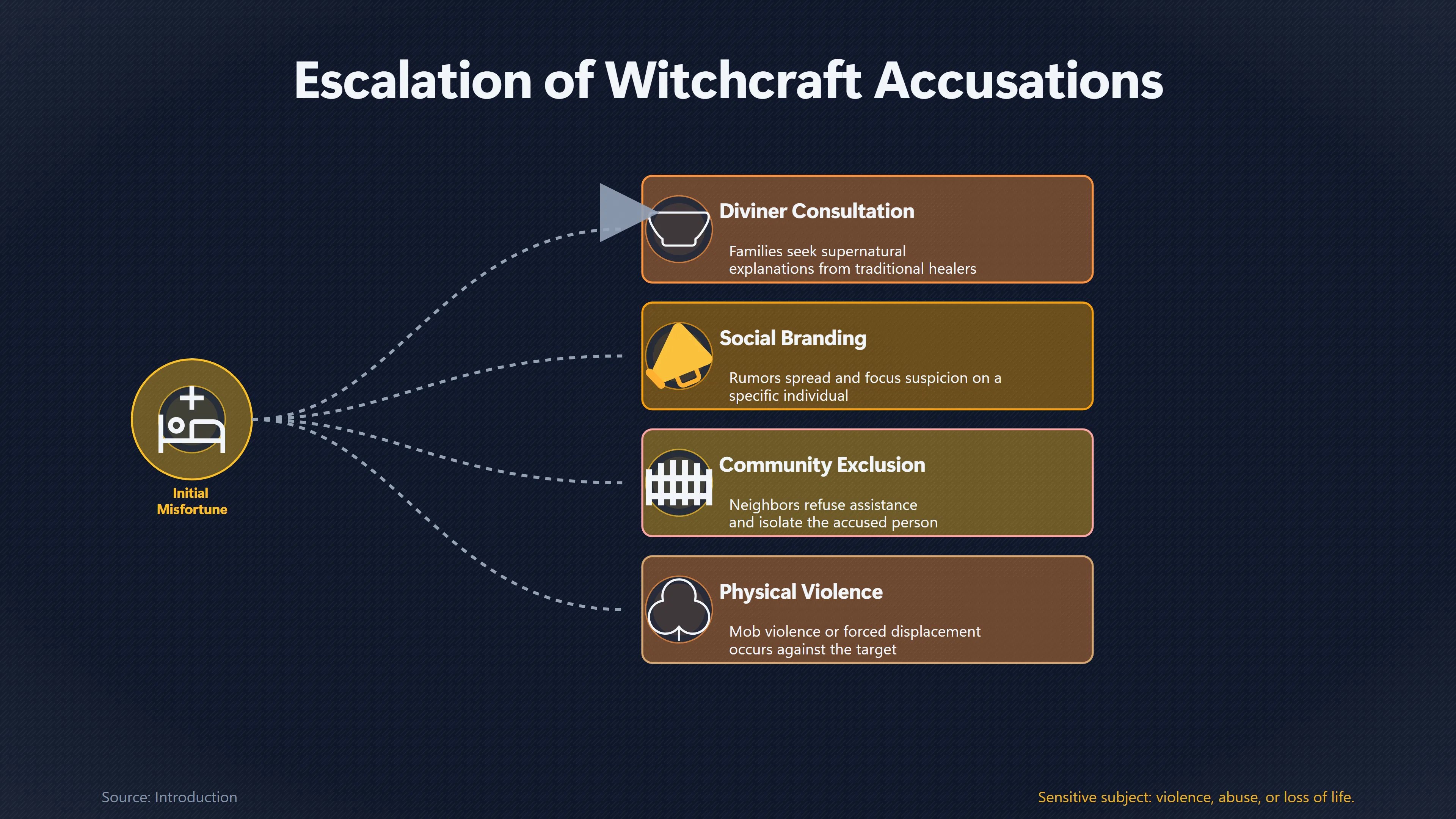
For older women, attacks commonly begin with rumours inside a family or village. A sudden death or prolonged illness may lead relatives to consult a diviner, after which suspicion becomes focused on one individual. Once an accusation gains social acceptance, neighbours may refuse assistance, expel the accused from the community or participate in mob violence. Researchers note that many victims are socially isolated before physical attacks occur.[journal.ru.ac.za]journal.ru.ac.zaOctober 1, 2000…
Attacks on people with albinism often involve a more organised pattern. Investigations by the United Nations and human rights organisations describe cases in which body parts have been sold through criminal networks serving clients seeking wealth or political influence through ritual practices. Although sensational reporting sometimes portrays such crimes as widespread features of everyday traditional belief, specialists stress that they are carried out by relatively small groups of offenders exploiting superstition for profit. Most traditional healers neither participate in nor support such crimes.[ohchr.org]albinism.ohchr.orgHuman Rights Dimension of AlbinismPeople with albinism, by United Nations Human Rights…
Northern Tanzania, particularly around the Lake Victoria region, has recorded many of the most notorious attacks, although incidents have occurred elsewhere. Human rights groups caution that official statistics almost certainly underestimate the scale of violence because families may fear retaliation or because killings are disguised as ordinary crimes or disappearances.[ohchr.org]albinism.ohchr.orgHuman Rights Dimension of AlbinismPeople with albinism, by United Nations Human Rights…
Why These Beliefs Persist
The persistence of witchcraft-related violence does not mean that most Tanzanians support it. Surveys and ethnographic research instead suggest a more complex picture in which many people simultaneously reject violence while continuing to believe that supernatural harm is possible.
Several factors reinforce accusations:
- unexplained illness or death in places with limited medical services;
- economic hardship that encourages people to seek supernatural explanations for bad fortune;
- consultation with individuals claiming special knowledge of hidden causes;
- longstanding social tensions within families or neighbourhoods;
- weak investigation and prosecution, allowing offenders to believe they can act with impunity.[ru.ac.za]journal.ru.ac.zaOctober 1, 2000…
Researchers therefore distinguish between belief itself and persecution. Belief in witchcraft exists in many societies without producing systematic violence. The danger emerges when accusations become accepted as sufficient justification for punishment outside the legal system.[journal.ru.ac.za]journal.ru.ac.zaOctober 1, 2000…
Protection, Law and Community Prevention
Successive Tanzanian governments have attempted to reduce witchcraft-related violence through policing, criminal prosecutions and regulation of traditional healers. During periods of heightened attacks on people with albinism, authorities closed or suspended many licensed traditional healers suspected of encouraging harmful beliefs and increased security for vulnerable children. Some children with albinism were temporarily placed in specialised centres for protection, although these measures also raised concerns about long-term segregation from their families and communities.[United Nations]un.orgited Nations Albinism and Human Rights | United Nationsited NationsAlbinism and Human Rights | United Nations…
International organisations increasingly argue that protection requires more than arrests. The United Nations has emphasised public education to counter myths about albinism, better access to justice, improved healthcare and stronger protection of human rights. Campaigns also encourage accurate medical understanding of albinism as a genetic condition rather than a supernatural phenomenon.[albinism.ohchr.org]albinism.ohchr.orgHuman Rights Dimension of AlbinismPeople with albinism, by United Nations Human Rights…
Recent legal developments have increased pressure for reform. In 2025, the African Court on Human and Peoples’ Rights found Tanzania responsible for failing to provide adequate protection for people with albinism and ordered a range of measures, including stronger legal safeguards, awareness campaigns and improved support for victims. Tanzania has also adopted a National Action Plan addressing the rights of persons with albinism.[hrw.org]hrw.orgHuman Rights WatchWorld Report 2026: Tanzania | Human Rights Watch…
Why This Matters in Tanzania’s History of Collective Belief
Within Tanzania’s broader history of collective belief, witchcraft violence occupies a distinct place. Unlike the 1962 laughter epidemic, where distress spread through social interaction without identifiable persecutors, or the Popobawa scares, where rumours generated widespread fear, witchcraft accusations concentrate suspicion on particular people. The central mechanism is not contagious illness but the transformation of shared belief into targeted persecution.
This distinction is important because it changes both the historical interpretation and the appropriate response. Medical explanations are relevant to episodes of mass psychogenic illness, while witchcraft-related killings require criminal investigation, protection of vulnerable groups, public education and efforts to reduce the social conditions that allow accusations to escalate into violence. The history of these attacks demonstrates how collective belief can become most dangerous when fear acquires a human target.[ru.ac.za]journal.ru.ac.zaOctober 1, 2000…
Amazon book picks
Further Reading
Books and field guides related to When Witchcraft Fear Becomes Persecution. Use these as the next step if you want deeper reading beyond the article.
Extraordinary Popular Delusions and the Madness of Crowds
Rating: 4.0/5 from 5 Google Books ratings
Discusses persecution driven by collective beliefs.
African religions and philosophy
Provides background on belief systems relevant to accusations.
Witchcraft, Violence, and Democracy in South Africa
Explores witchcraft accusations and violence in African societies.

Endnotes
1.
Source: journal.ru.ac.za
Link:https://journal.ru.ac.za/index.php/sajog/article/view/205
Source snippet
October 1, 2000...
Published: October 1, 2000
2.
Source: albinism.ohchr.org
Title: Human Rights Dimension of Albinism
Link:https://albinism.ohchr.org/human-rights-dimension-of-albinism.html
Source snippet
People with albinism, by United Nations Human Rights...
3.
Source: right-docs.org
Title: 24/57 Persons with albinism
Link:https://www.right-docs.org/doc/a-hrc-24-57/
Source snippet
Report of the Office of the United Nations High Commissioner for Human Rights / RightDocs - Where human rights resolutions count...
4.
Source: docstore.ohchr.org
Title: Files Handler.ashx
Link:https://docstore.ohchr.org/SelfServices/FilesHandler.ashx?enc=ETNFdzSlus0V%2BAu34blxAJcoVnR11gOyXfO1BTsOYDZkHxQuUBYP9tfmzNX7UuoduH9Cg7DLOK2NZ%2BX2HrCwSaxECVvoi1mUPQNMFZiOkkw%3D
5.
Source: albinism.ohchr.org
Link:https://albinism.ohchr.org/resources.html
6.
Source: minorityrights.org
Title: Minority Rights Group People with albinism in Tanzania
Link:https://minorityrights.org/communities/people-with-albinism/
Source snippet
Minority Rights GroupPeople with albinism in Tanzania - Minority Rights Group...
7.
Source: un.org
Title: ited Nations Albinism and Human Rights | United Nations
Link:https://www.un.org/en/node/206380
Source snippet
ited NationsAlbinism and Human Rights | United Nations...
8.
Source: hrw.org
Link:https://www.hrw.org/world-report/2026/country-chapters/tanzania
Source snippet
Human Rights WatchWorld Report 2026: Tanzania | Human Rights Watch...
9.
Source: hrw.org
Link:https://www.hrw.org/news/2019/02/09/it-felt-punishment-growing-albinism-tanzania
10.
Source: un.org
Link:https://www.un.org/development/desa/pd/news/first-ever-un-forum-albinism-africa-focus-less-talk-more-action
11.
Source: hrw.org
Title: child marriage and human rights abuses tanzania
Link:https://www.hrw.org/report/2014/10/29/no-way-out/child-marriage-and-human-rights-abuses-tanzania
12.
Source: un.org
Title: albinism and human rights
Link:https://www.un.org/en/observances/albinism-day/albinism-and-human-rights
Additional References
13.
Source: ecoi.net
Link:https://www.ecoi.net/en/document/1261407.html
Source snippet
OHCHR – UN Office of the High Commissioner for Human Rights (Author): “High Commissioner For Human Rights Condemns “Abhorrent” Attacks On...
14.
Source: journaljsrr.com
Link:https://journaljsrr.com/index.php/JSRR/article/view/1262
Source snippet
SciResearch ReportsBelief on Witchcraft and Killing of People with Albinism in Lack Victoria Zone, Tanzania | Journal of Scientific Resea...
15.
Source: amnesty.org
Title: International Ending attacks against persons with albinism
Link:https://www.amnesty.org/en/latest/campaigns/2026/07/ending-attacks-against-persons-with-albinism/
Source snippet
Amnesty InternationalEnding attacks against persons with albinism - Amnesty International...
16.
Source: youtube.com
Title: South Africa’s Deadly Gold Rush & Tanzania’s Witch Hunt | Unreported World
Link:https://www.youtube.com/watch?v=X99OXmMMHlQ
Source snippet
Myths fuel stigma against people living with albinism in Tanzania...
17.
Source: youtube.com
Title: Myths fuel stigma against people living with albinism in Tanzania
Link:https://www.youtube.com/watch?v=-TQlRzqyWeY
Source snippet
The stream - Albinism's deadly stigma in Tanzania...
18.
Source: africabib.org
Link:https://www.africabib.org/rec.php?RID=W00080716
19.
Source: cambridge.org
Link:https://www.cambridge.org/core/journals/journal-of-modern-african-studies/article/abs/miners-magic-artisanal-mining-the-albino-fetish-and-murder-in-tanzania/80FCEE7BB458C55CFA074497F7594F0D
20.
Source: scielo.org.za
Link:https://scielo.org.za/scielo.php?pid=S1727-37812020000100041&script=sci_arttext
22.
Source: docslib.org
Link:https://docslib.org/doc/4752928/elderly-women-and-witchcraft-killings-among-the-sukuma-of-northern-tanzania-from-the-1880s-to-the-present
Topic Tree