Within Zimbabwe Beliefs
Why Satanism Scares Spread Through Schools
Fainting, rumours and religious fear can turn school distress into claims of possession or Satanism without making pupils' symptoms unreal.
On this page
- How symptoms and rumours become contagious
- Why boarding schools and religious language matter
- How adults can respond without ridicule or panic
Page outline Jump by section
Introduction
Zimbabwe has experienced repeated school episodes in which pupils have fainted, screamed, reported seeing frightening visions, or behaved in ways interpreted by classmates, parents or religious leaders as evidence of Satanism, demonic possession or spiritual attack. These incidents have often spread rapidly through boarding schools and secondary schools, sometimes leading to temporary closures, protests or demands that particular teachers or pupils be removed. While the symptoms experienced by affected children are real and often distressing, investigations have frequently found no evidence of poisoning, infectious disease or organised “Satanic” activity. Instead, psychologists and public health researchers point to a combination of stress, suggestion, rumour and shared cultural expectations as a common explanation for many of these outbreaks.[nih.gov]pmc.ncbi.nlm.nih.govPMCEpisodes of mass hysteria in African schools: A study of literaturePMCEpisodes of mass hysteria in African schools: A study of literature
Understanding these school scares does not require dismissing pupils’ experiences or ridiculing religious belief. Rather, it means recognising how anxiety, social pressure and local spiritual language can combine to produce genuine physical symptoms and powerful collective fears.
How symptoms and rumours become contagious
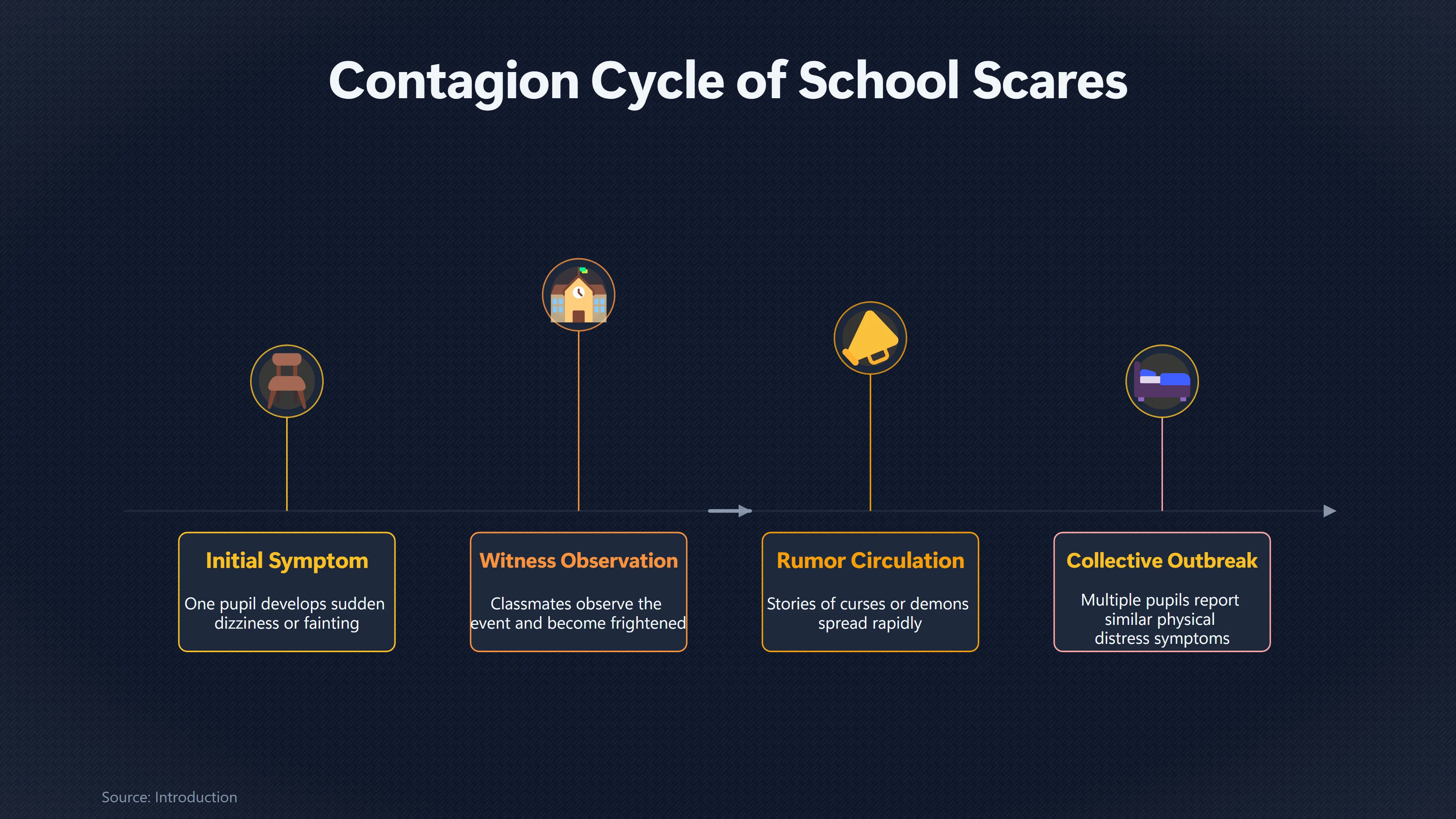
School-based outbreaks in Zimbabwe typically follow a recognisable pattern. One pupil develops sudden symptoms—perhaps dizziness, fainting, shaking or panic. Other pupils witness the event, become frightened and begin reporting similar experiences. Within hours or days, rumours circulate that the school has been cursed, that demons are present or that pupils are being initiated into Satanism.
Medical researchers describe many such episodes as mass psychogenic illness (sometimes called mass sociogenic illness). The term does not imply that symptoms are invented. Instead, it refers to genuine physical complaints that spread socially rather than through an infectious agent or toxic exposure. Common symptoms include:
- fainting or collapsing;
- headaches and dizziness;
- trembling or shaking;
- difficulty breathing;
- nausea;
- crying, screaming or panic;
- unusual behaviour interpreted as possession.
Large reviews of school outbreaks across Africa note that most occur among adolescents, particularly girls in boarding schools, and often appear during periods of heightened emotional stress such as examinations or disciplinary pressure. Investigations generally fail to identify environmental toxins or infectious causes.[nih.gov]pmc.ncbi.nlm.nih.govPMCEpisodes of mass hysteria in African schools: A study of literaturePMCEpisodes of mass hysteria in African schools: A study of literature
In Zimbabwe, the interpretation frequently differs from the medical explanation. Symptoms that psychologists describe as stress-related may instead be understood within communities as evidence of demonic attack, witchcraft or Satanism, giving the outbreak additional emotional force.
Why boarding schools and religious language matter
Many Zimbabwean cases have occurred in boarding schools or mission schools where pupils spend long periods together under close supervision. These environments contain several conditions that researchers repeatedly identify as increasing the likelihood of contagious distress.
First, pupils observe one another constantly. A dramatic event involving one student is quickly witnessed by dozens of classmates.
Second, boarding schools can involve significant pressures. Homesickness, demanding examinations, strict discipline, lack of privacy and adolescent social tensions all increase emotional stress. The African review of school outbreaks highlights approaching examinations, difficult hostel conditions and personal stress among early cases as recurring features.[PMC]pmc.ncbi.nlm.nih.govPMCEpisodes of mass hysteria in African schools: A study of literaturePMCEpisodes of mass hysteria in African schools: A study of literature
Third, shared religious language shapes how unusual experiences are interpreted. In many Zimbabwean communities, churches actively warn about Satanism, spiritual warfare and demonic influence. When unexplained events occur, pupils may already possess a common vocabulary that frames frightening experiences as supernatural rather than psychological.
This does not mean religious belief causes the illness. Rather, beliefs influence how people explain ambiguous events. If the dominant explanation becomes “demons are attacking the school,” fear itself may encourage further pupils to interpret ordinary sensations—such as dizziness caused by anxiety—as confirmation that they too have been targeted.
Zimbabwean school scares in practice
Zimbabwe has seen numerous localised school incidents over the past two decades. Although details vary, many share striking similarities.
Reports from schools in Hwange, Gokwe, Chipinge and elsewhere have described pupils collapsing, fainting, reporting visions of snakes or mysterious figures, speaking in unusual ways or accusing teachers and fellow pupils of Satanic initiation. Some schools temporarily suspended classes while education officials investigated. Parents sometimes demanded transfers or the removal of staff believed to be responsible.[Herald Online]heraldonline.co.zwHerald Online Satanism scare grips HwangeHerald OnlineSatanism scare grips Hwange - heraldApril 1, 2015…
In many cases, official investigations failed to find evidence supporting allegations of organised Satanism. Zimbabwe’s Ministry of Primary and Secondary Education has repeatedly argued that many incidents are better explained by anxiety, particularly around examination periods, while acknowledging that frightened communities require reassurance rather than dismissal.[Anadolu Agency]m.aa.com.trAnadolu Agency Zimbabwean schools rocked by ‘Satanism’Anadolu Agency Zimbabwean schools rocked by ‘Satanism’
The persistence of these episodes illustrates an important distinction. Individual incidents differ, and not every case has been studied in detail. However, the broader pattern closely resembles school outbreaks documented elsewhere in Africa and internationally, where symptoms spread socially even though no infectious or environmental cause is identified.[nih.gov]pmc.ncbi.nlm.nih.govPMCEpisodes of mass hysteria in African schools: A study of literaturePMCEpisodes of mass hysteria in African schools: A study of literature

Why accusations of Satanism spread so easily
Once rumours begin, they often expand beyond the original illness.
Several mechanisms reinforce one another:
- Visible illness creates credibility. Because pupils genuinely faint or become distressed, observers assume an equally dramatic cause.
- Rumour fills uncertainty. In the absence of an obvious medical explanation, supernatural stories can spread rapidly.
- Authority figures may disagree. Parents, clergy, traditional healers, teachers and health professionals sometimes offer competing explanations, increasing confusion.
- Social networks amplify fear. Parents communicate with relatives, churches and community groups, while local media can extend the story beyond the school.
- Scapegoating becomes possible. Particular teachers, pupils or outsiders may be accused without reliable evidence.
The greatest harm often comes not from the original illness but from these accusations. Individuals suspected of involvement may face intimidation, damaged reputations or demands for dismissal even when investigations uncover no supporting evidence.[Herald Online]heraldonline.co.zwHerald Online The satanism scare in Zimbabwe – heraldHerald Online The satanism scare in Zimbabwe – herald
What researchers think is happening
Researchers generally reject simple explanations.
Few scholars argue that all school scares are identical, and psychologists emphasise that each outbreak deserves proper investigation. Schools must first rule out poisoning, infectious disease, environmental hazards or deliberate abuse before concluding that an episode is psychogenic.
When no physical cause is found, several interacting influences are commonly proposed:
- emotional stress among pupils;
- social contagion through observation and expectation;
- culturally shared beliefs about spirits, witchcraft or Satanism;
- media and community rumours;
- the reassurance—or alarm—provided by adults.
Studies from multiple countries show that school settings are particularly vulnerable because pupils spend long periods together, are highly attentive to one another’s behaviour and may experience common stresses simultaneously.[ukhsa.gov.uk]researchportal.ukhsa.gov.ukUK Health Security Agency Frequency and predictors of mass psychogenic illnessUK Health Security AgencyFrequency and predictors of mass psychogenic illness - UK Health Security Agency…

How adults can respond without ridicule or panic
Experience from Zimbabwe and elsewhere suggests that the most effective responses combine careful investigation with calm communication.
Helpful approaches include:
- treating affected pupils respectfully and providing appropriate medical assessment;
- investigating possible environmental or infectious causes before reaching conclusions;
- avoiding public accusations against teachers, pupils or religious groups without evidence;
- communicating clear factual information to parents;
- reducing unnecessary anxiety where examinations, hostel conditions or other stresses appear significant;
- providing psychological support for affected pupils instead of assuming they are pretending or deliberately causing disruption.
Researchers reviewing African school outbreaks note that dismissing pupils as attention-seeking is both inaccurate and counterproductive. Their distress is genuine even when no physical disease is present. Equally, immediately attributing every unexplained symptom to Satanism may intensify fear and prolong the outbreak.[PMC]pmc.ncbi.nlm.nih.govPMCEpisodes of mass hysteria in African schools: A study of literaturePMCEpisodes of mass hysteria in African schools: A study of literature
Why these scares remain important
Zimbabwe’s recurring school Satanism scares reveal how collective fear develops when genuine distress meets powerful cultural explanations. They are not simply stories about superstition, nor are they merely medical curiosities. They show how schools become places where social pressures, religious belief, adolescent stress and rumour interact.
For historians and psychologists, these episodes illustrate that collective illness can arise without deception and that cultural beliefs shape how symptoms are interpreted. For educators and communities, they demonstrate the importance of responding with evidence, compassion and clear communication, recognising both the reality of pupils’ suffering and the dangers of allowing fear-driven accusations to spread unchecked.
Amazon book picks
Further Reading
Books and field guides related to Why Satanism Scares Spread Through Schools. Use these as the next step if you want deeper reading beyond the article.
Extraordinary Popular Delusions and the Madness of Crowds
Rating: 4.0/5 from 5 Google Books ratings
Provides historical perspective on collective panics and rumours.

African religions and philosophy
Supplies cultural context for spiritual interpretations of distress and misfortune.

The Psychology of Pandemics
Explains fear, rumours and contagious social responses applicable to school scares.
Endnotes
1.
Source: pmc.ncbi.nlm.nih.gov
Title: PMCEpisodes of mass hysteria in African schools: A study of literature
Link:https://pmc.ncbi.nlm.nih.gov/articles/PMC3588562/
2.
Source: m.aa.com.tr
Title: Anadolu Agency Zimbabwean schools rocked by ‘Satanism’
Link:https://m.aa.com.tr/en/world/zimbabwean-schools-rocked-by-satanism-/36071
3.
Source: researchportal.ukhsa.gov.uk
Title: UK Health Security Agency Frequency and predictors of mass psychogenic illness
Link:https://researchportal.ukhsa.gov.uk/en/publications/frequency-and-predictors-of-mass-psychogenic-illness/
Source snippet
UK Health Security AgencyFrequency and predictors of mass psychogenic illness - UK Health Security Agency...
4.
Source: nejm.org
Link:https://www.nejm.org/doi/full/10.1056/NEJM200001133420206
5.
Source: heraldonline.co.zw
Title: Herald Online Satanism scare grips Hwange
Link:https://www.heraldonline.co.zw/chronicle/satanism-scare-grips-hwange/
Source snippet
Herald OnlineSatanism scare grips Hwange - heraldApril 1, 2015...
Published: April 1, 2015
6.
Source: heraldonline.co.zw
Title: Herald Online Satanism scare sees school shut down – herald
Link:https://www.heraldonline.co.zw/chronicle/satanism-scare-sees-school-shut-down/
7.
Source: heraldonline.co.zw
Title: Herald Online JUST IN: Satanism scare at Chipinge school – herald
Link:https://www.heraldonline.co.zw/just-in-satanism-scare-at-chipinge-school/
8.
Source: heraldonline.co.zw
Title: Herald Online The satanism scare in Zimbabwe – herald
Link:https://www.heraldonline.co.zw/the-satanism-scare-in-zimbabwe/
9.
Source: heraldonline.co.zw
Title: Satanism scare grips school – herald
Link:https://www.heraldonline.co.zw/manicapost/satanism-scare-grips-school/
10.
Source: pubmed.ncbi.nlm.nih.gov
Link:https://pubmed.ncbi.nlm.nih.gov/35747341/
11.
Source: pmc.ncbi.nlm.nih.gov
Link:https://pmc.ncbi.nlm.nih.gov/articles/PMC9210177/
12.
Source: heraldonline.co.zw
Title: Pupils drop out after mass hysteria – herald
Link:https://www.heraldonline.co.zw/pupils-drop-out-after-mass-hysteria-2/
13.
Source: aa.com.tr
Title: Zimbabwean schools rocked by ‘Satanism’
Link:https://www.aa.com.tr/en/world/zimbabwean-schools-rocked-by-satanism-/36071
14.
Source: pubmed.ncbi.nlm.nih.gov
Link:https://pubmed.ncbi.nlm.nih.gov/6831135/
Additional References
15.
Source: aliencouncil.com
Title: Ariel School encounter — Ruwa, Zimbabwe, 16… · The Council
Link:https://aliencouncil.com/cases/00125-ariel-school-1994/
Source snippet
July 8, 2026 — CASE #00125 · CASE OF RECORD ARIEL SCHOOL ENCOUNTER — RUWA, ZIMBABWE, 16 SEPTEMBER 1994 Date observed 16 September 1994 Lo...
Published: July 8, 2026
16.
Source: theoriesofanything.com
Title: The Zimbabwe Ariel School Encounter | Theories of Anything
Link:https://theoriesofanything.com/research/the-zimbabwe-ariel-school-encounter
Source snippet
March 11, 2026 — THEORIES OF ANYTHING WHERE ALL FIELDS CONNECT I_3_13 I_3_13 — THE ZIMBABWE ARIEL SCHOOL ENCOUNTER Credible (Tier 2) Conf...
Published: March 11, 2026
17.
Source: skepticalinquirer.org
Link:https://skepticalinquirer.org/2025/10/a-closer-look-at-emencounters-em-and-the-ariel-school-sighting/
18.
Source: nejm.org
Link:https://www.nejm.org/doi/abs/10.1056/NEJM200001133420206
19.
Source: zimlive.com
Title: St Faith’s High School pupil who hanged himself was labelled ‘satanist’
Link:https://www.zimlive.com/st-faiths-high-school-pupil-who-hanged-himself-was-labelled-satanist/
20.
Source: newsday.co.zw
Title: Satanism scare at Nyanyadzi school -Newsday Zimbabwe
Link:https://www.newsday.co.zw/news/article/77584/satanism-scare-at-nyanyadzi-school
21.
Source: uapedia.ai
Title: ariel school encounter zimbabwe 1994 a dossier
Link:https://uapedia.ai/wiki/ariel-school-encounter-zimbabwe-1994-a-dossier/
22.
Source: thezimbabwemail.com
Title: Schoolgirl reveals scary Satanist escapades
Link:https://www.thezimbabwemail.com/?p=397
23.
Source: thezimbabwemail.com
Title: Satanism scare: Classes resume at school
Link:https://www.thezimbabwemail.com/?p=22417
24.
Source: africa-press.net
Title: Satanism Scare At School Disrupts Exams
Link:https://www.africa-press.net/zimbabwe/all-news/satanism-scare-at-school-disrupts-exams
Topic Tree