Within Antigua and Barbuda
Why Did Obeah Frighten Antigua's Slaveholders?
African-derived oaths, divination and healing could strengthen solidarity while appearing dangerously secretive to slaveholders.
On this page
- Court, Quawcoo and ritual leadership
- Healing, protection and political solidarity
- How spiritual fear amplified rebellion rumours
Page outline Jump by section
Introduction
Obeah frightened Antigua’s slaveholders not simply because it was unfamiliar, but because they believed it could unite enslaved people across plantations, strengthen loyalty, and encourage resistance. Colonial officials used the label obeah to describe a wide variety of African-derived practices involving healing, protection, divination, ritual authority and spiritual intervention. These practices were not a single religion, nor were they uniformly political. Yet during periods of tension they became closely associated in the colonial imagination with conspiracy and rebellion.

The clearest example comes from the alleged Antigua slave conspiracy of 1736. Contemporary officials claimed that ritual ceremonies, sacred oaths and spiritual specialists helped organise support for the planned uprising led by the enslaved man remembered as Prince Klaas (Court). Modern historians agree that African ritual traditions played an important social role, but they also emphasise that colonial records were written by fearful slaveholders whose descriptions of obeah often reflected anxiety as much as objective observation. Understanding that distinction is essential to understanding why obeah became such a powerful symbol of both resistance and repression.[Smithsonian Magazine]smithsonianmag.comantiguas disputed slave conspiracy of 1736 117569Smithsonian MagazineAntigua’s Disputed Slave Conspiracy of 1736January 2, 2013…
Court, Quawcoo and ritual leadership
The surviving records of the 1736 conspiracy repeatedly connect political leadership with ritual authority. According to testimony collected by colonial investigators, Court was ceremonially elevated before the planned revolt in an event that officials interpreted as an African royal installation. Participants reportedly performed ritual dances, carried symbolic weapons and took solemn commitments before trusted leaders. Colonial observers saw these ceremonies as proof that supernatural beliefs were being used to prepare an organised rebellion.[Smithsonian Magazine]smithsonianmag.comantiguas disputed slave conspiracy of 1736 117569Smithsonian MagazineAntigua’s Disputed Slave Conspiracy of 1736January 2, 2013…
Modern historians are more cautious. David Barry Gaspar and others argue that these ceremonies should be understood within the cultural traditions that enslaved Africans brought from West Africa rather than as evidence of irrational fanaticism. Many participants were of Akan or related West African backgrounds, where ritual authority, kingship and warfare were closely connected. Ceremonies that looked mysterious to Europeans could have been recognised by participants as legitimate political and military rites.[Smithsonian Magazine]smithsonianmag.comantiguas disputed slave conspiracy of 1736 117569Smithsonian MagazineAntigua’s Disputed Slave Conspiracy of 1736January 2, 2013…
The figure often identified in colonial accounts as Quawcoo or an “obeah man” illustrates this problem. Officials portrayed such ritual specialists as dangerous manipulators who exercised supernatural influence over others. Yet the same individual may have been regarded within the enslaved community as a respected healer, counsellor, interpreter of spiritual knowledge or guardian of collective traditions. Colonial records almost always describe these figures from the viewpoint of those trying to suppress them, making it difficult to separate observation from fear.[Obeah Histories]obeahhistories.orgOpen source on obeahhistories.org.
Healing, protection and political solidarity
The practices grouped together under the name obeah extended far beyond rebellion. Across the British Caribbean they included herbal healing, protective charms, spiritual cleansing, divination, the settling of disputes and attempts to understand illness or misfortune. Different practitioners possessed different skills, and there was no single doctrine or organisation called “Obeah”.[Obeah Histories]obeahhistories.orgOpen source on obeahhistories.org.
Those everyday functions nevertheless created networks of trust that worried colonial authorities. A respected healer might travel between plantations, maintain confidential relationships with many enslaved people and enjoy influence that did not depend on plantation owners. In a society where enslaved communities had few recognised institutions of their own, spiritual specialists could become important sources of advice, mediation and emotional support.
Protective rituals also had political implications. Historical accounts from Antigua and elsewhere in the British Caribbean describe ceremonies in which participants believed spiritual protection would help them face violence or maintain loyalty to one another. Whether or not such protection was believed literally by every participant, shared rituals could strengthen courage, reinforce promises and create a sense of collective identity. From the perspective of slaveholders, any institution that encouraged independent solidarity appeared threatening.[Smithsonian Magazine]smithsonianmag.comantiguas disputed slave conspiracy of 1736 117569Smithsonian MagazineAntigua’s Disputed Slave Conspiracy of 1736January 2, 2013…
This helps explain why colonial governments often failed to distinguish between healing practices and political organisation. Officials tended to treat the entire range of African-derived spiritual traditions as a single dangerous phenomenon rather than recognising their diverse social roles.

How spiritual fear amplified rebellion rumours
The fear inspired by obeah often exceeded the available evidence. Plantation societies depended on a small white minority ruling a much larger enslaved population through coercion. That imbalance created a constant expectation that rebellion might erupt. Reports of secret meetings, unfamiliar ceremonies or respected ritual leaders therefore acquired enormous significance.
During the investigation into the 1736 conspiracy, accusations spread through testimony collected under conditions that offered few legal protections to enslaved defendants. Once investigators believed that obeah had bound conspirators together through sacred oaths, almost any rumour about secret rituals could appear to confirm the existence of a wider plot. Historians caution that these records reveal both genuine resistance and the fears of those conducting the investigation.[Smithsonian Magazine]smithsonianmag.comantiguas disputed slave conspiracy of 1736 117569Smithsonian MagazineAntigua’s Disputed Slave Conspiracy of 1736January 2, 2013…
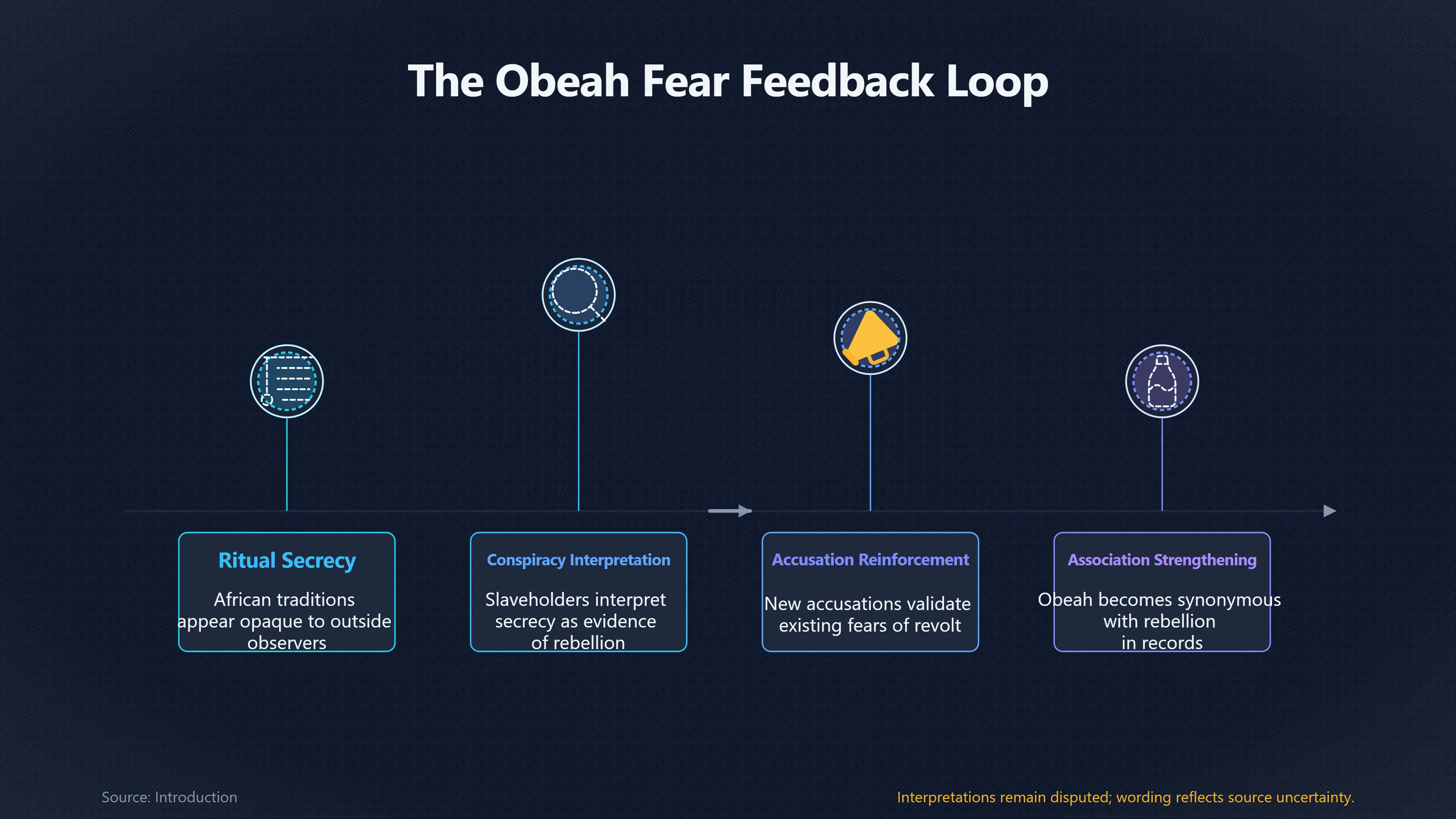
The resulting dynamic created a feedback loop:
- African rituals appeared secretive because outsiders rarely understood their meaning.
- Slaveholders interpreted secrecy as evidence of conspiracy, especially after rumours of revolt emerged.
- Each new accusation reinforced existing fears, encouraging investigators to look for additional ritual leaders.
- The association between obeah and rebellion became stronger, regardless of whether every alleged practitioner had any political role.
For this reason, historians generally avoid accepting colonial descriptions of obeah at face value. They examine how fear, racial prejudice and the pressures of a slave society shaped official interpretations alongside whatever genuine resistance existed.
Why colonial governments criminalised obeah
Antigua’s experience formed part of a broader pattern across the British Caribbean. Colonial governments increasingly associated obeah with resistance, disorder and challenges to imperial authority. Laws against obeah were presented as measures to preserve public order, but they also criminalised forms of African religious and healing practice that helped enslaved communities preserve cultural identity.
The first British Caribbean law specifically targeting obeah followed Jamaica’s Tacky’s Rebellion in 1760, where colonial authorities likewise believed ritual specialists had strengthened resistance. Similar ideas influenced later legislation throughout the region, including the Leeward Islands Obeah Act of 1904, which applied to Antigua and sought to prohibit what officials described as “pretended supernatural or occult practices”. The wording reflected colonial assumptions rather than any neutral description of African-derived religion.[Obeah Histories]obeahhistories.org1760 jamaica lawObeah HistoriesAn Act to Remedy the Evils arising from Irregular Assemblies of Slaves, Jamaica 1760 | Obeah Histories…
Modern scholarship therefore distinguishes between two related but separate historical realities. On one hand, some ritual leaders undoubtedly participated in resistance movements, just as clergy or spiritual figures have supported political struggles in many societies. On the other hand, colonial authorities expanded the meaning of obeah so broadly that healing, religious practice and political resistance became blurred together under a single criminal label.[History Workshop]historyworkshop.org.ukHistory Workshop The Racist History of Jamaica's Obeah Laws | History WorkshopHistory Workshop The Racist History of Jamaica's Obeah Laws | History Workshop
Lasting historical importance
The story of obeah in Antigua is not primarily about supernatural belief. It is about power, interpretation and fear. For enslaved people, African-derived ritual traditions could preserve identity, provide healing and reinforce mutual obligations in an oppressive society. For slaveholders, those same traditions appeared opaque, independent and potentially revolutionary.
This tension explains why obeah occupies such an important place in the history of Antigua’s 1736 conspiracy. It demonstrates how ritual authority could strengthen solidarity without necessarily being reducible to politics, while also showing how colonial fear transformed cultural difference into evidence of dangerous conspiracy. The result was not only the suppression of an alleged rebellion but also a long tradition of treating African spiritual practices as objects of legal control and public suspicion, a legacy that continued well beyond the end of slavery.[smithsonianmag.com]smithsonianmag.comantiguas disputed slave conspiracy of 1736 117569Smithsonian MagazineAntigua’s Disputed Slave Conspiracy of 1736January 2, 2013…
Amazon book picks
Further Reading
Books and field guides related to Why Did Obeah Frighten Antigua's Slaveholders?. Use these as the next step if you want deeper reading beyond the article.

A Brief History of the Caribbean
Supplies historical context for Antigua and Caribbean slavery.

Testing the Chains: Resistance to Slavery in the British West...
Examines resistance and plantation society across the British Caribbean.
The fear of French negroes
Explores how fear magnified perceived spiritual and political threats.
Endnotes
1.
Source: smithsonianmag.com
Title: antiguas disputed slave conspiracy of 1736 117569
Link:https://www.smithsonianmag.com/history/antiguas-disputed-slave-conspiracy-of-1736-117569/
Source snippet
Smithsonian MagazineAntigua’s Disputed Slave Conspiracy of 1736January 2, 2013...
Published: January 2, 2013
2.
Source: obeahhistories.org
Link:https://obeahhistories.org/
3.
Source: historyworkshop.org.uk
Title: History Workshop The Racist History of Jamaica’s [Obeah Laws]({{ ‘obeah-laws/’ | relative_url }}) | History Workshop
Link:https://www.historyworkshop.org.uk/empire-decolonisation/the-racist-history-of-jamaicas-obeah-laws/
4.
Source: obeahhistories.org
Title: 1760 jamaica law
Link:https://obeahhistories.org/1760-jamaica-law/
Source snippet
Obeah HistoriesAn Act to Remedy the Evils arising from Irregular Assemblies of Slaves, Jamaica 1760 | Obeah Histories...
5.
Source: obeahhistories.org
Title: 1904 leeward islands act
Link:https://obeahhistories.org/1904-leeward-islands-act/
Source snippet
Obeah HistoriesThe Obeah Act,1904 (Leeward Islands) | Obeah Histories...
6.
Source: obeahhistories.org
Title: Obeah Histories Legislation | Obeah Histories
Link:https://obeahhistories.org/law/
7.
Source: obeahhistories.org
Link:https://obeahhistories.org/grenada1825/
8.
Source: scholar.library.miami.edu
Link:https://scholar.library.miami.edu/slaves/Religion/religion.html
Additional References
9.
Source: handwiki.org
Title: Interrogations revealed that the conspirators enga
Link:https://handwiki.org/wiki/Religion%3AObeah
Source snippet
Religion:Obeah - HandWikiDecember 27, 2025 — ^{[91]} Meanwhile, in Antigua in 1736, an alleged slave conspiracy to attack Europeans was e...
Published: December 27, 2025
10.
Source: scholarship.miami.edu
Title: Powers of Imagination and Legal Regimes
Link:https://scholarship.miami.edu/esploro/outputs/journalArticle/Powers-of-Imagination-and-Legal-Regimes/991031660538402976
Source snippet
of Imagination and Legal Regimes against “Obeah” in the Late Eighteenth- and Early Nineteenth-Century British Caribbean - University of M...
11.
Source: degruyterbrill.com
Title: Archival Irruptions
Link:https://www.degruyterbrill.com/document/doi/10.1515/9781478094364/html?lang=en
Source snippet
August 22, 2025 — ARCHIVAL IRRUPTIONS Constructing Religion and Criminalizing Obeah in Eighteenth-Century Jamaica * Katharine Gerbner and...
Published: August 22, 2025
12.
Source: youtube.com
Title: History of [Antigua and Barbuda]({{ ‘antigua-and-barbuda/’ | relative_url }}): The Islands Britain Feared Would Rise
Link:https://www.youtube.com/watch?v=cWRXd8zOEOI
Source snippet
Guard Ring & Obeah: Beliefs That Still Shape Jamaica Today...
13.
Source: youtube.com
Title: Prince Klass & Kingdom of Antigua & Barbuda
Link:https://www.youtube.com/watch?v=dGPDLq4eQTw
Source snippet
History of Antigua and Barbuda: The Islands Britain Feared Would Rise...
14.
Source: academic.oup.com
Link:https://academic.oup.com/chicago-scholarship-online/book/38106
Source snippet
with Power: Obeah and the Remaking of Religion in Trinidad | Chicago Scholarship Online | Oxford AcademicJuly 7, 2020 — EXPERIMENTS WITH...
Published: July 7, 2020
15.
Source: jstor.org
Link:https://www.jstor.org/stable/j.ctv120qs9h
16.
Source: researchgate.net
Link:https://www.researchgate.net/publication/261731802_The_Bad_Business_of_Obeah_Power_Authority_and_the_Politics_of_Slave_Culture_in_the_British_Caribbean
17.
Source: slaveryandfreedomlaws.lib.unb.ca
Link:https://slaveryandfreedomlaws.lib.unb.ca/laws/antigua-1669
18.
Source: slaveryandfreedomlaws.lib.unb.ca
Link:https://slaveryandfreedomlaws.lib.unb.ca/laws/antigua
Topic Tree