Within Slovakia
How Slovak Witch Accusations Became Death Sentences
Neighbour disputes became deadly when courts accepted magic as a crime and transformed suspicion into legal proof.
On this page
- From neighbourhood quarrels to witchcraft claims
- Torture, confession and the search for accomplices
- Kežmarok and the late collapse of legal persecution
Page outline Jump by section
Introduction
The witch trials that took place in what is now Slovakia were not driven by sudden outbreaks of irrational panic alone. They became lethal because courts accepted the idea that harmful magic was a genuine crime and developed legal procedures that transformed rumour, neighbourly conflict and supernatural belief into criminal evidence. In the towns and estates of early modern Upper Hungary, local judges treated accusations of witchcraft as matters of law, using torture, compelled confessions and testimony from other suspects to build cases that often ended in execution. The history is therefore not simply about popular fear, but about how legal institutions gave that fear deadly force. Although beliefs in witches long outlived the trials themselves, changing standards of evidence and intervention from the Habsburg state eventually dismantled the judicial machinery that had sustained persecution.[OUP Academic]academic.oup.comOUP AcademicWitch-Hunting in Early Modern Hungary | The Oxford Handbook of Witchcraft in Early Modern Europe and Colonial America | Oxfor…
From neighbourhood quarrels to witchcraft claims
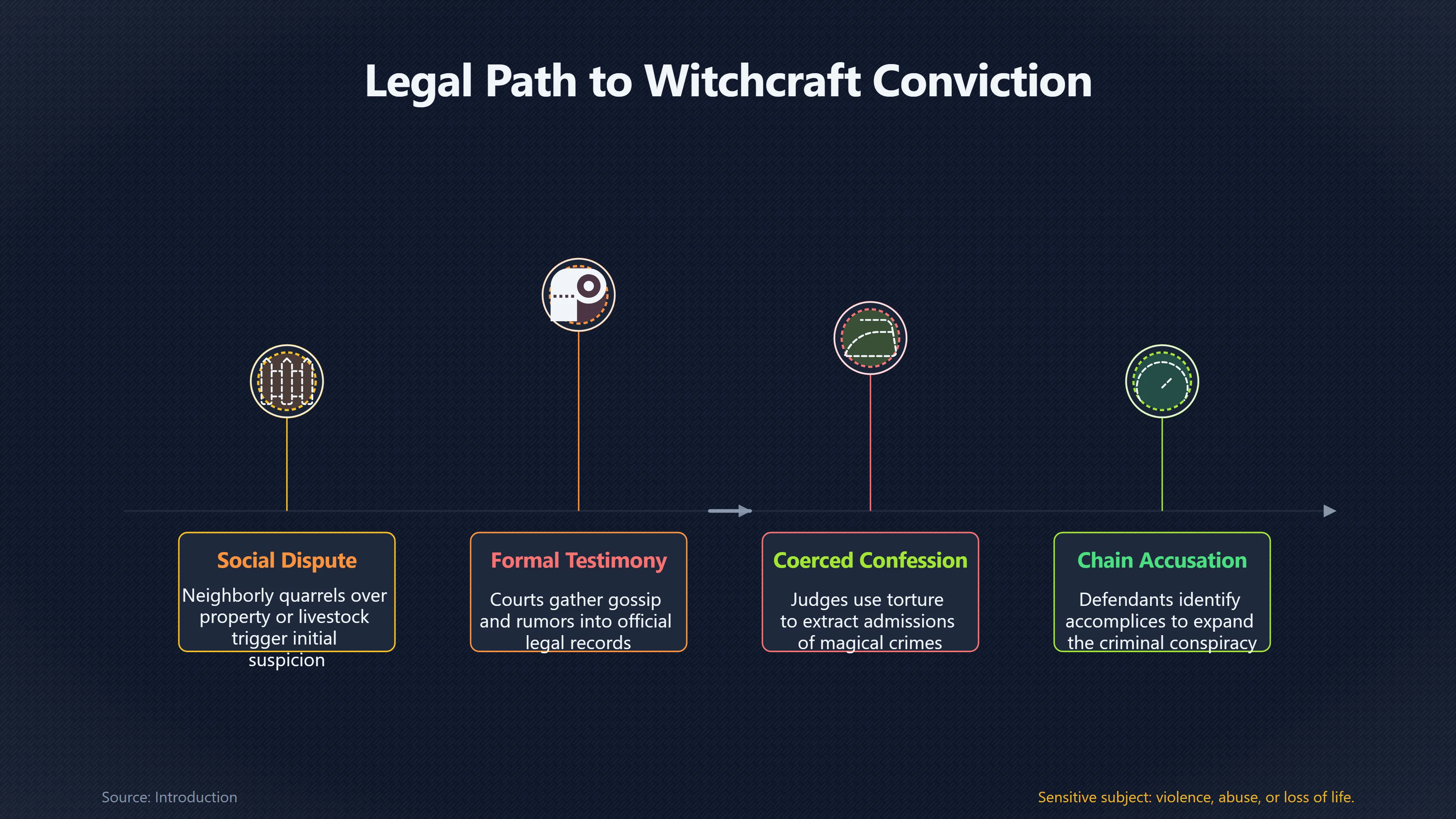
Across the territory of present-day Slovakia, then part of the Kingdom of Hungary, most witchcraft prosecutions began with ordinary disputes rather than spectacular claims of satanic conspiracy. Illnesses, livestock losses, failed harvests or the death of a child might be linked retrospectively to an argument with a neighbour. Someone who had offered herbal remedies, quarrelled over property, refused charity or acquired a reputation for unusual knowledge could become the obvious suspect when misfortune demanded an explanation. Historians studying Hungarian witch trials repeatedly find that accusations emerged from local social tensions before they entered the courtroom.[OUP Academic]academic.oup.comOUP AcademicWitch-Hunting in Early Modern Hungary | The Oxford Handbook of Witchcraft in Early Modern Europe and Colonial America | Oxfor…
The courts then reshaped these personal conflicts into criminal cases. Testimony that might otherwise have remained gossip was gathered formally, while rumours accumulated over many years could be presented together as evidence of a pattern of malicious behaviour. A neighbour’s recollection of an angry curse, unexplained sickness after an argument, or stories about strange nocturnal behaviour became mutually reinforcing once recorded in legal proceedings.
The people most vulnerable were often those who already occupied uncertain positions within their communities. Older women, widows and folk healers appeared frequently among the accused because they worked in areas where success and failure were difficult to explain, such as childbirth, illness and animal care. Men also faced prosecution, particularly if associated with folk magic, divination or reputed supernatural powers. The pattern reflected both gender inequality and the broader tendency of courts to criminalise local suspicions rather than dismiss them as unprovable.
Torture, confession and the search for accomplices
The defining feature of these prosecutions was not belief in witches alone but the legal procedures used to establish guilt. Urban courts and feudal jurisdictions across the Kingdom of Hungary accepted torture as a legitimate means of obtaining confessions in serious criminal cases, including witchcraft. Once torture was authorised, denial itself could be interpreted as evidence that stronger pressure was needed.[Wikipedia]WikipediaWitch trials in HungaryWitch trials in Hungary
Confessions extracted under torture rarely ended with a single admission. Judges typically wanted defendants to identify:
- other supposed witches;
- meetings or gatherings of witches;
- harmful magical acts against neighbours or livestock;
- pacts with the Devil or other supernatural explanations accepted within contemporary demonology.
This created a self-reinforcing process. Every new name generated another investigation, while each confession appeared to confirm the existence of a wider conspiracy. Modern historians stress that these expanding chains of accusation reflected judicial expectations rather than reliable evidence of organised witchcraft.[OUP Academic]academic.oup.comOUP AcademicWitch-Hunting in Early Modern Hungary | The Oxford Handbook of Witchcraft in Early Modern Europe and Colonial America | Oxfor…
Procedures such as the ordeal by water also appeared in parts of Upper Hungary, although their use varied considerably by region and period. By the eighteenth century they had increasingly attracted criticism from educated officials, yet some local authorities continued to rely upon older practices despite growing scepticism from central government.[ResearchGate]researchgate.netIn Gábor KLANICZAY - Éva PÓCS: Demons, Spirits, Witches. Vol. III. Witchcraft Mythologies and Persecutions. Central European University P…
The result was a legal system in which supernatural assumptions shaped the interpretation of ordinary events. Dead animals, failed crops or recurring illness were not treated as unexplained misfortunes but as possible proof that hidden malice had been at work. Courts did not merely reflect popular fears; they organised and legitimised them.

Why local courts proved more dangerous than popular belief
Many people believed in witchcraft without anyone being prosecuted. The crucial difference came when magistrates, town councils or estate courts accepted those beliefs as legally actionable.
Early modern Hungarian law distinguished between harmful magic and mere folklore, but local courts possessed considerable discretion in interpreting accusations. City courts handled prosecutions in towns, while noble estates exercised jurisdiction over much of the countryside. This fragmented legal landscape meant that outcomes depended heavily upon local officials, community pressures and regional traditions.[OUP Academic]academic.oup.comOUP AcademicHungary: The Accusations and the Universe of Popular Magic | Early Modern European Witchcraft: Centres and Peripheries | Oxfo…
Legal records reveal several mechanisms that turned suspicion into conviction:
- cumulative witness testimony that treated rumour as corroboration;
- reliance on confessions obtained under coercion;
- assumptions that witches acted collectively, encouraging accusations against additional suspects;
- limited opportunities for defendants to challenge supernatural claims with empirical evidence.
From a modern perspective these procedures violated basic standards of proof. Yet within the intellectual framework of the seventeenth and early eighteenth centuries they appeared consistent with accepted ideas about invisible spiritual dangers and the responsibility of magistrates to protect their communities.
Kežmarok and the late collapse of legal persecution
The prosecution at Kežmarok in 1777 illustrates both the persistence of witch beliefs and the decline of judicial support for them. The execution is widely described as the last witchcraft execution in the Kingdom of Hungary and is sometimes presented as the last in Central Europe, although historians note that such regional “last” claims depend on how different jurisdictions are compared. More important than the label is what the case reveals about changing law.[Wikipedia]WikipediaWitch trials in HungaryWitch trials in Hungary
By the middle of the eighteenth century the Habsburg government had become increasingly sceptical of witchcraft prosecutions. The physician Gerard van Swieten persuaded Empress Maria Theresa that witchcraft accusations rested on superstition rather than demonstrable criminal acts. Beginning in the 1750s, central authorities required closer review of convictions, overturned some local sentences and progressively restricted prosecutions. In 1768 the death penalty for witchcraft was abolished throughout the Habsburg lands.[mtak.hu]real.mtak.huAcademy's Library Repository1Hungary (Published in Encyclopedia of Witchcraft…
The Kežmarok execution therefore occurred after legal policy had already shifted. Rather than representing the normal operation of eighteenth-century justice, it demonstrated how local authorities and popular beliefs could lag behind reforms imposed from Vienna. The case highlights the uneven pace of legal change: governments could alter statutes more quickly than communities abandoned long-held assumptions about supernatural harm.
What the Slovak witch trials reveal today
The history of witch trials in present-day Slovakia is less a story of uncontrollable mass hysteria than of institutions giving official authority to fear. Neighbours generated suspicions, but courts determined whether those suspicions became imprisonment, torture or execution.
For historians, the prosecutions provide an important reminder that legal systems are shaped by the assumptions of their age. Once judges accepted that hidden magical crimes existed, ordinary standards of evidence became secondary to the search for confirmation. Confessions extracted under torture appeared to validate previous accusations, while every new suspect reinforced belief in an expanding conspiracy.
The eventual decline of the trials did not occur because belief in witchcraft suddenly disappeared. Instead, higher authorities increasingly demanded stronger evidence, questioned coerced confessions and restricted the power of local courts. In Upper Hungary, including the lands of modern Slovakia, it was this transformation in legal culture—rather than a simple change in popular belief—that finally made it much harder for fear to become a death sentence.[oup.com]academic.oup.comOUP AcademicWitch-Hunting in Early Modern Hungary | The Oxford Handbook of Witchcraft in Early Modern Europe and Colonial America | Oxfor…
Amazon book picks
Further Reading
Books and field guides related to How Slovak Witch Accusations Became Death Sentences. Use these as the next step if you want deeper reading beyond the article.
Extraordinary Popular Delusions and the Madness of Crowds
Rating: 4.0/5 from 5 Google Books ratings
Explores recurring patterns of collective belief.
The witch-hunt in early modern Europe
Authoritative overview of European witch prosecutions.


Endnotes
1.
Source: academic.oup.com
Link:https://academic.oup.com/edited-volume/34335/chapter-abstract/291373333
Source snippet
OUP AcademicWitch-Hunting in Early Modern Hungary | The Oxford Handbook of Witchcraft in Early Modern Europe and Colonial America | Oxfor...
2.
Source: academic.oup.com
Link:https://academic.oup.com/book/47469/chapter/422428769
Source snippet
OUP AcademicHungary: The Accusations and the Universe of Popular Magic | Early Modern European Witchcraft: Centres and Peripheries | Oxfo...
3.
Source: Wikipedia
Title: Witch trials in Hungary
Link:https://en.wikipedia.org/wiki/Witch_trials_in_Hungary
4.
Source: researchgate.net
Link:https://www.researchgate.net/publication/348390712River_Ordeal-Trial_by_Water-Swimming_of_Witches_Procedures_of_Ordeal_in_Witch_Trials_In_Gabor_KLANICZAY-_Eva_POCS_Demons_Spirits_Witches_Vol_III_Witchcraft_Mythologies_and_Persecutions_Central_Europe
Source snippet
In Gábor KLANICZAY - Éva PÓCS: Demons, Spirits, Witches. Vol. III. Witchcraft Mythologies and Persecutions. Central European University P...
5.
Source: researchgate.net
Link:https://www.researchgate.net/publication/312792806_The_decline_of_witches_and_the_rise_of_vampires_under_the_eighteenth-century_Habsburg_Monarchy
6.
Source: academic.oup.com
Link:https://academic.oup.com/book/47469/chapter-abstract/422428769
7.
Source: youtube.com
Title: The History of Witch Trials
Link:https://www.youtube.com/watch?v=wa2Sii94qK4
Source snippet
A History of Witchcraft and Magic in Europe Part 7: The Early Modern Witch Trials...
8.
Source: real.mtak.hu
Title: Academy’s Library Repository1
Link:https://real.mtak.hu/78777/1/SzKristof_WitchHuntinginHungaryABCClio2004_u.pdf
Source snippet
Hungary (Published in Encyclopedia of Witchcraft...
Additional References
9.
Source: research.aston.ac.uk
Link:https://research.aston.ac.uk/en/publications/discursive-reconstruction-of-witchcraft-as-a-community-and-witch-/
Source snippet
(re)construction of “witchcraft” as a community and “witch” as an identity in the eighteenth-century Hungarian witchcraft trial records...
10.
Source: projustice.sk
Title: Trestanie čarodejníc podľa najstarších uhorských dekrétov | Projustice
Link:https://www.projustice.sk/pravne-dejiny/trestanie-carodejnic-podla-najstarsich-uhorskych-dekretov
Source snippet
11. 2022 - 08:36 Články Právne dejiny The punishment of witches according to the oldest Hungarian decrees A...
11.
Source: youtube.com
Link:https://www.youtube.com/watch?v=plN6onTiJpw
Source snippet
The Secret History of Witches | Witch Trials and Fear in History...
12.
Source: youtube.com
Title: The Secret History of Witches | Witch Trials and Fear in History
Link:https://www.youtube.com/watch?v=HvNHzeM3EjU
Source snippet
Witches: Truth Behind the Trials MEGA Episode | National Geographic...
13.
Source: youtube.com
Title: Witches: Truth Behind the Trials MEGA Episode | National Geographic
Link:https://www.youtube.com/watch?v=g2vCaxHllg0
Source snippet
What REALLY happened to women accused of witchcraft?...
14.
Source: link.springer.com
Link:https://link.springer.com/book/10.1007/978-3-319-54756-5
Source snippet
and Demonology in Hungary and Transylvania | Springer Nature LinkNovember 29, 2017 — WITCHCRAFT AND DEMONOLOGY IN HUNGARY AND TRANSYLVANI...
Published: November 29, 2017
15.
Source: projustice.sk
Link:https://www.projustice.sk/pravne-dejiny
16.
Source: semanticscholar.org
Link:https://www.semanticscholar.org/paper/Decline-of-Witches-and-Rise-of-Vampires-in-18th-Klaniczay/bb1c8135d616abdfe4176c00b8b9c127e8f53d42
17.
Source: dokumen.pub
Link:https://dokumen.pub/early-modern-european-witchcraft-centres-and-peripheries-clarendon-paperbacks-0198203888-9780198203889.html
18.
Source: youtube.com
Title: What REALLY happened to women accused of witchcraft?
Link:https://www.youtube.com/watch?v=DDP5j7B4yXs
Topic Tree