Within Guinea Bissau
Was Kyangyang a Cult or Religious Reform?
The Kyangyang movement challenged elder authority and shows how religious reform can be mistaken for irrational mass excitement.
On this page
- How the movement began among Balanta communities
- Why young followers challenged elders and sorcery
- How scholars distinguish reform from cult panic
Page outline Jump by section
Introduction
Kyangyang was not simply a religious craze or an isolated prophetic cult. It was a far-reaching reform movement that emerged among the Balanta people of Guinea-Bissau in 1984 and challenged long-established ideas about authority, healing, witchcraft and religious practice. Led initially by a woman believed to receive messages from the supreme deity, the movement attracted many young women and men who wanted moral renewal and freedom from what they saw as the burdens of sorcery, ancestor rituals and elder control. To outsiders, and especially to some established leaders, the speed of its growth created fears of dangerous religious upheaval. Modern scholarship, however, generally interprets Kyangyang as a complex movement of religious innovation and social reform rather than as an episode of irrational mass excitement or a destructive “cult”.[Wiley Online Library]onlinelibrary.wiley.comWiley Online LibraryThe shade of religion: Kyangyang and the works of prophetic imagination in Guinea‐Bissau - Sarró - 2020 - Social Anth…
Was Kyangyang a Cult or Religious Reform?
The question reflects the anxieties the movement generated rather than an agreed historical judgement. During the 1980s, Kyangyang spread rapidly through Balanta communities in southern Guinea-Bissau. Such rapid expansion naturally provoked rumours and suspicion. Established ritual specialists, village elders and some outside observers worried that young followers were abandoning accepted customs and upsetting the social order.
Yet anthropologists who have studied the movement over many years caution against reducing it to a “cult”. They argue that Kyangyang should instead be understood as a prophetic reform movement that reorganised existing Balanta beliefs while also borrowing visible practices from Islam and Christianity, such as collective prayer, white clothing and new forms of public worship. Rather than replacing Balanta identity, it attempted to redefine it around direct devotion to the high god, often called Nhaala, while rejecting practices viewed as spiritually corrupt.[wiley.com]onlinelibrary.wiley.comWiley Online LibraryThe shade of religion: Kyangyang and the works of prophetic imagination in Guinea‐Bissau - Sarró - 2020 - Social Anth…
The distinction matters because labels such as “cult” often imply manipulation, isolation or coercive control. The available evidence instead points towards a broad social movement rooted in local religious traditions and responding to changing political and economic circumstances.[Lund University]portal.research.lu.send University The Birth of Religion among the Balanta of Guinea-Bissaund UniversityThe Birth of Religion among the Balanta of Guinea-Bissau - Lund University…
How the movement began among Balanta communities
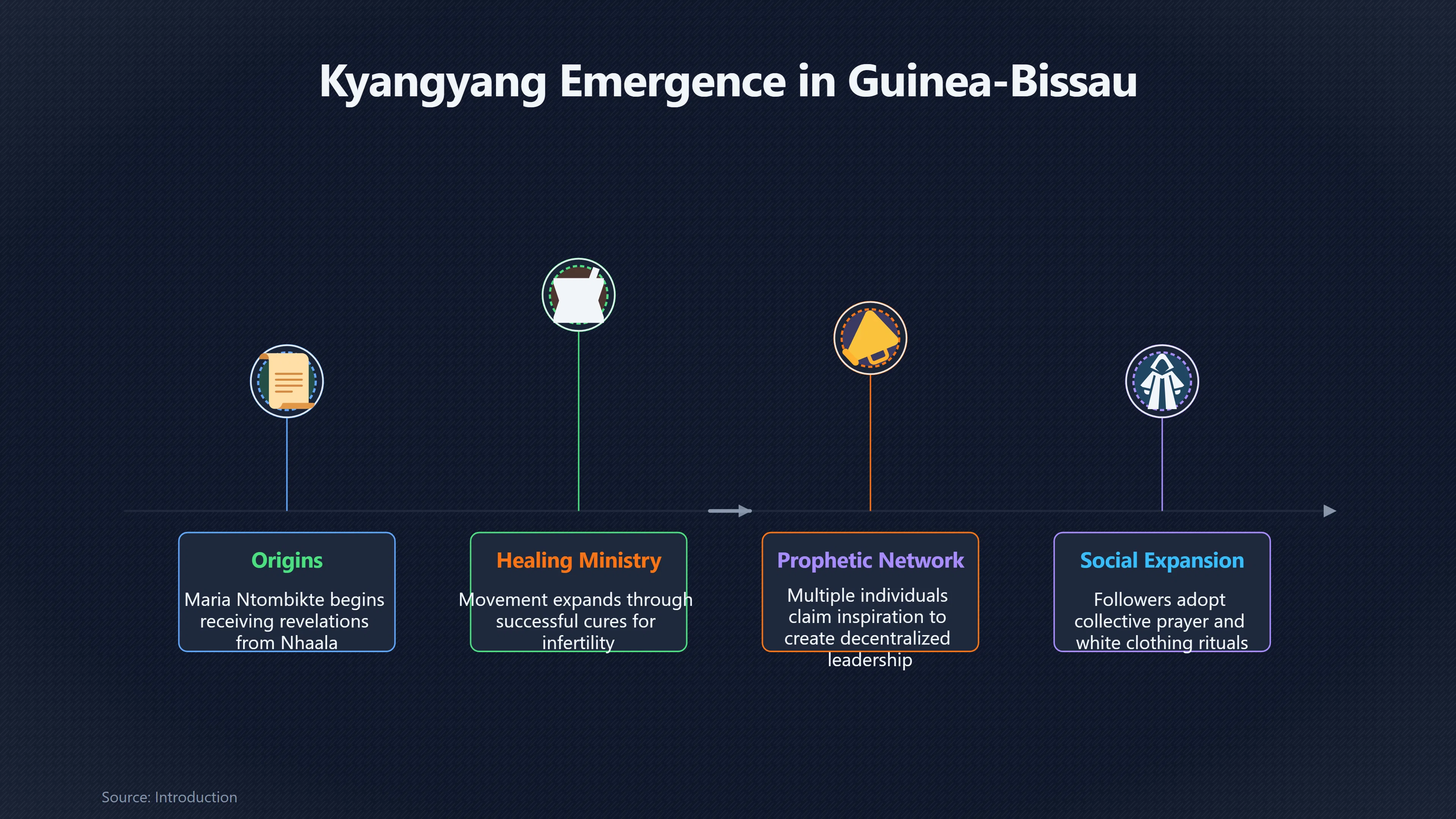
According to the best-documented accounts, Kyangyang emerged in 1984 when a Balanta woman, widely identified in historical studies as Maria Ntombikte, was believed to receive revelations from Nhaala. Initially she was sought out for healing, particularly by women suffering infertility or the loss of children. Reports of successful cures and prophetic messages spread quickly through Balanta regions.
What began as a healing ministry soon expanded into a much broader programme of moral renewal. Other men and women also claimed prophetic inspiration, creating an expanding network rather than a movement centred permanently on a single charismatic leader. Followers became known as Kyangyang—often translated as “the shadows” or “the shades”—and adopted distinctive forms of worship and ritual intended to prepare believers for a transformed society.[wiley.com]onlinelibrary.wiley.comWiley Online LibraryThe shade of religion: Kyangyang and the works of prophetic imagination in Guinea‐Bissau - Sarró - 2020 - Social Anth…
Scholars emphasise that the movement did not emerge in isolation. Guinea-Bissau had recently experienced colonial rule, a liberation war and independence. Balanta society itself was undergoing economic and political change. Kyangyang offered an explanation for these disruptions while promising both spiritual purification and social renewal.[Lund University]portal.research.lu.send University The Birth of Religion among the Balanta of Guinea-Bissaund UniversityThe Birth of Religion among the Balanta of Guinea-Bissau - Lund University…
Why young followers challenged elders and sorcery
Much of the alarm surrounding Kyangyang came from its challenge to established authority rather than from unusual religious beliefs alone.
Balanta society traditionally placed significant authority in senior generations and in specialists associated with ancestor rituals and protection against sorcery. Kyangyang questioned both.
Its followers argued that:
- direct devotion to the supreme god should replace dependence on numerous ritual intermediaries;
- fear of sorcery had become socially destructive;
- costly ritual obligations should be abandoned;
- younger people could receive divine inspiration alongside, or even instead of, recognised elders;
- moral reform was more important than inherited ritual status.[Lund University]portal.research.lu.send University The Birth of Religion among the Balanta of Guinea-Bissaund UniversityThe Birth of Religion among the Balanta of Guinea-Bissau - Lund University…
These ideas particularly appealed to younger generations and many women, who found new opportunities for religious leadership inside the movement. That redistribution of spiritual authority inevitably produced conflict with established community structures.
Importantly, opposition to sorcery should not be confused with encouraging witch hunts. Kyangyang sought to purify society from what followers regarded as spiritually harmful practices. While accusations of sorcery formed part of Balanta social life, the movement’s principal aim was religious and moral reform rather than organised persecution.[Lund University]portal.research.lu.send University The Birth of Religion among the Balanta of Guinea-Bissaund UniversityThe Birth of Religion among the Balanta of Guinea-Bissau - Lund University…

Why people feared religious upheaval
The movement spread remarkably quickly across Balanta areas, creating an impression that familiar institutions might collapse almost overnight.
Several features encouraged this perception:
- large public gatherings and collective prayer;
- visible rejection of established ritual practices;
- prophetic messages announcing profound change;
- increasing participation by young adults;
- the appearance of numerous prophets rather than one central authority.[Wiley Online Library]onlinelibrary.wiley.comWiley Online LibraryThe shade of religion: Kyangyang and the works of prophetic imagination in Guinea‐Bissau - Sarró - 2020 - Social Anth…
To critics, this looked like a dangerous social revolution disguised as religion. To supporters, it represented necessary purification and a return to the true will of God.
Anthropologists note that fears of “religious upheaval” often reflected broader anxieties about changing generations, political uncertainty and weakening traditional authority. The rapid visibility of the movement made it appear more radical than many of its everyday practices actually were.[Wiley Online Library]onlinelibrary.wiley.comWiley Online LibraryThe shade of religion: Kyangyang and the works of prophetic imagination in Guinea‐Bissau - Sarró - 2020 - Social Anth…
How scholars distinguish reform from cult panic
Recent research has significantly changed how Kyangyang is interpreted.
Earlier descriptions sometimes portrayed the movement primarily as an exotic healing cult or as an outbreak of religious enthusiasm. More recent scholarship argues that this misses its intellectual and theological creativity.
Researchers such as Ramon Sarró and Marina Temudo argue that Kyangyang should be understood as a prophetic religion that creatively combined elements familiar from Islam and Christianity with distinctly Balanta understandings of ancestors, revelation and divine action. Rather than simply copying neighbouring religions, followers used familiar forms of prayer and ritual to imagine a renewed Balanta future.[Wiley Online Library]onlinelibrary.wiley.comWiley Online LibraryThe shade of religion: Kyangyang and the works of prophetic imagination in Guinea‐Bissau - Sarró - 2020 - Social Anth…
Similarly, Inger Callewaert’s long-term research describes the movement as a profound transformation in Balanta religious life. She argues that it represented the emergence of religion as a more distinct sphere of social life while still drawing heavily upon older traditions instead of abandoning them completely.[Lund University]portal.research.lu.send University The Birth of Religion among the Balanta of Guinea-Bissaund UniversityThe Birth of Religion among the Balanta of Guinea-Bissau - Lund University…
This perspective helps explain why historians generally avoid treating Kyangyang as an example of mass hysteria. Its followers maintained coherent religious beliefs, organised collective practices and pursued identifiable moral goals over many years rather than displaying short-lived, contagious irrational behaviour.
Why Kyangyang remains culturally important
Kyangyang occupies an unusual place in the religious history of Guinea-Bissau because it illustrates how rapid religious innovation can generate widespread fear without fitting neatly into categories such as “cult”, “panic” or “mass hysteria”.
The movement challenged existing social hierarchies, gave greater prominence to young people and women, reinterpreted traditional beliefs and created new forms of worship that crossed familiar boundaries between indigenous religion, Islam and Christianity. These changes naturally provoked controversy, yet they also demonstrated the capacity of Balanta communities to reshape their own religious traditions rather than merely adopting outside models.[wiley.com]onlinelibrary.wiley.comWiley Online LibraryThe shade of religion: Kyangyang and the works of prophetic imagination in Guinea‐Bissau - Sarró - 2020 - Social Anth…
Within the broader history of collective belief in Guinea-Bissau, Kyangyang therefore stands as an important contrast to episodes such as witchcraft panics. Instead of a community united by fear of hidden enemies, it was primarily a movement seeking moral renewal whose rapid success led many observers to fear that established religious and social life was being fundamentally transformed.[Wiley Online Library]onlinelibrary.wiley.comWiley Online LibraryThe shade of religion: Kyangyang and the works of prophetic imagination in Guinea‐Bissau - Sarró - 2020 - Social Anth…
Amazon book picks
Further Reading
Books and field guides related to Was Kyangyang a Cult or Religious Reform?. Use these as the next step if you want deeper reading beyond the article.
African Religions A Very Short Introduction
Explains indigenous belief systems often misunderstood by colonial authorities.

The fate of Africa
Places Guinea-Bissau's religious developments in historical context.

Witchcraft, Violence, and Democracy in South Africa
First published 2005. Subjects: Witchcraft, africa, Witchcraft, Political aspects.
African Religions: A Very Short Introduction
Excellent introduction to African religious movements and reform.
Endnotes
1.
Source: onlinelibrary.wiley.com
Link:https://onlinelibrary.wiley.com/doi/10.1111/1469-8676.12768
Source snippet
Wiley Online LibraryThe shade of religion: Kyangyang and the works of prophetic imagination in Guinea‐Bissau - Sarró - 2020 - Social Anth...
2.
Source: researchgate.net
Link:https://www.researchgate.net/publication/236789810_From_the_Margins_of_the_State_to_the_Presidential_Palace_The_Balanta_Case_in_Guinea-Bissau
3.
Source: balanta.org
Title: The war had also eroded social organizatio
Link:https://www.balanta.org/history/brief-notes-on-balanta-history-after-guinea-bissau-independence
Source snippet
BRIEF NOTES ON BALANTA HISTORY BEFORE AND AFTER GUINEA BISSAU INDEPENDENCE — @September 2, 2021 — AMILCAR CABRAL TRIED TO FIGHT WHAT HE C...
Published: September 2, 2021
4.
Source: researchgate.net
Link:https://www.researchgate.net/publication/343525006_The_shade_of_religion_Kyangyang_and_the_works_of_prophetic_imagination_in_Guinea-Bissau
5.
Source: portal.research.lu.se
Title: nd University The Birth of Religion among the Balanta of Guinea-Bissau
Link:https://portal.research.lu.se/en/publications/the-birth-of-religion-among-the-balanta-of-guinea-bissau/
Source snippet
nd UniversityThe Birth of Religion among the Balanta of Guinea-Bissau - Lund University...
6.
Source: lu.se
Link:https://www.lu.se/publikation/620e8935-476f-4dd5-8b9d-18bcde08455f
Source snippet
nd UniversityThe Birth of Religion among the Balanta of Guinea-Bissau | Lunds universitet...
7.
Source: boap.uib.no
Title: Bergen Open Access Publishing Chasing Shadows | Journal of Anthropological Films
Link:https://boap.uib.no/index.php/jaf/article/view/3306
Source snippet
"Shadows | Journal of Anthropological FilmsOctober 23, 2021 — CHASING SHADOWS AUTHORS * Roger Canals University of Barcelona [http://orcid..."](http://orcid...")...
Published: October 23, 2021
8.
Source: lunduniversity.lu.se
Title: se The Birth of Religion among the Balanta of Guinea-Bissau | Lund University
Link:https://www.lunduniversity.lu.se/publication/620e8935-476f-4dd5-8b9d-18bcde08455f
9.
Source: lunduniversity.lu.se
Title: se The Birth of Religion among the Balanta of Guinea-Bissau | Lund University
Link:https://www.lunduniversity.lu.se/lup/publication/620e8935-476f-4dd5-8b9d-18bcde08455f
Additional References
10.
Source: ora.ox.ac.uk
Link:https://ora.ox.ac.uk/objects/uuid%3A4af7ea19-6501-4676-b648-e21a432cc922
Source snippet
shade of religion: Kyangyang and the works of prophetic imagination in Guinea‐Bissau - ORA - Oxford University Research ArchiveAugust 7...
11.
Source: researchportal.ulisboa.pt
Link:https://researchportal.ulisboa.pt/en/publications/the-shade-of-religion-kyangyang-and-the-works-of-prophetic-imagin/
Source snippet
Universidade de LisboaThe shade of religion: Kyangyang and the works of prophetic imagination in Guinea-Bissau - University of Lisbon...
12.
Source: youtube.com
Title: Guinea Bissau: A Journey Through Its Diverse Cultures | African Scribe
Link:https://www.youtube.com/watch?v=oDtBDTtjC1E
Source snippet
The Inheritance of Spiritual Power Among the Balanta People...
13.
Source: youtube.com
Title: The Inheritance of Spiritual Power Among the Balanta People
Link:https://www.youtube.com/watch?v=k0WQyL-cGT8
Source snippet
Contesting World Christianity: Neotraditional Resurgences in Africa...
14.
Source: youtube.com
Title: Contesting World Christianity: Neotraditional Resurgences in Africa
Link:https://www.youtube.com/watch?v=YjfERkyq1RQ
Source snippet
BALANTA LANGUAGE - Lesson #7 (Spirituality)...
16.
Source: lup.lub.lu.se
Link:https://lup.lub.lu.se/search/publication/19530
17.
Source: ics.ulisboa.pt
Link:https://www.ics.ulisboa.pt/en/projeto/prophetess-and-rice-farmer-innovations-religion-agriculture-and-gender-guinea-bissau
18.
Source: youtube.com
Title: BALANTA LANGUAGE
Link:https://www.youtube.com/watch?v=gnv0JeOQMaI
Source snippet
A History Of The Balanta People...
19.
Source: pubmed.ncbi.nlm.nih.gov
Link:https://pubmed.ncbi.nlm.nih.gov/20422270/
Topic Tree