Within Bangladesh Panics
Why Did Illness Sweep Through Bangladesh's Schools?
Bangladesh's school outbreaks show how genuine symptoms can spread through fear, observation and shared expectations.
On this page
- The nationwide outbreaks of 2007
- How symptoms spread without a detected poison
- The 2010 school biscuit scare
Page outline Jump by section
Introduction
Bangladesh has experienced several well-documented episodes in which large numbers of schoolchildren suddenly developed headaches, fainting, dizziness, nausea, breathing difficulties or stomach pain without investigators finding a shared poison, infectious disease or other environmental hazard. These events are important because they show how genuine physical symptoms can spread through observation, fear and shared expectations within closely connected groups. Rather than indicating that pupils were pretending or inventing illness, the strongest evidence points towards mass psychogenic illness (also called mass sociogenic illness): a recognised phenomenon in which psychological stress is expressed through real physical symptoms that rapidly spread through social interaction.[Bangladesh Journals Online]banglajol.infoBangladesh Journals OnlineMass Psychogenic Illness among Learners at Jaforabad High School, in Hathazari, Chittagong, Bangladesh | Journa…
Bangladesh’s school illness waves are especially notable because they combined medical uncertainty with intense public anxiety. Parents, teachers, health officials and journalists all had to decide quickly whether children had been poisoned, infected or exposed to dangerous chemicals. Careful investigations repeatedly found that rumours, observation of other sick pupils and community fears often explained the pattern of spread better than any toxic exposure.[PubMed]pubmed.ncbi.nlm.nih.govOutbreak of mass sociogenic illness in a school feeding program in northwest Bangladesh, 2010 - PubMed…
The nationwide outbreaks of 2007
During mid-2007, clusters of unexplained illness were reported from schools in several parts of Bangladesh. Pupils suddenly complained of symptoms including headaches, dizziness, nausea, weakness, tingling sensations, breathing difficulties and occasional loss of consciousness. The episodes disrupted lessons, overwhelmed local health facilities and generated widespread concern that schools might have been exposed to an unknown hazard. Contemporary reporting described multiple outbreaks occurring within a relatively short period, making the events appear to spread from district to district.[Bangladesh Journals Online]banglajol.infoBangladesh Journals OnlineMass Psychogenic Illness among Learners at Jaforabad High School, in Hathazari, Chittagong, Bangladesh | Journa…
One of the best-investigated incidents occurred at Jaforabad High School in Hathazari, Chattogram. According to the investigation, the episode began when one student reported feeling feverish before rapidly developing headache, nausea and vertigo. Within an hour, fourteen more pupils from different classes reported remarkably similar symptoms. Medical examinations, environmental inspections and laboratory testing failed to identify poisoning or another organic cause.[Bangladesh Journals Online]banglajol.infoBangladesh Journals OnlineMass Psychogenic Illness among Learners at Jaforabad High School, in Hathazari, Chittagong, Bangladesh | Journa…
Researchers found several features typical of mass psychogenic illness:
- symptoms appeared rapidly after an initial visible case;
- affected pupils were scattered across different classrooms rather than sharing a single exposure;
- laboratory tests found no evidence of disease or toxic contamination;
- pupils who had seen another student become ill or had heard about classmates’ symptoms were significantly more likely to report becoming ill themselves;
- girls were affected more frequently than boys, a pattern seen in many school outbreaks internationally.[Bangladesh Journals Online]banglajol.infoBangladesh Journals OnlineMass Psychogenic Illness among Learners at Jaforabad High School, in Hathazari, Chittagong, Bangladesh | Journa…
These findings helped distinguish the events from poisoning or infectious disease while reinforcing that the symptoms themselves were genuine.
How symptoms spread without a detected poison
Mass psychogenic illness does not mean that people imagine symptoms or consciously imitate them. Stress, anxiety and expectation can produce real physiological effects including rapid breathing, dizziness, trembling, stomach discomfort, chest tightness and fainting.
Schools provide conditions that can unintentionally amplify these reactions. Pupils spend long periods together, closely observe one another and often respond collectively to unexpected events. When one student suddenly collapses or complains of severe illness, classmates naturally become highly alert to their own bodily sensations. Minor feelings that might normally pass unnoticed can instead be interpreted as signs that the same mysterious illness has begun.
The Bangladeshi investigations found that observation and communication played a central role. Seeing another child become ill or hearing that classmates were affected significantly increased the likelihood of reporting similar symptoms. This pattern is inconsistent with most forms of poisoning, which normally follow shared exposure rather than social contact.[Bangladesh Journals Online]banglajol.infoBangladesh Journals OnlineMass Psychogenic Illness among Learners at Jaforabad High School, in Hathazari, Chittagong, Bangladesh | Journa…
Researchers also note broader social pressures that may have increased vulnerability. Adolescents often experience academic stress, social expectations and limited opportunities to discuss emotional distress openly. Heat, crowded classrooms and concern about unfamiliar illnesses may further increase anxiety, allowing symptoms to spread rapidly once an outbreak appears to have begun.[PubMed]pubmed.ncbi.nlm.nih.govOutbreak of mass sociogenic illness in a school feeding program in northwest Bangladesh, 2010 - PubMed…
For these reasons, many specialists prefer the term mass psychogenic illness over the older expression mass hysteria, which can wrongly suggest exaggeration or irrationality and has historically carried gendered stereotypes.
The 2010 school-biscuit scare
A second major episode occurred in October 2010 during Bangladesh’s primary school feeding programme, which distributed fortified high-energy biscuits supported by the World Food Programme in food-insecure areas.
Children at several primary schools in Gaibandha District became ill shortly after eating the biscuits. Many complained of abdominal pain, burning sensations in the throat, headache, bitter taste and weakness. More than one hundred pupils attended health facilities, prompting immediate fears that the biscuits had been contaminated. Authorities suspended biscuit distribution while investigations were carried out.[PubMed]pubmed.ncbi.nlm.nih.govOutbreak of mass sociogenic illness in a school feeding program in northwest Bangladesh, 2010 - PubMed…
Detailed epidemiological, laboratory and environmental investigations produced a different picture.
No pathogenic bacteria were isolated from stool samples. Investigators found no evidence of widespread contamination or spoiled biscuits. Most pupils recovered within only a few hours, and the overall pattern of illness did not match a conventional food-poisoning outbreak.[CDC Stacks]stacks.cdc.govOutbreak of Mass Sociogenic Illness in a School Feeding Program in Northwest Bangladesh, 2010November 14, 2013…
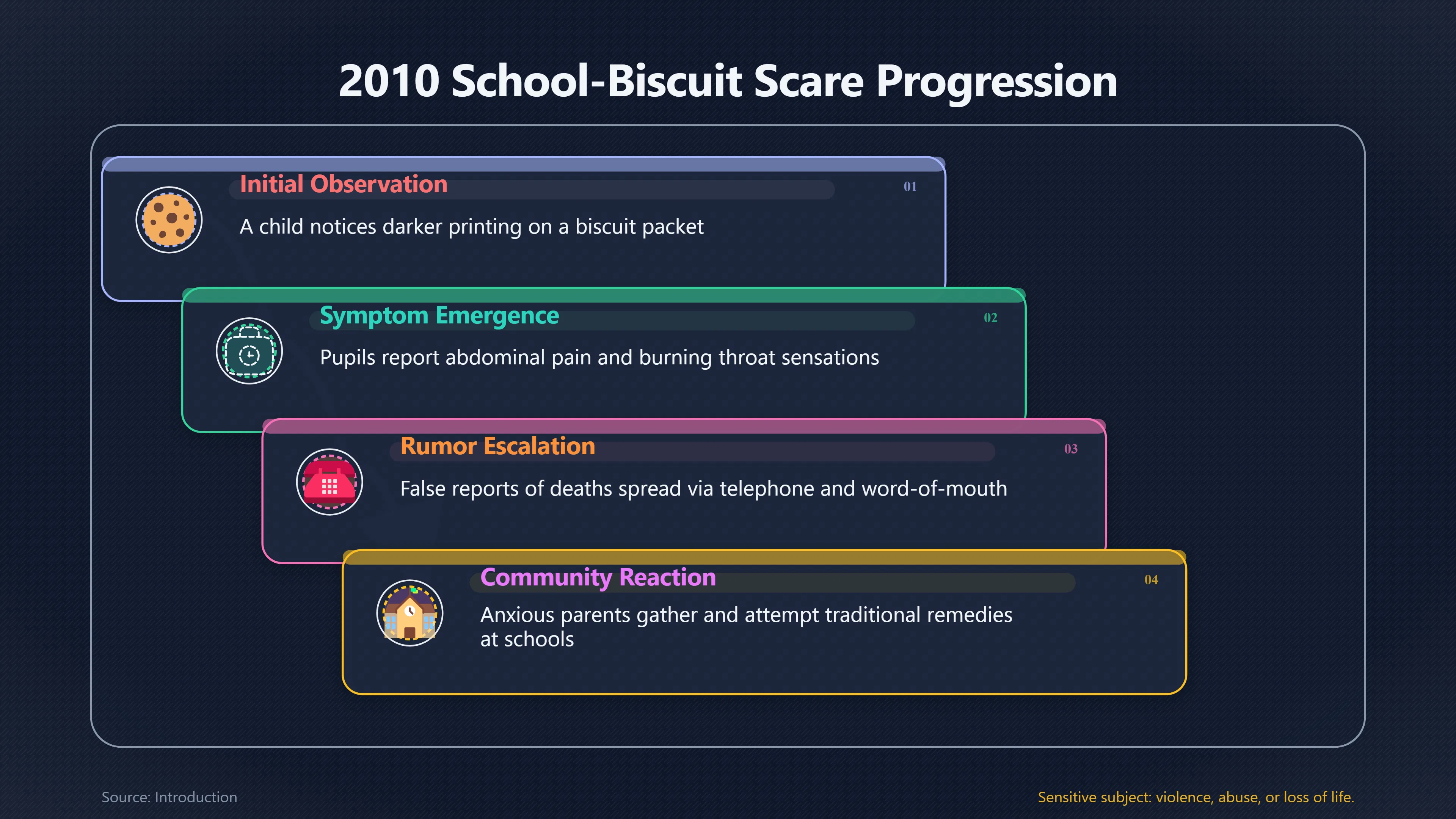
Instead, investigators reconstructed a sequence in which perception and rumour became central.
The first affected child reportedly noticed that the printing on a biscuit packet looked darker than usual and interpreted this as evidence that the biscuits were dangerous. After she became ill, classmates rapidly developed similar symptoms. Rumours that children had died from poisoned biscuits spread between nearby villages by telephone and word of mouth, even though those reports were false. At some schools, pupils became ill despite not receiving biscuits that day, suggesting that fear rather than exposure had become the driving force behind the outbreak.[PMC]pmc.ncbi.nlm.nih.govOutbreak of Mass Sociogenic Illness in a School Feeding Program in Northwest Bangladesh, 2010 - PMC…
Researchers concluded that the episode showed several classic features of mass sociogenic illness:
- rapid onset and equally rapid recovery;
- predominance among girls;
- absence of laboratory or environmental evidence for poisoning;
- spread through rumours and observation across neighbouring schools;
- increasing illness as anxious parents and community members gathered and reacted emotionally.[PubMed]pubmed.ncbi.nlm.nih.govOutbreak of mass sociogenic illness in a school feeding program in northwest Bangladesh, 2010 - PubMed…
Why rumours became so powerful
The biscuit incident illustrates that contagious illness outbreaks are often also information outbreaks.
Parents already worried about food safety found rumours of poisoned biscuits believable. Stories of children supposedly dying travelled faster than official investigation results. Community members interpreted unusual packet colours, unfamiliar tastes and ordinary variations in packaging as confirmation that something dangerous had happened.
Investigators recorded accounts of frightened parents rushing to schools, carrying children to hospital, crying openly and attempting traditional remedies believed to counter poisoning. Such reactions unintentionally reinforced the perception that a genuine toxic exposure had occurred, increasing anxiety among pupils who had not yet shown symptoms.[PMC]pmc.ncbi.nlm.nih.govOutbreak of Mass Sociogenic Illness in a School Feeding Program in Northwest Bangladesh, 2010 - PMC…
The events demonstrate how social trust influences public health. When communities lack confidence in official explanations or fear that authorities may hide dangers, rumours can become more persuasive than laboratory findings.
What these outbreaks changed
Bangladesh’s school illness episodes have become important case studies in public health and psychology because they show the need to investigate carefully before drawing conclusions.
Medical teams must first rule out genuine hazards such as infectious disease, contaminated food, chemicals or environmental toxins. Only after reasonable investigation excludes these possibilities should mass psychogenic illness be considered. This protects both public safety and the credibility of health authorities.[PubMed]pubmed.ncbi.nlm.nih.govOutbreak of mass sociogenic illness in a school feeding program in northwest Bangladesh, 2010 - PubMed…
The investigations also highlighted practical lessons for responding to future school outbreaks:
- communicate findings quickly and transparently;
- avoid unnecessary alarm while continuing appropriate medical evaluation;
- provide reassurance to pupils and parents once hazards have been excluded;
- coordinate messages between schools, health officials and local media to reduce rumour-driven escalation;
- recognise that affected children are experiencing real symptoms and deserve compassionate medical care rather than dismissal.[CDC Stacks]stacks.cdc.govOutbreak of Mass Sociogenic Illness in a School Feeding Program in Northwest Bangladesh, 2010November 14, 2013…

Why these episodes remain significant
Bangladesh’s school illness waves remain among the country’s clearest examples of contagious symptoms spreading through social mechanisms rather than through a shared toxic exposure. They illustrate how fear, observation and expectation can shape genuine physical experiences, especially in tightly connected school communities.
They also demonstrate the importance of distinguishing different kinds of collective events. These outbreaks were not evidence of supernatural forces, deliberate deception or simple imagination. Nor were they ordinary infectious epidemics. Instead, they occupy an important place in Bangladesh’s history of collective fear because they show how real bodily distress, uncertainty and rapidly spreading rumours can combine to produce large-scale public health emergencies even when no common poison or pathogen is ultimately found.[banglajol.info]banglajol.infoBangladesh Journals OnlineMass Psychogenic Illness among Learners at Jaforabad High School, in Hathazari, Chittagong, Bangladesh | Journa…
Amazon book picks
Further Reading
Books and field guides related to Why Did Illness Sweep Through Bangladesh's Schools?. Use these as the next step if you want deeper reading beyond the article.

The Body Keeps the Score
Helps readers understand real physical symptoms linked to psychological processes.
Extraordinary Popular Delusions and the Madness of Crowds
Rating: 4.0/5 from 5 Google Books ratings
Provides wider context for collective behavior.

Endnotes
1.
Source: pmc.ncbi.nlm.nih.gov
Link:https://pmc.ncbi.nlm.nih.gov/articles/PMC3828262/
Source snippet
Outbreak of Mass Sociogenic Illness in a School Feeding Program in Northwest Bangladesh, 2010 - PMC...
2.
Source: stacks.cdc.gov
Link:https://stacks.cdc.gov/view/cdc/21350
Source snippet
Outbreak of Mass Sociogenic Illness in a School Feeding Program in Northwest Bangladesh, 2010November 14, 2013...
Published: November 14, 2013
3.
Source: stacks.cdc.gov
Title: cdc 21350 DS1
Link:https://stacks.cdc.gov/view/cdc/21350/cdc_21350_DS1.pdf
Source snippet
CDC StacksOutbreak of Mass Sociogenic Illness in a School Feeding Program in Northwest Bangladesh, 2010...
4.
Source: banglajol.info
Link:https://www.banglajol.info/index.php/JDMC/article/view/6267
Source snippet
Bangladesh Journals OnlineMass Psychogenic Illness among Learners at Jaforabad High School, in Hathazari, Chittagong, Bangladesh | Journa...
5.
Source: pubmed.ncbi.nlm.nih.gov
Link:https://pubmed.ncbi.nlm.nih.gov/24244685/
Source snippet
Outbreak of mass sociogenic illness in a school feeding program in northwest Bangladesh, 2010 - PubMed...
6.
Source: pmc.ncbi.nlm.nih.gov
Link:https://pmc.ncbi.nlm.nih.gov/articles/PMC4884863/
Source snippet
Mass psychogenic illness has been a recurrent phenomenon in Bangladesh over recent times. Objectives. This study was aimed at investigati...
Additional References
7.
Source: dergipark.org.tr
Link:https://dergipark.org.tr/en/pub/jnbs/article/1741021
Source snippet
doi:10.1177/0973134220050404 25. 25. Amin M, Mahmood S, Rabbi S, Hossain A, Sharif H. Mass Psychogenic Illness among learners at Jaforaba...
8.
Source: researchgate.net
Link:https://www.researchgate.net/publication/399204227_Institutional_Context_Triggers_and_Symptoms_of_Mass_Psychogenic_Illness_A_Literature-Based_Content_Analysis
Source snippet
abstract Mass Psychogenic Illness among Learners at Jaforabad High School, in Hathazari, Chittagong, Bangladesh Article Full-text availab...
9.
Source: researchgate.net
Link:https://www.researchgate.net/publication/273012886_Mass_Psychogenic_Illness_among_Learners_at_Jaforabad_High_School_in_Hathazari_Chittagong_Bangladesh
Source snippet
(PDF) Mass Psychogenic Illness among Learners at Jaforabad High School, in Hathazari, Chittagong, BangladeshOctober 1, 2010 — Article PDF...
Published: October 1, 2010
10.
Source: nejm.org
Link:https://www.nejm.org/doi/abs/10.1056/NEJM200001133420206
Source snippet
RESULTS We were unable to find a medical or environmental explanation for the reported illnesses. The persons who reported sy...
11.
Source: researchgate.net
Title: Many students, parents and community members reported concerns about rumors of s
Link:https://www.researchgate.net/publication/258639725_Outbreak_of_Mass_Sociogenic_Illness_in_a_School_Feeding_Program_in_Northwest_Bangladesh_2010
Source snippet
(PDF) Outbreak of Mass Sociogenic Illness in a School Feeding Program in Northwest Bangladesh, 2010November 14, 2013 — The female index c...
Published: November 14, 2013
12.
Source: researchgate.net
Title: (PDF) Symptom patterns of mass psychogenic illness in Bangladesh
Link:https://www.researchgate.net/publication/355826848_Symptom_patterns_of_mass_psychogenic_illness_in_Bangladesh
Source snippet
November 1, 2021 — Article PDF Available SYMPTOM PATTERNS OF MASS PSYCHOGENIC ILLNESS IN BANGLADESH * November 2021 * Bangladesh Journal...
Published: November 1, 2021
13.
Source: youtube.com
Title: The Razor-Thin Line Between Contagion and Connection
Link:https://www.youtube.com/watch?v=u0fFIJapsRY
Source snippet
What Caused 200+ Children to Suddenly Collapse? | Hollinwell Incident...
14.
Source: journals.plos.org
Link:https://journals.plos.org/plosone/article/figures?id=10.1371%2Fjournal.pone.0080420
Source snippet
The location of the outbreak-affected schools. The map showing the five government primary schools with students reporting acute symptoms...
15.
Source: youtube.com
Title: High School Epidemic: The Tourette Syndrome Outbreak
Link:https://www.youtube.com/watch?v=DOH1gqrw9UI
Source snippet
Frenzy – The Turmoil of Mass Psychogenic Illness...
16.
Source: youtube.com
Title: The Tanganyika Laughter Epidemic
Link:https://www.youtube.com/watch?v=wu6_NUWlQ_c
Source snippet
The Razor-Thin Line Between Contagion and Connection...
Topic Tree