Within Namibia
How Can Fear Become Physical Symptoms?
Examination pressure, close group settings and frightening spiritual explanations may help explain how symptoms intensify without deliberate copying.
On this page
- Stress and bodily reactions
- The role of crowds, rumour and attention
- Why spiritual explanations can accelerate fear
Page outline Jump by section
Introduction
Episodes of unexplained fainting, screaming, shaking or trance-like behaviour reported in some Namibian schools are often interpreted in two very different ways. Families or classmates may see evidence of witchcraft, spirit attack or possession, while doctors and psychologists may describe the same events as mass psychogenic illness (sometimes called mass sociogenic illness): genuine physical symptoms that spread through a close-knit group after medical causes have been carefully investigated and no adequate organic explanation is found. These two ways of understanding the same experience are not simply competing beliefs. They also influence how quickly fear spreads, how people respond, and whether an outbreak grows or subsides.[nih.gov]pmc.ncbi.nlm.nih.govPMCEpisodes of mass hysteria in African schools: A study of literaturePMCEpisodes of mass hysteria in African schools: A study of literature
In Namibia, this question matters because many reported school outbreaks have occurred during periods of examination pressure or social stress, while rumours of possession or witchcraft have often circulated alongside them. Understanding the mechanisms behind symptom spread helps explain why these events can become so frightening without assuming that affected pupils are pretending or that every case has the same cause.
How can fear become physical symptoms?
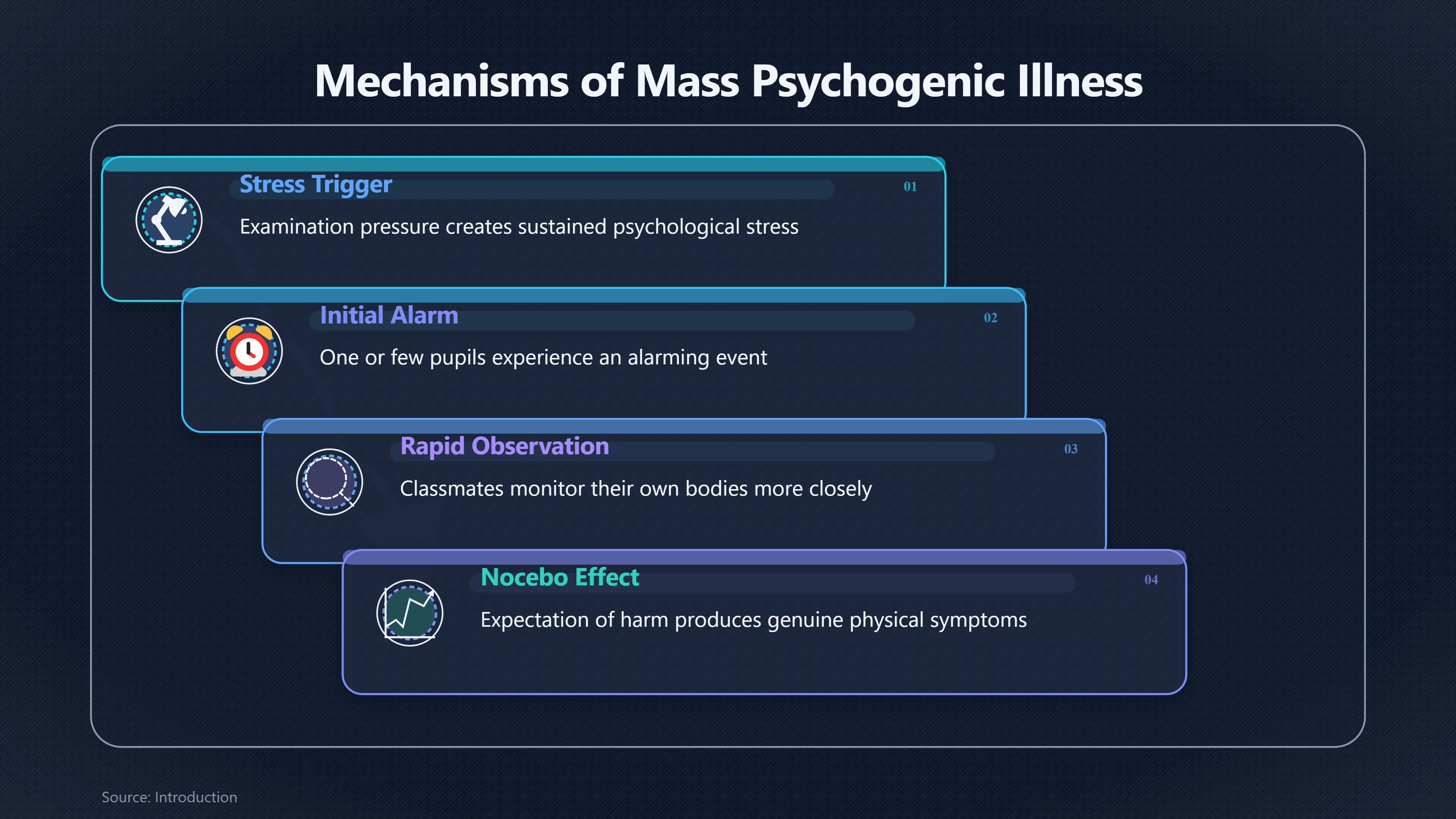
Stress affects the body as well as the mind. When people experience prolonged anxiety, their nervous system becomes more alert. Headaches, dizziness, stomach pain, rapid breathing, trembling, weakness, fainting and temporary voice changes are all recognised physical responses that can occur without infection or poisoning. In mass psychogenic illness, these symptoms are real rather than deliberately produced.[PMC]pmc.ncbi.nlm.nih.govPMCEpisodes of mass hysteria in African schools: A study of literaturePMCEpisodes of mass hysteria in African schools: A study of literature
Researchers studying school outbreaks have found that several conditions commonly appear together:
- sustained psychological stress, often linked to examinations or uncertainty;
- close social contact within classrooms or boarding schools;
- an alarming event affecting one or a few pupils first;
- uncertainty about the cause;
- rapid observation of other people’s symptoms.
These conditions make it easier for anxiety to spread through a group. Once one pupil collapses or appears distressed, classmates naturally monitor their own bodies more closely. Ordinary sensations that would usually be ignored can then be interpreted as signs that they are becoming ill too.[PubMed]pubmed.ncbi.nlm.nih.govFactors related to the occurrence of mass psychogenic illness in schools: a systematic review - PubMed…
This process is sometimes described as a “nocebo” effect—the opposite of the placebo effect—where expecting harm increases the likelihood of experiencing genuine physical symptoms. That does not mean the symptoms are imaginary; it means expectation influences how the brain processes bodily sensations.[New England Journal of Medicine]nejm.orgOpen source on nejm.org.
The role of crowds, rumour and attention
Rumours are powerful because they provide an explanation before reliable evidence is available. In a school where the cause of unusual behaviour is unknown, a single story—such as “a spirit has entered the classroom” or “someone has been bewitched”—can quickly become the framework through which later events are interpreted.
Research consistently identifies rumours and misinformation as major factors that amplify school outbreaks. Persistent discussion, repeated retelling, media attention and public anxiety all increase the number of people who become vigilant for similar symptoms.[PubMed]pubmed.ncbi.nlm.nih.govFactors related to the occurrence of mass psychogenic illness in schools: a systematic review - PubMed…
Several features make schools especially vulnerable:
- Pupils spend long periods together and observe one another closely.
- Adolescents are particularly sensitive to peer reactions.
- Examination periods already create heightened stress.
- Boarding schools allow rumours to circulate continuously.
- Teachers and parents may unintentionally reinforce concern by repeatedly discussing frightening possibilities.
The result is not deliberate imitation. Instead, shared expectations shape how individuals interpret normal bodily sensations and stressful emotions.
Why possession beliefs can accelerate fear
In many Namibian communities, spiritual explanations are familiar ways of making sense of unusual experiences. When pupils report seeing demons, hearing voices or believing they are under supernatural attack, those interpretations fit existing religious or cultural beliefs for many families.
Such beliefs can accelerate fear in several ways.
First, they transform uncertainty into apparent certainty. Instead of asking, “Why are people fainting?”, the community begins asking, “Who caused the possession?” That shift increases emotional intensity.
Second, possession beliefs encourage people to watch for further signs. Every scream, unusual voice or collapse may then be interpreted as confirming the original explanation.
Third, rumours about witchcraft or spirits can spread beyond the affected school into neighbouring communities, drawing parents, religious leaders, journalists and traditional healers into the event. Their involvement often reflects genuine concern, but it can also increase public attention and reinforce expectations that more pupils will become affected.[The Namibian]namibian.com.naThe Namibian Ignore mass hysteria, experts sayThe NamibianIgnore mass hysteria, experts say - The Namibian…
Importantly, recognising these mechanisms does not require dismissing people’s religious beliefs. Medical researchers simply note that supernatural explanations can influence how fear spreads regardless of whether individuals personally accept those beliefs.
What Namibian outbreaks suggest
Reports from Namibian schools repeatedly describe similar patterns. Episodes often involve mostly girls, occur in educational settings, coincide with stressful periods such as examinations, and include symptoms such as fainting, screaming, crawling, shaking or temporary changes in speech. Medical examinations frequently fail to identify infectious or toxic causes, although appropriate investigations remain essential before reaching any psychological explanation.[The Namibian]namibian.com.naThe Namibian Ignore mass hysteria, experts sayThe NamibianIgnore mass hysteria, experts say - The Namibian…
Psychologist Shaun Whittaker and psychiatrist Mnubi Farahani have argued publicly that many reported Namibian cases are better understood through recognised psychological mechanisms than through witchcraft or demonic possession. They emphasise counselling, reassurance and reducing unnecessary publicity rather than encouraging frightening supernatural interpretations.[The Namibian]namibian.com.naThe Namibian The case of mass hysteriaThe NamibianThe case of mass hysteria - The Namibian…
Education officials have also observed that extensive attention sometimes appears to prolong outbreaks. One widely reported example described pupils becoming calmer after being separated, only for symptoms to intensify again once television cameras and anxious parents arrived. While such observations do not prove cause and effect, they are consistent with international research showing that heightened public attention can reinforce symptom spread.[com.na]namibian.com.naThe Namibian Ignore mass hysteria, experts sayThe NamibianIgnore mass hysteria, experts say - The Namibian…
Why reassurance often works
Studies from many countries suggest that outbreaks usually decline when several things happen together:
- medical professionals rule out infectious, toxic or environmental hazards;
- trusted authorities communicate clearly and consistently;
- affected people receive reassurance and psychological support;
- unnecessary alarm and sensational reporting are reduced;
- pupils return gradually to normal routines.
This approach does not deny the reality of the symptoms. Instead, it aims to reduce the cycle of fear, attention and expectation that allows genuine distress to spread through a closely connected group.[nih.gov]pmc.ncbi.nlm.nih.govPMCEpisodes of mass hysteria in African schools: A study of literaturePMCEpisodes of mass hysteria in African schools: A study of literature
For Namibia, where spiritual interpretations remain important for many communities, this creates a practical challenge. Health workers must investigate possible physical illness thoroughly while also communicating respectfully with families whose understanding of the events may be shaped by religious or traditional beliefs. Dismissing those beliefs outright can increase mistrust, but reinforcing frightening rumours may unintentionally prolong the outbreak.
What this tells us about collective fear
Namibia’s school incidents illustrate that stress, rumour and cultural expectations interact rather than operate separately. Examination pressure may make pupils physically vulnerable to anxiety. Rumours provide a shared explanation. Possession beliefs can give frightening experiences a powerful narrative that spreads through friendship groups, families and communities.
The key lesson is that these episodes involve real suffering. Mass psychogenic illness does not mean people are pretending or inventing symptoms. Instead, it demonstrates how closely the brain, body and social environment are connected, and why calm communication, careful medical assessment and culturally sensitive reassurance are often the most effective ways to prevent fear from spreading further.[nih.gov]pmc.ncbi.nlm.nih.govPMCEpisodes of mass hysteria in African schools: A study of literaturePMCEpisodes of mass hysteria in African schools: A study of literature
Amazon book picks
Further Reading
Books and field guides related to How Can Fear Become Physical Symptoms?. Use these as the next step if you want deeper reading beyond the article.

The Body Keeps the Score
Shows how severe fear and psychological stress can become embodied through changes in arousal, sensation, movement and physical functioning.

Is it all in your head?
Describes functional and psychosomatic disorders in which distress produces disabling physical symptoms without conscious fabrication or...
Why Zebras Don't Get Ulcers
Explains how stress responses affect the nervous system and produce or intensify bodily symptoms such as pain, digestive problems, trembl...

The Sleeping Beauties
Directly examines outbreaks of genuine physical symptoms shaped by fear, social conditions, cultural beliefs and group attention.
Endnotes
1.
Source: pmc.ncbi.nlm.nih.gov
Title: PMCEpisodes of mass hysteria in African schools: A study of literature
Link:https://pmc.ncbi.nlm.nih.gov/articles/PMC3588562/
2.
Source: namibian.com.na
Title: The Namibian Ignore mass hysteria, experts say
Link:https://www.namibian.com.na/ignore-mass-hysteria-experts-say/
Source snippet
The NamibianIgnore mass hysteria, experts say - The Namibian...
3.
Source: pubmed.ncbi.nlm.nih.gov
Link:https://pubmed.ncbi.nlm.nih.gov/40537604/
Source snippet
Factors related to the occurrence of mass psychogenic illness in schools: a systematic review - PubMed...
4.
Source: nejm.org
Link:https://www.nejm.org/doi/full/10.1056/NEJM200001133420206
5.
Source: namibian.com.na
Title: The Namibian The case of mass hysteria
Link:https://www.namibian.com.na/the-case-of-mass-hysteria/
Source snippet
The NamibianThe case of mass hysteria - The Namibian...
6.
Source: namibian.com.na
Title: The Namibian Mass hysteria hits Okongo school
Link:https://www.namibian.com.na/mass-hysteria-hits-okongo-school/
Source snippet
The NamibianMass hysteria hits Okongo school - The Namibian...
7.
Source: pmc.ncbi.nlm.nih.gov
Link:https://pmc.ncbi.nlm.nih.gov/articles/PMC12889253/
Source snippet
case report of mass conversion disorder associated with a local spirit narrative in Dhankuta, Eastern Nepal - PMCDecember 19, 2025 — ABST...
Published: December 19, 2025
8.
Source: pmc.ncbi.nlm.nih.gov
Link:https://pmc.ncbi.nlm.nih.gov/articles/PMC9210177/
Source snippet
of mass psychogenic illness in a junior secondary school in rural Botswana: A case control study - PMCMay 30, 2022 — PMC Copyright notice...
Published: May 30, 2022
9.
Source: pmc.ncbi.nlm.nih.gov
Link:https://pmc.ncbi.nlm.nih.gov/articles/PMC7704439/
10.
Source: pmc.ncbi.nlm.nih.gov
Link:https://pmc.ncbi.nlm.nih.gov/articles/PMC7396040/
11.
Source: pmc.ncbi.nlm.nih.gov
Link:https://pmc.ncbi.nlm.nih.gov/articles/PMC5992694/
12.
Source: pmc.ncbi.nlm.nih.gov
Link:https://pmc.ncbi.nlm.nih.gov/articles/PMC3536509/
13.
Source: namibian.com.na
Title: Nodding children puzzle teachers
Link:https://www.namibian.com.na/nodding-children-puzzle-teachers/
14.
Source: pmc.ncbi.nlm.nih.gov
Link:https://pmc.ncbi.nlm.nih.gov/articles/PMC543940/
Additional References
15.
Source: dergipark.org.tr
Link:https://dergipark.org.tr/tr/pub/jnbs/article/1741021
Source snippet
Employing qualitative content analysis, 14 case studies were evaluated through descriptive and thematic approaches...
16.
Source: lifescience.net
Link:https://www.lifescience.net/publications/1339932/factors-related-to-the-occurrence-of-mass-psychoge/
Source snippet
Created on 20 Jun 2025 * Publication details * Citations * Page views * * Reviews * * * * All pu...
17.
Source: youtube.com
Title: Stop that! It’s not Tourette’s but a new type of mass sociogenic illness
Link:https://www.youtube.com/watch?v=-nsIZwlHUBM
Source snippet
Aspects of Collective Behavior: Fads, Mass Hysteria, and Riots...
18.
Source: youtube.com
Title: The Razor-Thin Line Between Contagion and Connection | Dan Taberski | TED
Link:https://www.youtube.com/watch?v=u0fFIJapsRY
Source snippet
Mass Hysteria - How Intelligent Crowd Goes Insane...
19.
Source: youtube.com
Title: Mass Hysteria
Link:https://www.youtube.com/watch?v=Hb9ti9c_35s
Source snippet
Stop that! It's not Tourette's but a new type of mass sociogenic illness...
20.
Source: cambridge.org
Link:https://www.cambridge.org/core/journals/the-british-journal-of-psychiatry/article/protean-nature-of-mass-sociogenic-illness/2BDC2262E104B8A33F3DD49773DA0D8B
21.
Source: research.usc.edu.au
Link:https://research.usc.edu.au/esploro/outputs/journalArticle/Characteristics-of-Adolescents-Affected-by-Mass/991105844202621
22.
Source: nchr.elsevierpure.com
Link:https://nchr.elsevierpure.com/en/publications/factors-related-to-the-occurrence-of-mass-psychogenic-illness-in-/
23.
Source: journals.sagepub.com
Link:https://journals.sagepub.com/doi/10.1258/jrsm.2012.120053
24.
Source: aafp.org
Link:https://www.aafp.org/afp/2000/1215/p2649
Topic Tree