Within Suriname
Why the Gaan Gadu Movement Spread So Fast
The Gaan Gadu movement spread through Ndyuka communities by promising to expose hidden witches and restore moral order.
On this page
- The Great God and His Witch Finders
- Gold, Inequality and Social Suspicion
- Purification, Punishment and New Authority
Page outline Jump by section
Introduction
The Gaan Gadu movement was one of the most influential anti-witchcraft movements in the history of Suriname’s Ndyuka Maroon communities. Emerging in the early 1890s, it promised to identify hidden witches, purify society and restore moral order at a time when rapid economic and social change had unsettled long-established patterns of life. Rather than being simply a new religious movement, Gaan Gadu became a powerful system for explaining misfortune, enforcing discipline and redefining political authority. Its rapid spread illustrates how collective fears can grow when communities experience uncertainty, inequality and social disruption. Historians therefore treat Gaan Gadu as an important example of how beliefs about witchcraft, rather than existing in isolation, can become organised into a movement with lasting social and political consequences.[maroonhistory.com]maroonhistory.comOpen source on maroonhistory.com.

Why the Gaan Gadu Movement Spread So Fast
The Great God and His Witch-Finders
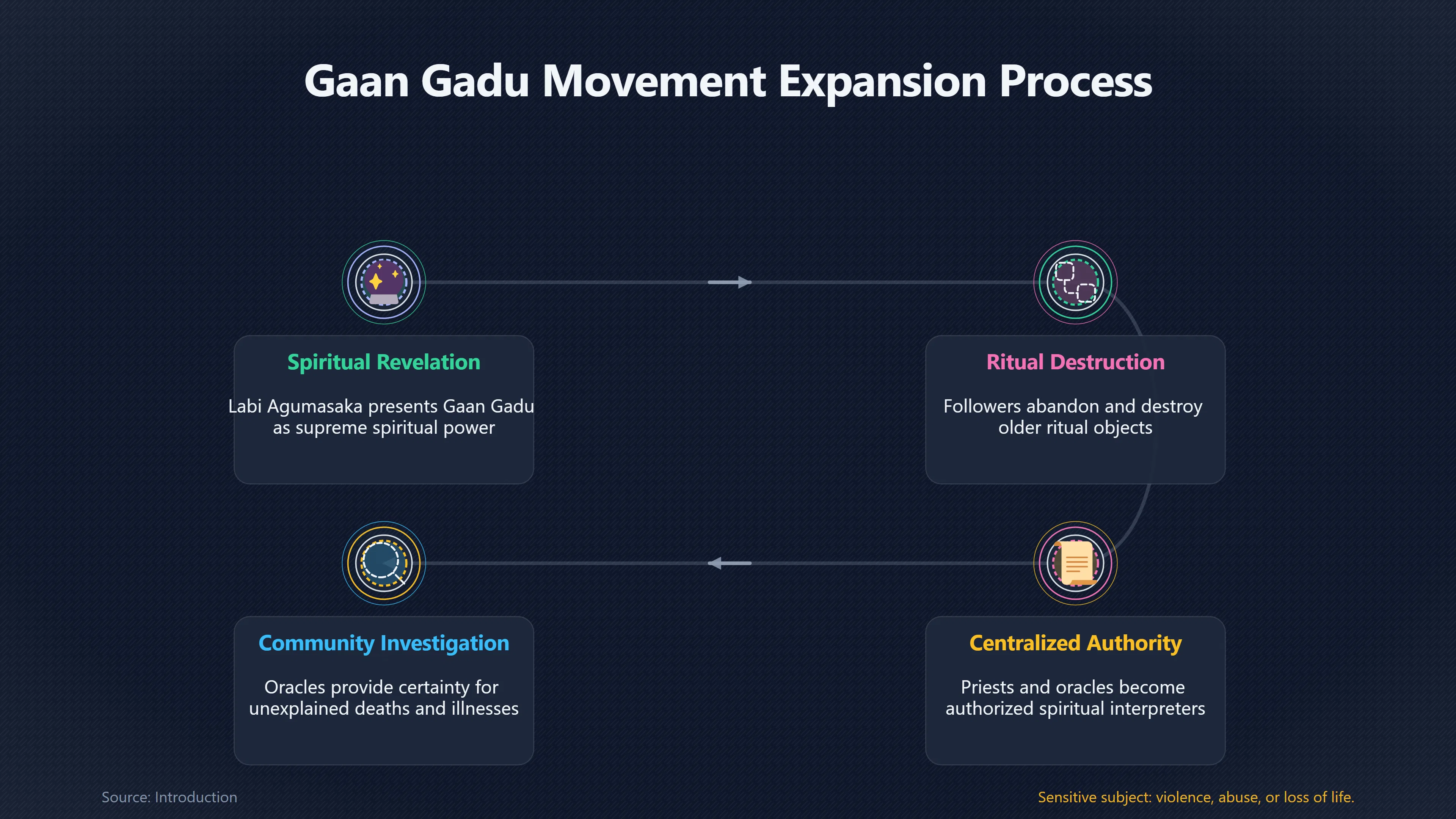
Gaan Gadu, meaning “Great God”, emerged among the Ndyuka Maroons in eastern Suriname during the closing years of the nineteenth century. According to historical studies, the movement was closely associated with the healer and oracle Labi Agumasaka, whose revelations presented Gaan Gadu as a supreme spiritual power capable of exposing witches responsible for illness, death and other forms of misfortune. Existing shrines and ritual objects connected with older spirits were often destroyed or abandoned as followers embraced the authority of the new deity.[cambridge.org]cambridge.orgCambridge University Press & Assessment“It's your family that kills you”: Responsibility, Evidence, and Misfortune in the Making of Ndyuk…
Unlike earlier religious practice, which was dispersed among numerous ritual specialists, Gaan Gadu developed a far more centralised organisation. Priests and oracles acted as authorised interpreters of the god’s will, and their decisions carried exceptional weight. This institutional structure helped the movement spread quickly because communities believed that a single, powerful spiritual authority could resolve disputes that older methods had failed to settle. Historians have described the movement as combining monotheistic aspirations with an organised campaign against witchcraft.[dbnl.org]dbnl.orgPeople in between: the Matawai Maroons of Suriname, Chris de Beet, Miriam Sterman - DBNL…
Its appeal was not merely theological. Every unexplained death, prolonged illness or sudden reversal of fortune could be investigated through Gaan Gadu’s oracle. Instead of accepting misfortune as random, believers were encouraged to identify an individual who bore spiritual responsibility. This gave the movement extraordinary influence over everyday life because it offered certainty in situations where ordinary evidence was unavailable.[Cambridge University Press & Assessment]cambridge.orgCambridge University Press & Assessment“It's your family that kills you”: Responsibility, Evidence, and Misfortune in the Making of Ndyuk…
Gold, Inequality and Social Suspicion
The movement cannot be understood apart from the profound changes affecting the Ndyuka during the 1890s. Colonial expansion into the interior, increased migration and, above all, the gold boom transformed the regional economy. Many Ndyuka became involved in river transport, carrying people and supplies to mining districts. While some families accumulated wealth through this trade, others benefited far less, creating new inequalities inside communities that had previously been more economically balanced.[Sage Journals]journals.sagepub.comSage JournalsThe Gaan Gadu Cult Material Forces and the Social Production of Fantasy - H.U.E. Thoden van Velzen, 1985…
Anthropologist H.U.E. Thoden van Velzen argued that these material changes created fertile conditions for the spread of Gaan Gadu. Those who controlled the lucrative transport economy often became strong supporters of the movement. Rapid wealth differences, competition and migration encouraged suspicion that prosperity or sudden success must have hidden spiritual causes. When fortunes rose or collapsed unexpectedly, accusations of witchcraft became an emotionally convincing explanation.[Sage Journals]journals.sagepub.comSage JournalsThe Gaan Gadu Cult Material Forces and the Social Production of Fantasy - H.U.E. Thoden van Velzen, 1985…
The movement therefore channelled anxieties that accompanied economic change. Rather than seeing inequality as the product of shifting markets or colonial expansion, many interpreted misfortune through established ideas about witchcraft. Gaan Gadu provided a coherent framework that connected individual suffering to collective moral failings and hidden enemies within the community.[Sage Journals]journals.sagepub.comSage JournalsThe Gaan Gadu Cult Material Forces and the Social Production of Fantasy - H.U.E. Thoden van Velzen, 1985…

Purification, Punishment and New Authority
Gaan Gadu’s campaign against witchcraft went well beyond prayer or ritual healing. Communities participated in programmes of purification that involved identifying suspected witches, destroying older ritual objects and recognising the authority of Gaan Gadu’s priests and oracles. The movement aimed to cleanse society by removing sources of hidden spiritual danger rather than merely treating individual illness.[DBNL]dbnl.orgPeople in between: the Matawai Maroons of Suriname, Chris de Beet, Miriam Sterman - DBNL…
Historical accounts indicate that the consequences for accused witches could be severe. Some individuals were ostracised, punished or denied normal burial after death because they were believed to embody dangerous supernatural forces. Such actions reflected the conviction that protecting the wider community required eliminating hidden spiritual threats. Modern historians emphasise that these punishments arose from sincerely held religious beliefs about communal survival rather than arbitrary cruelty, while also recognising the serious human costs of systems that relied on supernatural accusation rather than verifiable evidence.[maroonhistory.com]maroonhistory.comOpen source on maroonhistory.com.
The movement also altered political authority. Decisions that had previously been distributed among local leaders increasingly became tied to the judgments of recognised Gaan Gadu specialists. Their oracles influenced disputes over responsibility, inheritance, social standing and community discipline. Religious authority therefore became intertwined with governance in new ways.[DBNL]dbnl.orgPeople in between: the Matawai Maroons of Suriname, Chris de Beet, Miriam Sterman - DBNL…
Why Collective Fear Became Self-Reinforcing
One reason the movement endured was that its methods made contradiction difficult. If someone fell ill after questioning an oracle, the illness could be interpreted as confirmation of the oracle’s power. If a suspected witch confessed, the accusation appeared validated. If no confession emerged, divination itself supplied the necessary certainty.
This created a self-reinforcing cycle. Every new death or unexplained illness demanded another investigation, and every investigation strengthened belief that hidden witches remained active. Cambridge historian Richard Price has noted that Gaan Gadu eventually institutionalised the investigation of deaths through oracular procedures for decades, embedding witch-finding within everyday social life rather than treating it as an occasional emergency.[Cambridge University Press & Assessment]cambridge.orgCambridge University Press & Assessment“It's your family that kills you”: Responsibility, Evidence, and Misfortune in the Making of Ndyuk…
From a sociological perspective, the movement functioned as a mechanism for restoring order during uncertainty. It transformed diffuse fears into identifiable causes and supplied recognised authorities who claimed to possess the means of resolving them. This combination of moral certainty, institutional authority and repeated confirmation allowed anti-witchcraft fears to spread far beyond their original setting.[sagepub.com]journals.sagepub.comSage JournalsThe Gaan Gadu Cult Material Forces and the Social Production of Fantasy - H.U.E. Thoden van Velzen, 1985…

Historical Interpretation and Lasting Importance
Modern scholarship does not interpret Gaan Gadu simply as an episode of irrational panic. Instead, historians view it as a response to genuine social pressures, including colonial intrusion, economic transformation, changing patterns of wealth and longstanding concerns about responsibility for misfortune. Witchcraft beliefs themselves were deeply embedded in Ndyuka religious life; what made Gaan Gadu distinctive was the creation of an organised movement that systematically investigated and punished alleged witches through centralised religious authority.[sagepub.com]journals.sagepub.comSage JournalsThe Gaan Gadu Cult Material Forces and the Social Production of Fantasy - H.U.E. Thoden van Velzen, 1985…
The movement also illustrates an important distinction in the study of collective fear. Belief in spiritual causation was not unique to Gaan Gadu, nor was it automatically evidence of mass hysteria. The historically significant development was the way those beliefs became organised into an expansive anti-witchcraft campaign that reshaped authority, encouraged widespread suspicion and made accusations part of routine community governance. For historians of Suriname, Gaan Gadu therefore remains one of the clearest examples of how periods of rapid social change can transform longstanding beliefs into powerful movements capable of reorganising entire communities.[dbnl.org]dbnl.orgPeople in between: the Matawai Maroons of Suriname, Chris de Beet, Miriam Sterman - DBNL…
Amazon book picks
Further Reading
Books and field guides related to Why the Gaan Gadu Movement Spread So Fast. Use these as the next step if you want deeper reading beyond the article.
Purity and danger
First published 1966. Subjects: Purity, Ritual, Ritual Purity, Taboo, Pollution, Cultural Anthropology.
The Serpent and the Rainbow
First published 1985. Subjects: Social life and customs, Description and travel, Zombiism, Bizango (Cult), Religious life and customs.

The Penguin book of witches
First published 2014. Subjects: Witchcraft, History, Witchcraft, europe.
Endnotes
1.
Source: maroonhistory.com
Link:https://maroonhistory.com/item/the-origins-of-the-gaan-gadu-movement-of-the-bush-negroes-of-surinam/
2.
Source: cambridge.org
Link:https://www.cambridge.org/core/journals/comparative-studies-in-society-and-history/article/its-your-family-that-kills-you-responsibility-evidence-and-misfortune-in-the-making-of-ndyuka-history/6467A1D8632F2EF19D000A3C32374E88
Source snippet
Cambridge University Press & Assessment“It's your family that kills you”: Responsibility, Evidence, and Misfortune in the Making of Ndyuk...
3.
Source: dbnl.org
Link:https://www.dbnl.org/tekst/beet027peop01_01/beet027peop01_01_0011.php
Source snippet
People in between: the Matawai Maroons of Suriname, Chris de Beet, Miriam Sterman - DBNL...
4.
Source: cambridge.org
Link:https://www.cambridge.org/core/journals/international-review-of-social-history/article/okanisi-a-surinamese-maroon-community-c17122010/FEB980D8422F82D4154CEFAE020DAA04
Source snippet
Cambridge University Press & AssessmentThe Okanisi: A Surinamese Maroon Community, c.1712–2010* | International Review of Social History...
5.
Source: cambridge.org
Link:https://www.cambridge.org/core/journals/africa/article/working-for-the-stomach-sustaining-peasant-mining-in-southwestern-uganda/A9ED9860FDEB550EC082DB917A248BD1
Source snippet
December 18, 2024 — ‘WORKING FOR THE STOMACH’: SUSTAINING PEASANT MINING IN SOUTH-WESTERN UGANDA Published online by Cambridge University...
Published: December 18, 2024
6.
Source: cambridge.org
Title: The Earth Is Sweet
Link:https://www.cambridge.org/core/journals/comparative-studies-in-society-and-history/article/abs/earth-is-sweet-on-cottica-ndyuka-decompositions/E9C66940F0CFD121FFA80F07D898FC2A
Source snippet
On Cottica Ndyuka (De)compositions | Comparative Studies in Society and History | Cambridge CoreFebruary 5, 2024 — THE EARTH IS SWEET. ON...
Published: February 5, 2024
7.
Source: cambridge.org
Link:https://www.cambridge.org/core/journals/african-studies-review/article/economic-change-and-occultic-sika-bone-market-womens-responses-to-increased-financialization-in-ghana/6CCDDAA1F74215278C4AE7FA6C68B466
8.
Source: maroonhistory.com
Link:https://maroonhistory.com/english/
9.
Source: maroonhistory.com
Link:https://maroonhistory.com/kennisbank/
10.
Source: maroonhistory.com
Title: maroon leadership and the surinamese state 1760 1990
Link:https://maroonhistory.com/item/maroon-leadership-and-the-surinamese-state-1760-1990/
11.
Source: dbnl.org
Link:https://www.dbnl.org/tekst/beet027peop01_01/beet027peop01_01_0013.php
12.
Source: dbnl.org
Link:https://www.dbnl.org/tekst/_oso001201601_01/_oso001201601_01_0016.php
13.
Source: dbnl.org
Link:https://www.dbnl.org/tekst/_oso001200601_01/_oso001200601_01_0008.php
14.
Source: suriname.nu
Title: Sweli Gadu | Suriname Anda
Link:https://suriname.nu/surinamezoeken/knowledge-base/sweli-gadu/
15.
Source: journals.sagepub.com
Link:https://journals.sagepub.com/doi/10.1177/003776868503200107
Source snippet
Sage JournalsThe Gaan Gadu Cult Material Forces and the Social Production of Fantasy - H.U.E. Thoden van Velzen, 1985...
16.
Source: encyclopedia.com
Title: The Ndyuka live in the northern extension of the Amazon ra
Link:https://www.encyclopedia.com/humanities/encyclopedias-almanacs-transcripts-and-maps/ndyuka
Source snippet
Ndyuka | Encyclopedia.comJune 23, 2026 — NDYUKA views updated NDYUKA ETHNONYMS: Ndyuka, Ndyuka Nengee, Ndjuka, Djuka, Okanisi, Aucaners O...
Published: June 23, 2026
17.
Source: journals.sagepub.com
Link:https://journals.sagepub.com/doi/abs/10.1177/14647001231209900
Source snippet
magic: Global resource extraction, witchcraft and resistance in Yaba Badoe's The Witches of Gambaga (2011) and Wolf Light (2019) - Treasa...
18.
Source: journals.sagepub.com
Link:https://journals.sagepub.com/doi/10.1177/14647001231209900
19.
Source: minorityrights.org
Link:https://minorityrights.org/country/suriname/
Additional References
20.
Source: youtube.com
Title: The Maroons of Suriname: The Resistance of Boni
Link:https://www.youtube.com/watch?v=BmES166Xmqg
Source snippet
Kunu: A Deep-Rooted Curse on a Matrilineal Family is highly relevant as it is a direct academic documentary series by Maroon scholar Andr...
21.
Source: youtube.com
Link:https://www.youtube.com/watch?v=dyJ7X1GYpVo
Source snippet
The Maroons of Suriname: The Resistance of Boni...
22.
Source: youtube.com
Title: The Warrior Maroons of Suriname
Link:https://www.youtube.com/watch?v=-VJcsv4OxBI
Source snippet
The Maroons of Suriname: A Journey to Find Africans Living Deep in the South American Forest...
23.
Source: africabib.org
Link:https://www.africabib.org/rec.php?RID=256009422
24.
Source: joshuaproject.net
Link:https://joshuaproject.net/people_groups/13297/NS
25.
Source: patheos.com
Link:https://www.patheos.com/library/country-profiles/south-america/suriname
26.
Source: sciencedirect.com
Link:https://www.sciencedirect.com/science/article/abs/pii/S2214790X24000078
27.
Source: sciencedirect.com
Link:https://www.sciencedirect.com/science/article/pii/S2214790X24000078
28.
Source: paperzz.com
Title: Book Reviews -Selwyn R. Cudjoe, John Thieme, The web of tradition
Link:https://paperzz.com/doc/9240099/book-reviews–selwyn-r.-cudjoe–john-thieme–the-web-of-t
29.
Source: youtube.com
Title: Kunu: A Deep-Rooted Curse on a Matrilineal Family
Link:https://www.youtube.com/watch?v=YpHyEsIbrvk
Source snippet
Stones Have Laws...
Topic Tree