Within Senegal
How a Genital Theft Rumour Became Deadly
A rumour about stolen sexual power turned brief encounters with strangers into accusations, crowd attacks and deaths across Senegalese cities.
On this page
- What people believed had been stolen
- How accusation and crowd pressure reinforced the panic
- Why foreigners and strangers became targets
Page outline Jump by section
Introduction
In the summer of 1997, Senegal experienced one of the deadliest episodes in a wider West African wave of rumours about “genital theft”. The panic centred on the belief that a stranger could steal or magically shrink a man’s genitals—and, with them, his sexual power—through a brief touch, handshake or accidental brush in a crowded street. Although there was no medical evidence that such thefts occurred, the rumour had devastating real-world consequences. Within days, accusations escalated into mob attacks, leaving several people dead and many more injured in Dakar and other cities.[Mail & Guardian]mg.co.zaMail & Guardian Foreigners lynched in ‘penis’ hysteria – The Mail & GuardianMail & GuardianForeigners lynched in ‘penis’ hysteria – The Mail & GuardianAugust 1, 1997…
The 1997 panic remains important because it demonstrates how a contagious rumour can transform ordinary social encounters into perceived emergencies. Rather than being an isolated act of irrationality, the violence emerged from a combination of cultural ideas about occult harm, urban uncertainty, distrust of strangers and the powerful social pressure created by rapidly forming crowds.
What people believed had been stolen
The central fear was not always that a penis had literally disappeared. Accounts collected by anthropologists show that alleged victims described several different experiences: sudden sensations of shrinking, numbness, retraction or the feeling that their sexual potency had been taken away. In many versions of the rumour, the visible body was only one part of the problem. The true target was believed to be a person’s reproductive power or spiritual essence, which could supposedly be stolen for occult purposes or held until the victim paid money.[University of Chicago Press]press.uchicago.eduOpen source on uchicago.edu.
This distinction helps explain why the rumour survived despite the obvious physical impossibility of permanent disappearance. A frightened man could inspect himself and still believe that something essential had been taken. Ambiguous bodily sensations—especially those triggered by anxiety—could therefore reinforce rather than weaken the accusation.
The rumour also drew strength from everyday urban interactions. A simple handshake, an accidental collision in a market or a stranger’s touch became interpreted as possible attacks. Ordinary social behaviour was transformed into a source of danger.
How accusation and crowd pressure reinforced the panic
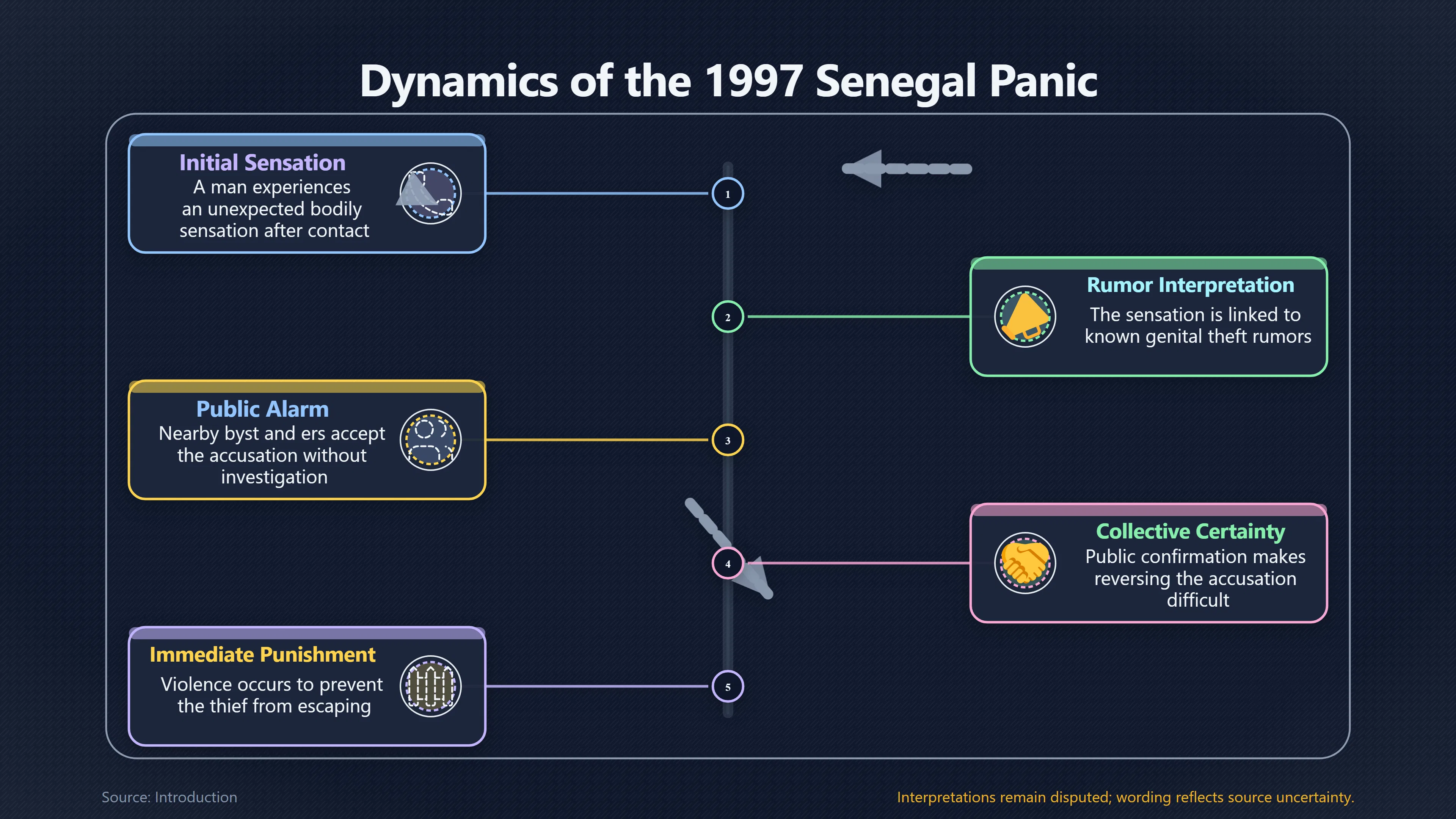
Researchers describe the panic as a social process rather than simply a mistaken private belief. A typical sequence unfolded remarkably quickly:
- A man experienced an unexpected sensation immediately after contact with another person.
- Having already heard rumours about genital theft, he interpreted the sensation as evidence of an attack.
- His alarm attracted attention from nearby people.
- Bystanders accepted the accusation before any investigation could occur.
- Attempts by the accused person to flee or defend themselves were often treated as confirmation of guilt.
Within minutes, uncertainty became public certainty. The crowd itself became part of the mechanism producing belief. Once dozens of people had accepted the accusation, reversing it became increasingly difficult. The emotional intensity of the gathering encouraged immediate punishment because many participants believed delay would allow the supposed thief to escape with the victim’s stolen sexual power.[University of Chicago Press]press.uchicago.eduOpen source on uchicago.edu.
Anthropologist Julien Bonhomme argues that these rumours should be understood as collective interactions rather than isolated delusions. The accusation only became convincing because it was performed publicly, witnessed by others and reinforced through repeated social confirmation.[University of Chicago Press]press.uchicago.eduOpen source on uchicago.edu.
Why foreigners and strangers became targets
One of the most striking features of the Senegalese outbreak was the identity of many victims. Contemporary reporting recorded that several foreigners were lynched in Dakar after being accused of causing genital shrinkage through casual physical contact. Reports at the time described seven foreigners being killed in a single day, while later academic work places the Dakar death toll at around eight, alongside roughly forty injuries and further serious assaults in cities including Saint-Louis and Ziguinchor.[Mail & Guardian]mg.co.zaMail & Guardian Foreigners lynched in ‘penis’ hysteria – The Mail & GuardianMail & GuardianForeigners lynched in ‘penis’ hysteria – The Mail & GuardianAugust 1, 1997…
The selection of suspects followed recognisable social patterns rather than random chance. Across West Africa, alleged genital thieves were frequently:
- travelling traders;
- recent migrants;
- visitors from neighbouring countries;
- people whose clothing or language marked them as outsiders.
Because these individuals lacked extensive local family networks, they were less likely to find neighbours willing or able to defend them when crowds formed. Rumour therefore merged with existing anxieties about mobility, migration and unfamiliarity.[HAU Books]haubooks.orgHAU Books The Sex Thieves: The Anthropology of a RumorHAU Books The Sex Thieves: The Anthropology of a Rumor
Bonhomme notes that stereotypes also influenced suspicion. In several countries, Hausa merchants became common targets, while in Senegal other Sahelian groups or people whose appearance resembled widely recognised trading communities could also become vulnerable. The rumour spread across national borders, but adapted itself to local ideas about who counted as an outsider.[HAU Books]haubooks.orgHAU Books The Sex Thieves: The Anthropology of a RumorHAU Books The Sex Thieves: The Anthropology of a Rumor
Why the rumour spread so quickly
The 1997 panic did not originate in Senegal. Similar genital-theft rumours had circulated in Nigeria from the 1970s before spreading episodically through numerous West and Central African countries during the 1990s. Each outbreak followed a similar pattern: rapid circulation for a few weeks, intense public attention, episodes of violence and then an equally rapid decline.[La Vie des Idées]laviedesidees.frLa Vie des Idées Macron and the sex thievesLa Vie des IdéesMacron and the sex thieves - Books & ideasJune 10, 2025…
Several conditions helped the rumour flourish in Senegal:
- dense urban environments where strangers constantly encountered one another;
- rapid word-of-mouth transmission through markets, transport hubs and neighbourhoods;
- widespread belief that occult attacks could occur through apparently ordinary encounters;
- public anxiety created by economic uncertainty and changing urban life.
The rumour succeeded because it offered a familiar explanation for unexpected bodily sensations while identifying a visible human culprit who could be confronted immediately.
Official responses and the human cost
Police attempted to intervene once mob violence escalated, but many attacks developed too quickly for authorities to prevent. Contemporary newspaper coverage described victims being beaten by large crowds, with at least one person reportedly burned alive.[Mail & Guardian]mg.co.zaMail & Guardian Foreigners lynched in ‘penis’ hysteria – The Mail & GuardianMail & GuardianForeigners lynched in ‘penis’ hysteria – The Mail & GuardianAugust 1, 1997…
The most lasting harm came not from any alleged supernatural theft but from the accusations themselves. Innocent people were assaulted or killed because others believed immediate violence was necessary to reverse the supposed attack. The panic therefore illustrates an important distinction: although the supernatural claim lacked credible evidence, the consequences of believing it were entirely real.
How scholars interpret the episode today
Modern researchers generally reject explanations that portray the events simply as irrational superstition or “mass hysteria”. Instead, they treat the panic as a revealing example of how rumours function within changing urban societies.
Several themes recur in scholarly interpretations:
- Social uncertainty. Modern cities bring frequent encounters with anonymous strangers, making trust harder to establish.
- Occult explanations. Existing beliefs about invisible spiritual harm provided a culturally meaningful framework for interpreting unexplained bodily sensations.
- Crowd dynamics. Public accusations gained authority through collective participation rather than independent evidence.
- Moral boundaries. Outsiders became symbols onto which wider fears about insecurity, migration and social change could be projected.
Bonhomme argues that genital-theft rumours deserve serious analysis precisely because they expose how fragile ordinary trust can become. A routine greeting, normally a sign of friendship, was temporarily transformed into an act regarded as potentially dangerous.[University of Chicago Press]press.uchicago.eduOpen source on uchicago.edu.
Why the 1997 panic still matters
The Senegalese outbreak remains one of the clearest examples of how rumours can produce lethal violence without any supporting physical evidence. It shows that collective fear does not require everyone to hold identical beliefs. Some people may have been convinced that occult theft had occurred, others may simply have trusted the alarm of the crowd, and still others may have joined attacks because they believed immediate action was necessary.
The episode also demonstrates that rumours are not harmless stories. Even when their central claims are impossible to verify or medically implausible, they can reshape behaviour, identify scapegoats and legitimise violence against vulnerable strangers. For historians and anthropologists, the 1997 genital theft panic is therefore less a curiosity than a powerful case study in how fear, social interaction and public accusation can rapidly reinforce one another until ordinary urban life turns deadly.[uchicago.edu]press.uchicago.eduOpen source on uchicago.edu.
Amazon book picks
Further Reading
Books and field guides related to How a Genital Theft Rumour Became Deadly. Use these as the next step if you want deeper reading beyond the article.
Extraordinary Popular Delusions and the Madness of Crowds
Rating: 4.0/5 from 5 Google Books ratings
Offers classic case studies of contagious beliefs, mass excitement and crowd-driven persecution that illuminate the wider mechanics of le...

Witchcraft, Violence, and Democracy in South Africa
Provides a substantial account of how witchcraft beliefs, fear and social insecurity can produce accusations and real violence in modern...

On Rumors
Explains why alarming claims spread through groups, become reinforced by social pressure and persist even when supporting evidence is abs...
The Sex Thieves: The Anthropology of a Rumor
Examines accusations that strangers magically stole or shrank genitals, how the rumour spread across African cities, and why accused peop...
Endnotes
1.
Source: mg.co.za
Title: Mail & Guardian Foreigners lynched in ‘penis’ hysteria – The Mail & Guardian
Link:https://mg.co.za/article/1997-08-01-foreigners-lynched-in-penis-hysteria/
Source snippet
Mail & GuardianForeigners lynched in ‘penis’ hysteria – The Mail & GuardianAugust 1, 1997...
Published: August 1, 1997
2.
Source: press.uchicago.edu
Link:https://press.uchicago.edu/ucp/books/book/distributed/S/bo25470205.html
3.
Source: haubooks.org
Title: HAU Books The Sex Thieves: The Anthropology of a Rumor
Link:https://haubooks.org/wp-content/uploads/2020/11/Julien-Bonhomme-The-Sex-Thieves-The-Anthropology-of-a-Rumor.pdf
4.
Source: laviedesidees.fr
Title: La Vie des Idées Macron and the sex thieves
Link:https://laviedesidees.fr/Macron-and-the-sex-thieves
Source snippet
La Vie des IdéesMacron and the sex thieves - Books & ideasJune 10, 2025...
Published: June 10, 2025
5.
Source: journals.uchicago.edu
Link:https://www.journals.uchicago.edu/doi/abs/10.14318/hau2.2.012
Additional References
6.
Source: literatur.review
Link:https://literatur.review/fr/essai/macron-et-les-voleurs-de-sexe-rumeur-et-desinformation-en-afrique
Source snippet
June 4, 2025 — MACRON ET LES VOLEURS DE SEXE – RUMEUR ET DÉSINFORMATION EN AFRIQUE Une rumeur circule dans certains pays africains: l’Ét...
Published: June 4, 2025
7.
Source: literatur.review
Link:https://literatur.review/de/essay/macron-und-die-sex-diebe-geruechte-und-desinformation-afrika
Source snippet
June 4, 2025 — MACRON UND DIE SEX-DIEBE: GERÜCHTE UND DESINFORMATION IN AFRIKA In einigen afrikanischen Ländern kursiert ein Gerücht: Fra...
Published: June 4, 2025
8.
Source: paff.africa
Title: Disparition d’organes génitaux: sur les traces d’une rumeur africaine
Link:https://paff.africa/disparition-dorganes-genitaux-sur-les-traces-dune-rumeur-africaine/
Source snippet
Plateforme Africaine des Factcheckers Francophones...
9.
Source: youtube.com
Title: Episode 71. Frenzy – The Turmoil of Mass Psychogenic Illness
Link:https://www.youtube.com/watch?v=e2AdorYLDF8
Source snippet
Koro - Shrinking Penis Syndrome - What is it? Short Documentary...
10.
Source: lesoleil.sn
Title: Il est tom
Link:https://lesoleil.sn/actualites/sports/julien-bonhomme-un-anthropologue-francais-sous-le-charme-de-la-lutte-senegalaise/
Source snippet
Julien Bonhomme, un anthropologue français sous le charme de la lutte sénégalaise - Le SoleilMay 19, 2025 — JULIEN BONHOMME, UN ANTHROPOL...
Published: May 19, 2025
11.
Source: researchgate.net
Link:https://www.researchgate.net/publication/7652866_Understanding_Genital-Shrinking_Epidemics_in_West_Africa_Koro_Juju_or_Mass_Psychogenic_Illness
12.
Source: cambridge.org
Link:https://www.cambridge.org/core/journals/annales-histoire-sciences-sociales/article/abs/don-sacrifice-et-sorcellerie-leconomie-morale-de-l-aumone-au-senegal/60501B825804A42373645CB13E498221
13.
Source: cambridge.org
Link:https://www.cambridge.org/core/journals/annales-histoire-sciences-sociales-english-edition/article/abs/gift-sacrifice-and-sorcery-the-moral-economy-of-alms-in-senegal/BBA5AA4C3E0CF7BA7F3ED70BECD3EDFB
14.
Source: pludoc.mesrs.gov.gn
Link:https://pludoc.mesrs.gov.gn/bib/104620
15.
Source: literatur.review
Link:https://literatur.review/en/essay/macron-and-sex-thieves-rumour-and-disinformation-africa
Topic Tree