Within Turkmenistan
How Did a President's Book Become Sacred?
The Ruhnama became a compulsory political scripture through schools, workplaces, licensing systems and controlled religious institutions.
On this page
- What the Ruhnama Claimed
- How the State Enforced Reverence
- Religion, Education and Political Power
Page outline Jump by section
Introduction
The Ruhnama (“Book of the Soul”) was not simply a presidential memoir or patriotic text. Under Turkmenistan’s first president, Saparmurat Niyazov, it was deliberately elevated into something resembling a state-created sacred scripture. Published in two volumes between 2001 and 2004, it blended autobiography, moral advice, national mythology and an official version of Turkmen history. The book became compulsory reading in schools, universities, government offices and even religious institutions. Public officials, students and job applicants were expected to demonstrate knowledge of it, while ceremonies and monuments treated it with unusual reverence.[Vrije Universiteit Amsterdam]research.vu.nlVrije Universiteit Amsterdam Turkmenistan: Epics in Place of HistoriographyVrije Universiteit AmsterdamTurkmenistan: Epics in Place of Historiography - Vrije Universiteit Amsterdam…
This makes the Ruhnama an important example of enforced public belief rather than spontaneous religious devotion. Instead of replacing Islam outright, the state sought to surround its own political narrative with many of the symbols and rituals normally associated with sacred texts. Historians and specialists in Central Asia therefore regard the Ruhnama less as an eccentric curiosity than as a powerful instrument of nation-building, political control and personality cult.[Vrije Universiteit Amsterdam]research.vu.nlVrije Universiteit Amsterdam Turkmenistan: Epics in Place of HistoriographyVrije Universiteit AmsterdamTurkmenistan: Epics in Place of Historiography - Vrije Universiteit Amsterdam…
What the Ruhnama Claimed
The Ruhnama presented itself as a guide to the moral and spiritual renewal of the Turkmen nation after the collapse of the Soviet Union. Niyazov argued that independence required not only new political institutions but also a shared national philosophy. Rather than offering a conventional history, the book mixed legendary accounts of ancient Turkmen ancestors with ethical lessons, patriotic instruction and reflections on family life, discipline and loyalty.[Vrije Universiteit Amsterdam]research.vu.nlVrije Universiteit Amsterdam Turkmenistan: Epics in Place of HistoriographyVrije Universiteit AmsterdamTurkmenistan: Epics in Place of Historiography - Vrije Universiteit Amsterdam…
Its historical claims frequently departed from mainstream scholarship. Ancient epics and folklore were woven together with selective historical episodes to create a continuous story of Turkmen greatness stretching deep into the past. Academic studies argue that the work functioned more like a national epic than a modern history book, projecting present-day political unity backwards into history to legitimise the contemporary state.[Vrije Universiteit Amsterdam]research.vu.nlVrije Universiteit Amsterdam Turkmenistan: Epics in Place of HistoriographyVrije Universiteit AmsterdamTurkmenistan: Epics in Place of Historiography - Vrije Universiteit Amsterdam…
The book also promoted Niyazov himself as the interpreter of national destiny. Rather than separating political leadership from moral authority, it portrayed the president as the figure uniquely capable of explaining Turkmen identity, ethics and historical purpose. In this respect, the Ruhnama became inseparable from the wider personality cult built around him.[Vrije Universiteit Amsterdam]research.vu.nlVrije Universiteit Amsterdam Turkmenistan: Epics in Place of HistoriographyVrije Universiteit AmsterdamTurkmenistan: Epics in Place of Historiography - Vrije Universiteit Amsterdam…
How the State Enforced Reverence
The Ruhnama became remarkable not because people freely embraced it, but because the state embedded it throughout everyday life.
Knowledge of the book became a practical requirement for advancement:
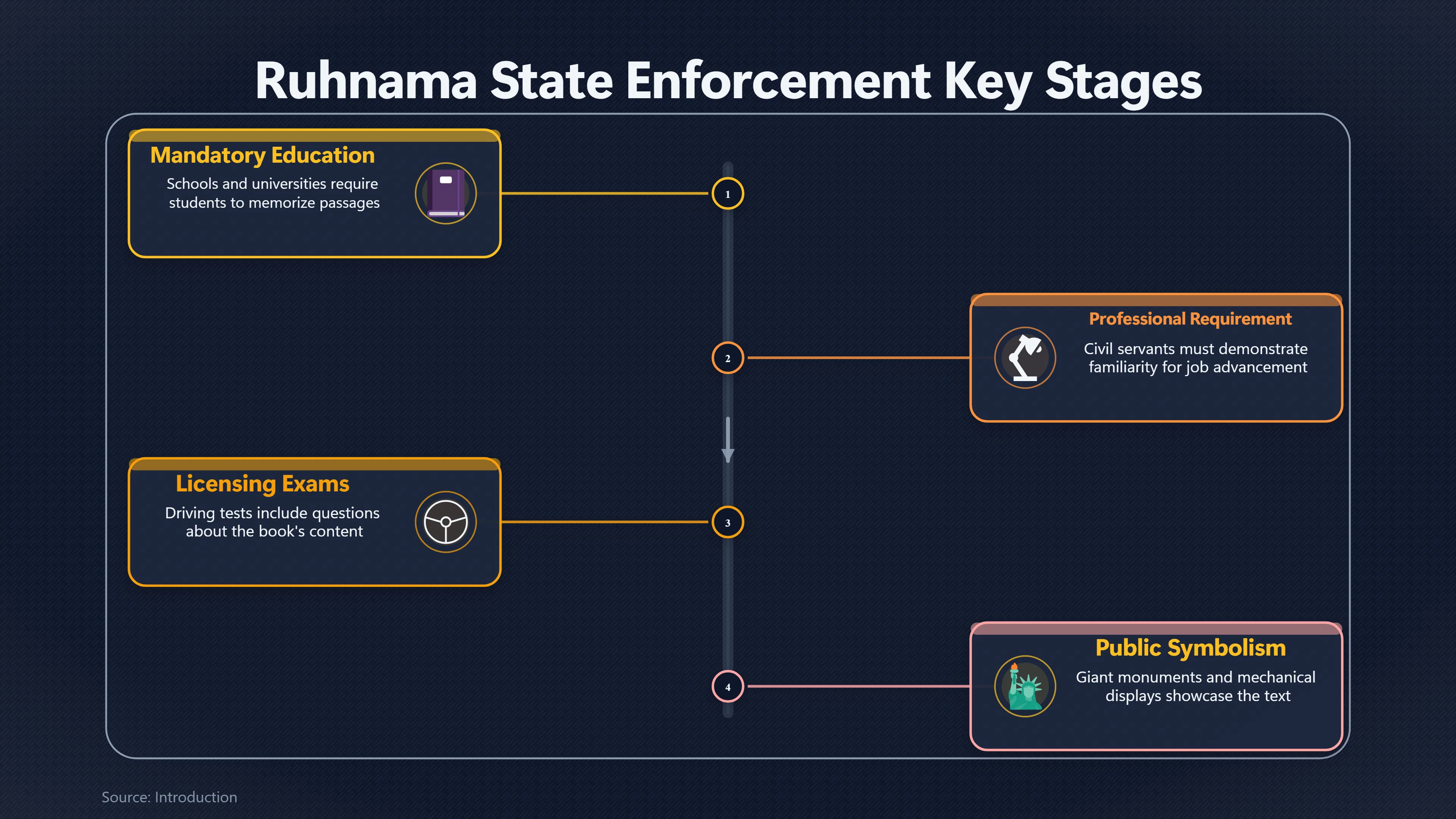
- Schools devoted substantial classroom time to studying and memorising passages.
- Universities examined students on its contents regardless of their academic subject.
- Civil servants and many employees were expected to demonstrate familiarity with it.
- Driving licence examinations reportedly included questions about the Ruhnama alongside traffic regulations.
- Public libraries, offices and homes often displayed the book prominently.[Wikipedia]WikipediaOpen source on wikipedia.org.
The state reinforced these expectations through constant public symbolism. Giant editions of the Ruhnama appeared in public spaces, including a famous mechanical monument in Ashgabat that opened dramatically while passages were displayed. Television, newspapers and official ceremonies repeatedly praised the text as an essential guide to national life. The cumulative effect was to make visible respect for the book an expected performance of civic loyalty.[Wikipedia]WikipediaOpen source on wikipedia.org.
This distinction is important. Evidence does not show that the entire population privately regarded the Ruhnama as genuinely sacred. Instead, authoritarian conditions meant that public conformity often concealed private scepticism. Compliance was encouraged through educational, professional and political incentives rather than voluntary religious conviction.

Religion, Education and Political Power
The most controversial aspect of the Ruhnama was the way it entered spaces traditionally occupied by religious authority.
State officials encouraged comparisons between the Ruhnama and the Qur’an, and in some cases implied that the two should stand alongside one another as guides for Turkmen society. Religious communities came under pressure to acknowledge the book’s importance, even though many Muslims regarded such comparisons as inappropriate.[USCIRF]uscirf.gov2008 Annual Report of the U.S. Commission on International Religious Freedom…
One of the clearest examples was the Türkmenbaşy Ruhy Mosque, completed in Niyazov’s home village. Alongside Qur’anic verses, extensive quotations from the Ruhnama were inscribed on the mosque itself, while references to Niyazov appeared in prominent locations. International religious freedom observers noted that many Muslims considered this deeply offensive because it blurred the boundary between divine revelation and presidential ideology. Government officials defended the inscriptions by arguing that Turkmen religious practice had its own distinctive national character and that the Ruhnama expressed patriotic rather than theological values.[USCIRF]uscirf.gov2008 Annual Report of the U.S. Commission on International Religious Freedom…
Education became another channel through which political authority merged with moral instruction. Rather than existing as one textbook among many, the Ruhnama increasingly served as a framework through which history, citizenship and ethics were interpreted. Academic research notes that during Niyazov’s rule, conventional history textbooks were largely absent, leaving the Ruhnama to function as the principal official guide for teachers explaining the nation’s past.[Vrije Universiteit Amsterdam]research.vu.nlVrije Universiteit Amsterdam Turkmenistan: Epics in Place of HistoriographyVrije Universiteit AmsterdamTurkmenistan: Epics in Place of Historiography - Vrije Universiteit Amsterdam…
Was It Really a Sacred Scripture?
Most scholars avoid describing the Ruhnama as an authentic religious scripture because its authority rested entirely on state power rather than on an independent religious tradition.
Instead, they describe it as an example of the “sacralisation” of politics. Political leaders borrowed religious language, rituals and symbols to strengthen state authority without formally replacing Islam. The book occupied an ambiguous position: officially it was presented as moral guidance for the nation, yet many of the practices surrounding it resembled the treatment normally reserved for holy texts.[Vrije Universiteit Amsterdam]research.vu.nlVrije Universiteit Amsterdam Turkmenistan: Epics in Place of HistoriographyVrije Universiteit AmsterdamTurkmenistan: Epics in Place of Historiography - Vrije Universiteit Amsterdam…
This also explains why the phenomenon differs from many new religious movements. The Ruhnama did not create a voluntary community of believers. Participation was largely compulsory, enforced through state institutions rather than sustained by independent faith communities.
Why the System Worked
The Ruhnama’s influence depended on several mutually reinforcing mechanisms.
First, independent media scarcely existed, leaving little room for public criticism. Second, schools, universities and government workplaces all promoted the same official message, making alternative interpretations difficult to express openly. Third, advancement in education and public employment often depended on visible conformity. Finally, the broader personality cult encouraged citizens to demonstrate loyalty publicly, regardless of their private opinions.
These conditions produced a society in which outward agreement could not easily be distinguished from genuine belief. Political scientists studying authoritarian systems often describe this as ritualised conformity: people repeatedly perform expected acts of loyalty because refusing carries personal risks, not necessarily because they accept the underlying claims.

After Niyazov
Following Niyazov’s death in 2006, President Gurbanguly Berdimuhamedow gradually reduced the Ruhnama’s official prominence. Schools introduced new textbooks, references to the book became less pervasive and some of the most conspicuous rituals surrounding it disappeared. Nevertheless, many observers noted that the underlying system of personalised political authority survived, with new books and ideological materials promoting the succeeding president instead.[Vrije Universiteit Amsterdam]research.vu.nlVrije Universiteit Amsterdam Turkmenistan: Epics in Place of HistoriographyVrije Universiteit AmsterdamTurkmenistan: Epics in Place of Historiography - Vrije Universiteit Amsterdam…
The decline of the Ruhnama therefore illustrates an important point. Its authority depended less on the intrinsic power of the text than on the state’s willingness to require public reverence. Once official sponsorship diminished, the appearance of sacred status faded rapidly.
Why the Ruhnama Still Matters
The Ruhnama remains one of the clearest modern examples of a government attempting to manufacture a civic scripture. Rather than emerging through centuries of religious tradition, its authority was created administratively through education, examinations, public ceremonies and official symbolism.
For historians of collective belief, the episode demonstrates how political power can imitate the forms of religion without necessarily generating widespread private faith. It also highlights an important distinction within the study of cults and mass belief: what appeared from outside as national devotion was often better understood as compulsory public performance under authoritarian rule. The Ruhnama’s significance lies not in proving that an entire society embraced a new scripture, but in showing how a state sought to make reverence itself an obligation.
Amazon book picks
Further Reading
Books and field guides related to How Did a President's Book Become Sacred?. Use these as the next step if you want deeper reading beyond the article.
The Future Is History: How Totalitarianism Reclaimed Russia
Examines ideology and authoritarianism in the post-Soviet world.
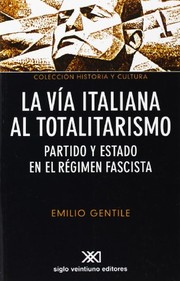
The Italian Road to Totalitarianism (Totalitarianism Movement...
First published 1995. Subjects: Totalitarianism, Fascism, Italy, politics and government, Politics and government.
Endnotes
1.
Source: Wikipedia
Link:https://en.wikipedia.org/wiki/Ruhnama
2.
Source: uscirf.gov
Link:https://www.uscirf.gov/sites/default/files/resources/AR2008/turkmenistan.pdf
Source snippet
2008 Annual Report of the U.S. Commission on International Religious Freedom...
3.
Source: uscirf.gov
Link:https://www.uscirf.gov/about-uscirf/about-us
4.
Source: uscirf.gov
Link:https://www.uscirf.gov/
5.
Source: uscirf.gov
Link:https://www.uscirf.gov/about-uscirf/about-uscirf
6.
Source: uscirf.gov
Link:https://www.uscirf.gov/publications/tolerance-religious-freedom-and-authoritarianism
7.
Source: 2017-2021.state.gov
Link:https://2017-2021.state.gov/report/custom/ebd34fee34/
8.
Source: research.vu.nl
Title: Vrije Universiteit Amsterdam Turkmenistan: Epics in Place of Historiography
Link:https://research.vu.nl/en/publications/turkmenistan-epics-in-place-of-historiography/
Source snippet
Vrije Universiteit AmsterdamTurkmenistan: Epics in Place of Historiography - Vrije Universiteit Amsterdam...
9.
Source: GOV.UK
Title: www.gov.uk Statement on freedom of religion or belief and cultural heritage
Link:https://www.gov.uk/government/publications/freedom-of-religion-or-belief-and-cultural-heritage-statement-at-the-international-ministerial-conference-2022/statement-on-freedom-of-religion-or-belief-and-cultural-heritage
Source snippet
Preamble 2. We commit to 3. Co-signatories [Button: Print this page] Image © Crown copyright 202...
10.
Source: hrw.org
Link:https://www.hrw.org/world-report/2006/country-chapters/turkmenistan
Additional References
11.
Source: centralasiaforum.org
Title: Towering above Ashga
Link:https://centralasiaforum.org/2023/11/05/the-age-of-maturity-for-the-turkmen-spirit-the-ruhnama-and-identity-production-in-post-soviet-turkmenistan/
Source snippet
‘The Age of Maturity for the Turkmen Spirit’: The Ruhnama and identity production in post-Soviet TurkmenistanNovember 5, 2023 — 5 Novembe...
Published: November 5, 2023
12.
Source: govinfo.gov
Title: COMPS 17724
Link:https://www.govinfo.gov/app/details/COMPS-17724
Source snippet
United States Commission on International Religious Freedom Reauthorization Act of 2024 - COMPS-17724 | Content Details | GovInfoSeptembe...
13.
Source: youtube.com
Title: This Country Renamed the Days of the Week. After the President’s Mom
Link:https://www.youtube.com/watch?v=mp5XhgZrpjw
Source snippet
Turkmenistan: The World's Strangest Dictatorship...
14.
Source: csce.gov
Link:https://www.csce.gov/press-releases/helsinki-commission-briefing-examine-0/
15.
Source: usa.gov
Link:https://www.usa.gov/agencies/u-s-commission-on-international-religious-freedom
16.
Source: youtube.com
Title: The Truth About Turkmenbashi, The Happy Dictator
Link:https://www.youtube.com/watch?v=_2Tmc_pmubQ
Source snippet
This Country Renamed the Days of the Week. After the President's Mom...
17.
Source: academic.oup.com
Link:https://academic.oup.com/edited-volume/37088/chapter/323192598?searchresult=1
Source snippet
and the Organization for Security and Co-operation in Europe | The Oxford Handbook of Religion and Europe | Oxford AcademicDecember 8, 20...
18.
Source: odihr.osce.org
Link:https://odihr.osce.org/odihr/429389
Source snippet
of Religion or Belief and Security: Policy Guidance | OSCE Office for Democratic Institutions and Human RightsSeptember 9, 2019 — GUIDE /...
Published: September 9, 2019
19.
Source: cambridge.org
Link:https://www.cambridge.org/core/journals/nationalities-papers/article/abs/aryans-or-prototurks-contested-ancestors-in-contemporary-central-asia/284C247A7745FCCF5EA127E2025D547A
20.
Source: cambridge.org
Link:https://www.cambridge.org/core/journals/nationalities-papers/article/aryans-or-prototurks-contested-ancestors-in-contemporary-central-asia/284C247A7745FCCF5EA127E2025D547A
Topic Tree