Within Mozambique Panics
Why Witchcraft Accusations Carry Such Power
Witchcraft accusations can turn illness, grief and rivalry into claims of intentional harm, exposing vulnerable people to expulsion or attack.
On this page
- How misfortune becomes a personal accusation
- Women, older people and property disputes
- Belief, social interest and legal response
Page outline Jump by section
Introduction
In Mozambique, witchcraft accusations are less about proving that supernatural harm has occurred than about explaining misfortune when ordinary answers feel inadequate. Sudden illness, an unexpected death, repeated family setbacks or disputes over land and inheritance can all become moments when suspicion settles on a particular individual. The accusation itself often matters more than any evidence: it can justify exclusion from a household, loss of property, social isolation or, in some cases, serious violence. Rather than treating these accusations simply as ancient superstition, historians and anthropologists argue that they reveal hidden tensions over wealth, authority, kinship and social change. They show how communities attempt to make sense of uncertainty while simultaneously exposing their most vulnerable members to harm.[CES - Centre for Social Studies]ces.uc.ptCentre for Social StudiesWitchcraft and Modernity in Mozambique…
How misfortune becomes a personal accusation
Many Mozambicans distinguish between everyday bad luck and harm believed to have been deliberately caused. When illness, infertility, crop failure or bereavement cannot be satisfactorily explained, rumours may identify a neighbour or relative as secretly responsible. The accusation transforms an impersonal tragedy into an interpersonal conflict with a recognisable culprit.
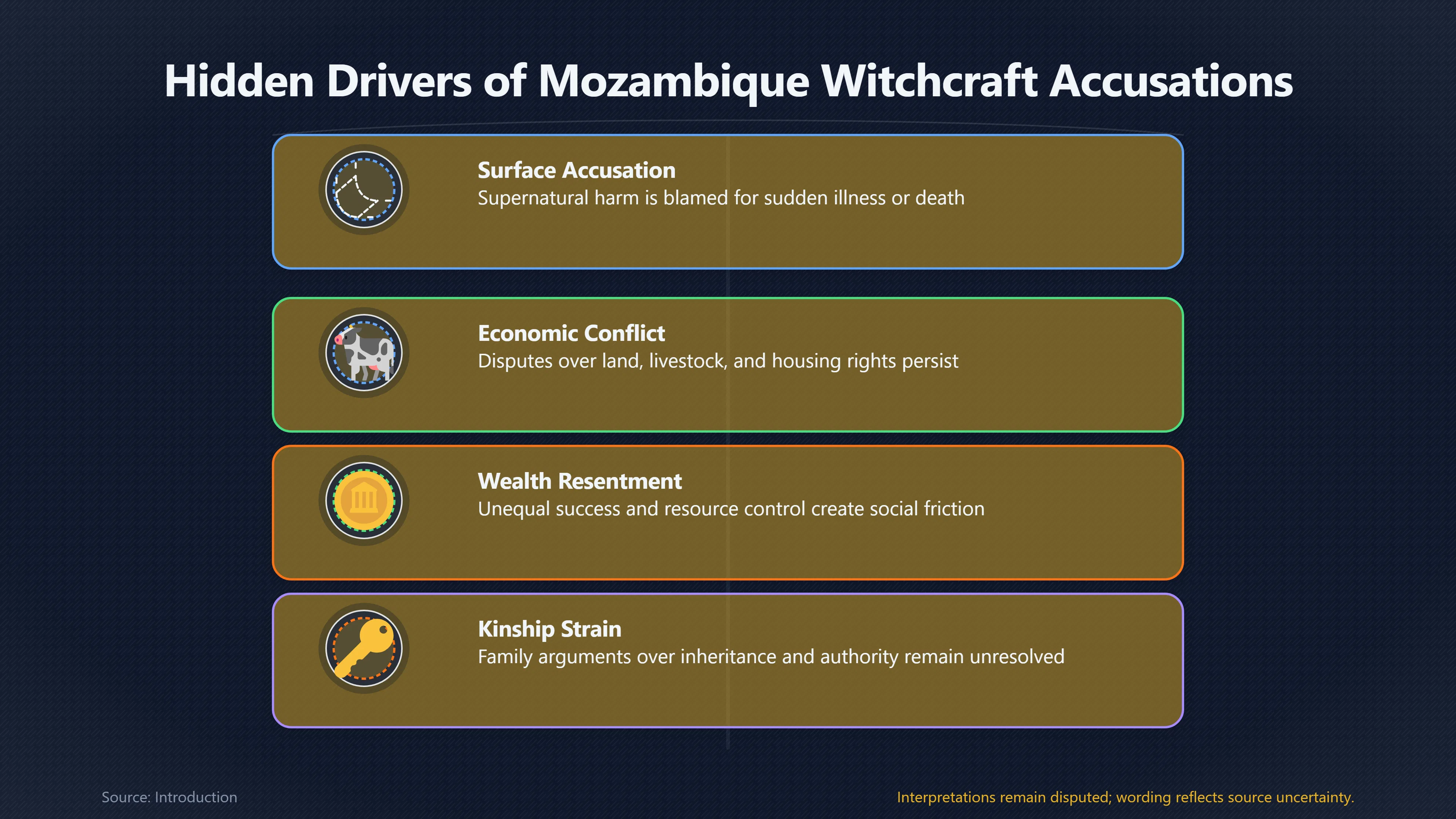
Anthropological research suggests that this process follows a recurring pattern rather than random fear. Misfortune alone rarely produces accusations. Instead, suspicion tends to settle on someone already connected to unresolved disputes, jealousy or unequal social relationships. A family argument over inheritance, resentment towards a successful relative or longstanding personal rivalry can suddenly acquire a supernatural explanation after an unexpected death or illness. Witchcraft therefore becomes a language through which social conflict is expressed rather than its original cause.[CES - Centre for Social Studies]ces.uc.ptCentre for Social StudiesWitchcraft and Modernity in Mozambique…
This helps explain why accusations often emerge during periods of economic hardship or rapid social change. Modernisation, migration and widening inequalities have not displaced beliefs about occult harm. Instead, researchers argue that uncertainty about who is prospering, who controls resources and who can be trusted has sometimes made such explanations more socially powerful.[CES - Centre for Social Studies]ces.uc.ptCentre for Social StudiesWitchcraft and Modernity in Mozambique…
Women, older people and property disputes
The people most frequently accused are rarely chosen at random. Across many parts of Mozambique, older women have been especially vulnerable, particularly if they are widowed, isolated or dependent on younger relatives. Elderly men can also be accused, but numerous reports describe older women being expelled from their homes after being blamed for illness or deaths within the family.[globalag.igc.org]globalag.igc.orgElderly 'Witches' Persecuted in MozambiqueJuly 3, 2002…
Property disputes often sit beneath these accusations. When land, livestock or housing rights are contested, branding an elderly relative a witch can become a way of removing them from the household without openly framing the dispute as an argument over inheritance. The accusation appears to concern supernatural danger while simultaneously producing practical economic consequences.
Reports from central Mozambique during the HIV/AIDS epidemic illustrated this mechanism. As deaths increased, some families sought explanations through traditional healers, who in certain cases identified elderly relatives as responsible. Those accused sometimes lost their homes, were abandoned by their children or faced physical attack. Researchers caution that these accusations reflected the strain placed on families by disease, grief and poverty rather than evidence of occult violence.[globalag.igc.org]globalag.igc.orgElderly 'Witches' Persecuted in MozambiqueJuly 3, 2002…
People with albinism have faced a different but related danger. In Mozambique and neighbouring countries, criminal networks have exploited beliefs that body parts from people with albinism possess magical powers capable of bringing wealth or success. Human Rights Watch and United Nations experts have documented killings, kidnappings and trafficking linked to these beliefs, demonstrating how occult narratives can contribute to severe human rights abuses.[Human Rights Watch]hrw.orgHuman Rights WatchWorld Report 2018: Mozambique | Human Rights Watch…
Why accusations persist despite modern institutions
Education, courts and modern medicine have not entirely displaced witchcraft accusations because they address different kinds of questions.
Medical professionals may identify the biological cause of an illness, but families may still ask why one particular person became ill at that particular moment. Courts can determine legal responsibility for a death, yet they cannot resolve anxieties about hidden motives, jealousy or spiritual danger. Witchcraft accusations often occupy this explanatory gap, offering a socially meaningful narrative even when they lack verifiable evidence.
Researchers studying contemporary Mozambique argue that beliefs about occult harm have adapted to modern conditions rather than surviving unchanged from the past. Rumours increasingly spread through mobile phones and social media, while accusations may involve successful business people, politicians or migrants alongside traditional village disputes. Modernity has therefore altered the form of these accusations without eliminating the underlying search for hidden causes.[CES - Centre for Social Studies]ces.uc.ptCentre for Social StudiesWitchcraft and Modernity in Mozambique…
Belief, social interest and legal response
Mozambique’s legal system does not recognise witchcraft as a factual basis for criminal liability, but authorities must still respond to the violence that accusations can trigger. Police investigate assaults, murders and forced expulsions arising from allegations of supernatural harm rather than attempting to determine whether magical acts occurred.
Human rights organisations consistently emphasise that victims require protection regardless of local belief systems. Older people, women and people with albinism have all been identified as groups facing elevated risks when accusations circulate. Public education campaigns have increasingly focused on preventing vigilantism while encouraging communities to resolve disputes through legal institutions instead of informal punishment.[Human Rights Watch]hrw.orgHuman Rights WatchWorld Report 2018: Mozambique | Human Rights Watch…
At the same time, scholars warn against dismissing belief itself as irrational ignorance. Doing so can obscure the genuine social pressures—bereavement, inequality, family conflict and insecurity—that give accusations their force. Effective responses therefore combine legal protection with mediation, healthcare, community education and efforts to reduce the underlying tensions that make accusations persuasive.[CES - Centre for Social Studies]ces.uc.ptCentre for Social StudiesWitchcraft and Modernity in Mozambique…

What these accusations reveal about hidden social conflict
Perhaps the most important insight from research in Mozambique is that witchcraft accusations are often better understood as indicators than explanations. They reveal fractures that might otherwise remain concealed.
Common underlying tensions include:
- Competition over land, housing or inheritance.
- Resentment of unequal wealth or unexpected success.
- Family conflict following illness or death.
- Anxiety created by migration, displacement or economic insecurity.
- Breakdown of trust between generations.
- The search for certainty during epidemics or periods of rapid social change.[igc.org]globalag.igc.orgElderly 'Witches' Persecuted in MozambiqueJuly 3, 2002…
Seen in this way, accusations of witchcraft are neither random folklore nor simply relics of the past. They are social mechanisms that transform private tensions into public blame. The immediate victim may be an elderly widow, a vulnerable neighbour or another marginalised individual, but the deeper conflict usually concerns family relationships, economic insecurity or struggles over authority. Understanding that distinction is essential for explaining why such accusations continue to carry extraordinary social power in parts of contemporary Mozambique.
Amazon book picks
Further Reading
Books and field guides related to Why Witchcraft Accusations Carry Such Power. Use these as the next step if you want deeper reading beyond the article.
Purity and danger
Offers influential ideas about belief, pollution, social order, and the cultural meaning of accusations.

The witch
Provides historical context for beliefs about witchcraft and why accusations endure across societies.
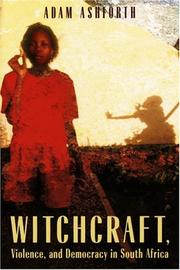
Witchcraft, Violence, and Democracy in South Africa
Examines the relationship between witchcraft beliefs, accusations, social tensions, and violence in southern Africa.
Witchcraft, Oracles and Magic Among the Azande
Explains how witchcraft accusations function as social explanations for misfortune and conflict.
Endnotes
1.
Source: ces.uc.pt
Link:https://www.ces.uc.pt/projectos/resumosen/profmm.php
Source snippet
Centre for Social StudiesWitchcraft and Modernity in Mozambique...
2.
Source: globalag.igc.org
Title: Elderly ‘Witches’ Persecuted in Mozambique
Link:https://globalag.igc.org/elderrights/world/elderlywitches.htm
Source snippet
July 3, 2002...
Published: July 3, 2002
3.
Source: youtube.com
Link:https://www.youtube.com/watch?v=st4uWIHc2YY
Source snippet
Police dismiss alleged genitals theft claims in Mombasa...
4.
Source: youtube.com
Link:https://www.youtube.com/watch?v=BkInvzS38ok
Source snippet
Mass Hysteria - How Intelligent Crowd Goes Insane...
5.
Source: hrw.org
Link:https://www.hrw.org/world-report/2018/country-chapters/mozambique
Source snippet
Human Rights WatchWorld Report 2018: Mozambique | Human Rights Watch...
6.
Source: hrw.org
Title: Human Rights Watch Mozambique | Country Page | World | Human Rights Watch
Link:https://www.hrw.org/africa/mozambique
7.
Source: hrw.org
Title: Those who do report may be further victimized by
Link:https://www.hrw.org/news/2025/04/07/submission-to-the-universal-periodic-review-of-malawi
Source snippet
Submission to the Universal Periodic Review of Malawi | Human Rights WatchApril 7, 2025 — Several LGBT individuals interviewed by Human R...
Published: April 7, 2025
8.
Source: hrw.org
Title: Mozambique: Alleged Soldiers Execute Woman | Human Rights Watch
Link:https://www.hrw.org/news/2020/09/17/mozambique-alleged-soldiers-execute-woman
9.
Source: hrw.org
Title: Mozambique: Security Forces Abusing Suspected Insurgents | Human Rights Watch
Link:https://www.hrw.org/news/2018/12/04/mozambique-security-forces-abusing-suspected-insurgents
10.
Source: ces.uc.pt
Link:https://ces.uc.pt/en/investigacao/projetos-de-investigacao/projetos-financiados/feiticaria-e-modernidade-em-mocambique
11.
Source: hrw.org
Link:https://www.hrw.org/world-report/2026/country-chapters/mozambique
12.
Source: hrw.org
Link:https://www.hrw.org/world-report/2024/country-chapters/mozambique
13.
Source: hrw.org
Link:https://www.hrw.org/world-report/2024/country-chapters/malawi
Additional References
14.
Source: nature.com
Link:https://www.nature.com/nature-index/topics/l4/witchcraft-accusations-and-socio-cultural-dynamics-in-africa
Source snippet
Witchcraft Accusations and Socio-Cultural Dynamics in Africa | Social and Cultural Anthropology | Anthropology | Social sciences |...
15.
Source: risetpress.com
Link:https://risetpress.com/index.php/pancasila/article/view/1999
Source snippet
f Applied Social ScienceNovember 4, 2025 — SOCIAL CONSEQUENCES OF WITCHCRAFT ACCUSATIONS: MARRIAGE, DIVORCE, AND COMMUNITY EXCLUSION IN Z...
Published: November 4, 2025
16.
Source: periodicos.unb.br
Title: br O que os negacionismos negam?
Link:https://periodicos.unb.br/index.php/anuarioantropologico/article/view/51426
Source snippet
Gestão do oculto e produção da verdade a partir de uma etnografia da política no norte de Moçambique | Anuário AntropológicoAugust 28, 20...
17.
Source: youtube.com
Title: Police dismiss alleged genitals theft claims in Mombasa
Link:https://www.youtube.com/watch?v=Obf_AVLUN9Q
Source snippet
"Government creates working group to understand rumors about genital organ atrophy.[https://www.youtube.com/watch?v=BkInvzS38ok..."](https://www.youtube.com/watch?v=BkInvzS38ok...")...
18.
Source: nature.com
Link:https://www.nature.com/articles/s41598-022-10315-8
19.
Source: youtube.com
Title: Why [Genital Panic]({{ ‘genital-panic/’ | relative_url }}) Is Spreading FASTER Than COVID
Link:https://www.youtube.com/watch?v=xi5bF2Kj8P0
Source snippet
"DAYBREAK EXTRA: How True Is Genital Theft?[https://www.youtube.com/watch?v=st4uWIHc2YY..."](https://www.youtube.com/watch?v=st4uWIHc2YY...")...
20.
Source: researchgate.net
Link:https://www.researchgate.net/publication/361115474_The_lived_experiences_of_elderly_women_accused_of_witchcraft_in_a_rural_community_in_South_Africa
21.
Source: africabib.org
Link:https://www.africabib.org/rec.php?RID=315943106
22.
Source: fao.org
Link:https://www.fao.org/4/al131e/al131e00.htm
23.
Source: cambridge.org
Link:https://www.cambridge.org/core/journals/africa/article/dangerous-neighbours-sorcery-conspicuous-exchange-and-proximity-among-urban-migrants-in-northern-mozambique/78024AB6832888931293D8059732F7CF
Topic Tree