When Belief Becomes Socially Powerful in Bosnia
Bosnia and Herzegovina does not have one famous, neatly bounded “mass hysteria” episode comparable with the Salem witch trials or a classic school fainting outbreak.
Page outline Jump by section
Introduction
What connects them is the way uncertainty becomes socially powerful. Reports spread through trusted communities, media repetition and personal testimony; authorities struggle to respond without deepening suspicion; and beliefs acquire economic, political or emotional value beyond the original claim. Bosnia and Herzegovina’s experience is therefore less a catalogue of bizarre delusions than a study of how faith, fear, trauma and distrust interact in a divided society.
Medjugorje: belief without official confirmation
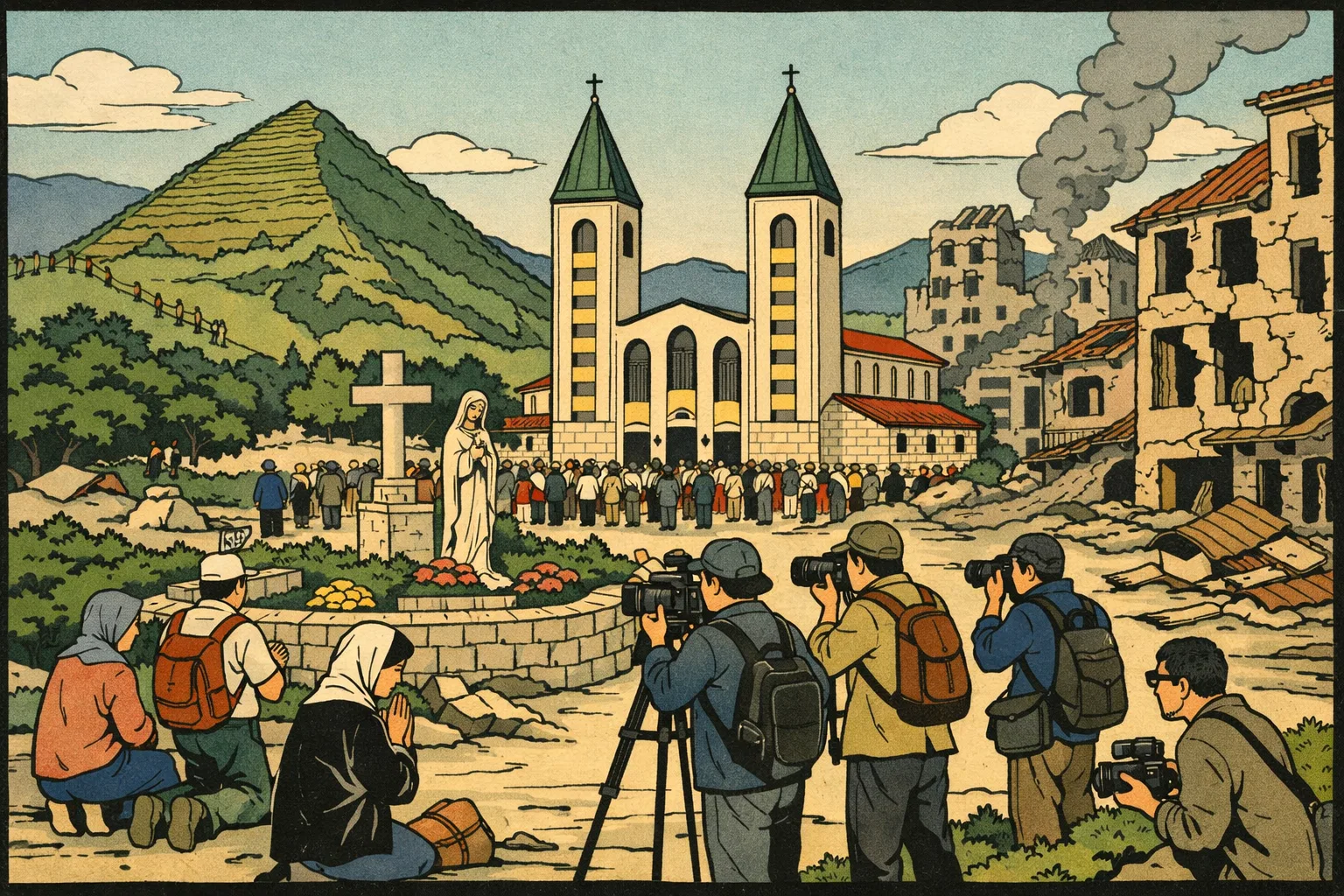
The country’s most internationally important collective-belief movement began in June 1981, when six children and teenagers in Medjugorje, then part of socialist Yugoslavia, reported seeing the Virgin Mary. Some of the original visionaries later said that the apparitions and messages continued. The reports attracted pilgrims first from the surrounding Catholic population and then from across the world, turning a small Herzegovinian parish into one of modern Catholicism’s best-known pilgrimage destinations.[apnews.com]apnews.comApproved apparitions often turn sites into major pilgrimage destinations, attracting millions of visitors. Some notable approved appariti…
Calling Medjugorje a “cult” would be misleading. It is better understood as a disputed apparition movement embedded within mainstream Catholic devotion. Pilgrims attend Mass, confess, pray, fast and climb local hills; believers commonly describe conversion, healing or renewed faith. The central message attributed to the apparition stresses peace, prayer and spiritual renewal, although some reported messages have also referred to catastrophe, secrets and future events.[Vatican]vatican.vaVatican“The Queen of Peace”: Note About the Spiritual Experience…19 Sept 2024 — “I have presented myself here as the Queen of Peace to…
The movement’s growth cannot be explained solely by whether an apparition occurred. It emerged in a region shaped by communist restrictions on organised religion, strong local Catholic identity and an old conflict between Franciscan clergy and the diocesan hierarchy. Scholars have therefore examined Medjugorje as both a religious experience and a social phenomenon: a local vision claim that became globally portable through pilgrimage networks, devotional publishing, recorded testimony and later the internet.[sagepub.com]journals.sagepub.comSage Journals Making Spirit Matter (for SociologySage JournalsMaking Spirit Matter (for Sociology) - Edward BERRYMAN…Herrero (1999) examines the Medjugorje apparitions mainly from the…
Church authorities spent decades separating three different questions: whether the visions were supernatural, whether the reported messages were doctrinally safe, and whether pilgrims experienced genuine spiritual benefit. In September 2024, the Vatican authorised public devotion associated with Medjugorje by issuing a favourable pastoral judgement. It explicitly did not declare the apparitions supernatural or authenticate every message attributed to Mary. Catholics may visit and practise the devotion, but they are not required to believe the visionaries’ claims.[vatican.va]press.vatican.vaVatican PressPress Conference to present the Note “The Queen of Peace…19 Sept 2024 — Note “The Queen of Peace” about the spiritual exp…
This distinction matters far beyond Medjugorje. Religious movements often persist because participants judge them by personal transformation rather than laboratory proof. A pilgrimage may produce friendship, hope or behavioural change even when the originating supernatural claim remains unresolved. The Vatican’s approach recognises those benefits while warning against treating every visionary statement as divine instruction. Its revised rules for alleged supernatural phenomena also reflect concern about fraud, financial exploitation and the speed with which unverified miracle claims can now circulate online.[The Guardian]theguardian.comOpen source on theguardian.com.
Medjugorje has also transformed its local economy. Accommodation, transport, shops and pilgrimage services grew around the influx of visitors. That does not disprove religious sincerity, but it creates interests that help sustain the site’s fame: pilgrims seek sacred experience, residents depend on visitors, promoters circulate testimonies, and sceptics see commercialisation as a reason for caution. The result is neither a simple hoax story nor an officially certified miracle, but a durable devotional culture built around an unsettled claim.[Reuters]reuters.comWhile the pope has not confirmed the authenticity of the apparitions, he highlights the positive spiritual outcomes for Catholics from th…

Visoko and the appeal of the “Bosnian pyramids”
A very different belief movement began in 2005, when businessman and amateur researcher Semir Osmanagić argued that steep hills around Visoko were enormous ancient pyramids constructed by an unknown civilisation. Visočica hill was promoted as the “Pyramid of the Sun”, while other landscape features received related names. Excavations, volunteer programmes, lectures and tourism followed, and the site developed into a mixture of archaeological attraction, alternative-history centre and New Age destination.[jstor.org]jstor.orgOpen source on jstor.org.
The scientific objection is straightforward. Geologists and archaeologists who examined the landscape concluded that the hills are natural formations made from local sedimentary layers. Their angular appearance is not evidence of artificial construction, and the exposed slabs presented as paving or concrete can be explained by ordinary geological processes. Researchers have also warned that unsupervised digging may damage genuine remains from medieval, Roman and earlier periods around Visoko.[Wikipedia]WikipediaBosnian pyramid claimsBosnian pyramid claims
In 2006, leading European archaeologists publicly condemned official support for the project, describing it as a misuse of scarce heritage resources. The criticism was not merely that a colourful theory had become popular. Archaeology is destructive: once a layer is dug away without proper recording, its context cannot be recreated. A search for an imagined lost civilisation can therefore erase evidence of real communities that occupied the same ground.[Wikipedia]WikipediaBosnian pyramid claimsBosnian pyramid claims
Yet scientific rejection did not end public enthusiasm. The project offers several things conventional archaeology often does not: an emotionally satisfying national antiquity, opportunities for volunteers to participate, dramatic claims of discovery and a landscape visitors can physically enter. Accounts of tunnels, unusual energy, healing atmospheres and forgotten technology broadened the appeal beyond people interested in ancient history. Scholars studying the phenomenon describe its use of scientific-sounding language alongside spiritual and alternative-archaeological themes.[JSTOR]jstor.orgOpen source on jstor.org.
The social setting is significant. Post-war Bosnia and Herzegovina has endured economic insecurity, damaged institutions and competing national histories. A claim that the country possesses structures older or greater than famous monuments elsewhere offers symbolic prestige without requiring agreement on the painful twentieth century. Tourism provides an additional incentive: even sceptics may welcome visitors and spending in a town that benefits from a distinctive attraction.[Condé Nast Traveler]cntraveler.comOpen source on cntraveler.com.
The Visoko phenomenon is best described as pseudoarchaeology rather than mass hysteria. There was no sudden epidemic of involuntary behaviour and no single moment when an entire population lost judgement. Instead, it shows how a weakly supported claim can develop a self-sustaining ecosystem. Media attention brings visitors; visitors are cited as evidence of importance; excavation creates visually persuasive surfaces; and scientific criticism can be reframed as proof that an establishment fears disruptive knowledge.
When fear became a weapon
The gravest episodes of contagious belief in Bosnia and Herzegovina were not harmless eccentricities. During the disintegration of Yugoslavia and the 1992–95 war, political leaders and aligned media helped portray neighbouring ethnic communities as existential threats. Nationalist reporting, selective atrocity stories, historical grievance and rumours of impending attack contributed to an atmosphere in which pre-emptive violence could be presented as self-defence. Journalists who witnessed the period have described how hostile broadcasting and inflammatory rhetoric escalated alongside the political crisis.[Balkan Insight]balkaninsight.comOpen source on balkaninsight.com.
This should not be confused with imaginary panic replacing a peaceful reality. Armed preparations, persecution, detention camps, ethnic cleansing, siege warfare and mass killing were real. Fear was powerful partly because genuine atrocities occurred. The manipulation lay in assigning collective guilt, repeating unverified or distorted stories, suppressing crimes committed by one’s own side and telling civilians that coexistence was impossible. International criminal proceedings subsequently assembled extensive evidence about organised campaigns of violence and the political structures behind them.[ICTY]icty.orgSecurity CouncilSecurity Council
Rumour in wartime serves several functions. It warns people of danger, fills gaps when reliable information is unavailable and helps communities interpret frightening events. It can also dehumanise. Stories about mutilated children, secret extermination plans or inherently treacherous neighbours are especially contagious because repeating them feels like protecting the group. Once fear becomes a test of loyalty, asking for evidence can itself appear suspicious.
Bosnia’s fragmented media environment after the war has allowed some of these dynamics to continue in altered form. Competing political narratives still present national groups as permanently endangered, especially around elections or constitutional disputes. The language is usually less openly violent than in the early 1990s, but recurring warnings of betrayal, domination or national disappearance keep public life organised around threat.[The New Yorker]newyorker.comThe New Yorker Conspiracy Theories, Denial, and the CoronavirusThe New Yorker Conspiracy Theories, Denial, and the Coronavirus
Denial as a collective belief system
The denial or minimisation of the 1995 Srebrenica genocide is a particularly consequential example. Courts, forensic investigations, mass-grave excavations, survivor testimony and DNA identification have established the systematic killing of thousands of Bosniak men and boys after Bosnian Serb forces captured the United Nations-declared safe area. Nevertheless, denialist narratives claim that victims were invented, were combat deaths, remain alive abroad or were bodies taken from other communities.[The New Yorker]newyorker.comThe New Yorker Conspiracy Theories, Denial, and the CoronavirusThe New Yorker Conspiracy Theories, Denial, and the Coronavirus
These claims are not simply individual misunderstandings. They are reinforced through political speeches, partisan media, commemorations and the public celebration of convicted war criminals. Denial protects collective self-image by replacing a morally intolerable history with a story of conspiracy and victimisation. It also shifts discussion away from evidence: every grave, judgement or identification can be presented as another part of the supposed plot.[The New Yorker]newyorker.comThe New Yorker Conspiracy Theories, Denial, and the CoronavirusThe New Yorker Conspiracy Theories, Denial, and the Coronavirus
Describing this as “mass hysteria” would obscure responsibility. Genocide denial is better understood as organised historical disinformation sustained by identity, power and institutional repetition. Its harm is concrete. It humiliates survivors, obstructs reconciliation, intimidates returnee communities and makes future political mobilisation through fear easier.

Magic, healing and the danger of careless labels
Belief in curses, harmful magic, spirits and supernatural illness has long existed among communities in Bosnia and Herzegovina, as it has elsewhere in the Balkans and Europe. Contemporary research among Bosniaks records ideas about possession, ghosts, magical attack and religious specialists who may be consulted for protection or healing. Such practices can combine Islamic language and prayer with older local customs, family tradition and popular explanations of misfortune.[ResearchGate]researchgate.netResearch Gate Magic and Witchcraft among the BosniaksResearch Gate Magic and Witchcraft among the Bosniaks
These beliefs should not automatically be presented as evidence of a national panic. Most are part of ordinary religious or folkloric life: private consultations, protective objects, prayers, stories or remedies. They become socially dangerous when an identifiable person is accused of causing illness or death, when frightened families spend heavily on fraudulent cures, or when psychological and medical problems are treated solely as supernatural attack.
Evidence for large, systematic witch prosecutions within the borders of present-day Bosnia and Herzegovina is much thinner than for some neighbouring Habsburg territories. That absence is important. Popular writing about “Balkan witch hunts” often merges different jurisdictions, centuries and legal systems into one dramatic narrative. Bosnia spent long periods under Ottoman administration, while neighbouring regions experienced different courts and church-state relationships. Folk belief in witches does not by itself prove that authorities conducted European-style mass trials.
The same caution applies to new or minority religions. Bosnia and Herzegovina contains small religious communities outside the largest Islamic, Orthodox, Catholic and Jewish traditions, but unfamiliarity is not evidence of coercion. The word “cult” is often used by opponents to imply brainwashing, secrecy or danger before any specific conduct has been demonstrated. A fair assessment asks about control over members, financial exploitation, isolation, abuse, threats and freedom to leave—not merely whether a group’s theology is unusual. Research on the country’s newer religious movements likewise treats them as a varied social field rather than one sinister category.[ResearchGate]researchgate.netOpen source on researchgate.net.
Pandemic rumours in a low-trust society
COVID-19 brought Bosnia and Herzegovina into a global wave of medical fear and misinformation. False claims about vaccines, microchips, population control, pharmaceutical conspiracies and the origins of the virus circulated through social media and informal networks. Regional polling and reporting found high levels of conspiracy belief and vaccine hesitancy, although attitudes varied and some initially sceptical people later accepted vaccination.[RadioFreeEurope/RadioLiberty]rferl.orgOpen source on rferl.org.
A qualitative study of vaccine attitudes in Bosnia and Herzegovina found that hesitation was not produced by one rumour alone. Participants referred to concerns about safety, hurried development, inconsistent official communication, distrust of institutions and contradictory information. In such settings, conspiracy stories succeed because they attach themselves to reasonable questions. A person may begin with uncertainty about side effects and end with a sweeping theory because the theory offers a clear villain and a complete explanation.[PMC]pmc.ncbi.nlm.nih.govPMCA Qualitative Study on COVID-19 Vaccine AcceptancePMCA Qualitative Study on COVID-19 Vaccine Acceptance
The country’s complex system of government made communication particularly difficult. Responsibility for health policy is divided across multiple levels and jurisdictions, while citizens already have reasons to distrust political institutions. Conflicting announcements or uneven access to vaccines can therefore look less like administrative disorder and more like intentional deception.
This episode fits the idea of a social scare more closely than a cult movement. The fear was decentralised, fast-moving and continually renewed by online content. Authorities faced a familiar dilemma: dismissing concerns could confirm suspicions of arrogance, while responding to every rumour risked giving fringe claims greater visibility. The most effective responses tended to address practical questions through trusted clinicians and local relationships rather than relying only on national political messaging.
What these cases have in common
Bosnia and Herzegovina’s episodes of contagious belief differ in origin and moral weight, but several recurring conditions help explain why they spread.
Uncertainty creates demand for coherent stories. Apparitions explain spiritual unease, pyramids offer a magnificent lost past, propaganda identifies an enemy, and medical conspiracies turn a confusing pandemic into an intentional plan.
Personal testimony can outweigh distant expertise. A pilgrim who reports healing, a neighbour who claims to have felt energy in a tunnel or a relative who fears a vaccine may seem more trustworthy than an institution already regarded with suspicion.
Beliefs become attached to identity. Questioning Medjugorje may feel like questioning a community’s faith. Rejecting the pyramids may be portrayed as belittling Bosnia. Accepting evidence of wartime crimes may be experienced as betraying one’s national group.
Material interests help narratives endure. Pilgrimage supports businesses, alternative archaeology attracts tourists, nationalist fear mobilises voters, and sensational misinformation generates attention. This does not mean every believer is motivated by profit or power; it means the surrounding system rewards continued circulation.
Official opposition can strengthen commitment. When a church, university, court or health authority challenges a claim, supporters may interpret that resistance as evidence of persecution. Flat denial is therefore often less effective than explaining how evidence was assessed and acknowledging the genuine needs that the belief addresses.
Why Bosnia’s history resists sensational summaries
The most important lesson is that collective belief is not a single psychological disorder. Medjugorje is a contested religious phenomenon with millions of participants and no Vatican ruling that its visions are supernatural. Visoko is a pseudoscientific and spiritualised tourism movement rejected by mainstream archaeology. Wartime propaganda and genocide denial are political systems of fear and distortion, not spontaneous crowd madness. Magical healing traditions are neither automatically fraudulent nor proof of persecution. Pandemic conspiracies combine global misinformation with local institutional distrust.
Placing all of them under the label “mass hysteria” would erase the differences between devotion, folklore, commercial promotion, trauma and deliberate manipulation. Bosnia and Herzegovina is more illuminating when those differences remain visible. Its history shows that beliefs spread not because whole populations suddenly become irrational, but because stories answer emotional and social needs, travel through trusted networks and become embedded in institutions, identities and livelihoods.
The enduring cultural question is therefore not simply why people believed extraordinary claims. It is why some claims supplied hope while others licensed hostility; why certain institutions earned trust and others did not; and how communities can challenge harmful narratives without treating believers as foolish or enemies.


Endnotes
1.
Source: academic.oup.com
Link:https://academic.oup.com/book/3873/chapter/145399189
Source snippet
OUP Academic13 Medjugorje: The Queen of Peace and a Civil WarHowever, the controversies of Medjugorje centred on regional affairs largely...
2.
Source: vatican.va
Link:https://www.vatican.va/roman_curia/congregations/cfaith/documents/rc_ddf_doc_20240919_nota-esperienza-medjugorje_en.html
Source snippet
Vatican“The Queen of Peace”: Note About the Spiritual Experience...19 Sept 2024 — “I have presented myself here as the Queen of Peace to...
3.
Source: reuters.com
Link:https://www.reuters.com/world/europe/pope-francis-allows-devotion-medjugorje-where-virgin-mary-said-appear-2024-09-19/
Source snippet
While the pope has not confirmed the authenticity of the apparitions, he highlights the positive spiritual outcomes for Catholics from th...
4.
Source: press.vatican.va
Link:https://press.vatican.va/content/salastampa/en/bollettino/pubblico/2024/09/19/240919i.html
Source snippet
Vatican PressPress Conference to present the Note “The Queen of Peace...19 Sept 2024 — Note “The Queen of Peace” about the spiritual exp...
5.
Source: jstor.org
Link:https://www.jstor.org/stable/48740784
6.
Source: Wikipedia
Title: Bosnian pyramid claims
Link:https://en.wikipedia.org/wiki/Bosnian_pyramid_claims
7.
Source: icty.org
Title: Security Council
Link:https://www.icty.org/x/file/About/OTP/un_commission_of_experts_report1994_en.pdf
8.
Source: icty.org
Title: Kordic and Cerkez
Link:https://www.icty.org/x/cases/kordic_cerkez/tjug/en/
9.
Source: researchgate.net
Title: Research Gate Magic and Witchcraft among the Bosniaks
Link:https://www.researchgate.net/publication/331285783_Curse_Possession_and_Other_Worlds_Magic_and_Witchcraft_among_the_Bosniaks
10.
Source: researchgate.net
Link:https://www.researchgate.net/publication/366263125_Magic_and_Hodzas_as_Magic_Specialists_in_Contemporary_Bosnia_and_Herzegovina
11.
Source: researchgate.net
Link:https://www.researchgate.net/publication/352045381_Survey_of_Religious_Movements_Communities_and_Churches_in_Bosnia_and_Herzegovina
12.
Source: icty.org
Link:https://www.icty.org/x/cases/mladic/trans/en/960628IT.htm
13.
Source: icty.org
Link:https://www.icty.org/x/cases/slobodan_milosevic/trans/en/040212ED.htm
14.
Source: icty.org
Title: brd tj040901e
Link:https://www.icty.org/x/cases/brdanin/tjug/en/brd-tj040901e.pdf
15.
Source: icty.org
Link:https://www.icty.org/x/cases/krstic/tjug/en/krs-tj010802e-3.htm
16.
Source: icty.org
Title: Delalic et al
Link:https://www.icty.org/x/cases/mucic/tjug/en/cel-tj981116e-2.htm
17.
Source: icty.org
Link:https://www.icty.org/x/cases/karadzic/trans/en/091102IT.htm
18.
Source: icty.org
Title: brcko en
Link:https://www.icty.org/x/file/Outreach/Bridging_the_Gap/brcko_en.pdf
19.
Source: icty.org
Link:https://www.icty.org/x/cases/sikirica/trans/en/010319ed.htm
20.
Source: Wikipedia
Title: Helena Scheuberin
Link:https://en.wikipedia.org/wiki/Helena_Scheuberin
21.
Source: Wikipedia
Title: Satanic panic
Link:https://en.wikipedia.org/wiki/Satanic_panic
22.
Source: Wikipedia
Title: List of mass panic cases
Link:https://en.wikipedia.org/wiki/List_of_mass_panic_cases
23.
Source: Wikipedia
Title: Witch trials in the early modern period
Link:https://en.wikipedia.org/wiki/Witch_trials_in_the_early_modern_period
24.
Source: Wikipedia
Title: Arnold Paole
Link:https://en.wikipedia.org/wiki/Arnold_Paole
25.
Source: Wikipedia
Title: Propaganda during the Yugoslav Wars
Link:https://en.wikipedia.org/wiki/Propaganda_during_the_Yugoslav_Wars
26.
Source: Wikipedia
Title: New religious movement
Link:https://en.wikipedia.org/wiki/New_religious_movement
27.
Source: press.vatican.va
Link:https://press.vatican.va/content/salastampa/en/bollettino/pubblico/2024/09/19.html
28.
Source: vatican.va
Title: 20260129 plenaria ddf
Link:https://www.vatican.va/content/leo-xiv/en/speeches/2026/january/documents/20260129-plenaria-ddf.html
29.
Source: vatican.va
Title: Calendar of Activities
Link:https://www.vatican.va/content/vatican/ar/events/day.dir.html/2024/9/19.html
30.
Source: press.vatican.va
Link:https://press.vatican.va/content/salastampa/en/info/2024/10/08/241008b.html
31.
Source: vatican.va
Link:https://www.vatican.va/roman_curia/congregations/cfaith/doc_doc_index.htm
32.
Source: press.vatican.va
Link:https://press.vatican.va/content/salastampa/en/bollettino/pubblico/2024/09/19/240919e.html
33.
Source: press.vatican.va
Link:https://press.vatican.va/content/salastampa/en/bollettino/pubblico/2024/09/19/240919g.html
34.
Source: press.vatican.va
Link:https://press.vatican.va/content/salastampa/en/bollettino/pubblico/2024/09.html
35.
Source: researchgate.net
Link:https://www.researchgate.net/publication/271759288_Mass_hysteria_among_South_African_primary_school_learners_in_Kwa-Dukuza_KwaZulu-Natal
36.
Source: researchgate.net
Title: 336655425 Understanding Medjugorje A Khaldunian Approach to a Marian Apparition
Link:https://www.researchgate.net/publication/336655425_Understanding_Medjugorje_A_Khaldunian_Approach_to_a_Marian_Apparition
37.
Source: researchgate.net
Link:https://www.researchgate.net/publication/392679270_Politicized_Archaeology_and_Cultural_Gatekeeping_The_Case_of_the_Bosnian_Pyramids
38.
Source: researchgate.net
Link:https://www.researchgate.net/publication/358767746_Balkan_Vampire_Myth_Urban_Legends_or_a_Publicity_tool
39.
Source: researchgate.net
Title: 400646219 NEW RELIGIOUS MOVEMENTS AS A FACTOR THREATENING SECURITY
Link:https://www.researchgate.net/publication/400646219_NEW_RELIGIOUS_MOVEMENTS_AS_A_FACTOR_THREATENING_SECURITY
40.
Source: church.mt
Title: the alleged phenomena at medjugorje
Link:https://church.mt/the-alleged-phenomena-at-medjugorje/
41.
Source: history.com
Title: what was satanic panic 1980s
Link:https://www.history.com/articles/what-was-satanic-panic-1980s
42.
Source: archive.archaeology.org
Link:https://archive.archaeology.org/online/features/osmanagic/UNESCO.pdf
43.
Source: youtube.com
Title: The Triumph, a Medjugorje documentary
Link:https://www.youtube.com/watch?v=c9dQYRQXbXc
Source snippet
Medjugorje | Between Heaven And Earth...
44.
Source: youtube.com
Title: Medjugorje | Between Heaven And Earth
Link:https://www.youtube.com/watch?v=0-D3PGPvkj8
45.
Source: apnews.com
Link:https://apnews.com/article/be65969f636c3055cd3b7b260e1fc412
Source snippet
Approved apparitions often turn sites into major pilgrimage destinations, attracting millions of visitors. Some notable approved appariti...
46.
Source: journals.sagepub.com
Title: Sage Journals Making Spirit Matter (for Sociology)
Link:https://journals.sagepub.com/doi/10.1177/003776801048004009
Source snippet
Sage JournalsMaking Spirit Matter (for Sociology) - Edward BERRYMAN...Herrero (1999) examines the Medjugorje apparitions mainly from the...
47.
Source: theguardian.com
Link:https://www.theguardian.com/world/article/2024/may/17/vatican-rules-supernatural-phenomena-crackdown-hoaxes
48.
Source: cntraveler.com
Link:https://www.cntraveler.com/stories/2008-01-03/landscape-after-battle
49.
Source: balkaninsight.com
Link:https://balkaninsight.com/2022/04/05/bosnian-journalists-recall-escalating-ethnic-hatred-as-war-began/btj/
50.
Source: rferl.org
Link:https://www.rferl.org/a/In_The_Balkans_The_Headlines_Preceded_The_War/1757912.html
51.
Source: newyorker.com
Title: The New Yorker Conspiracy Theories, Denial, and the Coronavirus
Link:https://www.newyorker.com/news/daily-comment/conspiracy-theories-denial-and-the-coronavirus
52.
Source: rferl.org
Link:https://www.rferl.org/a/bosnia-covid-vaccine-cuts-both-ways/30998431.html
53.
Source: apnews.com
Link:https://apnews.com/article/coronavirus-pandemic-health-business-sarajevo-pandemics-701c36d69d1884711eb9040b91303c3c
54.
Source: pmc.ncbi.nlm.nih.gov
Title: PMCA Qualitative Study on COVID-19 Vaccine Acceptance
Link:https://pmc.ncbi.nlm.nih.gov/articles/PMC10603202/
55.
Source: pmc.ncbi.nlm.nih.gov
Link:https://pmc.ncbi.nlm.nih.gov/articles/PMC7396040/
56.
Source: pmc.ncbi.nlm.nih.gov
Link:https://pmc.ncbi.nlm.nih.gov/articles/PMC8884480/
57.
Source: theguardian.com
Title: was ripon school gripped by mass psychogenic illness
Link:https://www.theguardian.com/science/2015/nov/14/was-ripon-school-gripped-by-mass-psychogenic-illness
58.
Source: theguardian.com
Title: carol morley the falling mass hysteria is a powerful group activity
Link:https://www.theguardian.com/film/2015/mar/29/carol-morley-the-falling-mass-hysteria-is-a-powerful-group-activity
59.
Source: theguardian.com
Link:https://www.theguardian.com/itn/article/0%2C%2C191232%2C00.html
60.
Source: journals.sagepub.com
Link:https://journals.sagepub.com/doi/10.1177/13675494221074715
61.
Source: journals.sagepub.com
Link:https://journals.sagepub.com/doi/10.1177/17579759231174750
62.
Source: balkaninsight.com
Title: bosnia and herzegovina
Link:https://balkaninsight.com/2017/03/23/bosnia-s-pyramids-get-celebrated-from-unusual-perspective-03-23-2017/bi/bosnia-and-herzegovina/
Additional References
63.
Source: inspire.redlands.edu
Link:https://inspire.redlands.edu/works/publication-article/02ef1c89-37f5-47a4-8840-4633cf5cb0c4
Source snippet
RepositoryA Khaldûnian Approach to a Marian Apparition1 Jul 2016 — Sociologists have generally treated the reports of the Marian appariti...
64.
Source: youtube.com
Link:https://www.youtube.com/watch?v=gzn54gqnefE
Source snippet
1986 BBC Medjugorje documentary, Madonna of Medjugorje...
65.
Source: youtube.com
Title: Are There Ancient Pyramids in Visoko, Bosnia?
Link:https://www.youtube.com/watch?v=rR2o1CvEfRY
Source snippet
I ENTERED THE LARGEST PYRAMID IN THE WORLD (NOT IN EGYPT!): VISOKO in BOSNIA AND HERZEGOVINA...
66.
Source: youtube.com
Link:https://www.youtube.com/watch?v=tTgy26_8e5k
Source snippet
The Triumph, a Medjugorje documentary - Full Movie...
67.
Source: academia.edu
Link:https://www.academia.edu/197875/Addressing_Invented_Heritage_The_Case_of_the_Bosnian_Pyramids
68.
Source: facebook.com
Link:https://www.facebook.com/Pyramid.of.the.Sun.Official/posts/breaking-new-scientific-publication-on-bosnian-pyramid-tunnels-ravne-6an-interna/1392387812916270/
69.
Source: wildwitchherbs.com
Link:https://wildwitchherbs.com/balkan-witchcraft-croatia-vs-serbia-vs-bosnia/
70.
Source: academia.edu
Link:https://www.academia.edu/Documents/in/Cults_and_New_Religious_Movements
71.
Source: ewtn.com
Link:https://www.ewtn.com/catholicism/library/medjugorje-deception-or-miracle-5427
72.
Source: jelsciences.com
Link:https://www.jelsciences.com/articles/jbres2106.php
Topic Tree
Follow this branch
Related pages 192
- Antigua and Barbuda
- Argentina Belief Scares
- Azerbaijan Belief
- Bahrain Beliefs
- North Korea
- +187 more in sidebar