When Belief Became a Threat in Palau
Palau does not have a well-documented history of classic mass-hysteria outbreaks, witch trials or large apocalyptic sects. The strongest case within this field is Modekngei, an indigenous religious movement that appeared around 1914, just as Japanese forces replaced German colonial rule.
Page outline Jump by section
Introduction
It would nevertheless be misleading to describe Modekngei simply as a “cult”, a collective delusion or a panic. It became a durable Palauan religion and remains part of the country’s public life. Its history is most revealing as a study of contested belief: a spiritual response to rapid colonial change that outsiders often interpreted as political subversion. The episode shows how administrative fear, missionary rivalry and anthropological labelling can turn an unfamiliar religion into an apparent social threat.
Why the evidence is unusually thin
Researchers looking for Palauan equivalents of the Salem witch trials, school fainting epidemics or satanic panics encounter a basic limitation: the published record contains no securely documented national episode of that kind. Searches often produce material from Papua New Guinea or the wider Melanesian region, where sorcery accusations have caused serious violence, but those cases should not be transferred to Palau merely because both lie in the Pacific.
That absence is itself important. “Mass hysteria” is a broad and frequently misused label. It can refer to genuine mass psychogenic illness, in which people develop real symptoms without an identified toxic or infectious cause; to a moral panic, in which authorities and media exaggerate a perceived social danger; or simply to beliefs that an outside observer considers irrational. These are not interchangeable phenomena.
Palau’s historical record is also uneven. Much of the written material was produced by colonial administrators, missionaries and later foreign anthropologists. Their documents preserve valuable information, but they do not provide a neutral window into local experience. Practices that Palauans understood as healing, prophecy, communication with spiritual beings or cultural continuity could be classified by outsiders as superstition, agitation or backwardness.
For that reason, Palau’s most useful case is not a dramatic outbreak of contagious illness. It is the struggle over how Modekngei should be understood.
Modekngei emerges under colonial rule
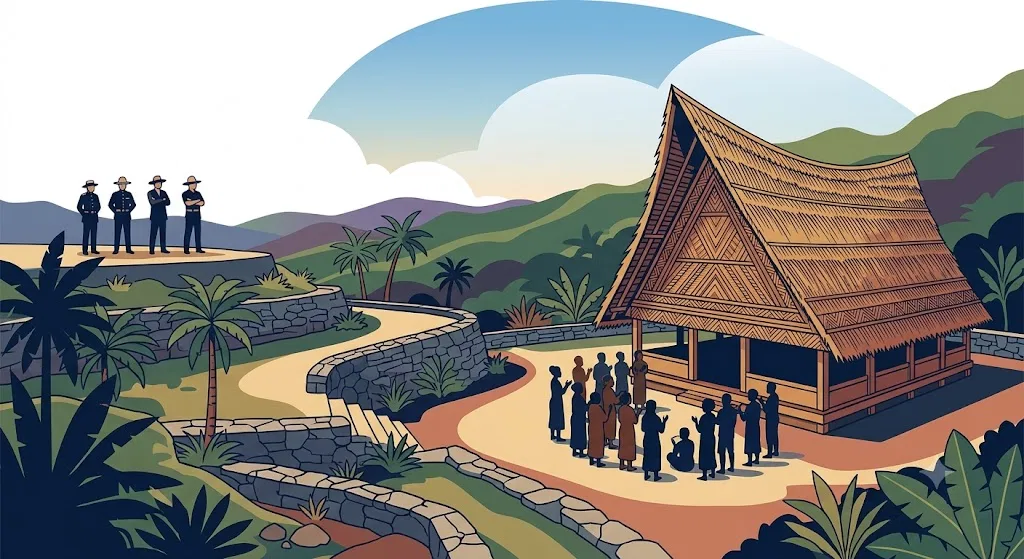
Modekngei began on Babeldaob, Palau’s largest island, at about the time Japan occupied the islands in 1914. Anthropologist Machiko Aoyagi traced its origin to Tamadad, a titled man and ritual specialist from Chol who was said to have received a revelation from a spiritual being. Tamadad and associates including Ongesi and Ruguul then developed a growing religious following. The name has been explained as conveying the idea of gathering or coming together.[minpaku.repo.nii.ac.jp]minpaku.repo.nii.ac.jpSES21 016Gods of the Modekngei Religion in Belauby 青柳真智子 · 1987 · Cited by 7 — The origin of the Modekngei religion can be traced back to about 19…
The movement joined elements that colonial writers often treated as incompatible. Its sacred songs referred to indigenous spiritual powers while also incorporating Christian figures and moral ideas. Aoyagi’s study of 128 religious songs found a complex body of teaching involving numerous named and unnamed divine beings rather than a simple imitation of either traditional religion or missionary Christianity.[minpaku.repo.nii.ac.jp]minpaku.repo.nii.ac.jpSES21 016Gods of the Modekngei Religion in Belauby 青柳真智子 · 1987 · Cited by 7 — The origin of the Modekngei religion can be traced back to about 19…
This blending made sense in a society experiencing repeated foreign interventions. Spain had claimed Palau, Germany had administered it from 1899, and Japan took control during the First World War. Christian missions competed for converts while colonial governments introduced new schools, laws, labour arrangements and ideas of proper behaviour. Modekngei offered a way to absorb some Christian teachings without abandoning Palauan spiritual authority.
Its teachings were transmitted largely through songs and performance rather than a single written scripture. That made the religion portable and communal, but it also made it difficult for officials to monitor. Meetings, inspired speech and songs whose meanings were not always accessible to Japanese administrators could appear to conceal political organisation.
When unfamiliar religion became a security scare
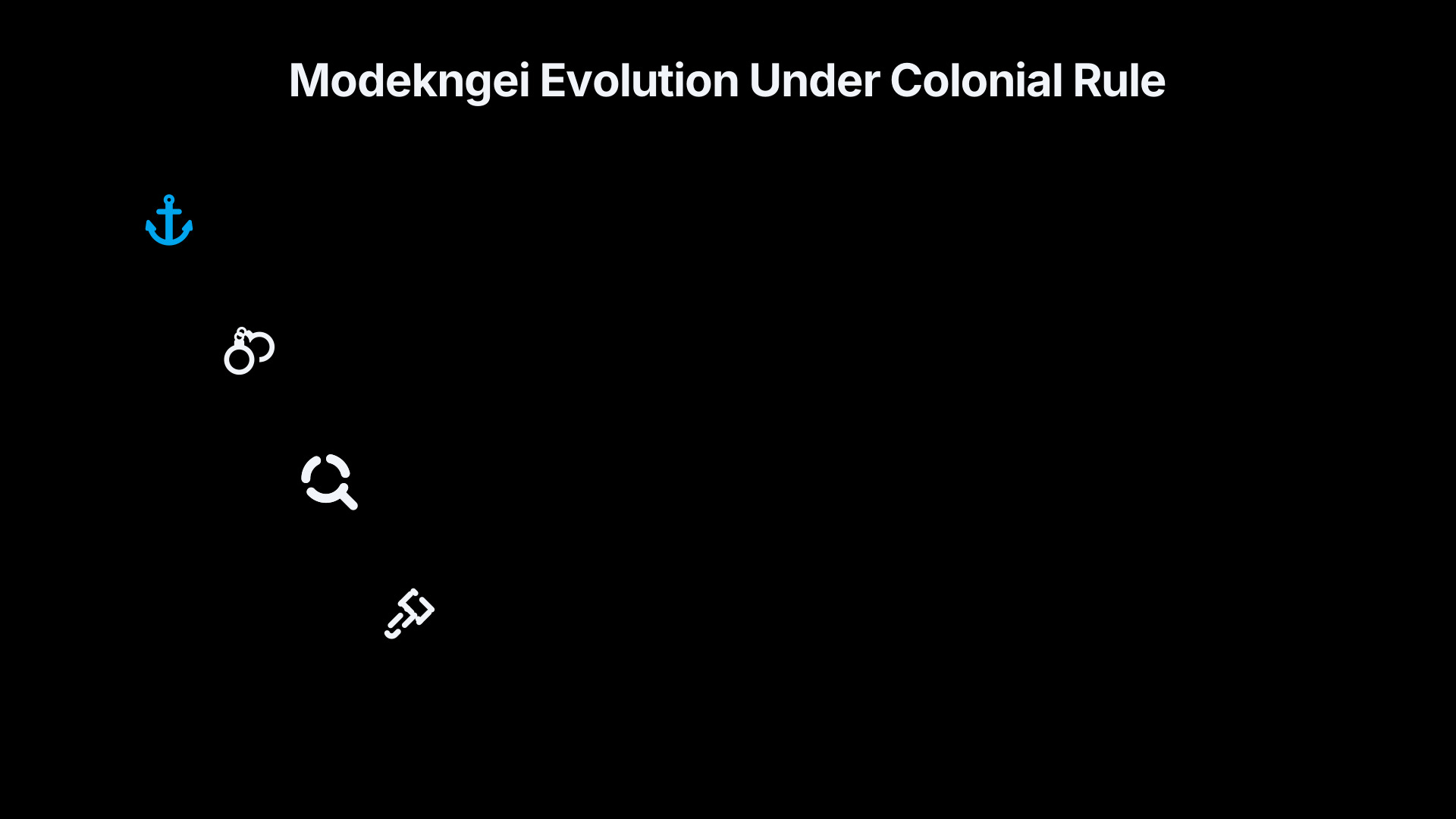
Japanese authorities began suppressing Modekngei soon after its appearance. Aoyagi reports that Tamadad, Ongesi and Ruguul were arrested and interrogated several times by the Japanese Navy and by the South Seas Bureau, the civilian administration that succeeded naval government in 1922. Officials suspected the leaders of politically dangerous activity.[minpaku.repo.nii.ac.jp]minpaku.repo.nii.ac.jpSES21 016Gods of the Modekngei Religion in Belauby 青柳真智子 · 1987 · Cited by 7 — The origin of the Modekngei religion can be traced back to about 19…
This response can be read as a colonial moral panic, although the surviving evidence does not establish a single sudden wave of public terror. The perceived danger lay less in a specific violent act than in an independent network of belief and loyalty. Modekngei leaders could gather people, communicate through religious forms and claim authority that did not come from the colonial state or an approved mission.
The political interpretation became influential in later scholarship. Many researchers described Modekngei as an anti-colonial or nationalist movement disguised as religion. On that reading, its combination of indigenous traditions and Christianity helped Palauans resist cultural assimilation without directly confronting a much stronger colonial power.
Aoyagi challenged this as too simple. Drawing on Palauan accounts and detailed study of worship, she argued that Modekngei must be taken seriously as a religion, not reduced to a coded political protest. Kazumi Nishihara’s review of her work notes that earlier scholars had commonly presented the movement as anti-colonial, whereas Aoyagi emphasised its theology and the ways followers themselves explained its origin and purpose.[ResearchGate]researchgate.netResearch Gate Modekngei: A New Religion in Belau, Micronesia (reviewModekngei: A New Religion in Belau, Micronesia (review)September 1, 2003 — In this book, Machiko Aoyagi challenges the preval…
Both interpretations may contain part of the truth. A religion does not have to begin as a political conspiracy to produce political consequences. In a colonial society, preserving local ritual knowledge, gathering independently and refusing complete cultural assimilation can become politically significant even when participants understand their actions primarily as spiritual.
Prophecy, healing and the language of “cult”
Modekngei belongs to a wider family of religious movements that scholars have variously called prophetic, revitalisation, syncretic or millenarian. Such labels describe attempts to renew society through revelation, moral reform or a promised transformation. They can be helpful, but each carries assumptions.
The word “cult” is especially problematic. In ordinary speech it suggests manipulation, coercion or devotion to a dangerous leader. Older anthropology used “cult” much more broadly for organised ritual activity or a recently formed religion. A historical source calling Modekngei a cult therefore does not necessarily allege abuse, criminal conduct or psychological control.
“Cargo cult” is also a poor fit when used casually. That term was applied across colonial Melanesia to movements supposedly expecting supernatural delivery of European goods. Scholars have criticised it for flattening very different indigenous responses to missionary teaching, racial inequality and colonial power. Modekngei was not simply a fantasy that ritual would produce material cargo. Its enduring concerns included spiritual authority, healing, morality, community discipline and the preservation of Palauan identity.
Nor is there evidence that its followers were swept up in a temporary collective delusion. Modekngei survived the Japanese period, the devastation of the Second World War, United States trusteeship and Palauan independence. A short-lived panic normally fades when the immediate fear or rumour collapses. A religion sustained across generations requires institutions, teachings, family transmission and a recognised place within society.
From suspected movement to recognised religion
The modern position of Modekngei sharply contrasts with its treatment under Japanese rule. Palau’s 2020 census recorded Modekngei as the religion of about 5.1 per cent of the population. It remains distinctive to Palau, combining indigenous and Christian elements rather than functioning as a branch of a larger overseas denomination.[palaugov.pw]palaugov.pw2020 Census of Population and HousingKoror2020 Census of Population, The 2020 Census of Palau contains basic tables, Ethnicity and Religion by Legal Residence, Ethnicity and…
Its strongest contemporary centre is associated with Ibobang in Ngatpang. The community is also home to Belau Modekngei School, established to provide ordinary education alongside Palauan culture, practical knowledge and religious instruction. Recent educational descriptions present the school as part of Palau’s recognised private-school landscape, not as a clandestine or prohibited organisation.[airuniversity.af.edu]airuniversity.af.eduCULTURE GUIDE - Air UniversityMarch 13, 2025 — Modekngei religion (see Religion and Spirituality), emerged victorious…
National law now provides explicit protection for religious belief. Article IV of Palau’s constitution prohibits government action that compels, hinders or forbids religious practice and rejects the establishment of a national religion. It also permits fair public assistance to religious schools for non-religious purposes.[FAOLEX]faolex.fao.orgPalau's Constitution of 1981 with Amendments through 1992April 24, 2014 — The government shall take no action to deny or impair the…
Recent religious-freedom reporting similarly describes Modekngei as an indigenous religious group and records no general state campaign against it. The same reports place its schools alongside Catholic, Evangelical and Seventh-day Adventist institutions receiving assistance for permitted educational purposes.[State Department]state.govModekngei, Catholic,State Department2023 Report on International Religious Freedom: PalauModekngei, an indigenous religious group embracing both animist and…
That transition—from arrests and suspicion to constitutional recognition—reveals how categories of deviance change. A movement that appeared threatening to a colonial government can later be understood as part of national heritage.
What made the movement spread
No single explanation accounts for Modekngei’s appeal. Its growth appears to have drawn strength from several overlapping pressures.
Rapid changes of government mattered. Palauans passed through Spanish, German and Japanese control within a relatively short period. Every administration brought different laws, languages, institutions and religious allies. A locally rooted faith offered continuity when outside authorities repeatedly changed.
Missionary Christianity created both pressure and new religious possibilities. Conversion did not simply erase earlier beliefs. Christian stories, prayers and moral language could be reinterpreted through Palauan concepts of spiritual power. Modekngei allowed followers to engage with Christianity without surrendering all indigenous forms of knowledge.
Songs created social cohesion. Sacred songs could preserve teachings, memories and spiritual names without reliance on colonial schools or imported books. Singing also made belief collective: participants did not merely accept a proposition but enacted it together.
Suppression may have increased solidarity. Arresting leaders could confirm followers’ sense that their faith possessed power or that outsiders feared it. Repression also drew sharper boundaries between adherents and institutions aligned with colonial authority.
The movement addressed uncertainty. Prophetic and healing religions often become compelling when familiar institutions no longer seem able to explain suffering or social disruption. This does not mean believers are irrational. It means religious movements can supply moral order, shared language and communal support during periods of profound change.
Colonial fear versus collective hysteria
The most accurate description of the Modekngei episode depends on whose behaviour is being examined. The followers formed an innovative religious community. Japanese officials perceived a possible political network. Missionaries encountered a competitor that blurred the boundary between Christianity and indigenous religion. Later scholars debated whether the movement was primarily theological, nationalist or both.
Calling the believers victims of “mass hysteria” would therefore obscure more than it explains. The evidence does not show an epidemic of involuntary symptoms or a rapidly spreading false fear among the population. Nor does it demonstrate that Modekngei was an apocalyptic organisation whose members abandoned ordinary life in expectation of an imminent end of the world.
The colonial reaction comes closer to a social scare: authorities interpreted independent gathering and prophetic authority through the lens of political security. Yet even “moral panic” must be used cautiously. Surviving sources do not provide the detailed press coverage, public mobilisation or sharply escalating enforcement usually needed to demonstrate a classic panic. What can be shown is sustained institutional suspicion and repeated coercion against religious leaders.
The distinction matters because colonial archives often make resistance look irrational and official fear look reasonable. Reading the same documents critically reverses that assumption. The question becomes not only why Palauans believed, but why a powerful administration found their belief threatening.
Why the story remains important
Modekngei is culturally important because it survived attempts to classify, suppress and redefine it. It demonstrates that new religions are not necessarily imported sects or temporary eruptions of credulity. They can be local acts of interpretation: ways of reorganising inherited traditions when political and religious worlds collide.
Its history also offers a warning about hostile labelling. Words such as “cult”, “superstition” and “fanaticism” can make coercive state action appear necessary before the actual conduct of a group has been established. In Palau, the better-supported account is not one of a population losing contact with reality. It is one of Palauans creating a new religious language while colonial officials struggled to decide whether spiritual independence concealed political rebellion.
Modern Palau’s recognition of Modekngei does not settle every historical debate about the movement’s origins or purposes. It does, however, make one conclusion difficult to avoid: the phenomenon once treated as a suspicious disturbance became an enduring part of the nation’s religious landscape. That change is the central lesson of Palau’s place in the history of cult scares, contagious belief and collective fear.

Amazon book picks
Further Reading
Books and field guides related to When Belief Became a Threat in Palau. Use these as the next step if you want deeper reading beyond the article.
Extraordinary Popular Delusions and the Madness of Crowds
Rating: 4.0/5 from 5 Google Books ratings
Provides broad historical comparisons.

The anthropology of religion, magic, and witchcraft
Explains how religions and spiritual movements are interpreted.
Endnotes
1.
Source: minpaku.repo.nii.ac.jp
Title: SES21 016
Link:https://minpaku.repo.nii.ac.jp/record/3266/files/SES21_016.pdf
Source snippet
Gods of the Modekngei Religion in Belauby 青柳真智子 · 1987 · Cited by 7 — The origin of the Modekngei religion can be traced back to about 19...
2.
Source: researchgate.net
Title: Research Gate Modekngei: A New Religion in Belau, Micronesia (review)
Link:https://www.researchgate.net/publication/247827772_Modekngei_A_New_Religion_in_Belau_Micronesia_review
Source snippet
Modekngei: A New Religion in Belau, Micronesia (review)September 1, 2003 — In this book, Machiko Aoyagi challenges the preval...
Published: September 1, 2003
3.
Source: palaugov.pw
Title: 2020 Census of Population and Housing
Link:https://www.palaugov.pw/wp-content/uploads/2022/09/2020-Census-of-Population-and-Housing.pdf
Source snippet
Koror2020 Census of Population, The 2020 Census of Palau contains basic tables, Ethnicity and Religion by Legal Residence, Ethnicity and...
4.
Source: airuniversity.af.edu
Link:https://www.airuniversity.af.edu/Portals/10/AFCLC/04.%20Ready%20Airman/Field%20Guides/INDOPACOM/CG%20Palau%202025r.pdf
Source snippet
CULTURE GUIDE - Air UniversityMarch 13, 2025 — Modekngei religion (see Religion and Spirituality), emerged victorious...
Published: March 13, 2025
5.
Source: pcc.palau.edu
Title: MESEKIUSNEWS Vol. 26 Iss 3 January 19 2024
Link:https://pcc.palau.edu/wp-content/uploads/2024/01/MESEKIUSNEWS-Vol.-26-Iss-3-January-19-2024.pdf
Source snippet
PCC Dormitory's Volleyball Court Renovations19 Jan 2024 — Modekngei School. Modekngei School's 50th Anniversary. The program began at 10...
6.
Source: faolex.fao.org
Link:https://faolex.fao.org/docs/pdf/pau132833.pdf
Source snippet
Palau's Constitution of 1981 with Amendments through 1992April 24, 2014 — The government shall take no action to deny or impair the...
Published: April 24, 2014
7.
Source: palaugov.pw
Link:https://www.palaugov.pw/about-palau/constitution/
Source snippet
Constitution – PalauGov.pwIn exercising our inherent sovereignty, We the people of Palau proclaim and reaffirm our immemorial right to be...
8.
Source: state.gov
Title: Modekngei, Catholic,
Link:https://www.state.gov/reports/2023-report-on-international-religious-freedom/palau
Source snippet
State Department2023 Report on International Religious Freedom: PalauModekngei, an indigenous religious group embracing both animist and...
9.
Source: state.gov
Link:https://www.state.gov/wp-content/uploads/2021/05/240282-PALAU-2020-INTERNATIONAL-RELIGIOUS-FREEDOM-REPORT.pdf
Source snippet
State DepartmentPALAU 2020 INTERNATIONAL RELIGIOUS FREEDOM...The government earmarks funds for nonreligious purposes for recognized priv...
10.
Source: youtube.com
Link:https://www.youtube.com/watch?v=XJSbtydSiAo
Source snippet
Modekngei | Wikipedia audio article...
11.
Source: youtube.com
Title: Modekngei | Wikipedia audio article
Link:https://www.youtube.com/watch?v=SG6YRFc_dWw
Source snippet
Belau Modekngei School - Talk Show (6/19/17)...
12.
Source: youtube.com
Title: Belau Modekngei School
Link:https://www.youtube.com/watch?v=QjNpWL2oNvA
Source snippet
50th Anniversary Celebration, January 12th, 2024...
Additional References
13.
Source: scholarspace.manoa.hawaii.edu
Title: POLITIC S OF FAITH
Link:https://scholarspace.manoa.hawaii.edu/bitstreams/86c6ae7c-6a24-4de9-8eac-608aa518e74b/download
Source snippet
Modekngei religious movement first started with the aim of helping Palauans cope. 207 Aoyagi's interpretation of Modekngei can be seen as...
14.
Source: Wikipedia
Title: Religion in Palau
Link:https://en.wikipedia.org/wiki/Religion_in_Palau
Source snippet
Modekngei/Indigenous. According to the 2020 census, 46.9% of the population is Roman Catholic, 25.9% Protestant … 5.1% Modekngei, 4.9% Mu...
15.
Source: youtube.com
Link:https://www.youtube.com/watch?v=EV-CwZsRUTU
Source snippet
Vitarelli - Modekngei (Part 3)...
16.
Source: youtube.com
Link:https://www.youtube.com/watch?v=YrwfKQVrZko
Topic Tree
Follow this branch
Related pages 192
- Antigua and Barbuda
- Argentina Belief Scares
- Azerbaijan Belief
- Bahrain Beliefs
- North Korea
- +187 more in sidebar