Within Thailand
How Spirit Accusations Turned Neighbours Into Suspects
Belief in dangerous spirit hosts could turn illness and misfortune into accusations that isolated families and drove people from their homes.
On this page
- The feared spirit and the people accused
- Rumour, ritual authority and social exclusion
- Why ordinary misfortune became evidence of guilt
Page outline Jump by section
Introduction
In parts of Thailand, especially the north-east, fear of dangerous spirit hosts has sometimes operated less as a story of supernatural belief than as a mechanism for identifying unwanted neighbours. Rather than spreading through a whole community as a shared illness, accusations focused on particular individuals or families who were blamed for unexplained sickness, livestock deaths, crop failures or repeated misfortune. The consequences could be severe: social isolation, expulsion from villages, broken families and long-lasting reputational damage. Anthropologists increasingly argue that these episodes are best understood not simply as examples of “superstition”, but as complex forms of social conflict in which spirit beliefs, local authority and community anxieties became intertwined.[iu.edu]scholarworks.iu.eduScholarWorksThe Ravenous Spirit (phii pob) Belief Tradition in Contemporary Thailand: Pluralistic Practices versus Monolithic Represent…
The feared spirit and the people accused
The accusations most commonly discussed in research concern the feared ravenous spirit often described in English as a spirit that inhabits a human host and secretly attacks other people. Villagers believed that the spirit could leave its host at night, causing wasting illness, unexplained deaths or the loss of livestock. Because these misfortunes often lacked obvious explanations, suspicion naturally sought a human carrier.[IUScholarWorks]scholarworks.iu.eduScholarWorksThe Ravenous Spirit (phii pob) Belief Tradition in Contemporary Thailand: Pluralistic Practices versus Monolithic Represent…
The accused were rarely random. Studies from Thailand and neighbouring Lao-speaking communities show recurring patterns. Suspicion often settled on people who already occupied an uncertain position within village life, including:
- families with previous accusations against relatives;
- newcomers without extensive local kinship ties;
- socially isolated households;
- people involved in unresolved disputes;
- individuals whose behaviour or circumstances marked them as different.
In this sense, the accusation did not merely identify a supposed spirit host. It also identified someone whose membership in the community had become fragile.[iu.edu]scholarworks.iu.eduScholarWorksThe Ravenous Spirit (phii pob) Belief Tradition in Contemporary Thailand: Pluralistic Practices versus Monolithic Represent…
Researchers caution that not every community handled these beliefs identically. Some villages treated accusations as exceptional and sought reconciliation, while others developed traditions that made exclusion more likely. This local variation is important because media portrayals have often presented the practice as though every rural community responded in the same way.[IUScholarWorks]scholarworks.iu.eduScholarWorksThe Ravenous Spirit (phii pob) Belief Tradition in Contemporary Thailand: Pluralistic Practices versus Monolithic Represent…
Rumour, ritual authority and social exclusion
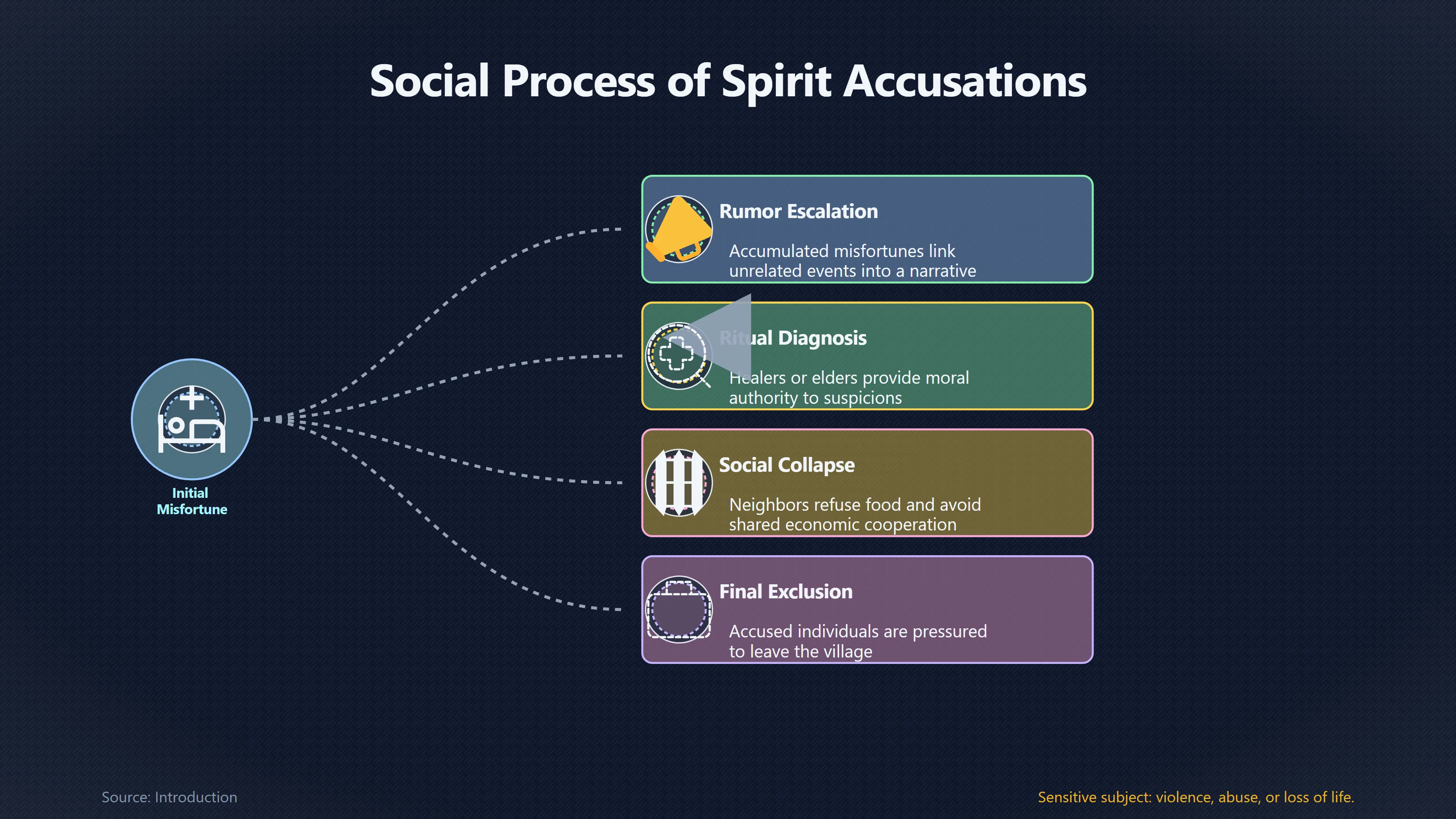
Spirit accusations usually emerged through an escalating social process rather than a single dramatic event.
An unexplained illness or death might first generate quiet speculation. As further misfortunes accumulated, rumours connected otherwise unrelated events into a single narrative. Ritual specialists, healers or respected elders could then be asked to diagnose the source of the problem. Even where no formal proof existed, a ritual diagnosis could give moral authority to suspicions that had already begun circulating.[ScienceDirect]sciencedirect.comScienceDirect Supernaturalist curers and sorcery accusations in ThailandSupernaturalist curers and sorcery accusations in Thailand - ScienceDirect…
Once a family became identified as dangerous, ordinary social relationships could rapidly collapse. People might refuse invitations, avoid sharing food, discourage marriage into the family or keep children away. Economic cooperation could also suffer if neighbours became unwilling to exchange labour or livestock.
Historical and ethnographic research describes communities in which the accused eventually left voluntarily because everyday life had become impossible. Others were explicitly pressured to move. Research extending across the wider Lao cultural region documents settlements where people expelled from other villages gathered together because they had nowhere else to go, illustrating how accusations could permanently reshape patterns of residence.[J-STAGE]jstage.jst.go.jpOpen source on go.jp.
Importantly, exclusion often solved the immediate social tension regardless of whether anyone genuinely believed the accused possessed a dangerous spirit. Removing the suspected household restored a sense that the community had acted against the source of misfortune, even though the original illnesses or deaths might have had entirely natural causes.[J-STAGE]jstage.jst.go.jpOpen source on go.jp.

Why ordinary misfortune became evidence of guilt
From a modern perspective it can seem surprising that ordinary illness could become evidence of supernatural attack. Anthropologists argue that the process becomes easier to understand when viewed through everyday village life rather than through modern medicine alone.
Small farming communities faced genuine uncertainty. Livestock diseases, sudden deaths, poor harvests and unexplained illnesses could threaten survival. Before reliable medical diagnosis and veterinary services were widely available, people naturally searched for patterns linking apparently unrelated tragedies.
Once one household attracted suspicion, later events tended to reinforce rather than weaken the accusation. Every additional illness appeared to confirm the existing explanation, while recoveries or contradictory evidence received less attention. This cumulative process resembles what psychologists describe as confirmation bias, although villagers interpreted events through their own moral and religious framework rather than through scientific concepts.[IUScholarWorks]scholarworks.iu.eduScholarWorksThe Ravenous Spirit (phii pob) Belief Tradition in Contemporary Thailand: Pluralistic Practices versus Monolithic Represent…
Social relationships also mattered. Existing tensions over inheritance, marriage, land or personality could become incorporated into a supernatural narrative. Instead of creating conflict from nothing, accusations often redirected conflicts that already existed into a culturally recognised form.[ScienceDirect]sciencedirect.comScienceDirect Supernaturalist curers and sorcery accusations in ThailandSupernaturalist curers and sorcery accusations in Thailand - ScienceDirect…
Beyond simple ideas of “superstition”
Recent scholarship challenges older descriptions that portrayed these accusations simply as irrational relics of the past.
Kanya Wattanagun’s detailed study of the ravenous spirit tradition argues that public discussion in Thailand has frequently concentrated on the most abusive and sensational cases, creating a misleading impression that all belief communities behave identically. Field research instead found considerable diversity. In some places, beliefs centred on healing rituals, explanation and coexistence rather than persecution. The same belief tradition therefore produced very different social outcomes depending on local history, religious practice and village organisation.[IUScholarWorks]scholarworks.iu.eduScholarWorksThe Ravenous Spirit (phii pob) Belief Tradition in Contemporary Thailand: Pluralistic Practices versus Monolithic Represent…
Other anthropologists similarly argue against treating beliefs about spirits as fixed systems with universally agreed meanings. Village understandings often contain ambiguity, negotiation and disagreement. Spirits may be regarded as protective in one context and dangerous in another, while villagers themselves may express uncertainty rather than absolute certainty about supernatural events.[Taylor & Francis Online]tandfonline.comTaylor & Francis OnlineEnunciating ambiguity: Thailand’s phi and the epistemological decolonization of Thai studies: South East Asia Rese…
This perspective does not deny that accusations caused real harm. Instead, it separates the existence of the belief from the social processes through which particular individuals became targets.

Lasting significance
Spirit accusations remain important because they illustrate how collective fear can become concentrated on identifiable people rather than spreading through an entire population. Unlike episodes of mass psychogenic illness, where many individuals experience similar symptoms, these cases more closely resemble mechanisms of scapegoating. Misfortune is personalised, rumours reinforce one another, respected authorities may unintentionally legitimise suspicion, and exclusion comes to appear both morally justified and socially necessary.
The history of these accusations in Thailand therefore provides insight into a broader human pattern found in many societies. When communities face uncertainty and lack convincing explanations for suffering, existing social divisions can become attached to supernatural narratives. The result is that neighbours become suspects, and ordinary people bear the consequences of fears that extend well beyond the original illness or misfortune.[iu.edu]scholarworks.iu.eduScholarWorksThe Ravenous Spirit (phii pob) Belief Tradition in Contemporary Thailand: Pluralistic Practices versus Monolithic Represent…
Endnotes
1.
Source: sciencedirect.com
Title: ScienceDirect Supernaturalist curers and sorcery accusations in Thailand
Link:https://www.sciencedirect.com/science/article/abs/pii/0277953688903668
Source snippet
Supernaturalist curers and sorcery accusations in Thailand - ScienceDirect...
2.
Source: jstage.jst.go.jp
Link:https://www.jstage.jst.go.jp/article/seas/13/1/13_109/_article/-char/en
3.
Source: scholarworks.iu.edu
Link:https://scholarworks.iu.edu/dspace/items/b72448c1-0147-4c94-8c0a-6136d9002c64
Source snippet
ScholarWorksThe Ravenous Spirit (phii pob) Belief Tradition in Contemporary Thailand: Pluralistic Practices versus Monolithic Represent...
4.
Source: tandfonline.com
Link:https://www.tandfonline.com/doi/abs/10.1080/0967828X.2022.2064761
Source snippet
Taylor & Francis OnlineEnunciating ambiguity: Thailand’s phi and the epistemological decolonization of Thai studies: South East Asia Rese...
5.
Source: tandfonline.com
Link:https://www.tandfonline.com/doi/abs/10.1080/0967828X.2022.2064761?scroll=top&tab=permissions
Source snippet
3, 2022 — South East Asia Research Volume 30, 2022 - Issue 2 Submit an article Journal homepage 449 Views 8 CrossRef citations to date 0...
6.
Source: jstage.jst.go.jp
Title: jst.go.jp Southeast Asia: History and Culture
Link:https://www.jstage.jst.go.jp/browse/sea/2011/40/_contents/-char/en
Source snippet
Against religious millenarianism and armed rebellions, the colonial state wielded a heavy hand on those who opposed. The student strike...
7.
Source: scholarworks.iu.edu
Link:https://scholarworks.iu.edu/dspace/items/b72448c1-0147-4c94-8c0a-6136d9002c64/full
8.
Source: jstage.jst.go.jp
Title: jst.go.jpMolam Phifa in Northeast Thailand
Link:https://www.jstage.jst.go.jp/article/sea1971/1999/28/1999_28_104/_article
9.
Source: jstage.jst.go.jp
Link:https://www.jstage.jst.go.jp/article/sea/2011/40/2011_54/_article/-char/ja/
Additional References
10.
Source: researchgate.net
Link:https://www.researchgate.net/publication/360575966_Enunciating_ambiguity_Thailand%27s_phi_and_the_epistemological_decolonization_of_Thai_studies
Source snippet
May 13, 2022 — ENUNCIATING AMBIGUITY: THAILAND’S PHI AND THE EPISTEMOLOGICAL DECOLONIZATION OF THAI STUDIES * May 2022 * South East Asia...
Published: May 13, 2022
11.
Source: cir.nii.ac.jp
Link:https://cir.nii.ac.jp/crid/1390001205773413504?lang=en
Source snippet
CiNii ResearchBetween Benevolent Spirits and Evil Spirits: An Anthropological Study on Guardian Spirits in Northeastern Thailand | CiNii...
12.
Source: scmp.com
Title: Demonic possession in Laos
Link:https://www.scmp.com/magazines/post-magazine/long-reads/article/2103274/demonic-possession-laos-it-real-or-pretext
Source snippet
South China Morning PostJuly 22, 2017 — DEMONIC POSSESSION IN LAOS - IS IT REAL, OR A PRETEXT FOR VILLAGE CHIEFS TO BANISH TROUBLEMAKER...
Published: July 22, 2017
13.
Source: youtube.com
Title: Every Mythical Creature In Thailand Folklore Explained In 8 Minutes
Link:https://www.youtube.com/watch?v=HG5oJqPkMt4
Source snippet
Thai Belief about Ghosts | Learn about Thai Culture and Language...
14.
Source: youtube.com
Title: Witch Hunts and Economic Scapegoats
Link:https://www.youtube.com/watch?v=1UEQmYCJ9nw
Source snippet
Every Mythical Creature In Thailand Folklore Explained In 8 Minutes...
15.
Source: cambridge.org
Link:https://www.cambridge.org/core/journals/journal-of-southeast-asian-studies/article/abs/thai-protestants-and-local-supernaturalism-changing-configurations/6A84891D66548C2E5AF2A2E76DB708D6
16.
Source: cambridge.org
Link:https://www.cambridge.org/core/journals/journal-of-southeast-asian-studies/article/abs/cult-of-phaya-narin-songkhram-spirit-mediums-and-shifting-sociocultural-boundaries-in-northeastern-thailand/D65F5B8A0567C72D8264FFF6C777A240
17.
Source: youtube.com
Title: Spiritual Abuse, Scapegoating, and the Mask of Virtue
Link:https://www.youtube.com/watch?v=zB9WziwTIGU
Source snippet
Ghosts: Confronting the Dead in Thailand...
18.
Source: youtube.com
Title: Ghosts: Confronting the Dead in Thailand
Link:https://www.youtube.com/watch?v=1HlTWlRgafQ
Source snippet
Witch Hunts and Economic Scapegoats - Raymond Fisman...
19.
Source: vice.com
Title: Thai Villagers Are Using Facebook to Make Witchcraft Accusations Go Viral
Link:https://www.vice.com/en/article/thai-villagers-are-terrorising-each-other-with-ghost-stories-spread-over-facebook/
Topic Tree