Within Lithuania
Why Could Soviet Rule Not Erase the Crosses?
Repeated Soviet attempts to erase the Hill of Crosses helped make it a stronger symbol of religious endurance and national identity.
On this page
- How the shrine grew and what the crosses meant
- Clearances, surveillance and restrictions under Soviet rule
- How repression strengthened the site's symbolic power
Page outline Jump by section
Introduction
The Hill of Crosses near Šiauliai became one of the most powerful symbols of peaceful resistance in Soviet-occupied Lithuania because repeated attempts to destroy it had the opposite effect. Rather than ending the tradition of placing crosses, Soviet repression encouraged thousands of people to return, often secretly at night, replacing every cross that had been removed. What began as a local pilgrimage site evolved into a national statement that religious faith, historical memory and Lithuanian identity could not easily be erased. The struggle over the hill was never simply about wooden crosses. It reflected a wider conflict between an officially atheist state determined to control public life and ordinary people who used a religious shrine to express cultural endurance, grief and quiet opposition to Soviet rule. Today the Hill of Crosses is remembered less for the government’s efforts to eliminate it than for the remarkable persistence of those who kept rebuilding it.
Why did the Hill of Crosses become such a challenge for Soviet rule?
Long before the Soviet occupation, people had left crosses on the hill to remember the dead, fulfil religious vows and seek divine help. The site expanded significantly during the nineteenth century and became an established Catholic pilgrimage destination by the early twentieth century. Various traditions explain its origins, including memorials to victims of the 1831 and 1863 uprisings against the Russian Empire, although historians caution that the earliest history is not fully documented.[Kryžių Kalnas]kryziukalnas.ltOpen source on kryziukalnas.lt.
After Lithuania was absorbed into the Soviet Union, however, the meaning of the hill changed. Communist authorities viewed public religion as incompatible with the state’s programme of scientific atheism, while expressions of Lithuanian national identity were also treated with suspicion. The Hill of Crosses combined both elements. Pilgrims continued to gather there despite official disapproval, making it an increasingly visible reminder that many Lithuanians retained loyalties outside Soviet ideology.[Lituanistika]lituanistika.ltSovietų valdžios antireliginė politika Lietuvoje ir Kryžių kalnasLituanistika | Sovietų valdžios antireliginė politika Lietuvoje ir Kryžių kalnasApril 17, 2026…
Unlike organised political demonstrations, leaving a cross could be presented as a personal religious act. Yet in the context of Soviet Lithuania, these individual acts accumulated into a powerful collective statement. Each new cross suggested that official campaigns against religion had failed.
How did Soviet authorities try to eliminate the shrine?
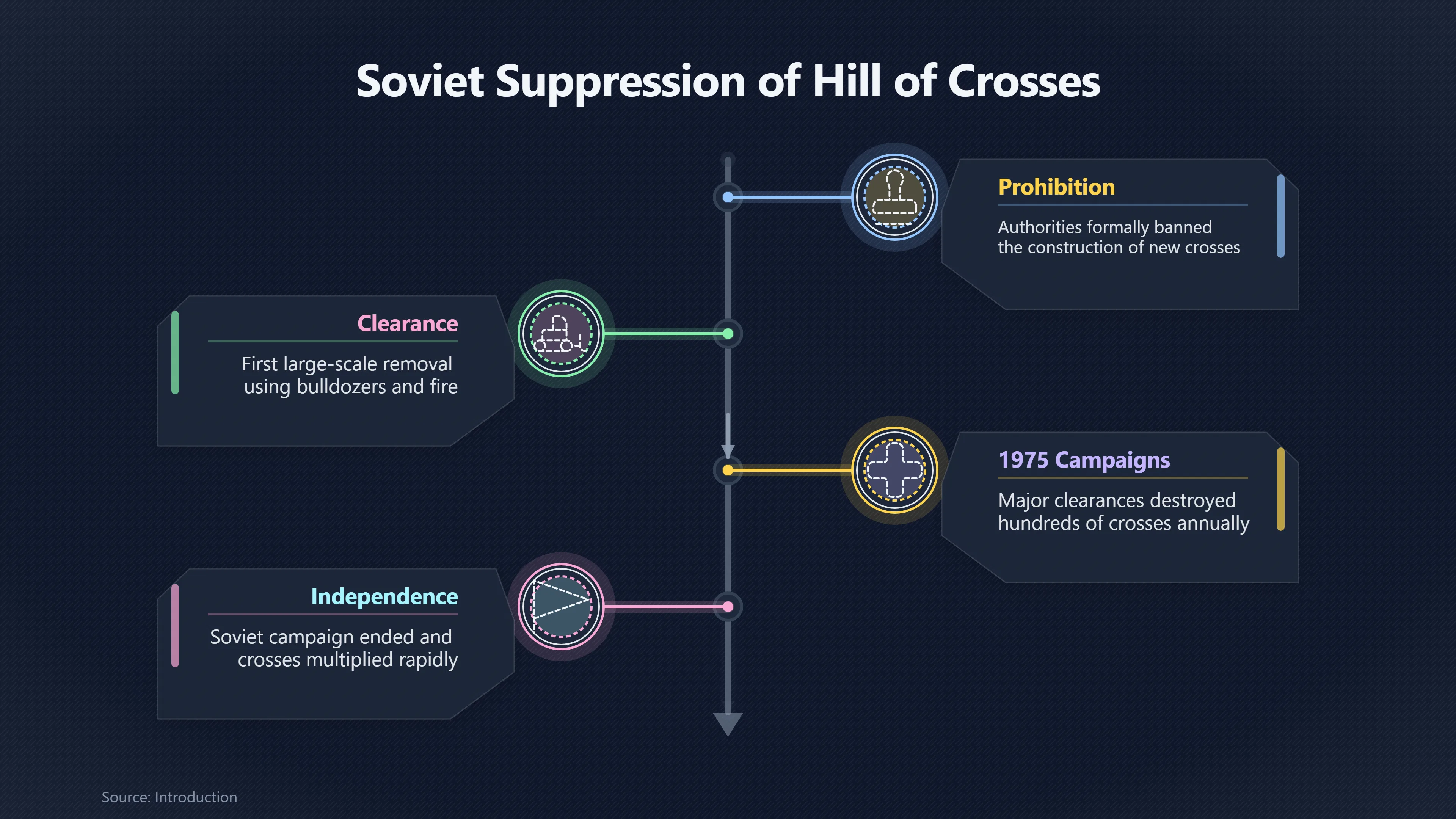
The Soviet campaign intensified from the late 1950s. Authorities first sought administrative measures to discourage pilgrimages before moving to direct destruction. In January 1961 the construction of new crosses was formally prohibited, and in April 1961 officials carried out the first large-scale clearance. Bulldozers levelled much of the site, wooden crosses were burned, metal ones were sent for scrap, and stone crosses were smashed or buried.[Lituanistika]lituanistika.ltSovietų valdžios antireliginė politika Lietuvoje ir Kryžių kalnasLituanistika | Sovietų valdžios antireliginė politika Lietuvoje ir Kryžių kalnasApril 17, 2026…
The destruction did not end there. Major clearances followed in 1973, 1974 and 1975, while smaller removals occurred in intervening years. Contemporary accounts describe hundreds of crosses being destroyed annually during parts of the 1970s.[kryziukalnas.lt]kryziukalnas.ltOpen source on kryziukalnas.lt.
The campaign extended beyond physical demolition. Soviet officials attempted to make access difficult by:
- restricting pilgrimages and religious gatherings;
- monitoring visitors through police and security services;
- guarding roads leading to the hill;
- using public-health justifications, including supposed disease outbreaks, to close the area;
- considering engineering projects that would have flooded or otherwise transformed the site.[hillofcrosses.com]hillofcrosses.comHill of Crosses History of the Hill of crosses in LithuaniaHill of CrossesHistory of the Hill of crosses in Lithuania - Hill of crossesSeptember 16, 2012…
These measures reflected broader Soviet anti-religious policy, which aimed not only to remove religious symbols but also to discourage communities from recreating them.
Why did repression make the hill even more important?
The authorities underestimated the symbolic power of repeated rebuilding. Almost immediately after each demolition, local residents and pilgrims returned, often under cover of darkness, carrying new crosses to replace those that had been destroyed. The cycle became familiar: officials cleared the hill, and ordinary people quietly rebuilt it.[Russia's Periphery]russiasperiphery.pages.wm.eduRussia's Periphery The Hill of Crosses – Russia's PeripheryRussia's Periphery The Hill of Crosses – Russia's Periphery
This transformed the meaning of the shrine. A cross was no longer simply a religious offering. It became evidence that state power had limits. Every replacement cross demonstrated that fear had not eliminated personal belief or national memory.
Historians increasingly describe the Hill of Crosses as an example of symbolic or everyday resistance rather than organised rebellion. Visitors were usually not attempting to overthrow Soviet rule directly. Instead, they defended a sacred place whose continued existence challenged official claims that religion was disappearing from socialist society.[Journals at KU]journals.ku.edua Nation’s Life | FOLKLORICA - Journal of the Slavic, East European, and Eurasian Folklore Association…
The government’s own actions strengthened this symbolism. Had officials ignored the hill, it might have remained a regional pilgrimage site. By repeatedly destroying it, they turned it into a nationally recognised emblem of endurance.

Faith, national identity and collective memory
The Hill of Crosses illustrates how religious devotion and national identity became closely connected under Soviet rule. Many crosses commemorated family members, political prisoners or people lost through war and repression. Others represented prayers for Lithuania itself.
This overlap makes the site significant within the history of collective belief. The continuing growth of the hill was not an example of mass hysteria or irrational panic. Instead, it showed how shared religious practice could become a peaceful form of collective resistance when other public expressions of identity were tightly controlled.
The shrine also accumulated layers of meaning over time. Different visitors understood the crosses differently:
- some saw them primarily as acts of Catholic devotion;
- others viewed them as memorials to relatives;
- many regarded them as expressions of Lithuanian cultural survival;
- for later generations, they became reminders of resistance to Soviet oppression itself.[Journals at KU]journals.ku.edua Nation’s Life | FOLKLORICA - Journal of the Slavic, East European, and Eurasian Folklore Association…
These meanings were not mutually exclusive. A single cross could simultaneously express grief, faith, patriotism and hope.
What happened after Lithuanian independence?
Following the restoration of Lithuanian independence in 1990, the Soviet campaign against the hill ended permanently. Crosses multiplied rapidly without fear of official removal, and the site became both a major pilgrimage destination and an internationally recognised cultural landmark. Pope John Paul II visited in 1993, reinforcing its importance within Lithuanian Catholic life and its symbolic connection to freedom after decades of repression.[Journals at KU]journals.ku.edua Nation’s Life | FOLKLORICA - Journal of the Slavic, East European, and Eurasian Folklore Association…
Today hundreds of thousands of crosses cover the hill. Visitors continue to leave new ones, ensuring that the landscape remains unfinished and constantly changing. Rather than preserving a fixed historical monument, Lithuanians have maintained a living tradition shaped by successive generations.
Why the Hill of Crosses remains historically important
The Hill of Crosses demonstrates an important lesson about state attempts to suppress collective belief. Soviet authorities possessed overwhelming administrative and physical power, yet they proved unable to eliminate a practice sustained by voluntary participation. Each act of destruction encouraged renewed commitment rather than surrender.
For historians of Lithuania, the site therefore represents more than a religious shrine. It illustrates how cultural identity can survive through repeated everyday actions rather than dramatic confrontation. Within the wider history of collective belief, the Hill of Crosses stands as a rare example in which attempts to suppress a shared symbolic practice strengthened its emotional and national significance instead of extinguishing it.

Amazon book picks
Further Reading
Books and field guides related to Why Could Soviet Rule Not Erase the Crosses?. Use these as the next step if you want deeper reading beyond the article.

Bloodlands: Europe Between Hitler and Stalin
Places Soviet rule in Eastern Europe into broader historical context.

Iron Curtain: The Crushing of Eastern Europe,
Explains early communist policies toward religion and society in Eastern Europe.
Bloodlands
First published 2010. Subjects: Massacres, Genocide, World War, 1939-1945, Holocaust, Jewish (1939-1945), Atrocities.
Endnotes
1.
Source: journals.ku.edu
Link:https://journals.ku.edu/folklorica/article/view/24684
Source snippet
a Nation’s Life | FOLKLORICA - Journal of the Slavic, East European, and Eurasian Folklore Association...
2.
Source: lituanistika.lt
Title: Sovietų valdžios antireliginė politika Lietuvoje ir Kryžių kalnas
Link:https://www.lituanistika.lt/content/57361
Source snippet
Lituanistika | Sovietų valdžios antireliginė politika Lietuvoje ir Kryžių kalnasApril 17, 2026...
Published: April 17, 2026
3.
Source: urm.lt
Title: mystical hill in lithuania city paper no.112 september 2008 p.30 31:28412
Link:https://www.urm.lt/en/news/928/mystical-hill-in-lithuania-city-paper-no.112-september-2008-p.30-31%3A28412
Source snippet
Užsienio reikalų ministerijaMYSTICAL HILL IN LITHUANIA (City Paper, No.112, September 2008, p.30-31) | Ministry of Foreign Affairs...
Published: september 2008
4.
Source: youtube.com
Title: Hill of Crosses
Link:https://www.youtube.com/watch?v=P0nX9PGRW64
Source snippet
Go Inside Lithuania's Hill of Crosses | National Geographic...
5.
Source: kryziukalnas.lt
Link:https://kryziukalnas.lt/en
6.
Source: russiasperiphery.pages.wm.edu
Title: Russia’s Periphery The Hill of Crosses – Russia’s Periphery
Link:https://russiasperiphery.pages.wm.edu/baltic-states/lithuania/general/the-hill-of-crosses/
7.
Source: hillofcrosses.com
Title: Hill of Crosses History of the Hill of crosses in Lithuania
Link:https://www.hillofcrosses.com/uncategorised/history-of-the-hill-of-crosses-in-lithuania/
Source snippet
Hill of CrossesHistory of the Hill of crosses in Lithuania - Hill of crossesSeptember 16, 2012...
Published: September 16, 2012
8.
Source: siauliurajonas.lt
Title: Šiaulių Rajonas Information
Link:https://www.siauliurajonas.lt/en/info/hill-of-crosses-2/
9.
Source: wordandway.org
Title: And it’s not even a big hill. It covers
Link:https://wordandway.org/2023/04/06/hill-of-crosses/
Source snippet
Hill of Crosses - Word&WayApril 6, 2023 — April 6, 2023 author: Brian Kaylor, Word&Way HILL OF CROSSES Image On a hill far away in Lithua...
Published: April 6, 2023
10.
Source: patheos.com
Title: Hill Of Crosses
Link:https://www.patheos.com/sacred-spaces/hill-of-crosses
Source snippet
Patheos Sacred SpacesMarch 23, 2023 — THE 100 MOST HOLY PLACES ON EARTH number 88 HILL OF CROSSES Jurgaičiai, Lithuania By Alonzo Gaskill...
Published: March 23, 2023
11.
Source: nomadit.co.uk
Link:https://nomadit.co.uk/conference/sief2019/paper/46853
12.
Source: kryziukalnas.lt
Link:https://www.kryziukalnas.lt/?id=44
13.
Source: pilgrimmap.com
Link:https://www.pilgrimmap.com/site/hill-of-crosses-siauliai-19116ff4
14.
Source: photocontest.smithsonianmag.com
Title: hill of crosses
Link:https://photocontest.smithsonianmag.com/photocontest/detail/hill-of-crosses/
15.
Source: vilnius-escape.com
Title: hill of crosses tour
Link:https://www.vilnius-escape.com/tours/hill-of-crosses-tour/
Additional References
16.
Source: researchgate.net
Link:https://www.researchgate.net/publication/338375497_The_Destruction_of_Religious_Monuments_in_Lithuania_in_Soviet_Times_Stories_Magic_and_Beliefs
Source snippet
January 3, 2020 — Chapter PDF Available THE DESTRUCTION OF RELIGIOUS MONUMENTS IN LITHUANIA IN SOVIET TIMES: STORIES, MAGIC AND BELIEFS *...
Published: January 3, 2020
17.
Source: youtube.com
Title: Defiance show up many forms Hill of crosses, Lithuania
Link:https://www.youtube.com/watch?v=d0OOY_NQJ9I
Source snippet
History of Hill of Cross lithuania | A place where millions of Crosses are found...
18.
Source: youtube.com
Title: Go Inside Lithuania’s Hill of Crosses | National Geographic
Link:https://www.youtube.com/watch?v=C7duefb6Khw
Source snippet
The Hill of Crosses, Siauliai, Lithuania, Torn down by Russians...
19.
Source: youtube.com
Title: The Hill of Crosses, Siauliai, Lithuania, Torn down by Russians!
Link:https://www.youtube.com/watch?v=yB7NY9qRdnE
Source snippet
Defiance show up many forms Hill of crosses, Lithuania...
20.
Source: militaryheritagetourism.info
Title: The demolition of the Hill of Crosses: evidence of the most active destruction
Link:https://militaryheritagetourism.info/en/military/stories/view/371
21.
Source: youtube.com
Title: History of Hill of Cross lithuania | A place where millions of Crosses are found
Link:https://www.youtube.com/watch?v=_SDOgmCVvg0
22.
Source: unesco.org
Title: Cross-crafting and Its Symbolism | Intangible Heritage
Link:https://www.unesco.org/archives/multimedia/document-1743
23.
Source: doczz.net
Title: Sacred Places Europe: 108 Destinations
Link:https://doczz.net/doc/500851/sacred-places-europe–108-destinations
24.
Source: ich.unesco.org
Title: cross crafting and its symbolism 00013
Link:https://ich.unesco.org/en/RL/cross-crafting-and-its-symbolism-00013
25.
Source: lkbkronika.lt
Title: SOVIE T VANDALISM
Link:https://lkbkronika.lt/index.php/en/issue-no-53/soviet-vandalism
Topic Tree