Within Sao Tome and Principe
How an Imaginary Revolt Justified Repression
Colonial officials turned unverified claims of communist conspiracy into a licence for arrests, torture and armed repression.
On this page
- How officials created the communist threat
- Why ordinary resistance became evidence of conspiracy
- What later investigations did and did not find
Page outline Jump by section
Introduction
The most revealing feature of the 1953 crisis in São Tomé was not the existence of a communist uprising, but the way the Portuguese colonial administration created one in its official narrative. Faced with growing resistance to labour policies and widespread rumours that free-born islanders would be forced onto cocoa plantations, Governor Carlos Gorgulho portrayed ordinary opposition as evidence of a communist conspiracy. That claim became the legal and political justification for arrests, torture and mass violence during what became known as the Batepá massacre. Later investigations failed to uncover evidence of an organised communist plot, leaving historians to conclude that the supposed revolt was primarily a political invention used to legitimise repression.[Wikipedia]WikipediaBatepá massacreBatepá massacre
How officials created the communist threat
The colonial administration did not simply respond to unrest; it actively reinterpreted local grievances through the language of Cold War security. During the early 1950s, anti-communism had become an increasingly powerful justification for emergency measures across European colonial empires. Officials often assumed that protests against colonial rule reflected foreign ideological influence rather than local economic or political grievances. Historian Alexander Keese has shown that colonial administrators elsewhere in Africa also exaggerated or imagined communist conspiracies, believing themselves to be confronting a coordinated international threat.[University of Portsmouth]researchportal.port.ac.uka culture of panic communist scapegoats and decolonization in freUniversity of PortsmouthA culture of panic: ‘communist’ scapegoats and decolonization in French West Africa and French Polynesia, 1945-19…
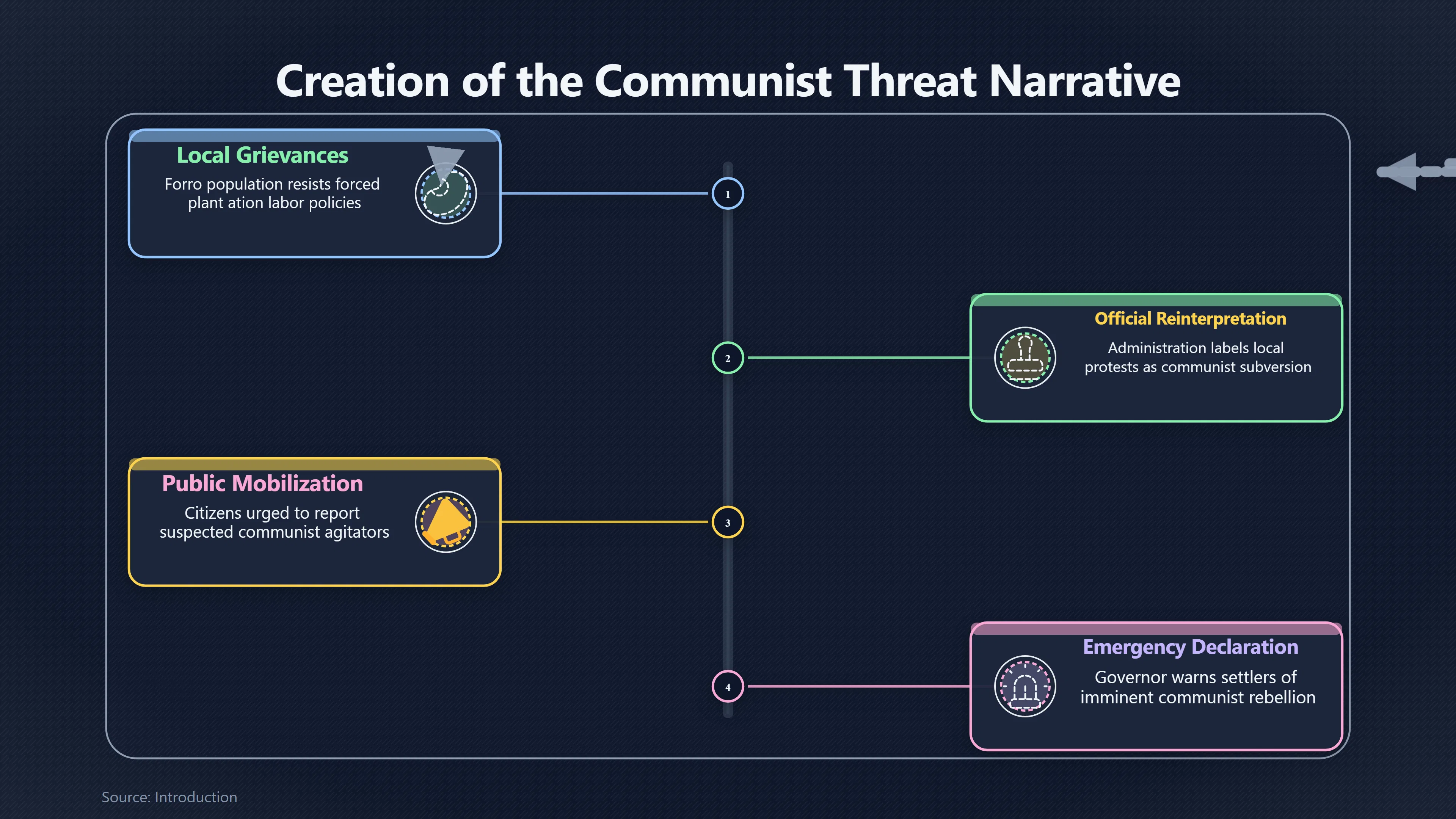
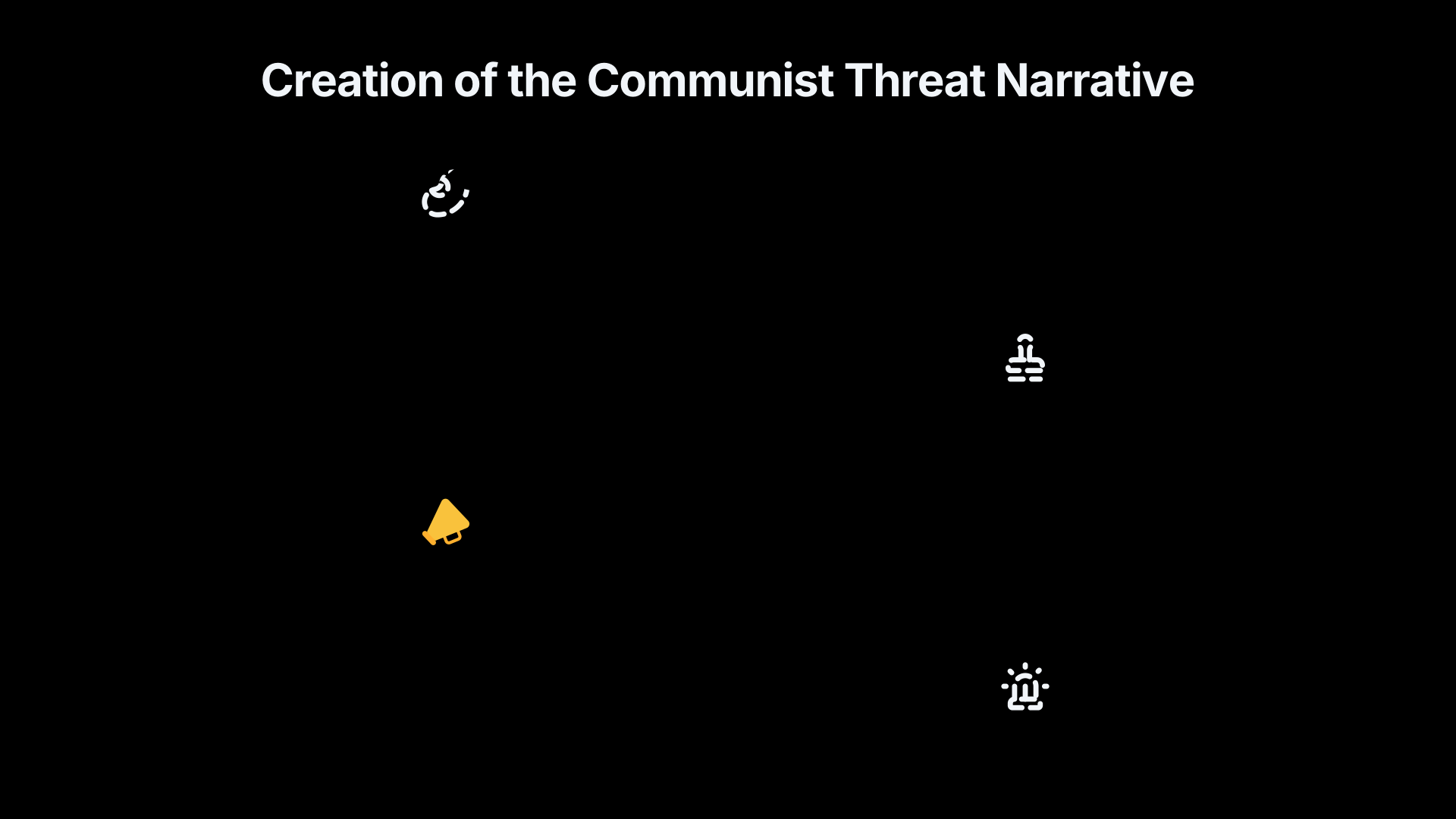
Governor Gorgulho applied this framework to São Tomé. As rumours spread that the Forro population would be compelled into plantation labour, the government publicly denied any such plan. At the same time, however, it claimed that “communists” were deliberately circulating false rumours in order to undermine public order. Citizens were encouraged to identify and report these supposed agitators to the police, transforming political suspicion into a civic duty.[Wikipedia]WikipediaBatepá massacreBatepá massacre
The official narrative quickly escalated. Rather than treating demonstrations and resistance as expressions of local discontent, Gorgulho warned settlers that a communist rebellion was imminent. White colonists were instructed to arm themselves for self-defence, while plantation owners mobilised additional personnel alongside colonial police. Once this emergency was declared, extraordinary violence could be presented as a necessary response to an alleged insurrection rather than as repression of civilians.[Wikipedia]WikipediaBatepá massacreBatepá massacre
Why ordinary resistance became evidence of conspiracy
The government’s accusations rested on remarkably ordinary acts of resistance rather than evidence of an organised revolutionary movement.
Many Forros refused plantation labour because they associated it with slavery and coercion. Others repeated rumours about forced recruitment, protested new policies or resisted administrative pressure. In the atmosphere created by the governor, these actions ceased to be interpreted as labour disputes or political complaints. Instead, they became proof that hidden organisers were directing a communist campaign.[ResearchGate]researchgate.netResearchGate(PDF) The February 1953 Massacre in São Tomé: Crack in the Salazarist Image of Multiracial Harmony and Impetus for Nationalis…
This logic created a self-reinforcing cycle:
- rumours became evidence of subversion;
- refusal to cooperate became proof of political disloyalty;
- public protests became signs of an organised revolt;
- stronger repression then appeared justified because officials claimed they were defeating an expanding conspiracy.
The result was a classic example of state-created threat inflation. Rather than uncovering a conspiracy through investigation, the authorities interpreted almost every form of resistance as confirmation that the conspiracy already existed.
The process also reflected the priorities of the Portuguese Estado Novo dictatorship. Admitting that islanders opposed colonial labour policies would have acknowledged serious flaws in Portuguese rule. Explaining unrest as communist manipulation instead preserved the official image of a supposedly harmonious multiracial empire while shifting blame onto external ideological enemies.[ResearchGate]researchgate.netResearchGate(PDF) The February 1953 Massacre in São Tomé: Crack in the Salazarist Image of Multiracial Harmony and Impetus for Nationalis…
How the invented revolt justified repression
Once the administration accepted the existence of a communist uprising, increasingly severe measures could be portrayed as defensive rather than punitive.
Police, colonial officials, armed settlers and plantation personnel carried out widespread arrests. Prisoners were subjected to beatings, electric torture and forced labour. Some detainees suffocated in overcrowded cells, while others were killed outright or died under interrogation. Bodies were reportedly disposed of secretly to reduce public scrutiny. Although estimates of the death toll vary considerably, historians generally agree that hundreds of Forros lost their lives during the repression.[Wikipedia]WikipediaBatepá massacreBatepá massacre
Significantly, those targeted were not identified through evidence of communist organisation. They were selected largely because they belonged to communities viewed as resistant to colonial labour policies or were suspected of sympathising with local opposition. The imagined revolt therefore functioned less as a description of events than as a framework that removed the normal limits on state violence.
What later investigations did and did not find
Following the massacre, Portuguese authorities initiated investigations into the alleged communist conspiracy. These inquiries did not uncover convincing evidence that an organised revolutionary network had planned an uprising or coordinated violent rebellion. Despite the extensive repression, the central claim used to justify it remained unsubstantiated.[Wikipedia]WikipediaBatepá massacreBatepá massacre
Modern historical research has reinforced that conclusion. Scholars such as Gerhard Seibert argue that the violence arose from labour shortages, colonial coercion, racial tensions and administrative decisions rather than from communist organisation. The governor’s allegations are understood as political rhetoric that converted genuine social conflict into an imagined security emergency.[ResearchGate]researchgate.netResearchGate(PDF) The February 1953 Massacre in São Tomé: Crack in the Salazarist Image of Multiracial Harmony and Impetus for Nationalis…
This distinction is important. Historians do not deny that rumours circulated, that protests occurred or that officials feared disorder. What they dispute is the claim that these events amounted to an organised communist revolt. The available documentary evidence supports the existence of widespread popular anxiety and resistance, but not the existence of the conspiracy that the colonial government claimed to have uncovered.[ResearchGate]researchgate.netResearchGate(PDF) The February 1953 Massacre in São Tomé: Crack in the Salazarist Image of Multiracial Harmony and Impetus for Nationalis…

Why the episode remains historically important
The imagined communist revolt demonstrates how moral panic and state power can reinforce one another. Fear did not spread only among the colonised population; colonial authorities themselves embraced an exaggerated interpretation of events that transformed suspicion into official policy.
Within the wider history of São Tomé and Príncipe, the episode illustrates how anti-communist rhetoric during the early Cold War could be adapted to local colonial conflicts. Rather than recognising legitimate resistance to coercive labour practices, the administration reframed dissent as ideological subversion. That framing helped justify one of the deadliest episodes in the country’s colonial history and contributed to the growth of nationalist sentiment that eventually challenged Portuguese rule.[researchgate.net]researchgate.netResearchGate(PDF) The February 1953 Massacre in São Tomé: Crack in the Salazarist Image of Multiracial Harmony and Impetus for Nationalis…
Amazon book picks
Further Reading
Books and field guides related to How an Imaginary Revolt Justified Repression. Use these as the next step if you want deeper reading beyond the article.
King Leopold's ghost
First published 1998. Subjects: Politics and government, Race relations, Forced labor, Human rights movements, Indigenous peoples.
The fate of Africa
First published 2004. Subjects: Politics and government, Social conditions, Economic conditions, Politique et gouvernement, Conditions so...

The cold war
First published 2017. Subjects: Cold War, World politics, Influence, Cold war, History.

Chocolate islands
First published 2012. Subjects: Moral and ethical aspects, Cacao growers, Cadbury Brothers, Travel, Administration.
Endnotes
1.
Source: Wikipedia
Title: Batepá massacre
Link:https://en.wikipedia.org/wiki/Batep%C3%A1_massacre
2.
Source: researchgate.net
Link:https://www.researchgate.net/publication/351091344_The_February_1953_Massacre_in_Sao_Tome_Crack_in_the_Salazarist_Image_of_Multiracial_Harmony_and_Impetus_for_Nationalist_Demands_for_Independence
Source snippet
ResearchGate(PDF) The February 1953 Massacre in São Tomé: Crack in the Salazarist Image of Multiracial Harmony and Impetus for Nationalis...
Published: February 1953
3.
Source: researchgate.net
Title: 358266384 Sao Tome O massacre de Fevereiro de 1953
Link:https://www.researchgate.net/publication/358266384_Sao_Tome_O_massacre_de_Fevereiro_de_1953
Source snippet
ResearchGate(PDF) São Tomé. O massacre de Fevereiro de 1953...
4.
Source: researchgate.net
Title: (PDF) As mortes esquecidas de Batepá (E
Link:https://www.researchgate.net/publication/368534463As_mortes_esquecidas_de[Batepa
Source snippet
A Revista do Expresso)February 15, 2023 — Article PDF Available AS MORTES ESQUECIDAS DE BATEPÁ (E. A REVISTA DO EXPRESSO) * February 2023...
Published: February 15, 2023
5.
Source: researchgate.net
Link:https://www.researchgate.net/publication/334552877_As_multiplas_vidas_de_Batepa_memorias_de_um_massacre_colonial_em_Sao_Tome_e_Principe
6.
Source: researchgate.net
Link:https://www.researchgate.net/publication/350020640_Le_massacre_de_fevrier_1953_a_Sao_Tome_raison_d%27etre_du_nationalisme_santomeen
7.
Source: researchportal.port.ac.uk
Title: a culture of panic communist scapegoats and decolonization in fre
Link:https://researchportal.port.ac.uk/en/publications/a-culture-of-panic-communist-scapegoats-and-decolonization-in-fre/
Source snippet
University of PortsmouthA culture of panic: ‘communist’ scapegoats and decolonization in French West Africa and French Polynesia, 1945-19...
8.
Source: researchportal.port.ac.uk
Link:https://researchportal.port.ac.uk/en/publications/building-a-new-image-of-africa-dissident-states-and-the-emergence
9.
Source: military-history.fandom.com
Title: Batepá massacre
Link:https://military-history.fandom.com/wiki/Batep%C3%A1_massacre
Additional References
10.
Source: talkafricana.com
Link:https://talkafricana.com/batepa-massacre-portugals-colonial-slaughter-in-[sao-tome-and-principe
Source snippet
Batepá massacre: Portugal’s Colonial Slaughter in São Tomé and Príncipe That Left Hundreds Dead - TalkAfricanaSeptember 20, 2025 — To man...
Published: September 20, 2025
11.
Source: museudoaljube.pt
Title: Massacre de Batepá – Museu do Aljube
Link:https://www.museudoaljube.pt/2025/02/03/massacre-de-batepa/
Source snippet
Os relatos revelam episódios hediondos de terror e perseguição da população nativa. A “operação de limpeza”, como era referida pelas auto...
12.
Source: youtube.com
Link:https://www.youtube.com/watch?v=1mrvMbL1K74
Source snippet
Cerca de 10 mil pessoas marcham em memória das vítimas e sobreviventes do massacre de Batepá...
13.
Source: youtube.com
Link:https://www.youtube.com/watch?v=V2gPagezjP4
Source snippet
Jovens Católicos Participam da Via Sacra em São Tomé e Príncipe...
14.
Source: youtube.com
Link:https://www.youtube.com/watch?v=UA0ePxvqtXQ
Source snippet
S. Tomé e o massacre do Batepá Fev de 1953 - Episódios a não repetir mas a recordar...
15.
Source: senate.gov
Link:https://www.senate.gov/about/powers-procedures/investigations/mccarthy-and-army-mccarthy-hearings.htm
16.
Source: youtube.com
Title: Jovens Católicos Participam da Via Sacra em São Tomé e Príncipe
Link:https://www.youtube.com/watch?v=Yj9i-2gkkzg
Source snippet
“Massacre de Batepá – 1953” –: SUN GLEZA - KWÁ TELÁ...
17.
Source: rstp.st
Link:https://rstp.st/2025/05/26/peritos-da-ceeac-concluiram-que-nao-houve-tentativa-de-golpe-de-estado-em-sao-tome-e-principe-em-2022/amp/
Source snippet
Peritos da CEEAC concluíram que não houve tentativa de golpe de Estado em São Tomé e Príncipe em 2022May 26, 2025 — PERITOS DA CEEAC CONC...
Published: May 26, 2025
18.
Source: youtube.com
Link:https://www.youtube.com/watch?v=xmSsLkxyHoE
19.
Source: esquerda.net
Title: o massacre de batepa em sao tome e principe ecos desde 1953 atualidade
Link:https://www.esquerda.net/dossier/o-massacre-de-batepa-em-sao-tome-e-principe-ecos-desde-1953-atualidade/63602
Topic Tree