Within Congo Belief Panics
Why Were Congolese Children Branded as Witches?
Witchcraft accusations gave families a culprit for hardship while exposing vulnerable children to abandonment, abuse and street life.
On this page
- Poverty, bereavement and family breakdown
- Deliverance rituals and pastoral authority
- Why legal protection often failed
Page outline Jump by section
Introduction
Since the 1990s, thousands of children in the Democratic Republic of the Congo, especially in Kinshasa and other large cities, have been accused of practising witchcraft. These accusations did not arise from a single religious tradition or isolated panic. Instead, they emerged where war, economic collapse, bereavement, displacement and fragile family structures created intense pressure to explain repeated misfortune. Children became convenient scapegoats for poverty, illness, infertility, unemployment or unexpected deaths. Once labelled as witches, many were beaten, abandoned, subjected to violent “deliverance” rituals or forced to survive on the streets. Human rights organisations, researchers and child-protection agencies broadly agree that this is less a story about supernatural belief than about vulnerable children becoming targets when social support systems fail.[hrw.org]hrw.orgHuman Rights WatchWhat Future? Street Children in the Democratic Republic of Congo: I. Summary…
Poverty, bereavement and family breakdown
The rise in child witchcraft accusations closely followed the upheavals that affected the Congo from the 1990s onwards. Armed conflict, mass displacement, hyperinflation and declining public services placed enormous strain on extended families that traditionally cared for orphaned or vulnerable children. As households struggled to feed everyone, accusations of witchcraft sometimes offered a culturally meaningful explanation for hardship while also justifying the removal of a dependent child from the household.[UNICEF]unicef.orgChildren accused of witchcraft | UNICEF NigeriaChildren accused of witchcraft | UNICEF Nigeria…
Research consistently finds that accusations are not randomly distributed. Children most at risk include:
- Orphans living with relatives rather than biological parents.
- Children in stepfamilies or newly formed households.
- Children with disabilities, epilepsy or developmental conditions.
- Children whose behaviour, illness or appearance is considered unusual.
- Children living in families experiencing repeated financial or personal crises.[ResearchGate]researchgate.net338958125 Christian Pastors and Alleged Child Witches in Kinshasa DRCResearchGate(PDF) Christian Pastors and Alleged Child Witches in Kinshasa, DRCJanuary 1, 2020…
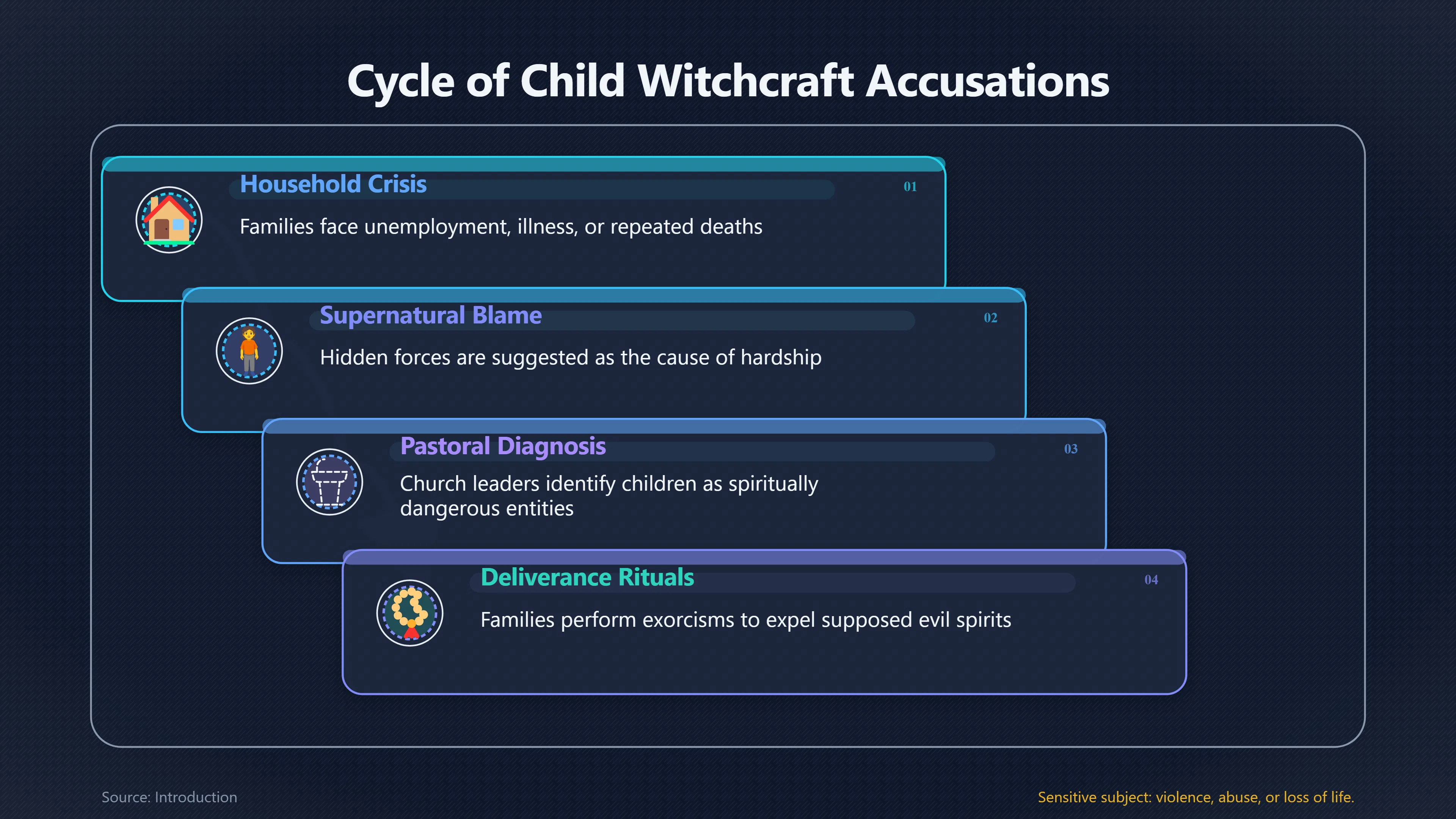
The accusations generally followed a familiar pattern. A family experienced unemployment, sickness, infertility, repeated deaths or business failure. Someone then suggested that hidden supernatural forces were responsible. Rather than identifying an adult neighbour, suspicion increasingly focused on children, particularly those already occupying insecure positions within the household. Researchers describe this as a major shift from older patterns of witchcraft suspicion, in which adults were more commonly accused.[ResearchGate]researchgate.net338958125 Christian Pastors and Alleged Child Witches in Kinshasa DRCResearchGate(PDF) Christian Pastors and Alleged Child Witches in Kinshasa, DRCJanuary 1, 2020…
For many accused children, expulsion from the family home came quickly. Some fled escalating abuse before being formally cast out. Others were deliberately abandoned after relatives became convinced that they threatened the family’s wellbeing. Human Rights Watch documented numerous cases in which accusations directly contributed to the growing population of street-connected children in Kinshasa and other cities.[Human Rights Watch]hrw.orgHuman Rights WatchWhat Future? Street Children in the Democratic Republic of Congo: I. Summary…
Deliverance rituals and pastoral authority
One of the most distinctive features of the Congolese phenomenon is the central role played by some independent churches and self-described prophets. Rather than consulting traditional healers, many families sought help from pastors who claimed to identify and expel witchcraft through prayer and exorcism.
Researchers surveying hundreds of church leaders found that two broad approaches now coexist. One accepts that children can genuinely be witches and promotes diagnosis followed by deliverance rituals. The other rejects child witchcraft accusations altogether and instead treats accused children as victims needing protection.[ResearchGate]researchgate.net338958125 Christian Pastors and Alleged Child Witches in Kinshasa DRCResearchGate(PDF) Christian Pastors and Alleged Child Witches in Kinshasa, DRCJanuary 1, 2020…
Where the first approach dominates, accusations may become self-reinforcing. A frightened family seeks confirmation from a pastor, who identifies the child as spiritually dangerous. The resulting “deliverance” ceremony is then presented as evidence that the accusation was justified.
Human Rights Watch documented abusive practices associated with some deliverance rituals, including prolonged fasting, physical assaults, forced confessions, isolation and other forms of coercion intended to drive out supposed evil spirits. Although many churches reject such practices entirely, abusive ministries attracted public attention because they offered apparently simple explanations for complex family problems.[Human Rights Watch]hrw.orgHuman Rights WatchWhat Future? Street Children in the Democratic Republic of Congo: I. Summary…
Importantly, researchers caution against portraying Congolese Christianity as uniformly responsible. Large numbers of churches actively oppose child witchcraft accusations, while organisations such as EPED (Pastoral Team for Children in Distress) work with pastors to replace accusations with child-protection approaches and reinterpret biblical teaching in ways that reject violence against children.[ResearchGate]researchgate.net338958125 Christian Pastors and Alleged Child Witches in Kinshasa DRCResearchGate(PDF) Christian Pastors and Alleged Child Witches in Kinshasa, DRCJanuary 1, 2020…

Why legal protection often failed
Congolese law increasingly recognised that accusations themselves endangered children, and international bodies repeatedly urged stronger legal protection. Nevertheless, enforcement has often proved far weaker than legislation or official commitments suggested.[Human Rights Watch]hrw.orgHuman Rights Watch DR Congo: Rights Panel Condemns Abuses Against Children | Human Rights WatchHuman Rights WatchDR Congo: Rights Panel Condemns Abuses Against Children | Human Rights WatchFebruary 4, 2009
Several factors contributed to this gap.
Weak state institutions. Police, prosecutors and social services frequently lacked the resources needed to investigate abuse or provide alternative care for abandoned children.
Limited child-protection capacity. Shelters and non-governmental organisations rescued many children, but demand greatly exceeded available places, leaving numerous children living permanently on the streets.[Human Rights Watch]hrw.orgHuman Rights WatchWhat Future? Street Children in the Democratic Republic of Congo: I. Summary…
Social acceptance of accusations. Because accusations often originated within families and neighbourhoods rather than organised criminal groups, many cases never reached the courts. Officials themselves sometimes shared the same underlying beliefs or hesitated to intervene in what appeared to be family or religious matters.[ScholarWorks]scholarworks.waldenu.eduOpen source on waldenu.edu.
Economic pressures. Even where families privately doubted that a child was a witch, extreme poverty could make reconciliation difficult if the child was already perceived as another financial burden. Researchers therefore argue that legal reform alone cannot eliminate accusations without broader improvements in employment, education and social welfare.[ScholarWorks]scholarworks.waldenu.eduOpen source on waldenu.edu.
In 2009, following a review of the Democratic Republic of the Congo’s compliance with the Convention on the Rights of the Child, child-rights organisations urged the government to criminalise accusations of witchcraft against children, strengthen reintegration programmes for street children and ensure that perpetrators of abuse were prosecuted. These recommendations reflected growing international recognition that accusations themselves constitute a serious child-protection issue.[Human Rights Watch]hrw.orgHuman Rights Watch DR Congo: Rights Panel Condemns Abuses Against Children | Human Rights WatchHuman Rights WatchDR Congo: Rights Panel Condemns Abuses Against Children | Human Rights WatchFebruary 4, 2009
Why the accusations persisted
Simply dismissing belief in witchcraft as irrational does not explain why accusations proved so resilient. Anthropological research instead points to the interaction of several reinforcing pressures.
When repeated misfortune strikes households with few economic or medical resources, people naturally seek explanations. In communities where spiritual causes are widely accepted, accusations may appear emotionally convincing even without objective evidence. At the same time, charismatic religious leaders may reinforce these interpretations, while neighbours who already suspect a child can provide apparent confirmation.
The result is a cycle in which family hardship, religious authority, neighbourhood rumours and weak public institutions reinforce one another. Breaking that cycle requires more than policing individual cases. Successful interventions have generally combined public education, theological engagement with church leaders, economic support for vulnerable families and stronger child-protection services.[researchgate.net]researchgate.net338958125 Christian Pastors and Alleged Child Witches in Kinshasa DRCResearchGate(PDF) Christian Pastors and Alleged Child Witches in Kinshasa, DRCJanuary 1, 2020…
Why this remains an important chapter in Congolese social history
Child witchcraft accusations are one of the clearest examples of how collective belief can become harmful when combined with prolonged social crisis. Unlike classic witch trials centred on formal courts, these accusations unfolded mainly within families, churches and neighbourhoods, making them difficult for the state to detect and prevent.
They also illustrate an important distinction in the wider history of collective fear in the Democratic Republic of the Congo. Belief itself is not the central historical problem. The greatest harm arose when beliefs about hidden supernatural causes combined with poverty, bereavement, fractured families and inadequate legal protection, allowing vulnerable children to be blamed for problems they neither created nor could possibly solve. Today, researchers and child-protection organisations increasingly emphasise that reducing these accusations depends on strengthening both family resilience and the institutions capable of protecting children when families fail.[waldenu.edu]scholarworks.waldenu.eduOpen source on waldenu.edu.
Amazon book picks
Further Reading
Books and field guides related to Why Were Congolese Children Branded as Witches?. Use these as the next step if you want deeper reading beyond the article.
King Leopold's ghost
First published 1998. Subjects: Politics and government, Race relations, Forced labor, Human rights movements, Indigenous peoples.
The fate of Africa
First published 2004. Subjects: Politics and government, Social conditions, Economic conditions, Politique et gouvernement, Conditions so...

Africa's world war
First published 2009. Subjects: Genocide, Geopolitics, Political violence, Political aspects, Refugees.
Endnotes
1.
Source: unicef.org
Title: Children accused of witchcraft | UNICEF Nigeria
Link:https://www.unicef.org/nigeria/reports/children-accused-witchcraft
Source snippet
Children accused of witchcraft | UNICEF Nigeria...
2.
Source: researchgate.net
Title: 338958125 Christian Pastors and Alleged Child Witches in Kinshasa DRC
Link:https://www.researchgate.net/publication/338958125_Christian_Pastors_and_Alleged_Child_Witches_in_Kinshasa_DRC
Source snippet
ResearchGate(PDF) Christian Pastors and Alleged Child Witches in Kinshasa, DRCJanuary 1, 2020...
Published: January 1, 2020
3.
Source: unicef.org
Title: and partners bring hope children accused witchcraft liberia
Link:https://www.unicef.org/liberia/stories/unicef-and-partners-bring-hope-children-accused-witchcraft-liberia
Source snippet
UNICEF and partners bring hope to children accused of `witchcraft` in Liberia | UNICEF LiberiaFebruary 7, 2023 — Article UNICEF AND PARTN...
Published: February 7, 2023
4.
Source: researchgate.net
Link:https://www.researchgate.net/publication/338959188_19_Overview_of_the_Work_of_the_Pastoral_Team_for_Children_in_Need_EPED_in_its_Struggle_Against_the_Problem_of_So-Called_Child-Witches_in_the_DR_Congo
5.
Source: hrw.org
Link:https://www.hrw.org/reports/2006/drc0406/1.htm
Source snippet
Human Rights WatchWhat Future? Street Children in the Democratic Republic of Congo: I. Summary...
6.
Source: scholarworks.waldenu.edu
Link:https://scholarworks.waldenu.edu/dissertations/9389/
7.
Source: hrw.org
Link:https://www.hrw.org/news/2009/02/04/[dr-congo
Source snippet
Human Rights WatchDR Congo: Rights Panel Condemns Abuses Against Children | Human Rights WatchFebruary 4, 2009...
Published: February 4, 2009
8.
Source: ecoi.net
Link:https://www.ecoi.net/en/document/1227851.html
9.
Source: hrw.org
Title: D.R. Congo: Election Poses Dangers for Street Children | Human Rights Watch
Link:https://www.hrw.org/news/2006/04/04/dr-congo-election-poses-dangers-street-children
10.
Source: hrw.org
Title: les enfants de la rue en republique democratique du congo
Link:https://www.hrw.org/fr/report/2006/04/04/quel-avenir/les-enfants-de-la-rue-en-republique-democratique-du-congo
11.
Source: hrw.org
Link:https://www.hrw.org/reports/2006/drc0406/6.htm
Additional References
12.
Source: ojs.unica.it
Link:https://ojs.unica.it/index.php/anuac/article/view/3675
Source snippet
accused of witchcraft in Democratic Republic of Congo (DRC): Between structural and symbolic violence | AnuacDecember 29, 2019 — CHILDREN...
Published: December 29, 2019
13.
Source: youtube.com
Title: DRC kids accused of witchcraft
Link:https://www.youtube.com/watch?v=rTFEL-t8R9Q
Source snippet
Child witchcraft accusations Congo Kinshasa documentary Congo's children accused of witchcraft find shelter Reuters...
14.
Source: digitallibrary.un.org
Link:https://digitallibrary.un.org/record/4004272
Source snippet
on the situation of the violations and abuses of human rights rooted in harmful practices related to accusations of witchcraft and ritual...
15.
Source: digitallibrary.un.org
Link:https://digitallibrary.un.org/record/4004272?ln=en
Source snippet
on the situation of the violations and abuses of human rights rooted in harmful practices related to accusations of witchcraft and ritual...
16.
Source: henrycenter.org
Link:https://henrycenter.org/2015/05/the-child-witches-of-kinshasa-drc/
17.
Source: theguardian.com
Link:https://www.theguardian.com/global-development/2013/jan/24/witchcraft-children-congo-drc-poverty
18.
Source: resourcecentre.savethechildren.net
Link:https://resourcecentre.savethechildren.net/document/invention-child-witches-social-cleansing-religious-commerce-and-difficulties-being-parent
19.
Source: youtube.com
Title: Congo’s children accused of witchcraft find shelter
Link:https://www.youtube.com/watch?v=jNtycOXGgRs
Source snippet
The agony of Congo's 'child witches'...
20.
Source: wunrn.com
Title: Congo – Child Witches – Girls – Save the Children Report
Link:https://wunrn.com/2006/06/congo-child-witches-girls-save-the-children-report/
21.
Source: youtube.com
Title: AFRICA OTR | NEWS
Link:https://www.youtube.com/watch?v=yj4UQoBtyxw
Source snippet
'Witchcraft courts' settling disputes in traditional Congo africanews...
Topic Tree