Within Saint Lucia
Why Was Kele Forced Underground?
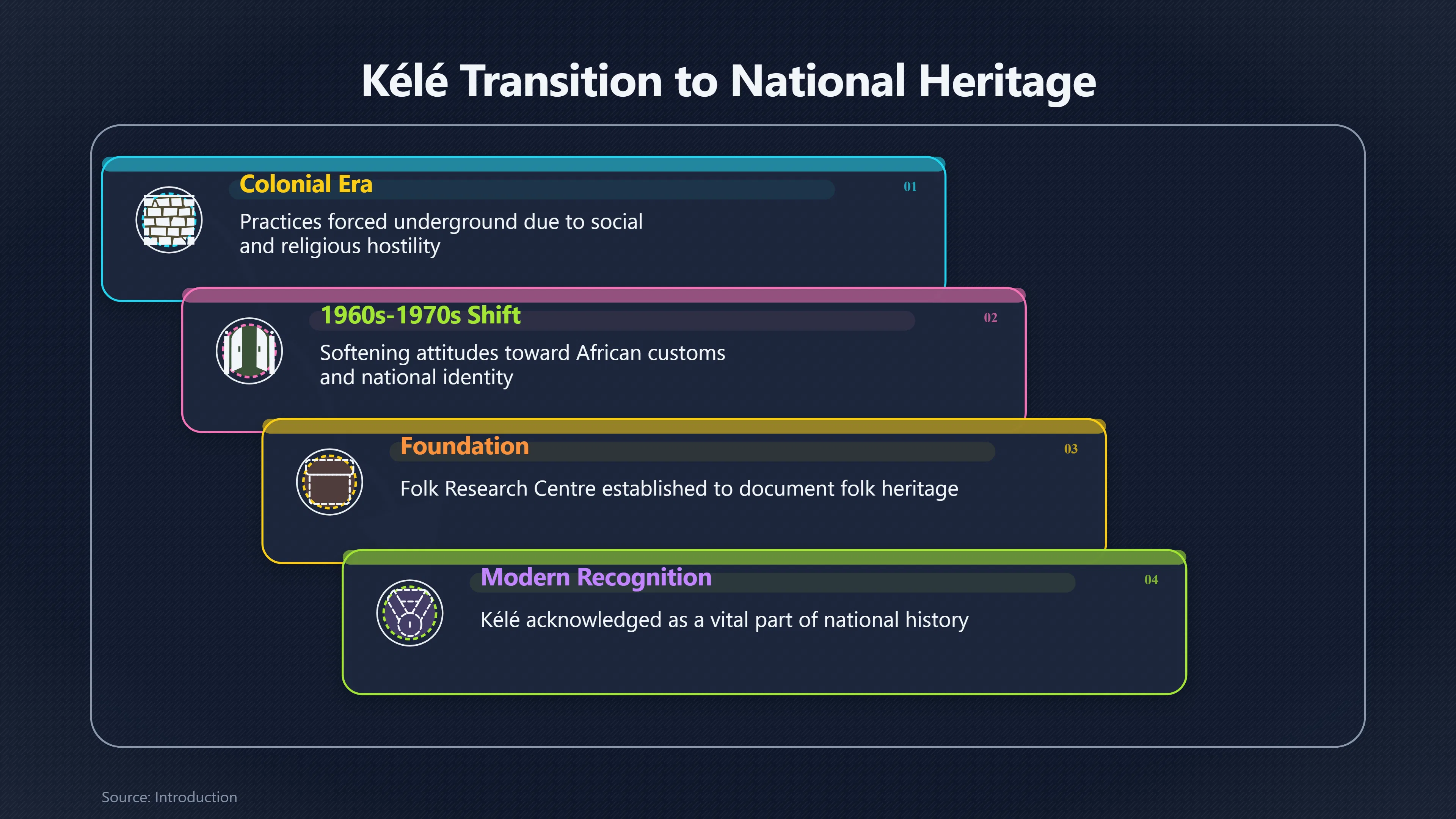
Kele was driven underground by hostility, then reclaimed as an important Afro-Saint Lucian religious and cultural tradition.
On this page
- Beliefs, deities and ceremonial practice
- Why secrecy followed church and colonial hostility
- How cultural institutions helped restore recognition
Page outline Jump by section
Introduction
Kélé is one of Saint Lucia’s most distinctive Afro-descended religious traditions. Rather than representing a secretive or extremist movement, it is a community-based faith that preserved elements of West African religious practice through slavery, emancipation and colonial rule. For much of its history, however, Kélé was forced underground because church leaders and colonial society viewed African-derived ceremonies with suspicion or hostility. In recent decades, that picture has changed. Cultural researchers, community leaders and national heritage organisations have helped document and publicly recognise Kélé as an important part of Saint Lucian history rather than a threat to public order. This shift makes Kélé an important case study in how religious traditions can move from stigma and secrecy towards cultural recognition.[folkresearchcentre.org]folkresearchcentre.orgTraditional Music – Folk Research CentreTraditional Music – Folk Research Centre

Why Was Kélé Forced Underground?
Kélé developed principally among Afro-Saint Lucian families in the Babonneau district and neighbouring communities. It is closely associated with descendants of Africans known locally as the Djiné, whose ancestors arrived in Saint Lucia during the nineteenth century after the end of the transatlantic slave trade. Although scholars describe Kélé as uniquely Saint Lucian, they also identify strong links with Yoruba religious traditions from present-day Nigeria.[folkresearchcentre.org]folkresearchcentre.orgTraditional Music – Folk Research CentreTraditional Music – Folk Research Centre
The tradition survived during a period when African religious practices were widely regarded by colonial authorities and many Christian leaders as incompatible with respectable society. Unlike an organised campaign of mass persecution, the pressure on Kélé came through social exclusion, religious condemnation and the belief that African ceremonies represented superstition or dangerous spiritual practices. Practitioners therefore limited ceremonies largely to trusted families and established participants, allowing the religion to continue while avoiding unwanted attention.[publications.iai.spk-berlin.de]publications.iai.spk-berlin.deKÉLÉ IN ST. LUCIA — A MINORITY CULTKÉLÉ IN ST. LUCIA — A MINORITY CULT
This secrecy should not be confused with evidence of a destructive cult. The closed nature of ceremonies was largely a response to external pressure rather than a defining theological principle. Historians generally interpret Kélé’s underground existence as a strategy for cultural survival under hostile conditions rather than an attempt to isolate followers from wider society.[publications.iai.spk-berlin.de]publications.iai.spk-berlin.deKÉLÉ IN ST. LUCIA — A MINORITY CULTKÉLÉ IN ST. LUCIA — A MINORITY CULT
Beliefs, Deities and Ceremonial Practice
Kélé centres on reverence for powerful spiritual beings associated with the Yoruba religious world, particularly Ogun, Shango and Eshu. Researchers note especially strong connections with festivals dedicated to Ogun in Nigeria, although Saint Lucian practice developed its own distinctive character over time.[folkresearchcentre.org]folkresearchcentre.orgTraditional Music – Folk Research CentreTraditional Music – Folk Research Centre
Ceremonies combine prayer, music, drumming, offerings and remembrance of ancestors. Traditional Batá-style drums—including a larger “mother” drum and a smaller companion drum—play a central role in worship. Ritual objects associated with iron honour Ogun, while smooth stones are linked with Shango. Ceremonies have traditionally been held for major seasonal observances, anniversaries of ancestors’ deaths, or to seek protection, health, successful harvests and general wellbeing.[folkresearchcentre.org]folkresearchcentre.orgTraditional Music – Folk Research CentreTraditional Music – Folk Research Centre
Some documented ceremonies also include animal sacrifice, processions to flowing water, offerings of food and communal prayer. These practices reflect long-standing West African religious traditions adapted to Saint Lucian conditions rather than later inventions. They remained meaningful to participants despite outside criticism because they linked living families with ancestors, community identity and divine protection.[folkresearchcentre.org]folkresearchcentre.orgTraditional Practices – Folk Research CentreTraditional Practices – Folk Research Centre

Why Church Hostility Produced Secrecy Rather Than Separation
One of the most interesting features of Kélé is that many practitioners did not see themselves as rejecting Christianity. Ethnographic studies found that leading Kélé figures were often baptised Catholics who participated actively in parish life. At ceremonies, some leaders explicitly told visitors that they worshipped the same God as Christians, illustrating that participants often viewed Kélé and Catholicism as compatible rather than mutually exclusive.[publications.iai.spk-berlin.de]publications.iai.spk-berlin.deKÉLÉ IN ST. LUCIA — A MINORITY CULTKÉLÉ IN ST. LUCIA — A MINORITY CULT
The conflict therefore arose less from practitioners withdrawing from wider society than from institutional attitudes towards African religious customs. The Roman Catholic Church rejected Kélé for many decades, contributing to its practice “underground” until attitudes gradually softened during the 1960s and 1970s. Later theological discussions about culture, together with changing ideas about national identity after independence, encouraged a more sympathetic understanding of Afro-Saint Lucian traditions.[folkresearchcentre.org]folkresearchcentre.orgTraditional Music – Folk Research CentreTraditional Music – Folk Research Centre
This distinction is important when considering the history of collective fear in Saint Lucia. Kélé was not the source of a nationwide moral panic in the sense of mass accusations or widespread hysteria. Instead, it illustrates how minority religious traditions can become marginalised through long-term social suspicion, leading communities to preserve their practices privately until public attitudes change.
How Cultural Institutions Helped Restore Recognition
The turning point for Kélé came through cultural rather than purely religious reform. The establishment of the Folk Research Centre in 1973 created an institution dedicated to documenting, preserving and promoting Saint Lucia’s folk heritage. Under the leadership of Patrick Anthony and other researchers, traditions that had often been dismissed as backward or embarrassing were instead presented as valuable expressions of national history.[folkresearchcentre.org]folkresearchcentre.orgAbout Us – Folk Research CentreAbout Us – Folk Research Centre
The Centre documented Kélé music, ritual practice and oral history while encouraging broader public understanding of the tradition. Rather than presenting it as exotic or threatening, researchers situated it within the wider story of African cultural survival in the Caribbean. This work formed part of a broader movement that also promoted the Kwéyòl language and other forms of Saint Lucian cultural heritage.[folkresearchcentre.org]folkresearchcentre.orgAbout Us – Folk Research CentreAbout Us – Folk Research Centre
Recognition has not erased every misunderstanding, and Kélé remains practised by a relatively small community. Nevertheless, its transition from an underground faith to an acknowledged element of national heritage demonstrates how scholarship, community leadership and cultural institutions can challenge inherited prejudices without erasing the religion’s distinctive identity.[folkresearchcentre.org]folkresearchcentre.orgAbout Us – Folk Research CentreAbout Us – Folk Research Centre

Why Kélé Matters Today
Kélé offers an important reminder that secrecy does not always indicate danger or manipulation. In Saint Lucia, secrecy largely reflected the need to protect a vulnerable religious minority from social condemnation. As attitudes changed, the same tradition became recognised as evidence of resilience, cultural continuity and the survival of African religious heritage in the eastern Caribbean.[publications.iai.spk-berlin.de]publications.iai.spk-berlin.deKÉLÉ IN ST. LUCIA — A MINORITY CULTKÉLÉ IN ST. LUCIA — A MINORITY CULT
For readers interested in the history of collective beliefs, Kélé is best understood not as a “cult” in the sensational sense, but as a traditional religion whose reputation was shaped by colonial assumptions about African spirituality. Its story illustrates how fear, misunderstanding and religious authority can push a faith into hiding—and how cultural recovery can later transform public understanding without changing the tradition’s essential character.[spk-berlin.de]publications.iai.spk-berlin.deKÉLÉ IN ST. LUCIA — A MINORITY CULTKÉLÉ IN ST. LUCIA — A MINORITY CULT
Amazon book picks
Further Reading
Books and field guides related to Why Was Kele Forced Underground?. Use these as the next step if you want deeper reading beyond the article.

Africa and Africans in the making of the Atlantic world, 1400...
Provides background on African cultural continuities in the Caribbean.

Creole religions of the Caribbean
Provides context for Afro-Caribbean traditions such as Kélé.
Endnotes
1.
Source: folkresearchcentre.org
Title: Traditional Music – Folk Research Centre
Link:https://folkresearchcentre.org/heritage-studies/traditional-music/
2.
Source: folkresearchcentre.org
Title: About Us – Folk Research Centre
Link:https://folkresearchcentre.org/about-us/
3.
Source: publications.iai.spk-berlin.de
Title: KÉLÉ IN ST. LUCIA — A MINORITY CULT
Link:https://publications.iai.spk-berlin.de/servlets/MCRFileNodeServlet/Document_derivate_00002167/BIA_046_093_101.pdf
4.
Source: folkresearchcentre.org
Title: Traditional Practices – Folk Research Centre
Link:https://folkresearchcentre.org/heritage-studies/traditional-practices/
5.
Source: folkresearchcentre.org
Title: Founding Bio – Folk Research Centre
Link:https://folkresearchcentre.org/founding-bio/
6.
Source: folkresearchcentre.org
Link:https://folkresearchcentre.org/
7.
Source: folkresearchcentre.org
Link:https://folkresearchcentre.org/author/dauvel/
8.
Source: Wikipedia
Link:https://en.wikipedia.org/wiki/K%C3%A9l%C3%A9
Additional References
9.
Source: vocesdelsur.prensa-latina.cu
Title: cu African Roots of a Caribbean Odyssey of Occultism in the Age of Internet
Link:https://vocesdelsur.prensa-latina.cu/african-roots-of-a-caribbean-odyssey-of-occultism-in-the-age-of-internet/
Source snippet
while European interpretations differ, all agree that Voodoo and [Obeah]({{ 'obeah-0bf7a1/' | relative_url }}) both originated in Africa -and also include ‘some Christian belief...
10.
Source: tianmu.org
Title: Lucumí — La Regla de Ocha · Tianmu Anglican Church
Link:https://tianmu.org/good-work-library/living-traditions/americas/lucumi-la-regla-de-ocha
Source snippet
CABILDOS, INITIATION, AND THE LUCUMÍ LANGUAGE The institutional unit of Lucumí is the ilé — "house" — a community organized around a foun...
11.
Source: govt.lc
Title: Web Portal of the Government of Saint Lucia
Link:https://www.govt.lc/news/babonneau-wellness-centre-resumes-operations
Source snippet
February 25, 2026 — BABONNEAU WELLNESS CENTRE RESUMES OPERATIONS Wednesday, February 25, 2026 by Ministry of Health The official reopenin...
Published: February 25, 2026
12.
Source: loc.gov
Link:https://www.loc.gov/item/hlas-bi98015864/
13.
Source: journals.uchicago.edu
Link:https://www.journals.uchicago.edu/doi/10.1086/729918
Source snippet
uchicago.edu“The Oriṣa Have No Color”: Black Gods, Social Media, and Racial and Ethnic Difference in Lucumí Religion | Transforming Anthr...
14.
Source: stluciafolk.org
Link:https://stluciafolk.org/programmes/view/50
15.
Source: cambridge.org
Link:https://www.cambridge.org/core/journals/cambridge-journal-of-postcolonial-literary-inquiry/article/abs/ritual-observance-colonial-representations-of-afrocaribbean-spiritual-practices-in-the-eighteenth-and-nineteenth-century-french-caribbean/BF7F117B87F6D61E62663AD7A281584C
16.
Source: everything.explained.today
Link:https://everything.explained.today/K%C3%A9l%C3%A9/
17.
Source: research.ed.ac.uk
Link:https://www.research.ed.ac.uk/en/publications/obeah-acts-producing-and-policing-the-boundaries-of-religion-in-t/
18.
Source: cdfstlucia.org
Link:https://www.cdfstlucia.org/restoration-of-folk-research-centre/
Topic Tree