Within Chad Panics
When Sorcery Accusations Became State Power
President Francois Tombalbaye used sorcery accusations and compulsory initiation to turn political loyalty into ritual obedience.
On this page
- The Black Sheep Plot
- Compulsory initiation and political loyalty
- How ritual language strengthened repression
Page outline Jump by section
Introduction
In the final years of President François Tombalbaye’s rule, the Chadian state transformed ideas about sorcery and traditional initiation into instruments of political control. Rather than simply relying on police powers or military repression, the government increasingly portrayed hidden supernatural threats as political conspiracies while compelling thousands of officials to undergo ritual initiation as proof of loyalty. These policies blurred the line between cultural tradition and state coercion, making participation in selected rituals a condition of advancement and survival within government.
This episode is significant not because it represents a case of mass hysteria, but because it demonstrates how belief in hidden spiritual forces could be harnessed by an authoritarian government. Accusations of “political sorcery” justified arrests and purges, while compulsory initiation ceremonies helped redefine obedience as both a political and ritual obligation. Historians generally regard these measures as a major factor in the rapid collapse of Tombalbaye’s support before the military overthrew and killed him in April 1975.[Country Studies]countrystudies.usCountry Studies ChadCountry StudiesChad - TOMBALBAYE ERA, 1960-75…
When sorcery accusations became state power
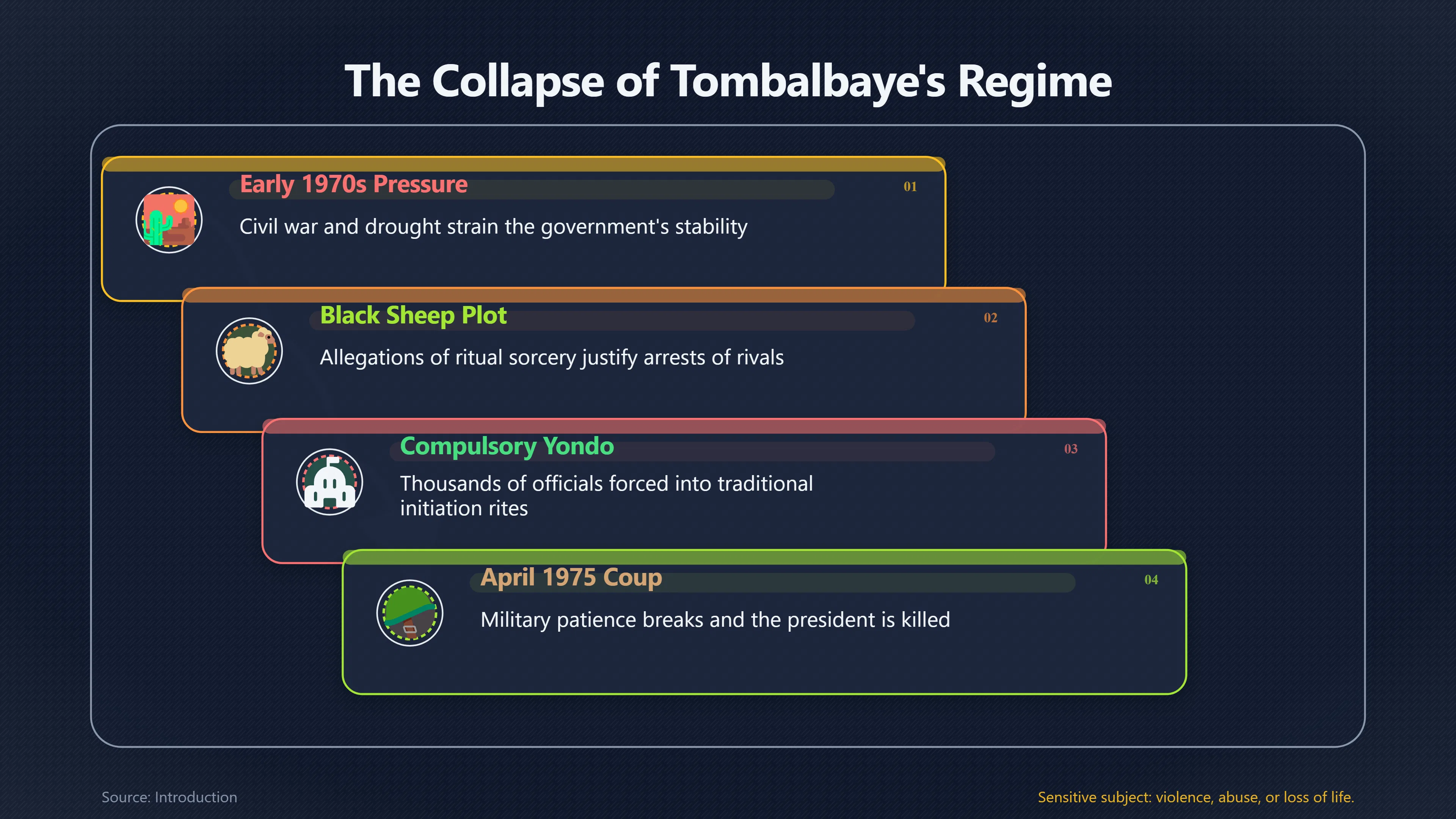
By the early 1970s Tombalbaye’s government faced mounting pressure. Civil war continued in the north, economic conditions worsened, drought intensified hardship, and support within his own southern political base was beginning to fracture. Rather than easing repression, the government increasingly interpreted political disagreement through the language of hidden conspiracies and supernatural attack.[Country Studies]countrystudies.usCountry Studies ChadCountry StudiesChad - TOMBALBAYE ERA, 1960-75…
Within this atmosphere, accusations of “political sorcery” became more than rhetorical insults. They entered official investigations, arrests and public trials. The implication was that opponents were not merely plotting politically but were attempting to destroy the state through occult means. In a society where belief in spiritual causation was familiar to many communities, such accusations carried enormous symbolic weight. The state effectively transformed supernatural suspicion into a category of political crime.[Wikipedia]WikipediaChadian Civil War (1965–1979Chadian Civil War (1965–1979
Scholars stress that this should not be understood as evidence that Chadian society as a whole descended into irrational panic. Rather, the government appropriated existing cultural ideas about spiritual danger and redirected them into a system of authoritarian control. Beliefs that had long existed in local contexts became politically useful because they encouraged fear of invisible enemies whose guilt was difficult to disprove.[Cambridge University Press & Assessment]cambridge.orgCambridge University Press & AssessmentRegionalism, Political Decay, and Civil Strife in Chad | The Journal of Modern African Studies | C…
The Black Sheep Plot
The best-known example came in 1973 with allegations surrounding what later became known as the “Black Sheep Plot.”
General Félix Malloum, several senior officials and members of Tombalbaye’s own ruling party were arrested after being accused of involvement in “political sorcery.” According to official claims, conspirators had arranged ritual acts involving a black sheep intended to bring about the president’s death through supernatural means rather than conventional assassination.[wikipedia.org]WikipediaChadian Civil War (1965–1979Chadian Civil War (1965–1979
Contemporary reporting described accusations that ritual specialists had pierced the eyes of a black sheep representing Tombalbaye before burying the animal alive. Whether participants genuinely believed such practices could kill the president is impossible to establish. More important politically was that these allegations provided justification for imprisoning important rivals, including Malloum, who would later emerge as the leader of the military government after Tombalbaye’s overthrow.[Time]time.comCHAD: Death of a DictatorCHAD: Death of a Dictator…
Historians generally treat the affair as an example of political theatre intertwined with genuine local belief. The accusations reinforced the image of the president as the target of hidden enemies while allowing ordinary political dissent to be redefined as mystical treason.[Cambridge University Press & Assessment]cambridge.orgCambridge University Press & AssessmentRegionalism, Political Decay, and Civil Strife in Chad | The Journal of Modern African Studies | C…
Compulsory initiation and political loyalty
Even more controversial than the sorcery accusations was Tombalbaye’s decision to require thousands of public officials to undergo yondo, an initiation ceremony traditionally practised among parts of the Sara people, the president’s own ethnic community.
Yondo had long existed as a community rite marking the transition into adulthood. Its meaning depended upon voluntary participation within particular Sara groups. Tombalbaye fundamentally changed its political role by making initiation effectively compulsory for many non-Muslim men seeking careers in government, the civil service or the armed forces. Between mid-1973 and April 1974, around 3,000 civil servants—including ministers and senior military officers—were reportedly subjected to the initiation process.[Country Studies]countrystudies.usCountry Studies ChadCountry StudiesChad - TOMBALBAYE ERA, 1960-75…
For many participants, the issue was not simply physical hardship. The ritual belonged to only one section of Chad’s diverse population. Christians, Muslims and members of other southern ethnic groups often regarded compulsory participation as both culturally alien and religiously objectionable. Missionaries had previously criticised aspects of the ceremonies, while many educated urban officials viewed state enforcement as an attack on personal freedom rather than an expression of national culture.[cambridge.org]cambridge.orgCambridge University Press & AssessmentRegionalism, Political Decay, and Civil Strife in Chad | The Journal of Modern African Studies | C…
Contemporary accounts describe initiation involving physical ordeals that could include beatings, scarification, periods of isolation and symbolic experiences such as mock burial, although practices varied and not every participant experienced identical rituals. The crucial political point was not the exact form of every ceremony but that refusal threatened careers and could invite official suspicion.[Wikipedia]WikipediaFrançois TombalbayeFrançois Tombalbaye

How ritual language strengthened repression
Tombalbaye justified these measures as part of an Authenticité programme intended to replace colonial influences with indigenous African traditions. The campaign included renaming cities, encouraging African personal names and promoting cultural renewal.
Unlike comparable cultural policies elsewhere in Africa, however, Chad’s version increasingly became inseparable from coercion. Ritual participation ceased to be an expression of community identity and instead became a test of political reliability. Loyalty was demonstrated not merely through administrative service but through bodily participation in ceremonies endorsed by the president.[Wikipedia]WikipediaAuthenticité (ChadAuthenticité (Chad
This shift had several political consequences:
- Opposition appeared spiritually suspect. Critics could be portrayed as dangerous conspirators rather than ordinary political rivals.
- Promotion became conditional on ritual conformity. Advancement depended upon demonstrating obedience through compulsory initiation.
- State authority borrowed traditional legitimacy. Government repression acquired additional symbolic force by presenting itself as culturally authentic rather than merely authoritarian.
- Refusal became politically meaningful. Declining participation could itself appear as evidence of disloyalty.[countrystudies.us]countrystudies.usCountry Studies ChadCountry StudiesChad - TOMBALBAYE ERA, 1960-75…
Many historians argue that this represented a form of “political ritualisation” in which state power sought legitimacy through selective use of traditional practices while stripping those practices of their voluntary and local character.[Cambridge University Press & Assessment]cambridge.orgCambridge University Press & AssessmentRegionalism, Political Decay, and Civil Strife in Chad | The Journal of Modern African Studies | C…
Why the strategy failed
Ironically, the policies intended to strengthen Tombalbaye’s authority accelerated its collapse.
Instead of restoring support among southern communities, compulsory yondo alienated civil servants, students, military officers and many Sara themselves. Because the rites originated within only one subgroup, many southerners viewed the policy as favouring the president’s own cultural background rather than creating genuine national unity. Christians objected to enforced participation in rituals they considered incompatible with their faith, while many educated officials resented the government’s intrusion into personal belief and identity.[countrystudies.us]countrystudies.usCountry Studies ChadCountry StudiesChad - TOMBALBAYE ERA, 1960-75…
Meanwhile, repeated arrests over alleged conspiracies—including accusations of political sorcery—deepened distrust inside the armed forces. Officers increasingly feared arbitrary detention as much as external enemies. When Tombalbaye ordered further arrests of senior officers in early 1975, military patience finally broke. On 13 April 1975 soldiers staged a coup, killing the president and releasing General Félix Malloum from prison. Malloum subsequently became head of the new military government.[Wikipedia]Wikipedia1975 Chadian coup d'état1975 Chadian coup d'état
Why this episode matters
Tombalbaye’s final years remain one of Africa’s clearest examples of supernatural language becoming intertwined with state power rather than popular panic.
The episode illustrates several important distinctions:
- Traditional initiation rites are not inherently coercive; coercion arose when the state made participation effectively compulsory.
- Belief in sorcery was not unique to Chad, but official accusations transformed cultural ideas into political weapons.
- The resulting repression came primarily from government institutions rather than spontaneous collective fear.
For historians of collective belief, the period demonstrates how rulers can mobilise widely recognised cultural concepts to reinforce authority. Instead of persuading citizens through ideology alone, Tombalbaye attempted to fuse political obedience with ritual obligation and portray hidden supernatural enemies as threats to the state. The strategy ultimately weakened rather than strengthened his regime, leaving a lasting example of how cultural symbolism can become entangled with authoritarian governance.[cambridge.org]cambridge.orgCambridge University Press & AssessmentRegionalism, Political Decay, and Civil Strife in Chad | The Journal of Modern African Studies | C…

Amazon book picks
Further Reading
Books and field guides related to When Sorcery Accusations Became State Power. Use these as the next step if you want deeper reading beyond the article.


Endnotes
1.
Source: cambridge.org
Link:https://www.cambridge.org/core/services/aop-cambridge-core/content/view/7E5FA39D9D3D7374364998AF15183ADF/S0022278X00009435a.pdf/regionalism-political-decay-and-civil-strife-in-chad.pdf
Source snippet
Cambridge University Press & AssessmentRegionalism, Political Decay, and Civil Strife in Chad | The Journal of Modern African Studies | C...
2.
Source: Wikipedia
Title: Chadian Civil War (1965–1979)
Link:https://en.wikipedia.org/wiki/Chadian_Civil_War_%281965%E2%80%931979%29
3.
Source: time.com
Title: CHAD: Death of a Dictator
Link:https://time.com/archive/6851138/chad-death-of-a-dictator/
Source snippet
CHAD: Death of a Dictator...
4.
Source: content.time.com
Title: CHAD: Death of a Dictator
Link:https://content.time.com/time/subscriber/article/0%2C33009%2C917376%2C00.html
Source snippet
CHAD: Death of a Dictator - TIME...
5.
Source: Wikipedia
Title: François Tombalbaye
Link:https://en.wikipedia.org/wiki/Fran%C3%A7ois_Tombalbaye
6.
Source: Wikipedia
Title: Authenticité (Chad)
Link:https://en.wikipedia.org/wiki/Authenticit%C3%A9_%28Chad%29
7.
Source: Wikipedia
Title: 1975 Chadian coup d’état
Link:https://en.wikipedia.org/wiki/1975_Chadian_coup_d%27%C3%A9tat
8.
Source: cambridge.org
Link:https://www.cambridge.org/core/journals/africa/article/spirits-power-and-the-political-imagination-in-latecolonial-gabon/51C136E4EEB332571E60C16B1F1C22CA
9.
Source: country-studies.com
Title: tombalbaye era, 1960 75
Link:https://country-studies.com/chad/tombalbaye-era%2C-1960-75.html
10.
Source: countrystudies.us
Title: Country Studies Chad
Link:https://countrystudies.us/chad/10.htm
Source snippet
Country StudiesChad - TOMBALBAYE ERA, 1960-75...
11.
Source: minorityrights.org
Title: Minority Rights Group Chad
Link:https://minorityrights.org/app/uploads/2023/12/chad.pdf
Source snippet
The Minority Rights Group Report No. 80 The M...
12.
Source: mongabay.com
Link:https://www.mongabay.com/reference/country_studies/chad/all.html
Source snippet
Chad...
13.
Source: countrystudies.us
Title: Country Studies Chad
Link:https://countrystudies.us/chad/44.htm
Source snippet
Country StudiesChad - POLITICAL BACKGROUND...
14.
Source: anthropologieenligne.com
Title: François Tombalbaye
Link:https://www.anthropologieenligne.com/pages/04/4.1.html
Additional References
15.
Source: studyguides.com
Link:https://studyguides.com/topics/cmmkffvon6mq201aapo5rys56
Source snippet
Tombalbaye, François (Chadian President) - Overview | StudyGuides.comMarch 11, 2026 — His 1971 PPT congress speech admitted errors, incor...
Published: March 11, 2026
16.
Source: youtube.com
Link:https://www.youtube.com/watch?v=69NuSzmpLlE
Source snippet
Chad's ex-dictator Hissène Habré sentenced to life in prison...
Published: January 1971
17.
Source: kawa.ac.ug
Link:https://kawa.ac.ug/Africannationalismebook/the_military_overthrows_and_kills_president_tombalbaye.html
18.
Source: studyguides.com
Link:https://studyguides.com/study-methods/study-guide/cmmkffvon6mq201aapo5rys56
19.
Source: youtube.com
Title: The Chadian Civil War
Link:https://www.youtube.com/watch?v=OBw_qmTPcQI
Source snippet
Chad's 11th Independence Day Celebrations Attended by 9 African Heads of State | January 1971...
Published: January 1971
20.
Source: worldhistoryedu.com
Link:https://worldhistoryedu.com/life-and-political-career-of-francois-tombalbaye-1918-1975-the-first-president-of-chad/
21.
Source: youtube.com
Title: Chad’s Strange and Brutal Dictators: Tombalbaye, Habré and Déby
Link:https://www.youtube.com/watch?v=tCw9q5tmA6c
Source snippet
RR7011B CHAD FRANCE'S VIETNAM?...
22.
Source: youtube.com
Title: Chad’s ex-dictator Hissène Habré sentenced to life in prison
Link:https://www.youtube.com/watch?v=q7fUBMVMvl8
23.
Source: scribd.com
Title: Chad Country Study 00 Coll | PDF | Travel
Link:https://www.scribd.com/document/585871161/Chad-Country-Study-00-Coll
24.
Source: youtube.com
Link:https://www.youtube.com/watch?v=lrthJvufVc8
Source snippet
The Chadian Civil War...
Topic Tree