Within Philippine Belief Crises
How Lapiang Malaya Ended in Mass Killing
The 1967 killings show how supernatural belief, rural grievance and armed state power combined in a preventable tragedy.
On this page
- Who joined Lapiang Malaya and what they wanted
- The march, confrontation and disputed death toll
- How 'fanaticism' obscured state responsibility
Page outline Jump by section
Introduction
The killing of members of Lapiang Malaya in May 1967 is one of the clearest examples in modern Philippine history of how an unusual religious-political movement could be dismissed as mere “fanaticism” while obscuring difficult questions about the state’s use of lethal force. The movement’s followers held extraordinary beliefs, including confidence that spiritual protection would shield them from bullets, but they were also rural people frustrated by inequality, corruption and political exclusion. When hundreds gathered to march towards Malacañang Palace, the confrontation ended with Philippine Constabulary troops using automatic rifles against opponents armed mainly with bolos and traditional weapons. At least 32 followers were killed according to official accounts, although the precise circumstances and casualty figures remain debated. The episode has since become a case study in how millenarian belief, rural grievance and state violence can combine in a preventable tragedy.[wikipedia.org]WikipediaLapiang MalayaLapiang Malaya
Who joined Lapiang Malaya and what they wanted
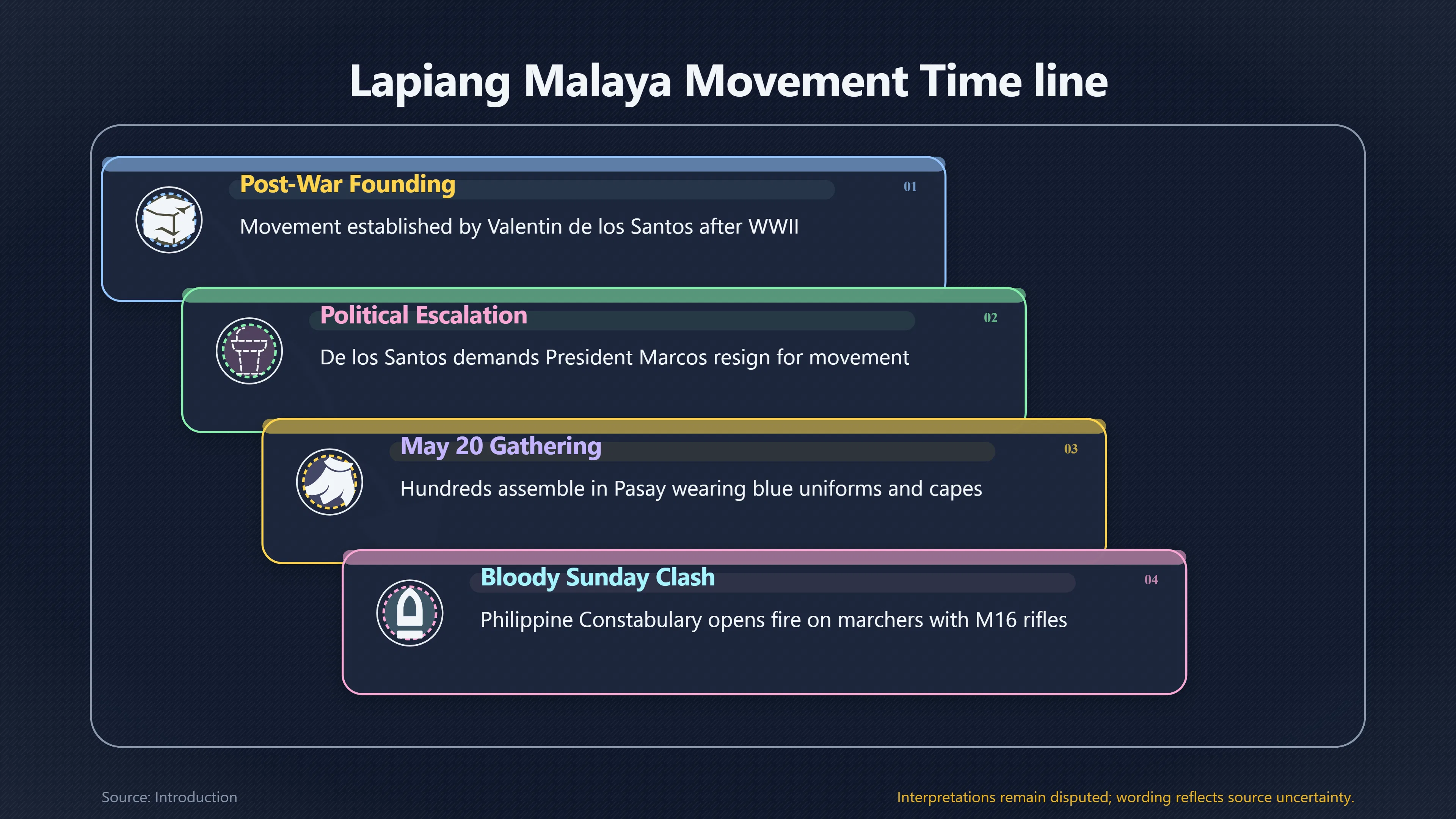
Lapiang Malaya (“Freedom Party” or “Freedom Movement”) was founded by Valentin de los Santos after the Second World War. It mixed nationalist politics, folk Catholicism, healing practices and millenarian expectations that the Philippines would be morally renewed through divine intervention. Although later commentators often reduced it to a “cult”, the movement also functioned as a political organisation attracting poor rural supporters, especially from southern Luzon, who felt excluded from economic and political power.[Wikipedia]WikipediaLapiang MalayaLapiang Malaya
Many followers believed that spiritual rituals, sacred objects and protective charms could shield them from physical harm. Such beliefs were not unique to Lapiang Malaya. Similar ideas about supernatural protection had appeared in earlier anti-colonial and millenarian movements across Philippine history. For participants, these beliefs existed alongside demands for social justice and national renewal rather than replacing political aspirations altogether. Historians of Philippine millenarian movements argue that reducing such groups to irrational “fanatics” overlooks the material conditions that encouraged people to seek salvation through religious politics.[Wikipedia]WikipediaLapiang MalayaLapiang Malaya
By May 1967, de los Santos publicly demanded that President Ferdinand Marcos resign and hand power to Lapiang Malaya. This transformed what had previously been an eccentric movement into a direct political challenge to the government.[Wikipedia]WikipediaLapiang MalayaLapiang Malaya
The march, confrontation and disputed death toll
On 20–21 May 1967, several hundred Lapiang Malaya members gathered at the movement’s headquarters in Pasay. Many wore distinctive blue uniforms with brightly coloured capes and carried bolos, while believing that rituals and charms would protect them from gunfire. Their declared intention was to march to Malacañang Palace.[Wikipedia]WikipediaLapiang MalayaLapiang Malaya
The Philippine Constabulary blocked the procession before it could begin. Negotiations and repeated attempts to disperse the gathering failed. The confrontation escalated rapidly into violence, with some followers advancing despite warnings while heavily armed constabulary personnel responded with M16 rifles. Official accounts reported that 33 people died, including 32 Lapiang Malaya members, while hundreds more were arrested and taken to Camp Crame. Contemporary newspapers described the event as “Bloody Sunday”, a name that reflected both the scale of the bloodshed and public shock at the outcome.[Wikipedia]WikipediaLapiang MalayaLapiang Malaya
Although official casualty figures are widely cited, historians note that many aspects of the confrontation remain disputed. Contemporary reporting relied heavily on government statements, while surviving members challenged official interpretations of both the movement’s intentions and the necessity of the force used against them. The imbalance between automatic weapons and largely traditional arms has remained central to later reassessments of the incident.[Wikipedia]WikipediaLapiang MalayaLapiang Malaya
How “fanaticism” obscured state responsibility
The extraordinary beliefs held by many followers have often dominated popular memory of the incident. Stories about pebbles believed to confer invulnerability or charms that could stop bullets became enduring symbols of supposed irrationality. Such details were undeniably part of the movement’s worldview, but focusing exclusively on them risks simplifying the historical record.[Time]time.comThe Philippines: A Bothered ArchipelagoThe Philippines: A Bothered Archipelago…
The language used by officials and much of the press portrayed the confrontation primarily as the suppression of dangerous fanatics. This framing made it easier to present the deaths as an unavoidable consequence of irrational behaviour rather than asking whether less lethal methods could have prevented mass casualties. Human rights advocates and later historians have pointed to the overwhelming disparity in firepower as evidence that the state’s response deserves independent scrutiny regardless of the movement’s beliefs.[amnesty.org.ph]amnesty.org.phMARTIA L LAWMARTIAL LAW - Amnesty Philippines…
After the clash, surviving members were arrested on charges including sedition. Valentin de los Santos himself was committed to the National Center for Mental Health rather than imprisoned, reflecting another way authorities framed the movement—as both politically dangerous and psychologically abnormal. Accounts of his later death differ, illustrating the uncertainty that still surrounds parts of the episode.[Wikipedia]WikipediaLapiang MalayaLapiang Malaya
Why the episode still matters
The Lapiang Malaya killings occupy an important place in Philippine discussions of religion, protest and state power because they resist simple explanation.
Several lessons stand out:
- Unusual beliefs do not eliminate political grievances. The movement’s supernatural expectations existed alongside real concerns about poverty, inequality and governance.
- Official labels shape public memory. Describing participants as “fanatics” influenced how journalists, officials and later generations interpreted the violence.
- State responses deserve independent evaluation. Even when confronting groups holding implausible or dangerous beliefs, governments remain responsible for ensuring that force is necessary and proportionate.
- Millenarian movements are historically diverse. Lapiang Malaya was neither simply a religious sect nor merely a political party, but part of a longer Philippine tradition in which spiritual expectations and demands for social change became intertwined.[amnesty.org.ph]amnesty.org.phMARTIA L LAWMARTIAL LAW - Amnesty Philippines…
Within the broader history of collective belief in the Philippines, Lapiang Malaya illustrates that the greatest harm did not arise solely from supernatural conviction. It emerged from the interaction between deeply held religious expectations, longstanding rural discontent and a state response that relied on overwhelming armed force. The event therefore remains significant not because it proves that millenarian movements inevitably become violent, but because it demonstrates how dismissing a movement as irrational can obscure difficult questions about political exclusion, policing and accountability.[amnesty.org.ph]amnesty.org.phMARTIA L LAWMARTIAL LAW - Amnesty Philippines…

Amazon book picks
Further Reading
Books and field guides related to How Lapiang Malaya Ended in Mass Killing. Use these as the next step if you want deeper reading beyond the article.
Noli Me Tangere
First published 1902. Subjects: Economics, Classic Literature, Fiction, Fiction, historical, general, Philippines, fiction.
Pasyon and revolution
First published 1979. Subjects: History, Kasaysayan ng pasiong mahal ni Hesukristong Panginoon natin, Revolutions, Casaysayan nang pasion...
An Anarchy of Families
First published 1993. Subjects: Politics and government, Family, Families, History, Family, asia.
Barangay
First published 1994. Subjects: Ethnology, Civilization, Filipinos, Social life and customs, Bisaya (Philippine people).
Endnotes
1.
Source: Wikipedia
Title: Lapiang Malaya
Link:https://en.wikipedia.org/wiki/Lapiang_Malaya
2.
Source: time.com
Title: The Philippines: A Bothered Archipelago
Link:https://time.com/archive/6638133/the-philippines-a-bothered-archipelago/
Source snippet
The Philippines: A Bothered Archipelago...
3.
Source: amnesty.org.ph
Title: MARTIA L LAW
Link:https://www.amnesty.org.ph/2022/07/protestph-martial-law-era/
Source snippet
MARTIAL LAW - Amnesty Philippines...
4.
Source: content.time.com
Title: 0,33009,902050 1,00
Link:https://content.time.com/time/subscriber/article/0%2C33009%2C902050-1%2C00.html
Additional References
5.
Source: cambridge.org
Link:https://www.cambridge.org/core/journals/journal-of-southeast-asian-studies/article/abs/rethinking-the-causes-of-islamisation-ontological-insecurity-postcoloniality-and-islam-in-malaysia/9D3B7AF516E1D3B353749DC4D00ECF4B
Source snippet
ies | Cambridge CoreSeptember 20, 2023 — RETHINKING THE CAUSES OF ISLAMISATION: ONTOLOGICAL (IN)SECURITY, POSTCOLONIALITY, AND ISLAM IN M...
Published: September 20, 2023
6.
Source: cambridge.org
Link:https://www.cambridge.org/core/journals/federal-law-review/article/measure-of-autonomy-federalism-as-protection-for-malaysias-indigenous-peoples/1D3F672B4095DFF5603C52EF4597DE1E
Source snippet
January 1, 2025 — ‘A MEASURE OF AUTONOMY’: FEDERALISM AS PROTECTION FOR MALAYSIA’S INDIGENOUS PEOPLES Published online by Cambridge Unive...
Published: January 1, 2025
7.
Source: everand.com
Link:https://www.everand.com/book/993422094/Pasyon-and-Revolution-Popular-Movements-in-the-Philippines
Source snippet
Pasyon and Revolution by Reynaldo Clemeña Ileto (Ebook) - Read free for 30 daysJanuary 22, 2026 — TOWARD A HISTORY FROM BELOW One Sunday...
Published: January 22, 2026
8.
Source: cambridge.org
Link:https://www.cambridge.org/core/journals/journal-of-southeast-asian-studies/article/abs/deliberately-forgotten-battle-the-lapiang-manggagawa-and-the-manila-port-strike-of-1963/6B8C7D5FFA181FB15369CA8B95D770D1
Source snippet
A deliberately forgotten battle: The Lapiang Manggagawa and the Manila Port Strike of 1963 | Journal of Southeast Asian Studies | Cambrid...
9.
Source: youtube.com
Link:https://www.youtube.com/watch?v=35dbJF7pTTM
Source snippet
Xiao Time: The Samahan of Papa God || Oct. 30, 2014...
10.
Source: cambridge.org
Link:https://www.cambridge.org/core/journals/journal-of-southeast-asian-studies/article/deliberately-forgotten-battle-the-lapiang-manggagawa-and-the-manila-port-strike-of-1963/6B8C7D5FFA181FB15369CA8B95D770D1
Source snippet
1972, Philippine Radical Papers (henceforth PRP), University of the Philippines Diliman, Quezon City, 09/10...
11.
Source: youtube.com
Title: Ang Katotohanan sa Madugong Lapiang Malaya Massacre
Link:https://www.youtube.com/watch?v=8uXIFZ5SyaQ
Source snippet
Ang unang rebelyon kay Pangulong Marcos | Sinalakay ang malakanyang | Supremo vs Constabulary Story...
12.
Source: youtube.com
Link:https://www.youtube.com/watch?v=a2QlmVNoJVs
Source snippet
Xiao Time: Sabah Claim part 1, kasaysayan ng Sabah Claim at ng Jabidah Incident...
13.
Source: academic.oup.com
Link:https://academic.oup.com/book/59235/chapter/499141301
Source snippet
Transformed: Upheaval in Post-War Malaya, 1945–1946 | Imagining Malaya: Peranakan Cosmopolitanism, Nationalism, and Belonging at the End...
14.
Source: researchgate.net
Link:https://www.researchgate.net/publication/339014866_Book_review_of_Knowledge_and_Pacification_On_the_US_Conquest_and_the_Writing_of_Philippine_History_by_Reynaldo_Clemena_Ileto
Topic Tree