When Fear and Belief Swept Across Russia
Russia’s history of collective fear and contagious belief is not one continuous story of “mass hysteria”.
Page outline Jump by section
Introduction
The most important pattern is the interaction between belief and power. Religious or supernatural ideas became especially dangerous when communities felt that the existing world was ending, when authorities treated difference as conspiracy, or when charismatic figures gained access to frightened and disoriented audiences. Russia therefore offers less evidence of classic crowd epidemics such as dancing plagues than of apocalyptic communities, miracle expectations and recurring moral panics over religious outsiders.
Why Russian witchcraft fears were different
Russia had witchcraft accusations and trials, but it did not experience witch-hunting on the scale seen in parts of Germany, Scotland or Switzerland. Russian cases were generally more local, practical and personal. People accused neighbours, servants, healers or rivals of causing illness, sexual impotence, failed crops, family conflict or the loss of a master’s favour. The central fear was often harmful magic rather than membership of a vast Satanic conspiracy.[Cambridge University Press & Assessment]cambridge.orgCambridge University Press & AssessmentProsaic Witchcraft and Semiotic Totalitarianism: Muscovite…by V Kivelson · 2011 · Cited by 20 —…
That distinction matters because the familiar Western European image of the witch — usually a woman who had made a formal pact with the Devil and joined an organised nocturnal conspiracy — fits Muscovite Russia poorly. Men formed a substantial proportion of defendants in seventeenth-century Russian cases. Accusations often concerned charms, roots, powders, spoken spells or healing practices that had allegedly gone wrong. Historians Valerie Kivelson and Jonathan Shaheen argue that Russian magical belief was diffuse and everyday rather than governed by a single, elaborate demonological system.[Cambridge University Press & Assessment]cambridge.orgCambridge University Press & AssessmentMale Witches and Gendered Categories in Seventeenth…by VA Kivelson · 2003 · Cited by 43 — Valer…
The courts could nevertheless be brutal. Torture and forced testimony distorted cases, while household dependency gave landlords and masters opportunities to compel servants into confessions or accusations. Witchcraft proceedings therefore reveal social tensions as much as supernatural belief: domestic violence, unequal power, struggles over reputation and attempts to explain misfortune in a world with limited medical knowledge.[Cambridge University Press & Assessment]cambridge.orgUniversity Press & Assessment Judicial culture (Part IIn another…
Russia was not simply more “rational” than western Europe. Magic remained culturally credible, and alleged practitioners could face severe punishment. What Russia largely lacked was the self-reinforcing judicial mechanism that produced some western European chain-reaction hunts: confessions to a Devil’s conspiracy, demands to name accomplices and trials that multiplied across a region. Calling Russian witchcraft prosecutions a single national hysteria would therefore obscure their fragmented and often intensely local character.
When apocalypse became a matter of life and death
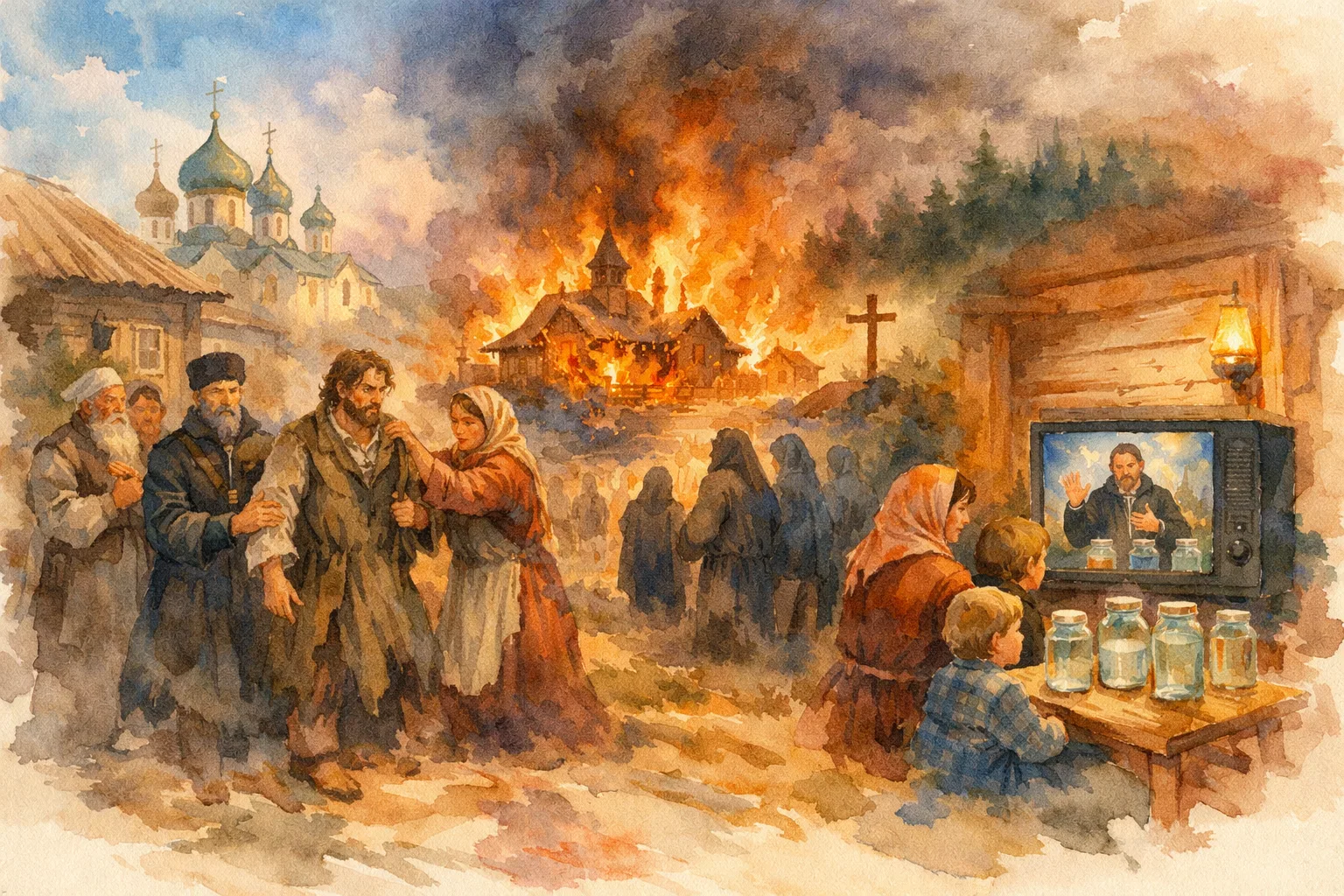
The most catastrophic Russian episode of collective millenarian belief followed the seventeenth-century split in the Russian Orthodox Church. Reforms introduced under Patriarch Nikon changed rituals and religious books in an attempt to bring Russian practice into closer alignment with contemporary Greek usage. Opponents, later known collectively as Old Believers, regarded the changes not as minor corrections but as evidence that the official Church had betrayed the true faith.
For some dissenters, the reforms and the state’s persecution confirmed that the age of the Antichrist had arrived. In the late seventeenth and early eighteenth centuries, groups of Old Believers died in collective fires, sometimes after barricading themselves in remote religious settlements. Sociologist Thomas Robbins estimates that tens of thousands may have died over several decades, although precise totals are difficult to establish from hostile, inconsistent and sometimes propagandistic records.[OUP Academic]academic.oup.comOver a period of several decades in late seventeenth and early eighteenth century Russia, tens of thousands of “Old Believers” committed…
These deaths are sometimes presented as straightforward examples of a suicidal cult. That description is too simple. “Old Believers” covered many communities with sharply differing beliefs, and the overwhelming majority did not participate in collective death. Those who did were responding to a combination of apocalyptic theology, state pressure, fear of forced conversion and the conviction that death by fire preserved them from spiritual contamination. The acts were usually collective and religiously organised, but they also occurred within a persecutory political environment.
The authorities’ response could intensify the crisis. Attempts to arrest, tax or forcibly reintegrate dissenters sometimes reinforced the belief that the state represented an evil final-age power. The resulting feedback loop is familiar in millenarian history: repression appears to prove the prophecy, the prophecy encourages greater withdrawal, and the group’s withdrawal alarms the authorities further.
Later imperial Russia contained many other dissident religious movements that officials, clergy and journalists described as dangerous “sects”. Among the best known were mystical Christian communities accused of secret ecstatic rites and groups notorious for extreme bodily discipline. Evidence about them was frequently filtered through police investigators, missionaries and sensational writers. Allegations of hidden orgies, ritual crimes or elaborate conspiracies therefore require care: some communities undoubtedly practised demanding or harmful disciplines, but hostile outsiders also converted secrecy and theological difference into lurid mythology.
The Soviet collapse and the return of mass belief
The Soviet state officially promoted atheism, but it did not eliminate religious longing, folk healing or fascination with paranormal powers. During the late 1980s, censorship weakened while confidence in political and scientific institutions was collapsing. Television suddenly provided charismatic healers and self-described psychics with audiences of extraordinary size.
Anatoly Kashpirovsky, a trained psychiatrist, became famous for mass televised healing sessions in which he claimed to influence viewers’ bodies through suggestion. Allan Chumak appeared on television making slow hand movements that supposedly charged jars of water, creams and other objects with healing energy. Viewers placed containers beside their television sets and later used the contents as remedies.[bbk.ac.uk]www7.bbk.ac.uka common madness tv psychics and hypnosis in the soviet uniona common madness tv psychics and hypnosis in the soviet union
It is tempting to treat these broadcasts merely as comic relics of a credulous era. Their popularity, however, reflected real social conditions. The Soviet public had been taught to respect scientific authority, yet official institutions routinely concealed information and were losing legitimacy. Medical shortages, economic insecurity and the loosening of ideological controls created a market for figures who combined therapeutic language, stage performance and promises of extraordinary personal control. The healers entered millions of homes through the same medium that had previously represented official truth.
The sessions were not a clear instance of mass psychogenic illness. Viewers did not all develop a shared unexplained disorder, and claims that broadcasts caused widespread injury or suicide were often difficult to verify. The episode is better understood as mass-mediated miracle belief: television transformed private hope, suggestion and anecdotal reports of recovery into the appearance of a nationwide healing event. Reports of warmth, pain relief, trance or emotional release could then serve as social proof for other viewers.
This atmosphere continued into the 1990s, when Russia experienced a rapid expansion of new religious movements, imported missionary groups, occult businesses and home-grown spiritual teachers. Public anxiety rose alongside them. Regional governments introduced restrictions, and the 1997 law on religion created legal distinctions that disadvantaged newer or supposedly “non-traditional” communities. Between 1993 and 1997, roughly a third of Russian regions had already adopted local measures restricting missionary activity, often with new religious movements as the implicit or explicit target.[cambridge.org]resolve.cambridge.orgnew religious movements in changing russianew religious movements in changing russia
Some concern was justified. Aum Shinrikyo, the Japanese apocalyptic organisation responsible for the 1995 Tokyo sarin attack, had built a remarkably large following and media presence in Russia after the Soviet collapse. Its violence demonstrated that a religious organisation could pose a genuine security threat. Yet Aum also became a powerful model through which unrelated minority religions could be portrayed as similarly manipulative, foreign or potentially violent.[cfr.org]cfr.orgCouncil on Foreign Relations Aum ShinrikyoCouncil on Foreign Relations Aum Shinrikyo
The resulting “cult panic” blurred several categories: violent organisations, unconventional but peaceful religions, commercial self-help schemes, fraudulent healers and churches competing with the Russian Orthodox Church. The word “sect” increasingly worked less as a precise description than as a warning label.
Modern prophets, fraud and apocalyptic withdrawal
Post-Soviet Russia produced several high-profile movements centred on charismatic figures. Their histories show why neither blanket scepticism nor blanket tolerance is adequate: claims of religious persecution can coexist with credible evidence of financial exploitation, psychological pressure or danger to followers.
The cave siege near Penza
In late 2007, about 30 followers of apocalyptic preacher Pyotr Kuznetsov entered an underground shelter near Nikolskoye in the Penza region. They expected the end of the world in 2008 and reportedly threatened to detonate fuel canisters if police stormed the site. Kuznetsov himself remained outside and was detained.[Reuters]reuters.comRussia sect holes up in cave to await end of worldRussia sect holes up in cave to await end of world
The authorities avoided an immediate assault. Officials, police, doctors and Orthodox clergy attempted to negotiate while journalists gathered nearby. Some members emerged after water and structural damage affected the shelter. The last group left in May 2008, when fumes from two decomposing bodies made continued occupation impossible.[Reuters]reuters.comLast members of Russian doomsday cult leave caveLast members of Russian doomsday cult leave cave
The episode involved a real apocalyptic community rather than an invented scare, but media coverage often reduced its members to grotesque stereotypes. Their beliefs combined extreme Orthodox traditionalism, fear of identity documents and barcodes, withdrawal from modern society and an imminent end-times expectation. The long standoff also demonstrates that a restrained response can prevent prophecy from becoming massacre. A violent raid might have confirmed the group’s belief that hostile worldly forces had come to destroy the faithful.
Promises to defeat death
Grigori Grabovoi offered a different form of salvation. He claimed powers that included curing serious diseases, preventing disasters and resurrecting the dead. His name became especially notorious after bereaved people connected with the 2004 Beslan school siege were exposed to promises concerning the return of dead children. In 2008 a Moscow court convicted him on 11 counts of fraud and sentenced him to 11 years, later reduced to eight; he was released on parole in 2010.[RadioFreeEurope/RadioLiberty]rferl.orgOpen source on rferl.org.
Grabovoi’s case is often told as a simple story of a cynical prophet deceiving desperate mothers. The documented fraud conviction is central, but the public controversy also became entangled with disputes among Beslan campaigners and accusations that sensational reporting exploited bereaved families. The safest conclusion is narrower: extraordinary promises of healing and resurrection were commercialised, vulnerable clients paid money, and a court found a pattern of fraudulent conduct.
The case shows how miracle belief spreads without requiring people to be irrational in every area of life. Bereavement, trauma and anger at official institutions can make an impossible promise emotionally difficult to reject. Testimonials, public meetings, elaborate technical language and the visible presence of other believers can give private hope the appearance of verified knowledge.

The “Jesus of Siberia”
Sergei Torop, known to his followers as Vissarion, founded the Church of the Last Testament in the early 1990s and established a remote community in Siberia. A former traffic policeman, he presented himself as a messianic figure and attracted thousands of followers, some of whom moved to settlements organised around his teachings.
Russian security forces arrested Torop and two senior associates in 2020. Investigators alleged that the leaders had used psychological pressure, extracted money and caused serious harm to followers. In June 2025, a Russian court sentenced Torop to 12 years in prison after convicting him of harming followers’ health and financial interests; two aides received sentences of 12 and 11 years.[Reuters]reuters.comRussia detains Siberian sect leader over allegations heRussia detains Siberian sect leader over allegations he
The convictions provide stronger grounds for discussing coercion than the mere fact that Torop claimed a divine identity. Even so, the case must be read within Russia’s wider record of using sweeping security operations against disfavoured religious communities. Unusual belief, communal living or devotion to a leader does not by itself prove abuse. The relevant questions are whether people were deceived, isolated, threatened, deprived of medical care or property, or subjected to demonstrable physical and psychological harm.
When “cult danger” becomes a tool of the state
Modern Russia’s language of sects, spiritual security and traditional values increasingly extends beyond movements accused of concrete violence or fraud. The state has used extremism laws against peaceful religious minorities, most prominently Jehovah’s Witnesses. Russia’s Supreme Court banned their national organisation as extremist in 2017 and dissolved hundreds of local bodies. Worship, religious discussion and continued community organisation have since led to raids, prosecutions and substantial prison sentences.[reuters.com]reuters.comRussia jails 9 Jehovah's Witnesses for "extremismRussia jails 9 Jehovah's Witnesses for "extremism
This is not a panic in the medical sense and should not be described as collective insanity. It is a state-supported moral and security campaign in which a minority religion is framed as a threat to society. The label “extremist” places peaceful worship in the same conceptual category as violent political activity, making exceptional policing appear necessary.
A still broader example came in July 2025, when Russia’s Supreme Court designated the supposed “International Satanist Movement” as extremist. Independent reporting noted that the alleged movement was not clearly defined as a conventional organisation with an identifiable membership or leadership. The ruling therefore created the possibility that symbols, music, publications, online posts or unconventional beliefs could be interpreted as participation in a prohibited movement.[ovd.info]ovd.infointernational satanist movement has been recognised extremistinternational satanist movement has been recognised extremist
Satanism had already become a recurring element in official and media rhetoric, particularly in descriptions of cultural decline, youth subcultures and the conflict with the West. Scholars of contemporary Russian conspiracy narratives have observed that enemies are frequently associated with sects, occultism or hidden spiritual corruption. Such language converts political confrontation into a cosmic struggle between sacred order and demonic conspiracy.[Meduza]meduza.iothe devil went down to kyivthe devil went down to kyiv
The danger is not that every warning about a religious organisation is fabricated. Aum Shinrikyo committed mass murder; fraudulent miracle sellers have exploited vulnerable people; closed communities can conceal abuse. The problem begins when vivid exceptional cases are used to suggest that all unfamiliar religions share the same hidden nature.
How to distinguish belief, panic and genuine harm
Russia’s cases become clearer when several phenomena that are often lumped together are kept separate.
- Witchcraft prosecution arose from sincere magical beliefs but was shaped by courts, torture, domestic conflict and unequal social power.
- Millenarian action involved communities interpreting political or religious crisis as evidence that the world was approaching a supernatural end.
- Mass-mediated miracle belief spread through television, testimonials and suggestion rather than through a shared epidemic of illness.
- Fraud or coercive control requires evidence of deception, financial exploitation, violence, threats, medical neglect or serious psychological harm.
- Moral panic occurs when a person or group is portrayed as a disproportionately broad threat and exceptional controls are demanded.
- Political persecution occurs when security language is used against peaceful belief or identity, even though the targeted group has not committed the harms associated with the label.
These categories can overlap. A genuinely abusive leader may become the focus of exaggerated folklore. A peaceful movement can contain former members with credible complaints. Authorities may prosecute real offences while also exploiting the case to strengthen control over religious life. Conversely, calling every investigation a “witch-hunt” can erase victims of actual abuse.
The Russian record also warns against diagnosing whole populations. Terms such as “mass hysteria” once encouraged the idea that crowds, women, religious minorities or traumatised communities had temporarily lost their minds. Modern scholarship generally favours more precise language: mass psychogenic illness for clusters of real stress-related symptoms without an identified physical cause, moral panic for socially amplified fear, and millenarianism for movements organised around expectations of a transformed or ending world. None of these terms should be applied until poisoning, infection, violence and other material explanations have been properly investigated.
Why these episodes still matter
Russia’s strange-belief history is culturally important because it tracks repeated moments when established authority became uncertain. The church reforms of the seventeenth century raised the question of whether official religion itself had become false. The end of the Soviet Union weakened faith in government, medicine and science while giving television healers and new prophets unprecedented access to the public. Contemporary extremism campaigns again ask citizens to accept that hidden, spiritually corrupt movements threaten the nation.
Across these periods, rumours and prophecies offered something that ordinary politics could not: a complete explanation of suffering. Illness became sorcery, institutional collapse became an approaching apocalypse, personal grief became a promise of resurrection, and cultural change became evidence of organised Satanism. These beliefs spread most effectively when they joined private fear to a public story already endorsed by neighbours, broadcasters, clergy or the state.
The central lesson is therefore not that Russians were unusually superstitious. It is that collective belief becomes powerful when it is embedded in institutions, media systems and social crises. The gravest harm often occurs not at the moment an extraordinary claim is first made, but when that claim acquires an enforcement mechanism: a court, a police operation, a closed community, a financial network, a television platform or a government campaign that decides who must be feared.


Endnotes
1.
Source: cambridge.org
Link:https://www.cambridge.org/core/journals/slavic-review/article/prosaic-witchcraft-and-semiotic-totalitarianism-muscovite-magic-reconsidered/79F43EF98D3524A76A35D77CCDDB57B2
Source snippet
Cambridge University Press & AssessmentProsaic Witchcraft and Semiotic Totalitarianism: Muscovite...by V Kivelson · 2011 · Cited by 20 —...
2.
Source: cambridge.org
Link:https://www.cambridge.org/core/books/crime-and-punishment-in-early-modern-russia/factions-witchcraft-and-heresy/648835E1AC8BE6CA1FCC695088470ACB
Source snippet
Cambridge University Press & AssessmentFactions, witchcraft, and heresy (Chapter 15)As Valerie Kivelson, Eve Levin and others have argued...
3.
Source: cambridge.org
Link:https://www.cambridge.org/core/journals/slavic-review/article/witchcraft-in-russia-and-ukraine-10001900-ed-valerie-a-kivelson-and-christine-d-worobec-ithaca-northern-illinois-university-press-imprint-of-cornell-university-press-2020-xxv-540-pp-appendix-notes-bibliography-chronology-glossary-index-illustrations-maps-3295-paper/CD93F7129D005F93C84D7C01C3BD53A8
Source snippet
Ed. Valerie...by CA Frierson · 2022 — Scholars of witchcraft in any culture can learn much here about distinctive features of Russian an...
4.
Source: cambridge.org
Link:https://www.cambridge.org/core/journals/comparative-studies-in-society-and-history/article/male-witches-and-gendered-categories-in-seventeenthcentury-russia/F9FA9F79E0576D4F0AC5EA29E3EFF59A
Source snippet
Cambridge University Press & AssessmentMale Witches and Gendered Categories in Seventeenth...by VA Kivelson · 2003 · Cited by 43 — Valer...
5.
Source: cambridge.org
Title: University Press & Assessment Judicial culture (Part I)
Link:https://www.cambridge.org/core/books/crime-and-punishment-in-early-modern-russia/judicial-culture/223A7BFCEDBEE96148B24ACD260D50A6
Source snippet
In another...
6.
Source: academic.oup.com
Link:https://academic.oup.com/socrel/article-abstract/47/1/1/1607906
Source snippet
Over a period of several decades in late seventeenth and early eighteenth century Russia, tens of thousands of “Old Believers” committed...
7.
Source: academic.oup.com
Link:https://academic.oup.com/socrel/article-pdf/47/1/1/4558437/47-1-1.pdf
Source snippet
OUP AcademicRELIGIOUS MASS SUICIDE BEFORE JONESTOWN" THE...by T Robbins · 1986 · Cited by 49 — Over a period of several decades in late...
8.
Source: www7.bbk.ac.uk
Title: a common madness tv psychics and hypnosis in the soviet union
Link:https://www7.bbk.ac.uk/hiddenpersuaders/blog/a-common-madness-tv-psychics-and-hypnosis-in-the-soviet-union/
9.
Source: postsoviet90s.com
Title: primetime hypnotic tele healing seances with kashpirovskii
Link:https://postsoviet90s.com/artifacts/primetime-hypnotic-tele-healing-seances-with-kashpirovskii
10.
Source: resolve.cambridge.org
Title: new religious movements in changing russia
Link:https://resolve.cambridge.org/core/services/aop-cambridge-core/content/view/0A1B2DE37E830AA4A2C682E9EE0F2761/9781139022651c17_p286-302_CBO.pdf/new-religious-movements-in-changing-russia.pdf
11.
Source: digitalcommons.law.byu.edu
Link:https://digitalcommons.law.byu.edu/cgi/viewcontent.cgi?article=2193&context=lawreview
12.
Source: reuters.com
Title: Russia sect holes up in cave to await end of world
Link:https://www.reuters.com/article/lifestyle/russia-sect-holes-up-in-cave-to-await-end-of-world-idUSL15689008/
13.
Source: reuters.com
Title: russia doomsday cult prays for sign to leave bunker idUSL31512941
Link:https://www.reuters.com/article/world/russia-doomsday-cult-prays-for-sign-to-leave-bunker-idUSL31512941/
14.
Source: reuters.com
Title: Last members of Russian doomsday cult leave cave
Link:https://www.reuters.com/article/world/last-members-of-russian-doomsday-cult-leave-cave-idUSL16235735/
15.
Source: reuters.com
Title: Russia detains Siberian sect leader over allegations he
Link:https://www.reuters.com/world/russia-detains-siberian-sect-leader-over-allegations-he-harmed-followers-2020-09-22/
16.
Source: reuters.com
Title: russia jails jesus siberia sect leader 12 years harming followers 2025 06 30
Link:https://www.reuters.com/world/russia-jails-jesus-siberia-sect-leader-12-years-harming-followers-2025-06-30/
17.
Source: reuters.com
Title: Russia jails 9 Jehovah’s Witnesses for “extremism”
Link:https://www.reuters.com/world/europe/russia-jails-9-jehovahs-witnesses-extremism-2024-03-05/
18.
Source: uscirf.gov
Title: 2024 Jehovah’s Witness Issue Update
Link:https://www.uscirf.gov/sites/default/files/2024-11/2024%20Jehovah%27s%20Witness%20Issue%20Update.pdf
19.
Source: uscirf.gov
Link:https://www.uscirf.gov/countries/russia
20.
Source: ovd.info
Title: international satanist movement has been recognised extremist
Link:https://ovd.info/en/express-news/2025/07/23/international-satanist-movement-has-been-recognised-extremist
21.
Source: meduza.io
Title: the devil went down to kyiv
Link:https://meduza.io/en/feature/2022/12/31/the-devil-went-down-to-kyiv
22.
Source: reuters.com
Title: russia passes law punishing searches extremist content 2025 07 22
Link:https://www.reuters.com/world/russia-passes-law-punishing-searches-extremist-content-2025-07-22/
23.
Source: reuters.com
Title: top ukraine cleric accused glorifying russian invasion appears court 2023 04 01
Link:https://www.reuters.com/world/europe/top-ukraine-cleric-accused-glorifying-russian-invasion-appears-court-2023-04-01/
24.
Source: reuters.com
Title: russias supreme court bans lgbt movement extremist 2023 11 30
Link:https://www.reuters.com/world/europe/russias-supreme-court-bans-lgbt-movement-extremist-2023-11-30/
25.
Source: uscirf.gov
Title: 2020 Anti Cult Update Religious Regulation in Russia edited
Link:https://www.uscirf.gov/sites/default/files/2020%20Anti-Cult%20Update%20-%20Religious%20Regulation%20in%20Russia%20edited.pdf
26.
Source: uscirf.gov
Link:https://www.uscirf.gov/sites/default/files/2024-05/Russia.pdf
27.
Source: uscirf.gov
Title: USCIRF 2024 Annual Report
Link:https://www.uscirf.gov/sites/default/files/2024-05/USCIRF%202024%20Annual%20Report.pdf
28.
Source: uscirf.gov
Link:https://www.uscirf.gov/sites/default/files/2025-06/2025%20Russia%20Country%20Update%20FINAL.pdf
29.
Source: academic.oup.com
Link:https://academic.oup.com/edited-volume/34335/chapter/291376546?searchresult=1
30.
Source: academic.oup.com
Link:https://academic.oup.com/edited-volume/34447/chapter/292284842
31.
Source: academic.oup.com
Title: upso 9781399519458
Link:https://academic.oup.com/edinburgh-scholarship-online/book/61031/book-pdf/64290922/upso-9781399519458.pdf
32.
Source: academic.oup.com
Link:https://academic.oup.com/edited-volume/62249/chapter/551445742?searchresult=1
33.
Source: academic.oup.com
Title: 9780190062286 web
Link:https://academic.oup.com/book/37361/book-pdf/57454545/9780190062286_web.pdf
34.
Source: cambridge.org
Link:https://www.cambridge.org/core/journals/the-british-journal-of-psychiatry/article/protean-nature-of-mass-sociogenic-illness/2BDC2262E104B8A33F3DD49773DA0D8B
35.
Source: cambridge.org
Link:https://www.cambridge.org/il/download_file/203039/
36.
Source: cambridge.org
Link:https://www.cambridge.org/core/services/aop-cambridge-core/content/view/530321B4438783A4781DCBD264A63F1A/S003443380002340Xa.pdf/div-class-title-marko-nenonen-and-raisa-maria-toivo-eds-span-class-italic-writing-witch-hunt-histories-challenging-the-paradigm-span-studies-in-medieval-and-reformation-traditions-173-leiden-brill-2014-xiv-220-pp-165-isbn-978-90-04-25790-0-div.pdf
37.
Source: cambridge.org
Link:https://www.cambridge.org/core/journals/slavic-review/article/who-was-tsar-dmitrii/E27FDF2FCD853E9981839D49A3CD313F
38.
Source: resolve.cambridge.org
Link:https://resolve.cambridge.org/core/services/aop-cambridge-core/content/view/A53ABF767C17CC22516C147B5A7E81BF/9781139177535bib_p438-478_CBO.pdf/bibliography.pdf
39.
Source: cambridge.org
Title: Punishment (Part II)
Link:https://www.cambridge.org/core/books/crime-and-punishment-in-early-modern-russia/punishment/3605FE5D21E592117E5EECCA0C8E84B0
40.
Source: history.com
Title: what was satanic panic 1980s
Link:https://www.history.com/articles/what-was-satanic-panic-1980s
41.
Source: history.com
Title: mysterious illnesses mass hysteria
Link:https://www.history.com/articles/mysterious-illnesses-mass-hysteria
42.
Source: ovd.info
Title: jehovah witnesses
Link:https://ovd.info/en/pulse/jehovah-witnesses
43.
Source: rferl.org
Link:https://www.rferl.org/a/Soviet_Era_TV_Mystic_To_Stage_Comeback/1563956.html
44.
Source: cfr.org
Title: Council on Foreign Relations Aum Shinrikyo
Link:https://www.cfr.org/backgrounders/aum-shinrikyo
45.
Source: nonproliferation.org
Link:https://www.nonproliferation.org/wp-content/uploads/2016/06/aum_chrn.pdf
46.
Source: rferl.org
Link:https://www.rferl.org/a/Controversial_Russian_Healer_Released_From_Jail/2050573.html
47.
Source: Wikipedia
Title: Mass psychogenic illness
Link:https://en.wikipedia.org/wiki/Mass_psychogenic_illness
48.
Source: Wikipedia
Title: Moral panic
Link:https://en.wikipedia.org/wiki/Moral_panic
49.
Source: Wikipedia
Link:https://en.wikipedia.org/wiki/Satanism
50.
Source: Wikipedia
Title: Aum Shinrikyo
Link:https://en.wikipedia.org/wiki/Aum_Shinrikyo
51.
Source: Wikipedia
Title: Grigori Grabovoi
Link:https://en.wikipedia.org/wiki/Grigori_Grabovoi
52.
Source: Wikipedia
Link:https://en.wikipedia.org/wiki/Vissarion
53.
Source: themoscowtimes.com
Link:https://www.themoscowtimes.com/2025/07/23/russian-supreme-court-outlaws-international-satanist-movement-a89930/pdf
54.
Source: rferl.org
Link:https://www.rferl.org/a/russia-grabovoi-healer-compensation-echr/28006925.html
55.
Source: jstor.org
Title: Aum Shinrikyo
Link:https://www.jstor.org/stable/10.7249/mg332nij.9
56.
Source: ebsco.com
Title: mass hysteria
Link:https://www.ebsco.com/research-starters/social-sciences-and-humanities/mass-hysteria
57.
Source: theins.press
Link:https://theins.press/en/society/269506
58.
Source: abcnews.com
Link:https://abcnews.com/International/russia-detains-dozens-suspected-members-japanese-doomsday-cult/story?id=38160952
59.
Source: sajp.org.za
Link:https://sajp.org.za/index.php/sajp/article/view/1671/2648
Additional References
60.
Source: youtube.com
Title: The Top 8 Sects of Russia: Vissarionites, Skoptsy, God Kuzya
Link:https://www.youtube.com/watch?v=3MOXv7E1xvc
Source snippet
Meet the Siberian Cult Leader Who Thinks He's Jesus is a documentary that explores Vissarion, a prominent modern apocalyptic cult leader...
61.
Source: youtube.com
Title: MASS PSYCHOSIS through the screens of the USSR: ANATOLIY KASHPIROVSKY
Link:https://www.youtube.com/watch?v=J-u_JjBcbmw
Source snippet
The Skoptsy Sect - Castration as a Path to Eternal Life...
62.
Source: youtube.com
Title: What ACTUALLY Happened to Russia’s Orthodox Old Believers?
Link:https://www.youtube.com/watch?v=jqLOdzAmtEs
Source snippet
MASS PSYCHOSIS through the screens of the USSR: ANATOLIY KASHPIROVSKY...
63.
Source: youtube.com
Title: Meet the Siberian Cult Leader Who Thinks He’s Jesus
Link:https://www.youtube.com/watch?v=KZXObv-c8wY
Source snippet
The Top 8 Sects of Russia: Vissarionites, Skoptsy, God Kuzya...
64.
Source: youtube.com
Title: The Skoptsy Sect
Link:https://www.youtube.com/watch?v=6VOLlhjLXWc
Source snippet
Meet the Siberian Cult Leader Who Thinks He's Jesus...
65.
Source: facebook.com
Link:https://www.facebook.com/kathmandupost/posts/mass-hysteria-is-a-misunderstood-psychological-phenomenon-in-which-stress-and-an/1459992042828712/
66.
Source: historysnob.com
Link:https://www.historysnob.com/war-and-historical-events/20-chilling-cases-mass-hysteria-throughout-history
67.
Source: skepsis.nl
Link:https://skepsis.nl/boeken/cultsbib/
68.
Source: religioninpraxis.com
Link:https://religioninpraxis.com/perestroika-and-the-paranormal-spiritual-and-social-upheaval-during-soviet-collapse/
69.
Source: reddit.com
Link:https://www.reddit.com/r/france/comments/1m9p5to/la_russie_part_en_croisade_politique_contre_un/?tl=en
Topic Tree
Follow this branch
Related pages 192
- Antigua and Barbuda
- Argentina Belief Scares
- Azerbaijan Belief
- Bahrain Beliefs
- North Korea
- +187 more in sidebar