Within Romanian Belief
Was There Ever a Romanian Witch Craze?
Romanian witchcraft history was a patchwork of local prosecutions, healers and magical specialists rather than one national craze.
On this page
- How Transylvanian witch accusations worked
- Healers, fortune tellers and accused neighbours
- Why modern retellings exaggerate a single national panic
Page outline Jump by section
Introduction
Romania has no direct equivalent to the great witch-hunting centres of Germany, Scotland or Switzerland. Instead, the territories that now form Romania experienced a patchwork of local prosecutions, village accusations and long-lived traditions of healing and popular magic. Between the sixteenth and eighteenth centuries, Transylvania, Wallachia and Moldavia operated under different political, legal and religious systems, producing markedly different responses to alleged witchcraft. Rather than a single national panic, the historical record reveals numerous local disputes shaped by neighbourhood quarrels, illness, inheritance conflicts, failed harvests and anxieties about unexplained misfortune.[Springer]link.springer.comWitchcraft in Romania | Springer Nature LinkWitchcraft in Romania | Springer Nature LinkNovember 30, 2022…
This distinction matters because modern portrayals often blur together two very different phenomena. Judicial witch trials involved criminal accusations of harmful magic, while everyday magical practices—including healing, fortune-telling, protective rituals and folk remedies—were often accepted parts of community life. The same individual might be respected as a healer by some neighbours and feared as a witch by others, depending on changing local relationships rather than any consistent legal or religious definition.[springer.com]link.springer.comWitchcraft in Romania | Springer Nature LinkWitchcraft in Romania | Springer Nature LinkNovember 30, 2022…
Was There Ever a Romanian Witch Craze?
The short answer is no—not in the sense of a single nationwide wave of persecution.
Modern Romania did not exist during the principal era of European witch trials. The lands that later became Romania were divided between distinct political entities. Transylvania belonged for much of the early modern period to the Kingdom of Hungary and later the Habsburg sphere, where legal institutions were more closely connected to Central European judicial traditions. Wallachia and Moldavia, although autonomous principalities under Ottoman influence, developed different legal cultures and left far fewer records of systematic witch prosecutions.[Springer]link.springer.comWitchcraft in Romania | Springer Nature LinkWitchcraft in Romania | Springer Nature LinkNovember 30, 2022…
As a result, historians increasingly argue against speaking of a unified “Romanian witch hunt”. Instead, they examine each region separately while recognising that beliefs about magic travelled across political borders through trade, migration and shared Orthodox and local folk traditions.[Springer]link.springer.comWitchcraft in Romania | Springer Nature LinkWitchcraft in Romania | Springer Nature LinkNovember 30, 2022…
Compared with regions of Central Europe where thousands of executions occurred during concentrated waves of panic, the Romanian lands experienced smaller, more fragmented episodes. Individual towns or districts might witness repeated accusations over several decades, but these rarely expanded into continent-scale persecution.
How Transylvanian Witch Accusations Worked
Transylvania contains by far the richest documentary evidence because towns, counties and urban courts preserved substantial legal records.
Unlike some parts of Western Europe where ecclesiastical courts played a dominant role, many Transylvanian prosecutions were handled by civic authorities. Town magistrates, county officials and local courts investigated complaints, heard witnesses and issued verdicts. The surviving records reveal that accusations usually emerged from everyday social tensions rather than abstract theological fears about Satanic conspiracies.[Directory of Open Access Journals]doaj.orgOpen source on doaj.org.
Typical allegations included:
- causing illness through magical means;
- harming livestock or crops;
- spoiling milk or food supplies;
- provoking infertility;
- bringing storms or other misfortunes;
- using charms to influence love or family disputes.
These accusations often followed disputes over property, unpaid debts, insults or broken neighbourly relationships. When sickness or unexplained deaths occurred, existing tensions could quickly acquire supernatural explanations.
Court records also show considerable ethnic diversity. Romanians, Hungarians, Saxons and other inhabitants of Transylvania appear as defendants, witnesses and accusers. The evidence therefore reflects local community dynamics rather than persecution directed at a single ethnic group.[Directory of Open Access Journals]doaj.orgOpen source on doaj.org.
Although executions did occur, surviving documentation suggests a more varied legal landscape than popular stereotypes imply. Some defendants were acquitted, others received lesser punishments, and courts sometimes demanded stronger evidence than rumour alone.
Healers, Fortune-Tellers and Accused Neighbours
One of the most important distinctions is between people prosecuted for allegedly harmful magic and practitioners who openly offered beneficial services.
Across Romanian villages, folk healers treated illness with herbs, prayers, charms and ritual actions. Fortune-tellers advised on marriage, lost property or family problems. Protective rituals were performed against disease, livestock losses and perceived supernatural dangers. Such practices formed part of everyday rural culture and were not automatically criminal.[OUP Academic]academic.oup.comOUP AcademicPopular Magic | Thinking with Demons: The Idea of Witchcraft in Early Modern Europe | Oxford Academic…
The boundary between accepted and condemned magic remained fluid.
A healer who successfully treated neighbours might enjoy considerable respect for years. The same individual could become the target of accusations if a patient died, livestock perished or village relationships deteriorated. Reputation therefore depended as much on social trust as on the rituals themselves.
Research on Transylvanian trial documents likewise shows that many accused individuals were known locally for healing or practical magical knowledge rather than secret Satanic worship. The records describe recognisable village conflicts more often than elaborate demonological narratives familiar from famous Western European trials.[Directory of Open Access Journals]doaj.orgOpen source on doaj.org.
Why Wallachia and Moldavia Look Different
Wallachia and Moldavia produced fewer documented witch trials than Transylvania, although belief in magic remained widespread.
Part of the difference reflects legal institutions. Transylvania’s urban administrations generated detailed written court records, while documentation survives less consistently elsewhere. Historians therefore caution against assuming that fewer surviving prosecutions necessarily mean fewer beliefs in witchcraft. Instead, they point to different judicial priorities and record-keeping traditions.[Springer]link.springer.comWitchcraft in Romania | Springer Nature LinkWitchcraft in Romania | Springer Nature LinkNovember 30, 2022…
Religious culture also mattered. Orthodox Christianity strongly condemned sorcery, divination and harmful magic, but condemnation did not always translate into large-scale judicial campaigns. Sermons, religious texts and visual depictions of the Last Judgment warned believers about witchcraft while simultaneously existing alongside enduring traditions of folk healing and protective ritual. This created a landscape in which official teaching and popular practice often coexisted uneasily rather than producing continuous persecution.[Springer]link.springer.comWitchcraft in Romania | Springer Nature LinkWitchcraft in Romania | Springer Nature LinkNovember 30, 2022…
Why Local Conflicts Became Witch Accusations
The historical evidence suggests that accusations usually reflected practical community pressures more than organised ideological campaigns.
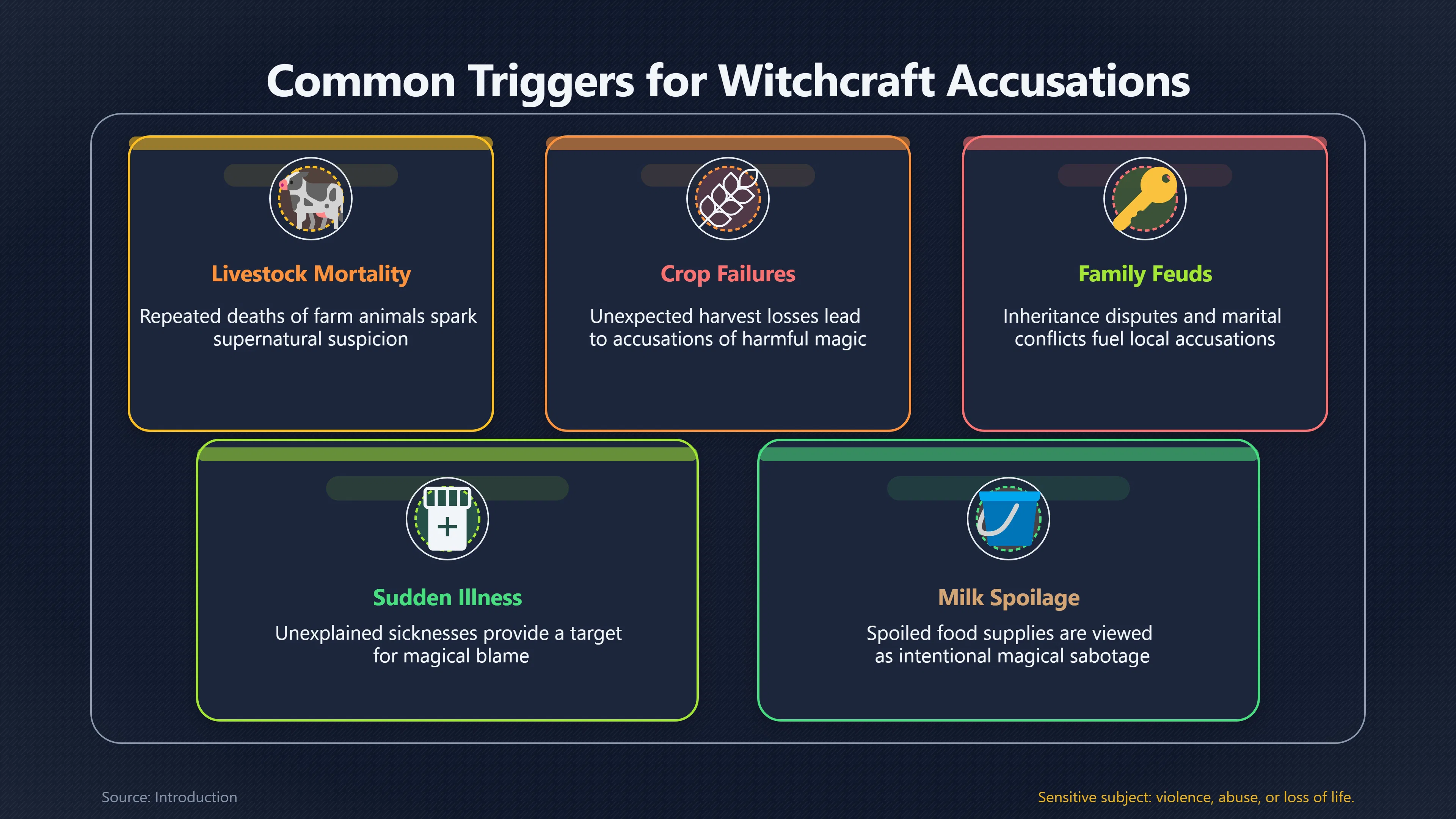
Common triggers included:
- sudden illness with no obvious explanation;
- repeated livestock deaths;
- crop failures;
- family feuds;
- inheritance disputes;
- marital conflict;
- damaged reputations within tightly connected villages.
Magic offered an explanation for misfortune at a time when disease, weather and economic hardship were poorly understood. Once suspicion attached to an individual, previous arguments or unusual behaviour could be reinterpreted as evidence of supernatural wrongdoing.
This pattern resembles many other European witch trials, but the Romanian evidence generally points towards localised episodes rather than cascading regional panics.[oup.com]academic.oup.comOUP AcademicPopular Magic | Thinking with Demons: The Idea of Witchcraft in Early Modern Europe | Oxford Academic…
Why Modern Retellings Exaggerate a Single National Panic
Contemporary media often presents Romania as a timeless land of witches, vampires and ancient supernatural traditions. This image combines folklore, tourism, Gothic fiction and isolated modern stories into a misleading historical narrative.
The popularity of Dracula mythology, together with international reporting on modern fortune-tellers or self-described witches, encourages readers to imagine an uninterrupted tradition stretching from medieval witch hunts to the present day. Historians argue that this oversimplifies a much more complex history. Early modern judicial persecution, village healing traditions, Orthodox religious teaching, nineteenth-century folklore collecting and twenty-first-century commercial fortune-telling belong to different historical contexts and should not be treated as one continuous phenomenon.[Springer]link.springer.comWitchcraft in Romania | Springer Nature LinkWitchcraft in Romania | Springer Nature LinkNovember 30, 2022…
Even modern practitioners who advertise magical services operate in a social and legal environment entirely different from that of early modern defendants facing criminal prosecution.
What the Witch Trials Reveal About Romanian Society
The surviving witch trials illuminate ordinary life more than extraordinary belief.
Court records preserve arguments between neighbours, anxieties about illness, concerns over reputation and the ways communities tried to explain unexpected suffering. They show that accusations of witchcraft emerged where social trust had broken down, not because entire populations descended into collective irrationality.
For historians of collective belief, the Romanian lands therefore offer an important contrast with Europe’s most famous witch panics. The evidence points towards numerous local episodes shaped by regional legal systems and village relationships rather than a single national witch craze. Understanding that distinction helps explain why popular magic remained embedded in everyday life long after many formal witch prosecutions had disappeared, while also preventing later folklore and modern media stereotypes from obscuring the far more nuanced historical record.[springer.com]link.springer.comWitchcraft in Romania | Springer Nature LinkWitchcraft in Romania | Springer Nature LinkNovember 30, 2022…


Endnotes
1.
Source: link.springer.com
Title: Witchcraft in Romania | Springer Nature Link
Link:https://link.springer.com/book/10.1007/978-3-031-15222-1
Source snippet
Witchcraft in Romania | Springer Nature LinkNovember 30, 2022...
Published: November 30, 2022
2.
Source: academic.oup.com
Link:https://academic.oup.com/book/3259/chapter-abstract/144253706
Source snippet
OUP AcademicPopular Magic | Thinking with Demons: The Idea of Witchcraft in Early Modern Europe | Oxford Academic...
3.
Source: link.springer.com
Link:https://link.springer.com/book/10.1007/978-3-319-54756-5
4.
Source: doaj.org
Link:https://doaj.org/article/dc187caee1784a0d9a9d7cedd43a61bd
5.
Source: mitpressbookstore.mit.edu
Link:https://mitpressbookstore.mit.edu/book/9783031152214
Source snippet
in Romania (Palgrave Historical Studies in Witchcraft and Magic) | mitpressbookstoreDecember 2, 2022 — Image: Witchcraft in Romania (Palg...
Published: December 2, 2022
Additional References
6.
Source: wired.com
Link:https://www.wired.com/story/romanian-witches-internet
Source snippet
Members typically learn the craft from their mothers at age seven or claim to have a divine "gift." The practice is respected and feared...
7.
Source: library.hrmtc.com
Title: witchcraft in romania
Link:https://library.hrmtc.com/2024/07/22/witchcraft-in-romania/
Source snippet
in Romania - The Hermetic Library BlogJuly 22, 2024 — WITCHCRAFT IN ROMANIA Witchcraft in Romania [Amazon, Bookshop, Publisher, Local Lib...
Published: July 22, 2024
8.
Source: journals.lub.lu.se
Title: seÉcrire pour guérir
Link:https://journals.lub.lu.se/sjrs/article/view/24897
Source snippet
Les formules magiques écrites dans la médecine populaire roumaine (XVIIe-XXe siècles): Write to heal. Written magic formulas in Romanian...
9.
Source: youtube.com
Title: Romania: Clues and Signs to Detect a Witch
Link:https://www.youtube.com/watch?v=JznRDS8Yr8Y
Source snippet
I Met Europe's Most Powerful Roma Gypsy Witches...
10.
Source: researchgate.net
Link:https://www.researchgate.net/publication/321365383_Divinatio_Diabolica_and_Superstitious_Medicine_Healers_Seers_and_Diviners_in_the_Changing_Discourse_of_Witchcraft_in_Early_Modern_Nagybanya
11.
Source: sekerkovalucia.cz
Link:https://sekerkovalucia.cz/vrajitoare/
12.
Source: nationalmuseum.md
Link:https://www.nationalmuseum.md/en/press_releases/journal_tyragetia/the_fate_of_women_in_wallachia_moldavia_and_transylvania_in_the_context_of_the_wars_in_the_17th_century_2023_sarolta_solcan/
13.
Source: nationalmuseum.md
Link:https://www.nationalmuseum.md/en/press_releases/journal_tyragetia/witchcraft_at_romanians_documents_of_witchcraft_trials_in_transylvania_of_the_16th_17th_centuries/
14.
Source: studia.reviste.ubbcluj.ro
Link:https://studia.reviste.ubbcluj.ro/index.php/subbhistoria/article/view/4863?articlesBySimilarityPage=9
15.
Source: youtube.com
Title: I Met Europe’s Most Powerful Roma Gypsy Witches
Link:https://www.youtube.com/watch?v=ePn-R5_NiLQ
Source snippet
Inside Romania's Witch School | Unreported World...
Topic Tree