Within Peru Beliefs
How Colonial Peru Turned Healing Into Heresy
Colonial campaigns against idolatry and witchcraft turned healing, sacred places and local authority into evidence of spiritual danger.
On this page
- The campaigns against idolatry
- How healers became suspected witches
- Why accusations reflected unequal power
Page outline Jump by section
Introduction
In colonial Peru, accusations of witchcraft were rarely just about magic. They formed part of a much broader campaign by Spanish religious authorities to replace Indigenous religious traditions with Catholic orthodoxy and to strengthen colonial rule. Practices that Andean communities regarded as healing, ancestor veneration, communication with sacred places or community leadership were frequently reinterpreted through European Christian ideas about heresy, the Devil and witchcraft. As a result, many Indigenous ritual specialists were no longer seen as respected healers but as dangerous servants of evil. Historians now argue that these prosecutions reveal less about Indigenous religion than about the ways colonial authorities used religious law to reshape society, undermine local authority and justify political control.[nih.gov]pubmed.ncbi.nlm.nih.govThe evolution of witchcraft and the meaning of healing in colonial Andean society - PubMed…
The campaigns against idolatry
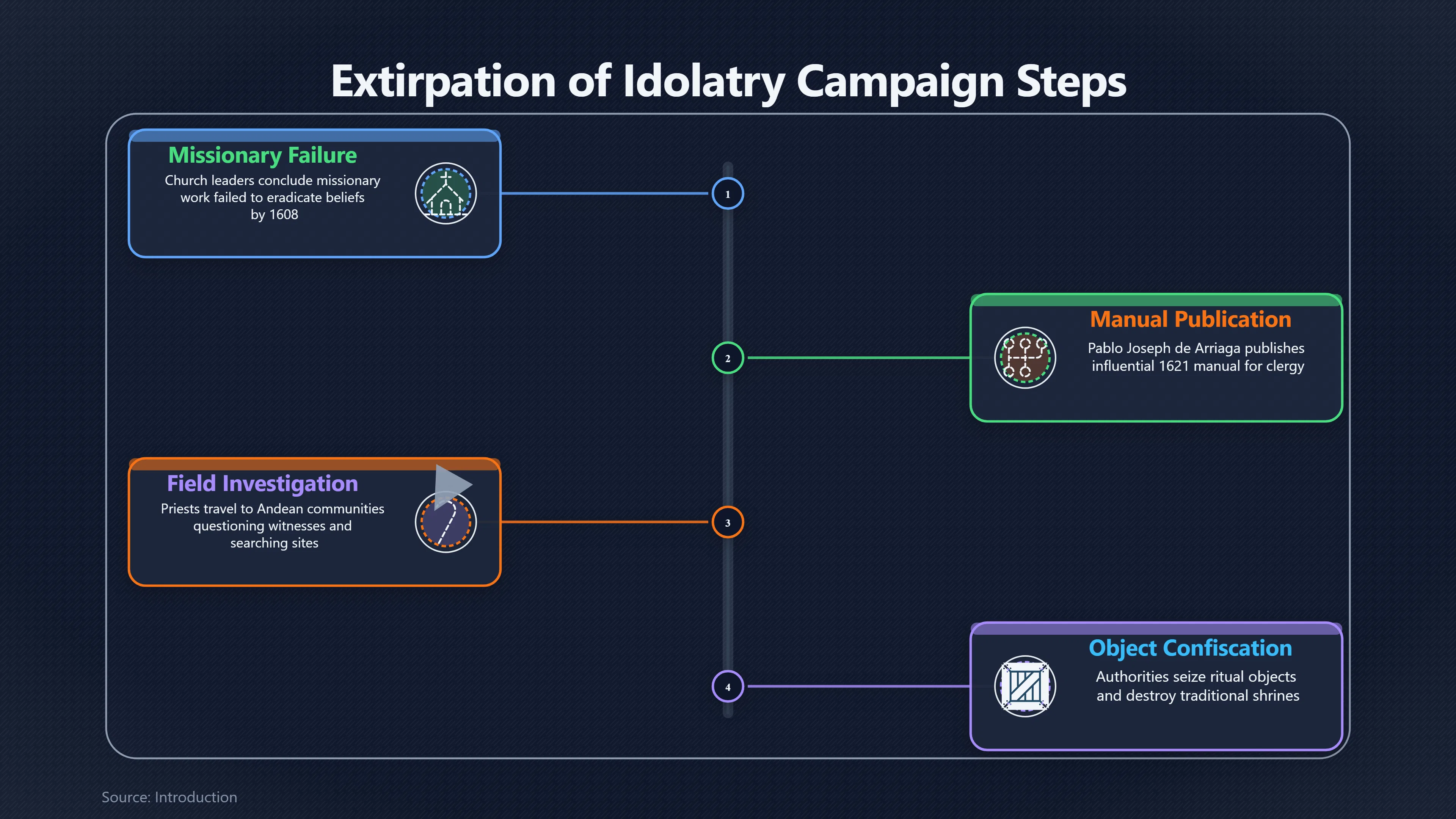
From the early seventeenth century, church officials in the Viceroyalty of Peru launched organised campaigns known as the “extirpation of idolatry”. Their purpose was not simply to convert Indigenous people to Christianity but to identify, investigate and eliminate religious practices that had survived beneath an outward acceptance of Catholicism. These campaigns became especially intense after around 1608, when church leaders concluded that decades of missionary work had failed to eradicate older beliefs.[revistas.udea.edu.co]revistas.udea.edu.coOpen source on edu.co.
Priests travelled through Andean communities questioning witnesses, searching sacred sites, confiscating ritual objects and interrogating local religious specialists. Pablo Joseph de Arriaga’s influential 1621 manual, written specifically for these campaigns, instructed clergy how to recognise Indigenous shrines, identify ritual leaders and destroy objects associated with traditional worship. It treated Indigenous priests, diviners and healers as “sorcerers” whose activities threatened both souls and colonial order.[UKnowledge]uknowledge.uky.eduUKnowledge The Extirpation of Idolatry in PeruUKnowledge The Extirpation of Idolatry in Peru
Although these investigations sometimes used the language of witchcraft, their principal concern was religious conformity. Rather than resembling the mass witch hunts seen in parts of central Europe, colonial Peru’s campaigns focused on identifying persistent Indigenous religious networks that officials believed encouraged resistance to Christianisation.[unm.edu]digitalrepository.unm.eduKenneth Mills, Idolatry and Its Enemies: Colonial Andean Religion and Extirpation, 1640-1750…
How healers became suspected witches
One of the clearest examples of colonial reinterpretation involved Indigenous healers.
Before Spanish conquest, Andean healing combined knowledge of medicinal plants, ritual offerings, ancestor traditions and relationships with sacred landscapes. Illness was commonly understood through social and spiritual relationships rather than through the Christian opposition between God and Satan. Ritual specialists helped restore balance between people, ancestors and sacred places rather than serving a supernatural force identified as evil.[PubMed]pubmed.ncbi.nlm.nih.govThe evolution of witchcraft and the meaning of healing in colonial Andean society - PubMed…
Spanish missionaries viewed these practices through an entirely different religious framework. Arriving during the height of Europe’s own witchcraft fears, they interpreted Indigenous ritual specialists using familiar Christian legal categories. Healing ceremonies, divination, offerings and communication with sacred places were increasingly described as evidence of pacts with the Devil or participation in idolatry. The accusation often said more about European theological assumptions than about the practices themselves.[PubMed]pubmed.ncbi.nlm.nih.govThe evolution of witchcraft and the meaning of healing in colonial Andean society - PubMed…
Historians such as Irene Silverblatt argue that colonisation fundamentally altered the meaning of healing itself. Indigenous practitioners gradually found themselves operating within a colonial world in which European concepts of witchcraft had become legally and politically powerful. Some traditional healers adapted their practices, others blended Catholic symbols with older rituals, while many became vulnerable to denunciation whenever illness, crop failure or social conflict demanded an explanation.[PubMed]pubmed.ncbi.nlm.nih.govThe evolution of witchcraft and the meaning of healing in colonial Andean society - PubMed…
Why accusations reflected unequal power
Witchcraft accusations cannot be separated from the unequal balance of power created by conquest.
Spanish clergy possessed the legal authority to define acceptable religion. Indigenous communities rarely had the opportunity to explain their beliefs using their own concepts because investigations were conducted within Christian courts using Christian categories. Local practices were translated into terms such as “idolatry”, “superstition” or “witchcraft”, categories that often distorted their original meanings.[revistas.udea.edu.co]revistas.udea.edu.coOpen source on edu.co.
The campaigns also weakened traditional leadership. Religious specialists often held authority that extended beyond ritual into mediation, healing and community decision-making. Removing them reduced alternative centres of influence while reinforcing the authority of parish priests and colonial officials. Destroying sacred sites, confiscating ritual objects and publicly punishing respected practitioners demonstrated that religious and political authority now flowed through colonial institutions.[uky.edu]uknowledge.uky.eduUKnowledge The Extirpation of Idolatry in PeruUKnowledge The Extirpation of Idolatry in Peru
The process was therefore as much about governance as theology. Religious uniformity helped support taxation, resettlement policies and colonial administration by reducing institutions that lay outside Spanish control. Modern historians increasingly interpret extirpation campaigns as mechanisms of colonial state-building as well as missionary work.[digitalrepository.unm.edu]digitalrepository.unm.eduKenneth Mills, Idolatry and Its Enemies: Colonial Andean Religion and Extirpation, 1640-1750…
Reading the evidence carefully
Most surviving evidence comes from the very officials who organised these campaigns. Manuals, court records and missionary reports describe Indigenous beliefs from the viewpoint of people trying to eliminate them. This creates an important challenge for historians.
Terms such as “witch”, “sorcerer” or “idolater” generally represent colonial labels rather than neutral descriptions of Indigenous religion. Modern scholarship therefore treats prosecution records critically, comparing them with archaeology, Indigenous chronicles and anthropological evidence to distinguish actual practices from the interpretations imposed by investigators.[nih.gov]pubmed.ncbi.nlm.nih.govThe evolution of witchcraft and the meaning of healing in colonial Andean society - PubMed…
Researchers also caution against assuming that every accusation reflected widespread panic. Unlike the large-scale witch crazes in parts of Germany or Scotland, colonial Peru’s investigations were usually organised from above by church authorities rather than driven by village-wide fears of neighbours practising harmful magic. Their primary objective was religious discipline and cultural transformation.[PubMed]pubmed.ncbi.nlm.nih.govThe evolution of witchcraft and the meaning of healing in colonial Andean society - PubMed…

Why this history remains important
Colonial Peru demonstrates that accusations of witchcraft can function as instruments of governance rather than simply expressions of popular fear. By redefining Indigenous healing and sacred traditions as evidence of demonic activity, colonial authorities transformed cultural difference into religious crime.
The campaigns left a lasting legacy. Many Indigenous healing traditions survived by adapting Catholic symbols, while others disappeared under sustained pressure. Modern historians increasingly view these prosecutions not as proof that Andean communities believed themselves to be witches, but as evidence of how colonial power reshaped religious language, legal categories and social authority. Understanding that distinction helps explain why accusations of witchcraft in colonial Peru were fundamentally about controlling belief, community leadership and cultural survival rather than uncovering supernatural crime.[nih.gov]pubmed.ncbi.nlm.nih.govThe evolution of witchcraft and the meaning of healing in colonial Andean society - PubMed…
Amazon book picks
Further Reading
Books and field guides related to How Colonial Peru Turned Healing Into Heresy. Use these as the next step if you want deeper reading beyond the article.

Sorcery: A History of Fear, from Ancient Times to the Present
Provides comparative history of witchcraft accusations.
Gods of the Andes
Explains Indigenous ritual traditions targeted by colonial authorities.
Endnotes
1.
Source: revistas.udea.edu.co
Link:https://revistas.udea.edu.co/index.php/boletin/user/setLocale/en_US?source=%2Findex.php%2Fboletin%2Farticle%2Fview%2F6974%3FarticlesBySimilarityPage%3D4
2.
Source: digitalrepository.unm.edu
Link:https://digitalrepository.unm.edu/clahr/vol7/iss1/4/
Source snippet
Kenneth Mills, Idolatry and Its Enemies: Colonial Andean Religion and Extirpation, 1640-1750...
3.
Source: revista.letras.unmsm.edu.pe
Link:https://revista.letras.unmsm.edu.pe/index.php/le/article/view/388
4.
Source: revistas.cientifica.edu.pe
Link:https://revistas.cientifica.edu.pe/index.php/desdeelsur/article/view/140
5.
Source: revistas.udea.edu.co
Link:https://revistas.udea.edu.co/index.php/boletin/user/setLocale/es_ES?source=%2Findex.php%2Fboletin%2Farticle%2Fview%2F6974%3FarticlesBySimilarityPage%3D4
6.
Source: revistas.udea.edu.co
Link:https://revistas.udea.edu.co/index.php/boletin/user/setLocale/pt_BR?source=%2Findex.php%2Fboletin%2Farticle%2Fview%2F6974%3FarticlesBySimilarityPage%3D4
7.
Source: revistas.udea.edu.co
Link:https://revistas.udea.edu.co/index.php/boletin/article/view/6974?articlesBySimilarityPage=1
8.
Source: repositorio.pucp.edu.pe
Link:https://repositorio.pucp.edu.pe/items/80f062ff-8588-4cde-8c19-ed09b1581e88
9.
Source: bibliotecadigital.udea.edu.co
Link:https://bibliotecadigital.udea.edu.co/entities/publication/517d1a01-57ec-4b2d-8585-a79a9626ea59
10.
Source: pubmed.ncbi.nlm.nih.gov
Link:https://pubmed.ncbi.nlm.nih.gov/6362989/
Source snippet
The evolution of witchcraft and the meaning of healing in colonial Andean society - PubMed...
11.
Source: uknowledge.uky.edu
Title: UKnowledge The Extirpation of Idolatry in Peru
Link:https://uknowledge.uky.edu/upk_latin_american_history/5/
12.
Source: redcol.minciencias.gov.co
Link:https://redcol.minciencias.gov.co/Record/UDEA2_c0ef8da7d4f423e60a40cebd3b89ef6f/Description
13.
Source: digitalcommons.chapman.edu
Link:https://digitalcommons.chapman.edu/vocesnovae/vol5/iss1/7/
Additional References
14.
Source: scielo.org.pe
Link:https://www.scielo.org.pe/scielo.php?lng=es&nrm=iso&pid=S2415-09592025000400024&script=sci_arttext
Source snippet
2025 EPUB 22-DIC-2025 [https://DOI.ORG/10.21142/DES-1704-2025-0102](https://DOI.ORG/10.21142/DES-1704-2025-0102) Artículos «Es que Dios lo podía todo, y que el Diablo no podía más; per...
15.
Source: kentuckypress.com
Title: The University Press of Kentucky The Extirpation of Idolatry in Peru
Link:https://www.kentuckypress.com/9780813152943/the-extirpation-of-idolatry-in-peru/
Source snippet
The University Press of KentuckyThe Extirpation of Idolatry in Peru - The University Press of Kentucky...
16.
Source: degruyterbrill.com
Title: Idolatry and Its Enemies
Link:https://www.degruyterbrill.com/document/doi/10.1515/9780691187334/html?lang=en
Source snippet
June 5, 2018 — IDOLATRY AND ITS ENEMIES Colonial Andean Religion and Extirpation, 1640-1750 * Kenneth Mills Language: English Published/C...
Published: June 5, 2018
17.
Source: youtube.com
Title: Lecture Series “How? When? Why?”
Link:https://www.youtube.com/watch?v=eTHu5xmhzqU
Source snippet
PERU: LIMA: HOLY INQUISITION MUSEUM IS HOT TOURIST ATTRACTION...
18.
Source: youtube.com
Title: The Empire of the Dead | The War Against Idolatry
Link:https://www.youtube.com/watch?v=ecrOB2liLMA
Source snippet
Lecture Series “How? When? Why?” - Pablo José de Arriaga and the Extirpation of Idolatry in Peru...
19.
Source: youtube.com
Title: PERU: LIMA: HOLY INQUISITION MUSEUM IS HOT TOURIST ATTRACTION
Link:https://www.youtube.com/watch?v=ns_-1YgZBMQ
Source snippet
The Dark Secret Behind the Basque Witch Trials...
20.
Source: youtube.com
Title: The Dark Secret Behind the Basque Witch Trials
Link:https://www.youtube.com/watch?v=NLbTdv1Lip0
Source snippet
The Witch-Hunt in Early Modern Europe: A Discussion with Brian Levack...
21.
Source: researchgate.net
Link:https://www.researchgate.net/publication/26549374_Extirpacion_de_idolatrias_e_identidad_cultural_en_las_sociedades_andinas_del_Peru_virreinal_siglo_XVII
22.
Source: doi.org
Link:https://doi.org/10.1007%2FBF00052240
23.
Source: revistas.ucm.es
Link:https://revistas.ucm.es/index.php/RCHA/es/article/view/RCHA0000110027A
Topic Tree